US Navy Mine-Warfare Ships Suddenly Leave Middle East, Appear in Malaysia — LCS Move Raises Indo-Pacific vs Hormuz Force Posture Questions
USS Tulsa and USS Santa Barbara spotted in Penang after Bahrain deployment as analysts question whether Washington is shifting naval priority from the Persian Gulf to the Indo-Pacific.

(DEFENCE SECURITY ASIA) — The sudden appearance of two U.S. Navy Littoral Combat Ships configured for mine-countermeasure operations in Penang, Malaysia, after previously being forward-deployed in the Middle East, is being closely scrutinised by defence analysts as a potential indicator of a shift in American naval force posture with implications for both the Indo-Pacific and the Persian Gulf security environment.
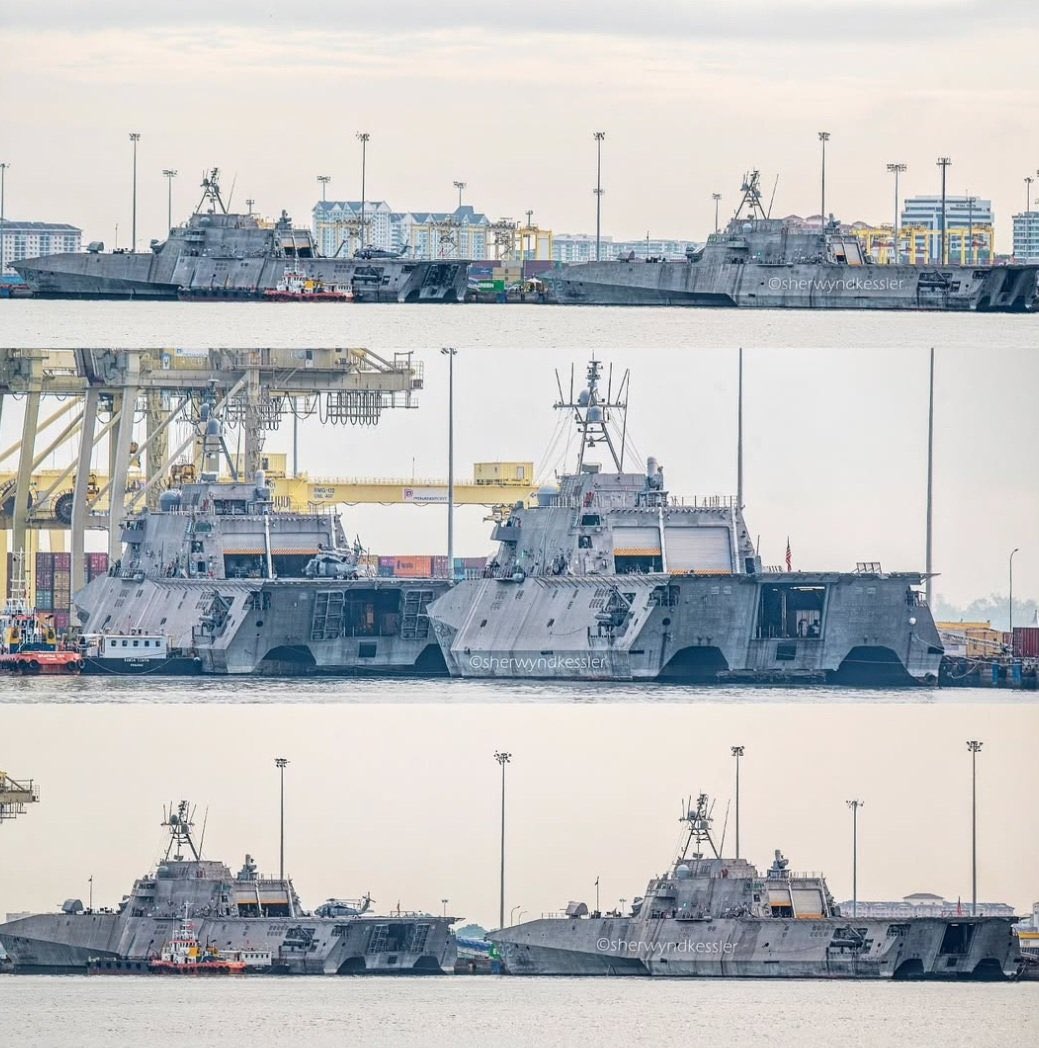
The vessels identified as USS Tulsa (LCS-16) and USS Santa Barbara (LCS-32), which had been assigned to replace legacy minesweepers in Bahrain, were photographed at North Butterworth Container Terminal on 15 March 2026, a movement that occurred despite continued tensions around the Strait of Hormuz where mine-warfare capability remains strategically critical.
The relocation has drawn particular attention because mine-countermeasure assets represent specialised force-protection platforms normally kept close to maritime choke points under threat, leading observers to question whether the deployment reflects a broader prioritisation of Indo-Pacific contingency planning over Middle East maritime security requirements.
Mine-Countermeasure Role Previously Assigned To Bahrain
For decades, the United States maintained Avenger-class mine-countermeasure ships in Bahrain as part of a permanent naval presence designed to ensure the Strait of Hormuz remained open to commercial shipping despite repeated threats involving naval mines in the Persian Gulf.
In 2025, the Avenger-class vessels were retired and their mission was transferred to Littoral Combat Ships equipped with modular mine-warfare packages intended to combine unmanned mine-hunting systems, remote sensors, and specialised clearance equipment into a more flexible counter-mine capability.
The transition to the Littoral Combat Ship platform was intended to modernise mine-warfare operations while maintaining forward-deployed readiness in the Gulf, reflecting the continued strategic importance of protecting sea lanes that carry a substantial share of global oil trade.
Mine-countermeasure forces remain essential in the Persian Gulf because naval mines are considered one of the most effective asymmetric weapons capable of disrupting shipping traffic without requiring large surface combatants.
The continued threat environment in the region has historically justified maintaining dedicated mine-warfare ships close to Bahrain, making the appearance of those same assets thousands of kilometres away in Southeast Asia operationally unusual.
Photographic confirmation of the two Littoral Combat Ships in Penang therefore represents a visible change in deployment geometry that may reflect adjustments in force allocation rather than routine transit.
Because the ships were assigned specifically to replace older minesweepers, their absence from the Middle East raises questions about whether the current mine-countermeasure posture in the Gulf has been reduced or reorganised.
The timing of the movement has further increased interest among defence observers because it coincides with ongoing reports of disruption to shipping traffic and continued risk of naval mines in the Strait of Hormuz.
This combination of factors has led analysts to treat the relocation as a potential signal rather than a routine port visit, particularly given the specialised nature of mine-warfare platforms within the U.S. Navy force structure.
The deployment change therefore becomes strategically significant not because of the ships themselves, but because of the mission they were originally assigned to perform.
READ: US Navy Makes History with First At-Sea Launch of LUCAS One-Way Attack Drone, Redefining Naval Warfare
Movement Occurs Despite Continued Strait of Hormuz Risk
The relocation of mine-countermeasure ships away from the Persian Gulf has drawn attention because the Strait of Hormuz remains one of the most sensitive maritime choke points in the world, where even limited mining activity could disrupt global energy flows.
Reports of attacks on shipping and continued threats involving naval mines have reinforced the perception that the operational requirement for mine-warfare capability in the Gulf has not diminished, making the departure of dedicated counter-mine ships difficult to explain purely as routine redeployment.
Mine-countermeasure vessels are typically positioned close to areas of anticipated risk in order to ensure rapid response capability, meaning their absence from the Gulf may indicate confidence that the threat level can be managed through other means.
Alternatively, the change could reflect a decision to accept higher operational risk in the Middle East in order to free specialised assets for use elsewhere, a calculation consistent with shifting strategic priorities.
The Littoral Combat Ship mine-warfare configuration was designed to allow rapid redeployment between theatres, but the movement of both vessels at the same time suggests deliberate planning rather than temporary maintenance scheduling.
Because mine-warfare ships are not general-purpose combatants, their relocation tends to reflect specific mission requirements rather than routine patrol rotations.
The continued sensitivity of the Strait of Hormuz makes any reduction in forward-deployed counter-mine capability a development with potential global economic implications.
Even a temporary change in force posture could affect the speed at which shipping lanes could be cleared in the event of a mining incident.
For that reason, the appearance of the ships in Malaysia has been interpreted by some observers as evidence that operational priorities may be shifting beyond the Middle East.
Such interpretations remain speculative, but the timing of the movement has made it difficult to separate the redeployment from wider strategic considerations.
Penang Location Suggests Indo-Pacific Repositioning
The presence of the two Littoral Combat Ships in Penang places them near one of the most important maritime crossroads in the world, linking the Indian Ocean, the South China Sea, and the wider Western Pacific.
Penang and Butterworth sit close to the Malacca Strait, a narrow shipping route through which a large portion of global trade passes, making the location strategically relevant for any naval force concerned with sea-lane security.
From this position, ships can move rapidly toward the South China Sea, the Indian Ocean, or the Western Pacific, giving planners flexibility that would not exist if the vessels remained in the Persian Gulf.
The geographic position also places the ships within reach of the U.S. Seventh Fleet operating area, which covers much of the Indo-Pacific region.
Because the Littoral Combat Ship is designed for operations in coastal waters and confined seas, positioning such vessels near Southeast Asian choke points fits their intended mission profile.
Mine-warfare capability is considered especially important in regions where narrow straits could be blocked by relatively small numbers of mines.
Potential conflict scenarios in the Indo-Pacific frequently include the possibility of mining operations in the Taiwan Strait, the Malacca Strait, or other key sea lanes.
Having mine-countermeasure ships closer to those areas would reduce response time if clearance operations became necessary.
The choice of Malaysia as a transit or staging point therefore has operational logic even if the deployment is temporary.
Whether the move represents a permanent shift or a short-term repositioning remains unclear, but the location itself is consistent with Indo-Pacific contingency planning.
LCS Mine-Warfare Transition May Affect Deployment Patterns
The Littoral Combat Ship mine-warfare mission package was introduced to replace older dedicated minesweepers, but the transition to the new system has involved delays and technical challenges that have already been discussed within defence circles.
Because the Avenger-class ships were retired before the new capability was fully established, the Navy has had to manage mine-countermeasure coverage using a smaller number of platforms.
Such constraints can force adjustments in deployment patterns, particularly when specialised ships are required in more than one theatre.
If the mine-warfare mission package has not reached full operational readiness, planners may need to rotate ships more frequently in order to maintain coverage.
That possibility could explain why vessels originally assigned to the Middle East have appeared in Southeast Asia without any formal announcement of a change in mission.
Reorganising deployments would allow the Navy to balance limited mine-countermeasure resources across multiple regions.
This type of adjustment would not necessarily indicate a reduction in capability, but it could reflect the practical limits of the current force structure.
Because mine-warfare ships are relatively few in number, even small changes in their location can have visible strategic effects.
The appearance of the two Littoral Combat Ships in Malaysia therefore may reflect the realities of managing a specialised fleet rather than a sudden shift in policy.
However, without official confirmation, the exact reason for the movement cannot be determined with certainty.
The lack of explanation has itself contributed to speculation about broader strategic motives.
Possible Signal Of Wider Indo-Pacific Contingency Planning
Some analysts interpret the redeployment as part of a wider pattern in which U.S. naval forces are increasingly oriented toward the Indo-Pacific, reflecting the region’s growing importance in defence planning.
Mine-warfare capability would be a critical requirement in any maritime conflict involving narrow straits, contested sea lanes, or attempts to block access to strategic waterways.
Scenarios involving the Taiwan Strait, the South China Sea, or other regional choke points often assume the use of naval mines as a means of restricting movement.
Positioning counter-mine ships closer to those areas could reduce response time in the event of a crisis.
Such positioning would also allow the Navy to conduct exercises or familiarisation operations in waters where future operations might occur.
At the same time, the continued threat environment in the Persian Gulf means any shift in focus carries potential risk.
Balancing requirements between the Middle East and the Indo-Pacific has become increasingly complex as both regions remain strategically important.
The movement of specialised ships therefore may reflect prioritisation rather than disengagement.
Without official statements, it is not possible to determine whether the relocation represents long-term planning or short-term flexibility.
Nevertheless, the redeployment has been widely noted because it fits a pattern of increasing attention to Indo-Pacific maritime security.
Even if temporary, the appearance of the vessels in Malaysia highlights the importance of geographic positioning in naval strategy.
No Official Confirmation Leaves Strategic Intent Unclear
Despite the visibility of the deployment, no official statement has confirmed that the ships have been permanently reassigned, leaving open the possibility that the visit to Malaysia is part of a transit, maintenance stop, or routine logistics movement.
Naval deployments often involve port calls for resupply, crew rotation, or training, meaning a single sighting does not necessarily indicate a change in operational plans.
However, the specialised role of mine-countermeasure ships makes their movements more noticeable than those of general-purpose vessels.
Because such ships are normally assigned to specific missions, their relocation tends to attract attention even when routine.
The absence of official clarification has allowed multiple interpretations to circulate, ranging from simple transit to deliberate repositioning.
Defence analysts therefore distinguish between confirmed facts, which include the ships’ presence in Penang, and broader conclusions, which remain speculative.
This distinction is important because visible movements do not always reflect long-term strategy.
At the same time, naval deployments are often used to send signals without formal announcements.
Whether intentional or not, the appearance of the Littoral Combat Ships in Malaysia has been interpreted as a possible indicator of shifting priorities.
Until further information becomes available, the redeployment remains a development whose full significance cannot yet be determined.
Technical Specifications — USS Tulsa (LCS-16) / USS Santa Barbara (LCS-32)
| Category | Specification | Operational / Strategic Significance |
|---|---|---|
| Ship Class | Independence-class Littoral Combat Ship (LCS) | Trimaran hull design optimized for high speed, shallow water operations, and modular mission packages |
| Builder | Austal USA, Mobile, Alabama | Shipyard specialised in aluminium-hull high-speed naval vessels for U.S. Navy littoral warfare |
| Displacement | ~3,100 tons (full load) | Lightweight structure allows high speed and rapid deployment in coastal combat zones |
| Length | ~127.4 m | Large flight deck and mission bay support unmanned systems and helicopters |
| Beam | ~31.6 m | Wide trimaran hull provides stability and large internal mission space |
| Draft | ~4.3 m | Shallow draft allows operations in littoral waters, straits, and coastal areas |
| Maximum Speed | Over 40 knots | High speed enables rapid response, patrol, and redeployment between theatres |
| Range | ~4,300 nautical miles at 18 knots | Long endurance suitable for Indo-Pacific and Middle East deployments |
| Crew | Core crew ~40 + mission detachment | Reduced crew concept with additional personnel depending on mission module |
| Mission Modules | Mine Countermeasures (MCM), Surface Warfare (SUW), Anti-Submarine Warfare (ASW) | Modular design allows ship to switch roles depending on operational requirement |