
Russia Forces Its Scarce Su-57 Stealth Fighter Into Emergency Anti-Drone War After Ukraine Hits Omsk Refinery 2,700km From the Front
Moscow strips stealth from its rarest fifth-generation jet to counter Ukraine's long-range kamikaze drones, exposing critical cracks in Russia's Pantsir and S-400 air defence shield.

(DEFENCE SECURITY ASIA) — Russia has diverted its most advanced and numerically scarcest combat aircraft, the Sukhoi Su-57 “Felon” stealth fighter, away from its intended air-superiority and deep-strike role to intercept Ukrainian long-range kamikaze drones penetrating deep into Russian strategic territory.
This pivot, first documented through imagery from the Akhtubinsk airfield in Astrakhan region in early July 2026, signals that Moscow’s layered ground-based air defence network, anchored by the Pantsir and S-400 systems, is now critically overstretched across an increasingly indefensible strategic depth.
The reconfiguration is not a structural redesign of the airframe but a rapid, field-driven adaptation of weapons loadout, sensor payload, and intercept tactics engineered specifically to counter low-observable unmanned threats.
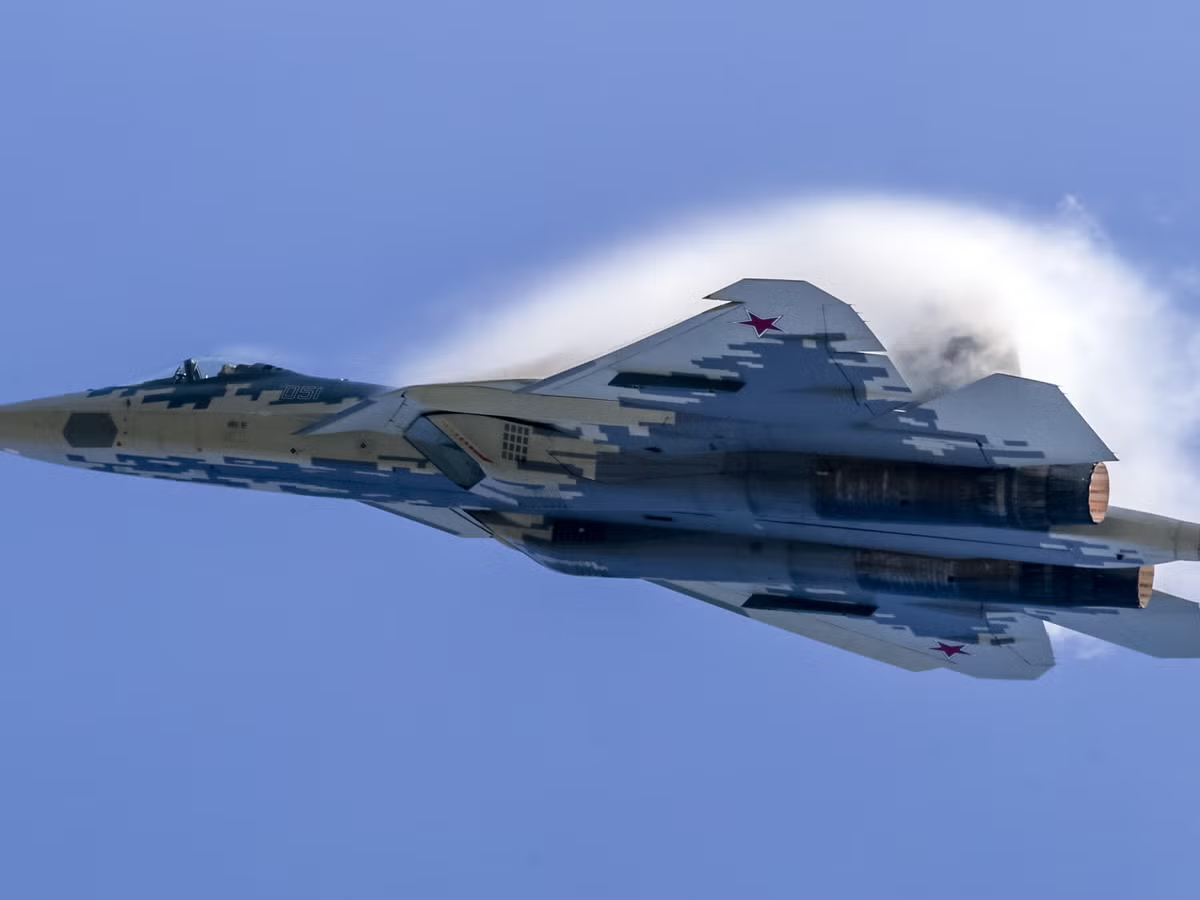
Analysts assessed that the modified Su-57 loadout represents a dedicated configuration purpose-built for hunting Ukrainian kamikaze drones and cruise missiles rather than contesting manned adversary aircraft.
The catalyst arrived on 6 July 2026, when Ukrainian long-range one-way attack drones, reportedly derivatives of the FP-1 airframe capable of ranges exceeding 2,500 to 3,000 kilometres, struck the Omsk Oil Refinery deep inside Siberia, a top-tier facility previously untouched by the war.
Russian Aerospace Forces scrambled Su-57 interceptors alongside at least one A-50U airborne early-warning aircraft in a bid to blunt the incoming drone wave before it reached the refinery’s processing units.
Open-source monitoring groups Exilenova+ and MAKS 26 assessed that the Su-57s achieved only one confirmed drone kill during the engagement, while the remainder of the package struck and damaged the facility, a claim corroborated by subsequent satellite imagery.
This outcome exposes a stark asymmetry, because a fifth-generation stealth fighter, among the most sophisticated platforms in the Russian inventory, is being committed against attritable, low-cost unmanned systems whose replacement cost is a fraction of a single sortie.
The strategic implication extends beyond Omsk, because it confirms Ukraine’s deep-strike drone campaign has achieved sufficient range and saturation to force Russia into reactive postures at the core of its war-sustaining oil infrastructure.
For Indo-Pacific defence planners observing this conflict as a template for future high-intensity warfare, the Su-57 episode offers an unambiguous lesson in how mass-produced, long-range unmanned systems can erode even the most advanced air defence architectures.
This feature examines the technical mechanics of the Su-57’s improvised configuration, the operational lessons from the Omsk intercept, and the geopolitical consequences reshaping the calculus of stealth-aircraft employment amid proliferating attritable drone warfare.
The Technical Anatomy of the Su-57’s Improvised Anti-Drone Configuration
Photographic evidence from Akhtubinsk revealed Su-57 airframes carrying an unusual external loadout of two to four R-73 or R-74 (RVV-MD) infrared-guided short-range missiles mounted openly on underwing pylons rather than housed within the aircraft’s stealth-preserving internal weapons bays.
These missiles were selected for their high off-boresight engagement envelope and, in several variants, thrust-vectoring control, both decisive advantages when engaging slow, low-altitude, manoeuvrable unmanned targets at within-visual-range distances.
The decision to mount them externally reflects a deliberate trade-off, because the bulkier R-73 variant is largely incompatible with the Su-57’s internal side bays, forcing designers to sacrifice radar cross-section discipline for magazine depth against saturation attacks.
Complementing the missile loadout, the modified airframes carried an external electro-optical targeting pod, widely assessed as a variant of the 101KS-N system, mounted beneath the left engine nacelle to identify small, low-radar-cross-section aerial threats.
Notably, the 101KS-N pod was originally engineered for precision ground-attack targeting, meaning its repurposing for aerial drone tracking constitutes an improvised, non-doctrinal application rather than a purpose-built anti-drone sensor solution.
This configuration draws on the Su-57’s integrated N036 Byelka active electronically scanned array radar, which reportedly offers detection ranges exceeding 100 kilometres against very low radar-cross-section targets such as cruise missiles under favourable conditions.
The aircraft’s indigenous 101KS “Atoll” suite, including its infrared search-and-track and missile-warning sensors, provides a passive detection layer that complements the pod without depending solely on radar emissions that could reveal the interceptor’s position.
Layering radar, infrared search-and-track, and electro-optical targeting against a single low-value drone illustrates the sensor-fusion overkill inherent in using a fifth-generation platform for what is fundamentally a point-defence intercept mission.
The Su-57’s internal 30mm cannon remains a last-resort option, though its limited ammunition renders it a marginal contributor against a sustained drone raid rather than a primary engagement tool.
Each element of this loadout was assembled from existing Russian air-to-air inventory, underscoring that Moscow is improvising with legacy short-range missile stocks under pressure rather than fielding a purpose-engineered counter-drone system.

Why Russia Is Risking Its Rarest Combat Aircraft Against Cheap Drones
Russia’s decision to commit Su-57 airframes to point-defence drone interception reflects the severe attrition and geographic overextension of its ground-based air defence network after years of sustained combat and repeated Ukrainian strikes on radar and missile systems.
The Pantsir and S-400 systems, mainstays of Russian strategic air defence, have been progressively thinned across a front line and rear-area target set that now spans thousands of kilometres of exposed strategic depth.
Ukraine’s long-range drone campaign, exemplified by the Omsk strike executed at a distance exceeding 2,500 kilometres from Ukrainian territory, has demonstrated the capacity to bypass or saturate ground-based defences by exploiting low-altitude flight profiles beneath conventional radar coverage.
Faced with this saturation threat, Russian planners evidently calculated that the Su-57’s superior sensor fusion offered a mobile detection and engagement capability that static ground radar installations could not replicate against low-signature targets.
This calculation mirrors tactics already adopted by the United States, Israel, and the United Kingdom, each of which has employed F-35 fighters in counter-drone roles when ground-based coverage proved insufficient against low-cost unmanned threats.
The Russian case is distinguished by the extreme scarcity of the platform committed, because Russia’s operational Su-57 fleet is estimated at only twenty to thirty-five serial production aircraft as of mid-2026, supplemented by roughly ten prototype airframes.
Diverting even a fraction of this limited inventory to drone interception directly reduces the number of airframes available for the Su-57’s intended missions, including standoff strikes using Kh-59 and Kh-69 munitions and suppression of Ukrainian air defences.
The opportunity cost is compounded by the fact that each Su-57 flight hour represents a disproportionately expensive commitment of maintenance and pilot resources relative to the low-value drone targets it now destroys.
This asymmetry reveals a fundamental vulnerability, because an adversary employing inexpensive, mass-producible drones can compel a technologically superior air force to expend its scarcest assets on attritional point defence.
For defence planners, the Su-57 episode functions as a case study in how attritable unmanned systems can invert the cost-exchange ratio that has historically favoured dominant air forces.
The Omsk Strike and the Exposure of Russia’s Strategic Air Defence Gaps
The 6 July 2026 strike on the Omsk Oil Refinery marked the first confirmed operational deployment of the Su-57 in its improvised anti-drone configuration, distinguishing it from unverified Russian claims circulated in May 2026.
Omsk’s designation as one of Russia’s largest and previously unstruck top-tier refining facilities made it a high-value target, signalling a deliberate strategy of demonstrating reach against economically critical infrastructure far beyond the conflict zone.
The reported use of upgraded FP-1 or similar munitions capable of traversing 2,500 to 3,000-plus kilometres represents a significant extension of Ukraine’s deep-strike envelope, placing much of European Russia’s refining base within theoretical reach.
Russian Aerospace Forces’ scramble response, pairing Su-57 interceptors with an A-50U airborne early-warning aircraft, illustrates an attempt to build a layered detection-and-engagement chain extending beyond conventional ground-based radar horizons.
The A-50U’s reported ineffectiveness against the low-flying drone package underscores a structural weakness in Russian airborne early-warning doctrine, because such platforms are optimised for higher-altitude, higher-signature threats rather than low-altitude unmanned systems.
Ukrainian and independent OSINT assessments from Exilenova+ and MAKS 26 concluded that Russian interceptors achieved only one confirmed drone kill during the engagement, with the remainder of the package reaching and damaging refinery infrastructure.
Russian and pro-Russian sources disputed this assessment and claimed broader intercept success, illustrating the contested battle-damage narratives that complicate independent verification throughout the conflict.
Satellite imagery nonetheless corroborated damage to Omsk’s processing units, providing an independently verifiable data point that partially substantiates the lower intercept-success estimate.
This intercept ratio, if accurate, suggests that even a purpose-adapted stealth fighter operating with airborne early-warning support achieved a markedly low success rate against a determined drone saturation attack.
The strategic significance lies not merely in the physical damage inflicted, but in what it reveals about the systemic difficulty of intercepting low-cost, low-signature drones even when a defender commits its most sophisticated available assets.
Strategic Trade-Offs: Stealth Sacrificed for Firepower and Reaction Time
Mounting missiles and sensor pods externally on the Su-57 fundamentally compromises its radar cross-section signature, eroding the low-observability characteristics that represent its core design advantage as a fifth-generation platform.
This stealth-for-firepower trade-off reflects a pragmatic judgement that low-observability offers minimal value against slow, low-flying drones typically detected through radar and infrared search-and-track rather than evaded through their own stealth.
By prioritising external short-range missiles over internally stowed radar-guided munitions such as the R-77 or R-37M, Russian planners signalled that within-visual-range engagement and magazine depth outweigh beyond-visual-range precision against this threat category.
The increased missile count enabled by external carriage directly addresses the requirement to engage multiple sequential drone targets within a single sortie, a capability constrained by the Su-57’s limited internal bay capacity in its standard configuration.
This reconfiguration imposes a measurable readiness cost, because returning airframes to their stealth-optimised configuration for a subsequent high-end mission requires additional ground maintenance time that reduces overall fleet availability during sustained operations.
The broader doctrinal implication is that Russia may be tacitly acknowledging that its stealth investment offers diminishing marginal value in an air war increasingly defined by drone saturation rather than contested manned engagements.
This shift could accelerate pressure within Russian defence planning circles to develop dedicated, lower-cost counter-drone platforms, potentially derived from light aircraft or purpose-built interceptor drones, to preserve the Su-57 fleet for its intended roles.
Externally configured Su-57s also become more vulnerable to detection during transit and intercept operations, compounding risk to an already scarce fleet that has previously suffered ground attacks.
Ukraine has already struck Su-57 airframes on the ground, including incidents at Akhtubinsk in 2024 and at Shagol airbase roughly 1,700 kilometres inside Russia in April 2026, reinforcing Moscow’s parallel investment in hardened shelters.
Taken together, these trade-offs illustrate that Russia’s adaptation, while tactically responsive, imposes compounding costs across fleet readiness, platform survivability, and the long-term utility of its most advanced stealth asset.
Geopolitical and Indo-Pacific Implications of an Escalating Drone War
The Su-57 anti-drone episode carries direct relevance for Indo-Pacific defence planners, because it shows how a numerically limited fifth-generation fleet can be strained toward irrelevance when confronted with a persistent, long-range, low-cost drone threat.
Regional air forces operating small fleets of advanced fighters, a common structural characteristic across several Indo-Pacific states, must reassess whether their existing air defence architecture can absorb a comparable saturation campaign without diverting scarce assets into attritional point-defence roles.
The episode validates the growing international consensus, already reflected in United States, Israeli, and United Kingdom employment of F-35 aircraft in counter-drone roles, that fifth-generation sensor fusion offers genuine utility against low-signature threats even when stealth is tactically irrelevant.
For policymakers, the central lesson is that safeguarding critical infrastructure, particularly energy facilities that sustain both civilian economies and, in Russia’s case, war-financing export revenue, increasingly requires dedicated counter-drone systems rather than reliance on premium manned interceptors.
Ukraine’s demonstrated ability to strike a target 2,500 kilometres from its own territory establishes a precedent that regional actors elsewhere may seek to emulate, given the comparatively low production cost and technological barrier to entry for such systems.
This proliferation risk is compounded by the likelihood that Ukraine will respond to the Su-57’s limited anti-drone success by developing lower-signature drone airframes, larger coordinated swarms, or decoy tactics engineered to exploit gaps in Russian fighter coverage.
Russian defence industry may seek to leverage this combat experience for export marketing, presenting the Su-57’s improvised drone-hunter role as evidence of adaptability to prospective international buyers evaluating fifth-generation acquisitions.
Analysts should apply equal scepticism to claims from both Russian and Ukrainian sources regarding intercept success rates, given the well-documented pattern of contested battle-damage assessment and the absence of fully independent verification mechanisms.
The Omsk incident, while significant, remains a single documented data point, and no further major operational examples of the Su-57 anti-drone configuration had emerged as of this writing, meaning continued monitoring is required.
Ultimately, the episode reinforces a broader global trend in which even the most advanced air forces are being forced to reallocate scarce high-end assets toward defending against low-cost, mass-producible unmanned systems, a dynamic with direct strategic relevance for any nation maintaining a small, high-value fighter fleet.
