
US Navy Makes History with First At-Sea Launch of LUCAS One-Way Attack Drone, Redefining Naval Warfare
The successful at-sea launch of the LUCAS one-way attack drone from USS Santa Barbara marks a decisive doctrinal shift in US naval warfare, enabling mass-deployable, low-cost unmanned strike power from forward-deployed warships operating in contested maritime theatres.

(DEFENCE SECURITY ASIA) — The United States has crossed a decisive threshold in modern naval warfare with the first-ever operational launch of a one-way attack drone from a warship at sea, marking a structural shift in how maritime power, deterrence, and strike capability will be generated, sustained, and scaled in contested waters across the Middle East, Indo-Pacific, and beyond.
This historic milestone, achieved on December 16, 2025, in the strategically volatile Arabian Gulf, signals the arrival of a new era in which warships are no longer solely platforms for crewed aircraft and expensive precision missiles, but increasingly act as mobile launch nodes for mass-deployable, attritable, and long-range unmanned strike systems optimised for high-intensity maritime conflict.

The launch of the Low-cost Unmanned Combat Attack System (LUCAS) from the Independence-class littoral combat ship USS Santa Barbara (LCS 32) underscores a deliberate and accelerating doctrinal evolution within the U.S. Navy and U.S. Central Command (CENTCOM), prioritising quantity, survivability, saturation, and operational agility over legacy concepts of exquisite but limited strike assets.
This achievement must be understood not as a singular test event, but as a tangible manifestation of the United States’ response to the rapid proliferation of low-cost unmanned systems by state and non-state actors, particularly across the Middle East, where drone warfare has become a defining feature of maritime and littoral conflict.
Across the Arabian Gulf, Red Sea, and Gulf of Oman, one-way attack drones have transformed from improvised tools into strategic instruments capable of disrupting global trade, threatening naval task groups, and imposing disproportionate costs on technologically superior adversaries.
The CENTCOM-led launch of LUCAS therefore represents not only a technological breakthrough, but also a strategic recalibration that accepts the operational reality that future naval warfare will be contested by swarms of expendable unmanned systems operating alongside, ahead of, and sometimes independently from traditional fleet elements.
In an era defined by anti-access and area-denial (A2/AD) environments, long-range precision fires, and pervasive surveillance, the ability to project affordable strike power from the sea without risking pilots, crewed aircraft, or billion-dollar platforms fundamentally alters escalation dynamics and force-employment calculus.
For global navies, including those across Southeast Asia, this milestone serves as a stark indicator that maritime combat power is no longer measured solely by tonnage, missile count, or aircraft numbers, but by the capacity to generate persistent, distributed, and attritable strike effects at scale.
Senior U.S. military leaders have openly framed the LUCAS launch as a defining moment in the evolution of maritime strike capability.
“This first successful launch of LUCAS from a naval vessel marks a significant milestone in rapidly delivering affordable and effective unmanned capabilities to the warfighter. This achievement demonstrates the power of innovation and joint collaboration in this critical region.”
“This platform will undoubtedly enhance regional maritime security and deterrence.”
“U.S. Navy forces in the Middle East are advancing warfighting capability in new ways, bringing more striking power from the sea and setting conditions for using innovation as a deterrent.”
“A cutting-edge, low-cost attack drone asset, launched from a naval vessel that can sail and operate wherever international law allows, is a tremendous new capability to employ in the region.”
Taken collectively, these statements reveal a unified strategic narrative that positions unmanned strike systems not as experimental technologies, but as integral components of forward-deployed deterrence and warfighting posture.
The emphasis on legality, affordability, and rapid deployment reflects an awareness that future conflicts may demand persistent presence and scalable response options below the threshold of full-scale war.
A Historic At-Sea Launch in One of the World’s Most Contested Maritime Theatres
The LUCAS launch unfolded in the Arabian Gulf, a maritime environment saturated with geopolitical friction, asymmetric threats, and strategic chokepoints, where U.S. naval forces operate continuously under the shadow of drone, missile, and fast-attack craft threats.
On December 16, 2025, personnel from Task Force 59, the U.S. Navy’s dedicated unmanned and autonomous systems formation under U.S. Naval Forces Central Command and the U.S. Fifth Fleet, executed the first operational at-sea launch of a one-way attack drone directly from a U.S. naval vessel.
The USS Santa Barbara (LCS 32), an Independence-class littoral combat ship optimised for modularity and near-shore operations, served as the launch platform, demonstrating that advanced unmanned strike capability can be integrated into existing fleet assets without extensive structural modification or bespoke launch infrastructure.
This detail is strategically significant, as it confirms that a wide array of current and future U.S. Navy surface combatants could potentially be adapted to deploy similar unmanned systems, dramatically expanding the number of maritime platforms capable of delivering long-range strike effects.
Task Force 59’s involvement reflects the U.S. Navy’s broader experimentation campaign, which has steadily advanced from unmanned surface vessels and aerial ISR platforms to fully weaponised unmanned strike systems capable of autonomous or semi-autonomous employment.
The launch also marked the operational debut of Task Force Scorpion Strike, a newly established one-way attack drone squadron deployed to the Middle East earlier in December 2025, representing the first U.S. military unit specifically structured around expendable unmanned strike assets.
The activation of Task Force Scorpion Strike illustrates a doctrinal acceptance that one-way attack drones are no longer niche or auxiliary systems, but core elements of modern strike architecture alongside cruise missiles, aircraft, and submarines.
The Arabian Gulf, encompassing critical maritime chokepoints such as the Strait of Hormuz through which roughly a fifth of global oil supply transits, provides a highly relevant operational environment for validating such capabilities under real-world threat conditions.
Conducting the launch in this theatre sends a deliberate deterrent signal to regional adversaries that the United States is prepared to counter low-cost drone threats with systems that are equally scalable, flexible, and operationally resilient.
The event immediately drew international attention, with defence analysts highlighting the implications for naval warfare, particularly the ability of surface combatants to project strike power while remaining outside the engagement envelope of many shore-based missile systems.
The fact that the launch occurred during routine naval operations rather than a controlled test range further reinforces its operational credibility and relevance to real-world conflict scenarios.

LUCAS and the Rise of Attritable Naval Strike Systems
The Low-cost Unmanned Combat Attack System, or LUCAS, represents a deliberate departure from traditional high-cost precision strike paradigms toward a model that emphasises affordability, expendability, and mass.
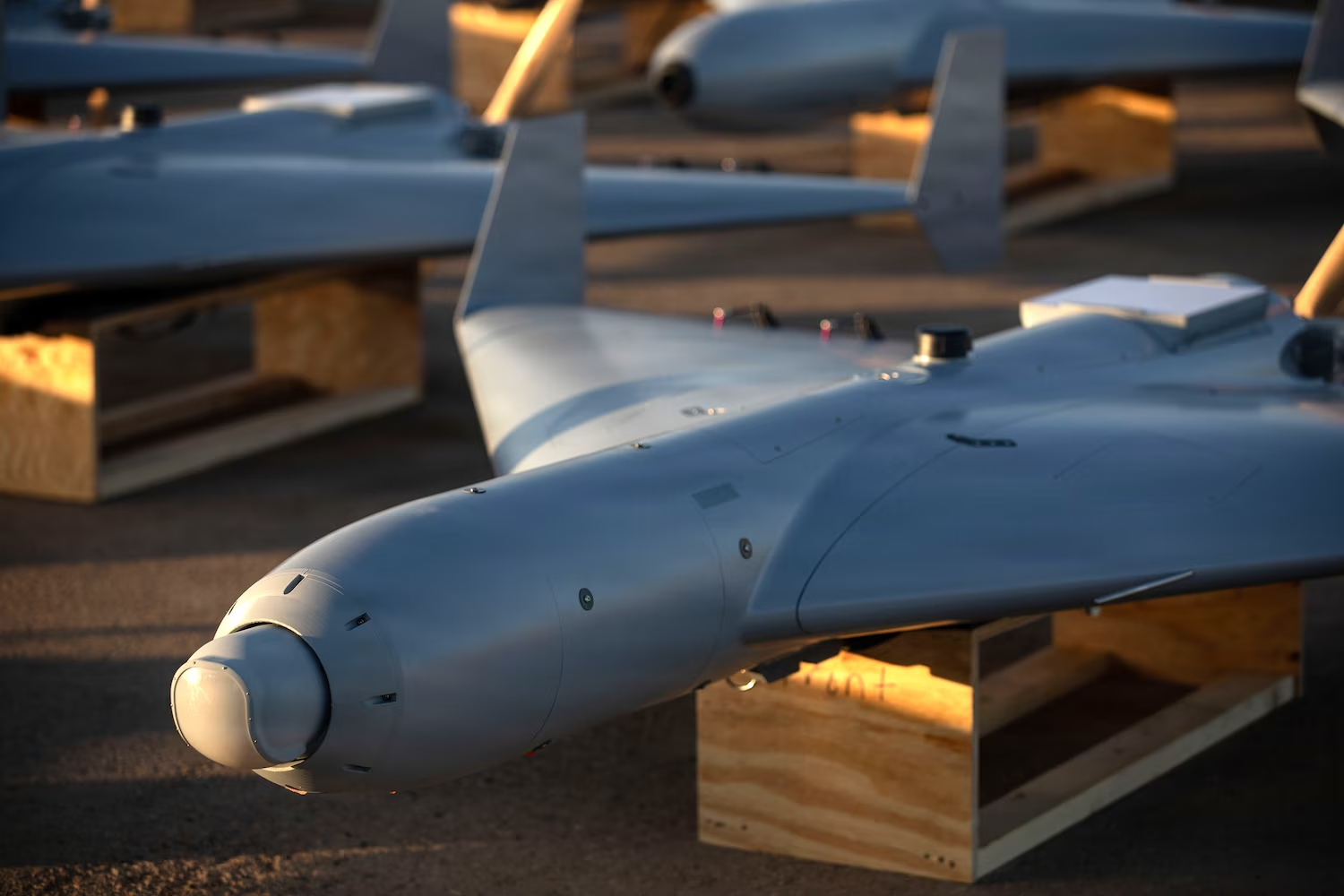
Classified as a one-way attack drone or loitering munition, LUCAS is designed to patrol a designated area for extended periods before executing a terminal dive onto its target, combining persistent surveillance with kinetic strike capability in a single platform.
With an endurance of up to six hours and a cruising speed of approximately 55 knots, LUCAS offers commanders the ability to conduct time-sensitive targeting, dynamic retasking, and delayed engagement, significantly expanding tactical flexibility compared to conventional missiles.
While exact range figures remain undisclosed, its described “extensive” operational radius suggests that LUCAS can be launched well beyond the reach of many coastal defences, enabling maritime forces to impose pressure deep into contested littoral zones.
The system’s versatility is further enhanced by its ability to be launched via multiple methods, including shipboard deployment, ground-based systems, vehicle platforms, catapults, and rocket-assisted take-off mechanisms.
This adaptability makes LUCAS particularly attractive for expeditionary forces, special operations units, and distributed maritime operations where infrastructure is limited or contested.
From a cost perspective, LUCAS is estimated to cost under USD100,000 per unit, equivalent to approximately RM470,000, a fraction of the multi-million-dollar price tag associated with cruise missiles such as the Tomahawk, which can exceed USD1.5 million (approximately RM7.05 million) per round.
This dramatic cost differential enables the U.S. military to pursue saturation strategies that impose asymmetric burdens on adversary air defences, forcing them to expend expensive interceptors against inexpensive attacking systems.
Visually and conceptually, LUCAS bears resemblance to the Iranian Shahed-136, a system that has demonstrated the disruptive potential of mass-produced one-way attack drones in conflicts such as Ukraine and across the Middle East.
The U.S. adoption of a similar operational concept reflects a clear recognition that the effectiveness of such systems lies not in sophistication alone, but in their ability to be fielded in large numbers, rapidly replaced, and continuously evolved.
Unlike reusable unmanned platforms such as the MQ-9 Reaper, LUCAS is intentionally expendable, allowing commanders to accept losses as a normal operational outcome rather than a strategic setback.
This shift aligns closely with the Pentagon’s broader “Replicator” initiative, which aims to field thousands of attritable autonomous systems across air, land, and sea domains to counter numerically superior adversaries.
Strategic Impact on Middle East and Indo-Pacific Naval Doctrine
The successful at-sea launch of LUCAS carries immediate implications for maritime security in the Middle East, where unmanned systems have become central to both offensive and defensive operations.
From Houthi drone and missile attacks on commercial shipping in the Red Sea to Iranian-backed militia operations targeting regional infrastructure, the proliferation of low-cost unmanned systems has fundamentally altered the security landscape.
By deploying its own one-way attack drones from naval platforms, the United States effectively levels the playing field, enabling rapid, proportional, and scalable responses without escalating to high-cost or high-visibility strike options.
This capability enhances deterrence by complicating adversary planning, as potential attackers must now account for the possibility of immediate maritime-launched counterstrikes from platforms operating in international waters.
Beyond the Middle East, the implications for the Indo-Pacific are profound, particularly in regions characterised by congested sea lanes, contested islands, and layered A2/AD networks.
The South China Sea, Strait of Malacca, and Taiwan Strait mirror many of the operational challenges present in the Arabian Gulf, including dense maritime traffic, proximity to hostile shores, and the presence of non-traditional threats.
For Southeast Asian states such as Malaysia, Indonesia, Singapore, and the Philippines, the emergence of ship-launched one-way attack drones underscores the growing importance of integrated air and maritime defence networks capable of detecting, tracking, and neutralising low-observable threats.
Malaysia, positioned astride one of the world’s most critical maritime chokepoints, has already begun investing in counter-drone technologies and sensor integration, recognising the vulnerability of commercial shipping and offshore infrastructure to unmanned attack.
The U.S. breakthrough is therefore likely to accelerate regional procurement and research efforts, as ASEAN navies seek both defensive countermeasures and offensive unmanned capabilities to preserve deterrence and maritime security.
At a strategic level, LUCAS reinforces a shift toward distributed maritime operations, where smaller, more numerous platforms collectively generate combat power, reducing reliance on a limited number of high-value assets.
This approach directly challenges traditional naval hierarchies and compels adversaries to defend against a far broader and more complex threat spectrum.
The Future of Naval Warfare in an Age of Unmanned Saturation
Historically, naval warfare has evolved through cycles of technological disruption, from the advent of aircraft carriers to guided missiles and nuclear submarines, each reshaping doctrine and force structure.
The rise of one-way attack drones represents the next such inflection point, introducing a class of weapons that blurs the line between missile, aircraft, and autonomous system.
As counter-drone technologies advance, including electronic warfare, directed-energy weapons, and layered air defences, the contest between offence and defence will intensify, driving rapid innovation on both sides.
For the United States and its allies, the challenge will lie in integrating systems like LUCAS into coherent command-and-control architectures that ensure effectiveness while maintaining compliance with international law and ethical frameworks.
For adversaries, the proliferation of such systems complicates deterrence by increasing uncertainty, reducing warning time, and expanding the range of plausible response options.
In the broader geopolitical context, the LUCAS milestone underscores a reality that Defence Security Asia has consistently highlighted: the future balance of power at sea will be shaped as much by industrial scalability and cost efficiency as by technological sophistication.
As navies around the world adapt to this new paradigm, the December 16, 2025, launch of LUCAS from USS Santa Barbara will be remembered as a defining moment when unmanned saturation warfare decisively entered the maritime domain. — DEFENCE SECURITY ASIA
