
Singapore Quietly Arms Its Naval Chokepoints: Saab Giraffe 1X Radars Now Fixed at Changi and the Singapore Strait’s Southern Gateway
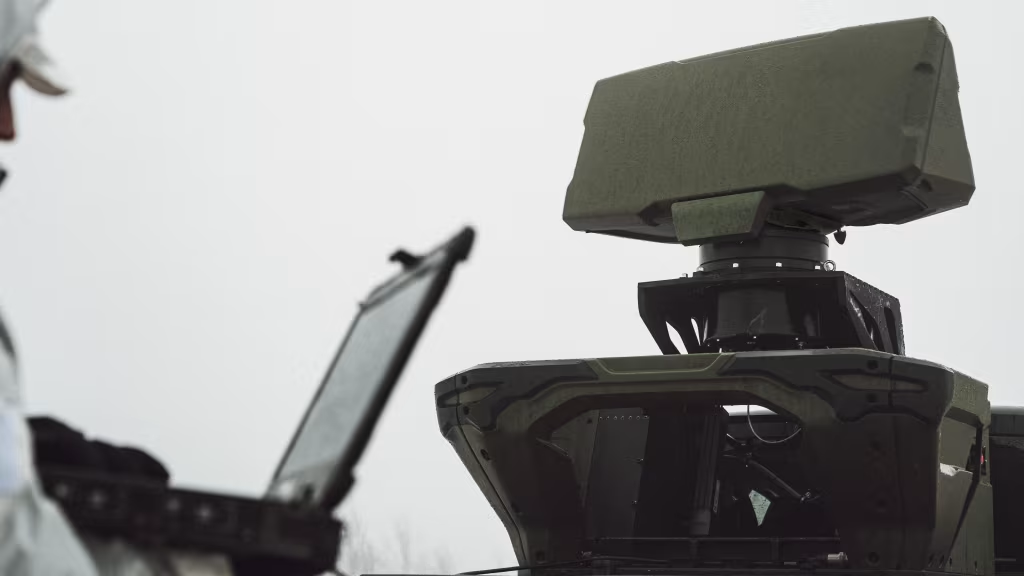
Satellite imagery confirms Singapore has permanently fixed Saab Sea Giraffe 1X radars at Changi Naval Base and Pulau Satumu, closing a critical low-altitude gap in the Island Air Defence system against drones, sea-skimming missiles, and littoral threats along the Singapore Strait.

(DEFENCE SECURITY ASIA) — Satellite reconnaissance imagery released in mid-June 2026 has confirmed what defence observers long suspected: Singapore has quietly transformed a radar once billed as a mobile battlefield sensor into a permanent fixture guarding its most sensitive naval chokepoints.
The Giraffe 1X, unveiled at the Singapore Airshow as a replacement for the ageing Portable Search and Target Acquisition Radar, has now been bolted onto fixed towers at Changi Naval Base and atop Pulau Satumu, the republic’s southernmost outpost.
Republic of Singapore Air Force Chief Major General Kelvin Fan Sui Siong had framed the acquisition in February 2026 as a mobility solution, mounted on newly procured URO VAMTAC vehicles alongside the motorised RBS 70 system.

That mobility-first narrative has since been quietly superseded, with Singapore instead embedding persistent, high-resolution sensor coverage directly into the permanent architecture of its Island Air Defence network.
The strategic timing is unmistakable, arriving as global battlefields from Ukraine to the Red Sea demonstrate with brutal clarity how cheap, low-observable drones can overwhelm legacy air-defence architectures built for conventional high-speed aerial threats.
For a city-state whose naval infrastructure sits within sight of one of the densest shipping corridors on Earth, hardening fixed points with a compact, multi-mission AESA radar signals a deliberate shift in threat prioritisation toward low-altitude and asymmetric attack vectors.
This is not a routine hardware swap disclosed through official channels, but a capability shift surfaced only through open-source satellite analysis, underscoring how quietly Singapore is reshaping its sensor posture around critical maritime chokepoints.
The Sea Giraffe 1X variant, built for simultaneous three-dimensional air and surface surveillance, fuses the Navy’s maritime domain awareness needs with the Air Force’s counter-drone and ground-based acquisition requirements into a single sensor node.
This deployment must be read against roughly half of global seaborne trade and an estimated seventy percent of Asia’s oil imports transiting the Straits of Malacca and Singapore daily, making any surveillance gap both an economic and a military vulnerability.
This analysis examines five dimensions: chokepoint logic behind persistent coverage, the sensor-gap closure within the Island Air Defence system, counter-drone mechanics behind the Giraffe 1X, the wider modernisation programme, and the regional deterrence signal this quiet upgrade sends.
No official unit cost, contract value, or total installation count has been disclosed by Saab, the Ministry of Defence, or the Defence Science and Technology Agency as of mid-July 2026, a gap this analysis flags rather than assumes.
What follows is a sober assessment of why a radar system pitched as a battlefield mobility solution has quietly become one of the most strategically significant fixed sensors guarding Singapore’s naval crown jewels.
The Singapore Strait Chokepoint: Why Fixed Radar Coverage Now Carries Existential Weight
Singapore’s entire economic and military calculus is anchored to its position astride the Straits of Malacca and Singapore, a maritime corridor through which an estimated one thousand commercial vessels transit on any given day.
Any sustained disruption to this corridor, whether through deliberate blockade, missile attack, or large-scale maritime accident, would inflict catastrophic and near-immediate damage on Singapore’s viability as a global trading and logistics hub.
The congested, island-studded littoral environment surrounding the strait is simultaneously an economic lifeline and a permissive environment for asymmetric threats, including small fast attack craft, sea-skimming missiles, and low-flying reconnaissance drones.
Placing a Sea Giraffe 1X radar atop Pulau Satumu, the nation’s southernmost territorial point, extends persistent twenty-four-hour surveillance precisely across the southern maritime gateway through which the bulk of strait-bound traffic must pass.
The Changi Naval Base installation performs an equivalent function on the eastern approach, protecting one of the Republic of Singapore Navy’s most operationally significant hubs from surprise low-altitude incursion or reconnaissance.
This dual-node deployment complements Singapore’s existing maritime security architecture, which already integrates the Maritime Security Task Force, Littoral Mission Vessels, and the newly operational Maritime Security Unmanned Surface Vessel fleet into one networked capability.
Persistent fixed radar coverage removes the logistical burden of constantly repositioning mobile sensor platforms, granting planners uninterrupted situational awareness precisely where traffic density and threat exposure are highest.
The Sea Giraffe 1X’s simultaneous air-and-surface mode is strategically significant because it collapses what would otherwise require two separate sensor systems into one compact installation with a minimal infrastructure footprint.
For a nation with severely constrained land area and limited appetite for new radar towers, mounting a sub-one-hundred-and-fifty-kilogram topside sensor onto existing masts is an efficient, low-visibility method of hardening chokepoint surveillance.
This chokepoint-centric logic, prioritising persistent low-altitude and surface-domain awareness over additional long-range detection, reveals that Singapore now treats littoral and asymmetric threats as at least as operationally urgent as conventional high-altitude aerial incursions.
Closing the Low-Altitude Sensor Gap Inside Singapore’s Island Air Defence Architecture
Singapore’s Island Air Defence system, developed jointly by the Republic of Singapore Air Force and the Defence Science and Technology Agency, is built around seeing further, shooting further, and deciding faster than any adversary operating in the theatre.
That architecture has historically relied on larger long-range systems such as the ageing AN/FPS-117, a radar now under active review for replacement precisely because of its diminishing effectiveness against smaller, lower, and slower aerial contacts.
The Giraffe 1X was never designed to replace such long-range early-warning radars, but instead to fill a persistent detection gap against low, slow, and small targets that larger systems routinely struggle to resolve in cluttered coastal environments.
By operating a refresh rate covering the full three-hundred-and-sixty-degree search volume once every second, the radar provides near-instantaneous track updates on contacts that legacy systems, tuned for larger and faster threats, might otherwise dismiss as clutter or miss entirely.
This sensor is designed to feed directly into Singapore’s Smart Combat Management System, which fuses multi-source sensor data using artificial intelligence and analytics to compress the decision-to-engagement timeline against fast-emerging low-altitude threats.
Integration with existing kinetic layers, including the medium-range Aster 30 missile system and the short-range SPYDER network, means the fixed Giraffe 1X installations function as forward-positioned cueing sensors rather than standalone detection assets.
This networked, non-redundant sensor architecture is deliberately designed to avoid single points of failure, ensuring that the loss or jamming of any one node does not collapse the wider Island Air Defence surveillance picture.
Positioning the radar at fixed naval chokepoints rather than solely relying on mobile army-configured units suggests Singapore’s threat modelling now treats naval infrastructure protection as inseparable from national island-wide air defence rather than a separate maritime-only concern.
The dual air-and-surface fusion capability of the Sea Giraffe 1X variant directly supports this doctrinal shift by allowing a single fixed sensor to simultaneously cue both air-defence missile batteries and naval force-protection assets against the same detected contact.
This closes what had previously been an exploitable seam between Singapore’s maritime domain awareness architecture and its island-wide ground-based air defence network, a seam increasingly relevant given the proliferation of dual-use drones capable of both reconnaissance and strike roles.
Counter-Drone Warfare Mechanics: Why the Giraffe 1X Is Built for the Low, Slow, Small Threat Era
The Giraffe 1X’s defining technical characteristic is its purpose-built capability against low, slow, and small aerial targets, a category increasingly dominated by cheap commercial and militarised quadcopters and fixed-wing drones.
Saab’s published specifications indicate the radar can detect objects with a radar cross-section lighter than a milk carton at ranges of several kilometres, a sensitivity threshold that conventional pulse-Doppler air-defence radars were never engineered to reliably achieve.
The system’s dedicated Drone Tracker mode is specifically tuned to suppress false alarms generated by birds, sea clutter, and wind-driven debris, a critical requirement in the congested and biologically active littoral environment surrounding Singapore’s coastline.
Lessons drawn from the Ukraine conflict, ongoing Middle Eastern hostilities, and regional unmanned aerial incursions have collectively accelerated Singapore’s prioritisation of counter-drone systems as a frontline requirement rather than a peripheral capability.
The Singapore Armed Forces has responded by rolling out mandatory drone-operations and counter-drone tactical training across all service-fit recruits between 2025 and 2026, embedding counter-UAS awareness at the individual soldier level rather than confining it to specialist units.
A dedicated Counter-UAS Development and Operations group has been established within the Singapore Armed Forces specifically to accelerate fielding of sensor, jamming, and kinetic countermeasures against the evolving drone threat spectrum.
Parallel development of the Drone Defence C3 system is intended to fuse multiple sensor feeds, including fixed Giraffe 1X installations, into a coherent common operating picture that compresses detection-to-response timelines against swarming or coordinated drone attacks.
Singapore is additionally exploring high-power microwave technologies as a non-kinetic countermeasure against what defence planners term dark drones, referring to low-signature unmanned platforms optimised specifically to evade conventional radar and infrared detection methods.
The Giraffe 1X’s search-on-the-move capability and sub-three-minute deployment cycle for mobile variants demonstrates the same underlying sensor architecture can flexibly transition between fixed infrastructure protection and rapid battlefield repositioning as operational requirements evolve.
Recent 2026 enhancements extending the system’s detection range toward two hundred and fifty kilometres in select configurations, alongside expanded simultaneous track capacity, indicate Saab is actively scaling the platform to meet accelerating regional demand for layered counter-drone sensor networks.
Beyond the Radar: How the Giraffe 1X Fits Singapore’s Wider Force Modernisation Trajectory
The fixed Giraffe 1X deployment cannot be assessed in isolation, as it sits within a considerably larger Singapore Armed Forces modernisation programme spanning maritime, air, and unmanned domains simultaneously.
On the maritime patrol front, Singapore has been acquiring Boeing P-8A Poseidon aircraft alongside Gulfstream G550 surveillance platforms to replace ageing Fokker aircraft and extend maritime domain awareness beyond coastal radar horizons.
The Republic of Singapore Navy’s incoming Multi-Role Combat Vessels are explicitly designed as motherships for unmanned surface and subsurface systems, reflecting a doctrinal pivot toward distributed, sensor-networked naval operations rather than concentrated manned-platform firepower.
On the air domain, Singapore’s phased introduction of the F-35 fighter alongside continuing Island Air Defence enhancements signals a parallel high-end and low-end capability build, hardening both the top and bottom ends of the aerial threat spectrum concurrently.
This layered procurement pattern, pairing fifth-generation strike aircraft with compact fixed counter-drone radars, indicates Singapore’s defence planners are simultaneously preparing for peer-level aerial contingencies and diffuse, low-cost asymmetric drone incursions without prioritising one over the other.
Choosing a radar engineered for both fixed and mobile configuration, mountable on VAMTAC vehicles or existing masts, reflects a Singapore Armed Forces preference for flexible, dual-role systems that maximise capability against a constrained manpower and land-area envelope.
No official contract value for the Giraffe 1X acquisition, whether in United States dollars or Malaysian ringgit at the approximate rate of USD 1 to RM4.0, has been disclosed by Saab or Singapore’s Ministry of Defence as of mid-2026.
This financial opacity extends to the total number of fixed installations planned beyond the two confirmed sites, leaving open-source analysts to rely on satellite imagery rather than procurement disclosure for capability assessment.
Singapore’s continued deepening of its defence-industrial relationship with Saab, tracing back to RBS 70 missile and earlier Giraffe radar acquisitions in the 1980s, illustrates a long-term technology-partnership model prioritised over diversified multi-vendor procurement for core sensor and air-defence systems.
This trajectory, spanning P-8A patrol aircraft, F-35 fighters, Multi-Role Combat Vessels, and now fixed counter-drone radar nodes, signals Singapore is engineering a networked, multi-domain sensor-to-shooter architecture to compress detection-to-engagement timelines across air, surface, and subsurface vectors.
Regional Signalling and the Deterrence Calculus Behind a Quietly Fixed Radar
The decision to fix rather than merely deploy the Giraffe 1X carries a deterrence signal that extends well beyond its immediate technical function as a low-altitude sensor.
Permanent radar installations at Changi Naval Base and Pulau Satumu communicate to regional observers that Singapore now treats persistent, all-weather maritime and low-altitude surveillance as a baseline requirement rather than a contingency-dependent capability.
This signalling matters acutely in a security environment where neighbouring Malaysia and Indonesia share overlapping maritime boundaries and interests across the same strait, and where any perceived unilateral hardening of surveillance posture invites careful diplomatic and strategic scrutiny.
Broader regional military modernisation, including expanding People’s Liberation Army Navy activity and increasingly sophisticated unmanned systems proliferating across Southeast Asian waters, forms the unstated but unmistakable backdrop against which Singapore’s quiet radar hardening should be interpreted.
By closing the low-altitude detection seam around its most sensitive naval infrastructure without a formal government announcement, Singapore avoids the diplomatic friction of an overt capability declaration while still achieving the operational deterrence effect of demonstrably persistent surveillance.
This pattern of quiet capability hardening, revealed only through open-source satellite intelligence rather than official disclosure, is increasingly characteristic of how smaller but technologically sophisticated states signal resolve without inviting escalatory rhetoric from larger regional actors.
The strategic implication is that Singapore is positioning itself to detect, characterise, and potentially intercept low-signature threats, whether hostile drones, unmanned surface vessels, or covert reconnaissance platforms, well before they can approach critical naval or civilian maritime infrastructure.
Any assessment of intent behind the timing or scale of this deployment remains necessarily speculative in the absence of official statements, and this analysis treats such interpretation as a strategic implication rather than a verified fact.
What is verifiable is that satellite imagery confirms two fixed installations, that the radar was originally announced as a mobile system, and that its detection profile is specifically optimised against small, low, and slow aerial and surface threats.
The broader strategic consequence is that Singapore’s quiet fixed-radar upgrade functions simultaneously as an operational counter-drone hardening measure and as a calibrated signal of persistent vigilance across one of the world’s most consequential and heavily trafficked maritime chokepoints.
