
Pakistan-Kuwait Defence Talks Emerge as Iran War Batters Kuwait’s Air Defences: Inside the Gulf’s Saudi-Style Security Question
As Iranian missiles and drones continue striking Kuwait, Islamabad and Kuwait City open early defence-for-energy negotiations — but Pakistani officials insist a Saudi-style troop deployment remains off the table, for now.

(DEFENCE SECURITY ASIA) — Pakistan and Kuwait have opened early-stage negotiations to expand their defence partnership in direct exchange for deeper energy cooperation and long-term Kuwaiti investment, fusing hard security with hydrocarbon logistics for the first time.
The talks surfaced after Lieutenant General Khaled Al-Shuraian, Kuwait’s Army Chief of Staff, met Pakistan Army Director of Operations Brigadier Naveed Qalb Abbas in June 2026 to discuss “strengthening defence relations” and “expanding military cooperation.”
Kuwait is reportedly probing the feasibility of a Saudi-style security arrangement, a model that could theoretically extend to Pakistani troops, fighter jets, drones, and air defence batteries on Kuwaiti soil.
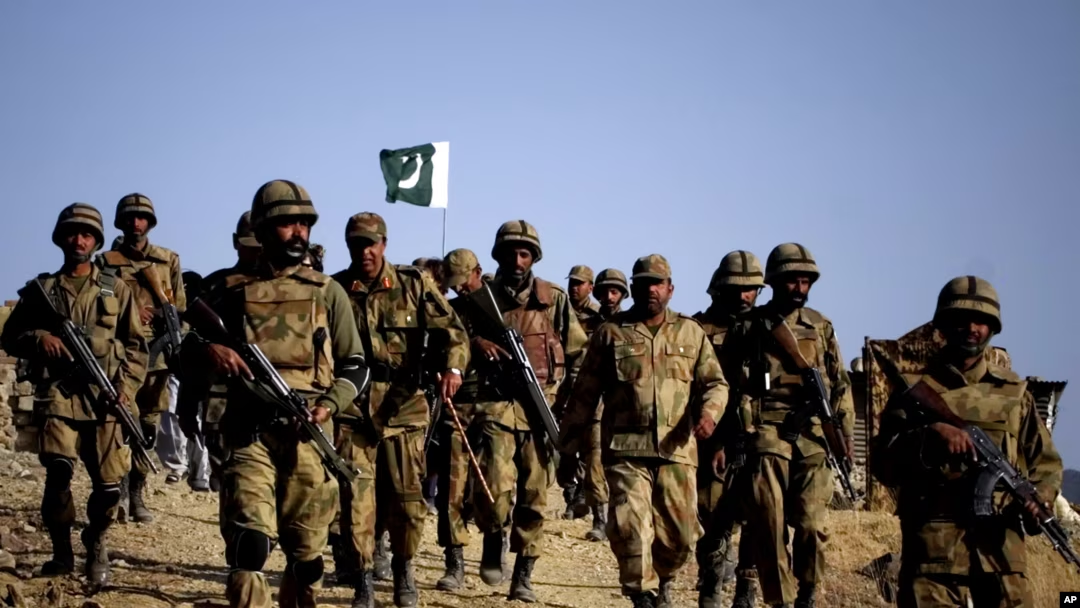
Pakistani officials have moved quickly to contain the speculation, stating that combat troop deployments are not under consideration and that discussions remain preliminary and far from any binding mutual-defence text.
This caution matters because Pakistan already carries a forward military commitment to Saudi Arabia under the September 2025 Strategic Mutual Defence Agreement, reportedly involving roughly 8,000 troops, a JF-17 Thunder squadron, drone units, and HQ-9 air defence systems.
Any parallel Kuwaiti track would multiply Islamabad’s overseas force-generation burden at a moment when its economy remains dependent on Gulf remittances and preferential energy credit lines.
The timing is inseparable from the 2026 Iran war, which began on 28 February when Iran launched Operation True Promise IV against American and allied installations across Bahrain, Qatar, the UAE, and Kuwait.
Kuwait has since absorbed direct hits on Kuwait International Airport, Ali Al Salem Air Base, Camp Buehring, and a coalition operations centre near Port Shuaiba, incidents that killed and wounded personnel and exposed limits of layered air defence.
Ambassador Dr Zafar Iqbal, Pakistan’s envoy to Kuwait City, has framed continuing consultations around “joint coordination” and “areas of mutual interest,” language that keeps cooperation open without committing Islamabad to combat exposure.
Running parallel to the security track, Kuwait Petroleum Corporation continues to supply more than sixty percent of Pakistan’s diesel imports, a dependency compounded by Strait of Hormuz disruptions and force-majeure declarations.
What emerges is a live case study in how missile warfare, energy insecurity, and defence diplomacy are converging into one strategic transaction shaping Gulf security architecture beyond the current war.
For global defence planners, the Pakistan-Kuwait track offers an early indicator of how mid-tier military exporters may reshape Gulf deterrence once traditional great-power security guarantees appear strained by sustained missile-drone attrition.
Iran’s Missile-Drone Campaign Is Rewriting Kuwait’s Threat Calculus
Kuwait’s exposure inside the 2026 Iran war stems from its geography, its proximity to Iranian launch sites, and its hosting of American and Italian forces at bases Tehran has designated as retaliatory targets.
Iranian strikes opened on 28 February 2026 with drone attacks against Kuwait International Airport and Ali Al Salem Air Base, damaging terminals, destroying radar infrastructure, and forcing a total suspension of commercial aviation.
A separate drone strike hit the American garrison at Camp Buehring, while late-April 2026 reporting revealed an Iranian Northrop F-5 fighter had penetrated the base’s layered air defence envelope to conduct a bombing run.
On 1 March 2026, an Iranian one-way attack drone evaded intercept systems and struck a US tactical operations centre near Port Shuaiba, killing six American service members and wounding more than thirty.
Kuwait’s air defence network has intercepted roughly ninety-seven ballistic missiles and two hundred eighty-three drones cumulatively, illustrating both the scale of Iran’s saturation-strike doctrine and the attritional stress on interceptor inventories.
As of mid-July 2026, Kuwait reported intercepting thirty-two additional hostile drones in a single day, confirming the campaign has not de-escalated despite ongoing diplomatic efforts.
This persistent threat environment is what has pushed Kuwait toward exploring diversified security partnerships beyond its traditional reliance on American air defence umbrellas and GCC frameworks.
Pakistan’s relevance stems from its demonstrated experience integrating Chinese-origin HQ-9 air defence batteries and JF-17 Thunder fighters into a contested Gulf air-defence environment under the Saudi agreement.
For Kuwaiti planners, the calculus is less about replicating Saudi Arabia’s troop-hosting model than acquiring layered-defence expertise and interoperability training against a threat showing no sign of abating.
The unresolved question is whether this training-and-liaison track can absorb continued attritional losses on its own, or whether mounting strikes eventually force Kuwait City toward the forward-deployed hardware Riyadh has already accepted.

The Saudi Template: Blueprint, Bellwether, or Cautionary Tale for Kuwait
Pakistan’s September 2025 Strategic Mutual Defence Agreement with Saudi Arabia represents the operative benchmark against which the Kuwaiti track is now being measured by regional analysts and open-source military observers.
Under that agreement, Pakistan reportedly deployed approximately 8,000 troops to Saudi territory alongside a squadron-strength JF-17 Thunder detachment, drone units, and HQ-9 air defence batteries, with Riyadh financing the deployment while Pakistani crews retained operational control.
In dollar terms, sustaining an eight-thousand-strong expeditionary force with squadron-level airpower plausibly costs several hundred million dollars annually, equivalent to well over one billion Malaysian ringgit at the standard USD 1 to MYR 4.0 rate.
Extending even a scaled-down version to Kuwait would require Islamabad to sustain two forward-deployed expeditionary postures inside one active war theatre, straining its available combat-ready squadrons and expeditionary manpower.
Analysts covering the talks have cautioned against assuming a direct replication of the Saudi arrangement, noting Kuwait is a smaller GCC state with its own entrenched American security guarantees.
Kuwait’s interest instead centres on training exchanges and technical expertise-sharing rather than the large-scale troop, fighter jet, and air defence transfers defining the Saudi precedent.
This distinction carries real weight because a genuine mutual-defence clause, obligating Pakistan to treat an attack on Kuwait as an attack on itself, would mark an unprecedented escalation of Islamabad’s regional commitments.
No official statement has confirmed such a clause, and both governments continue framing the dialogue in measured, cooperative language rather than alliance-defining terminology.
The Saudi template nonetheless functions as a bellwether, demonstrating Pakistan is both willing and logistically capable of exporting combat airpower into an active Gulf conflict zone when financing aligns.
Whether Kuwait ultimately negotiates a comparable package or settles for a lighter framework will signal how far Gulf states are prepared to diversify away from exclusive dependence on American extended deterrence.
Energy Chokepoints: Why the Strait of Hormuz Crisis Makes Pakistan Indispensable
The Strait of Hormuz, through which roughly eighty to ninety percent of Pakistan’s crude oil imports and a substantial share of global liquefied natural gas transits, became a primary casualty once the 2026 Iran war escalated beyond its initial February strikes.
Iranian strikes on shipping lanes near Oman, including tankers off Muscat and near Khasab, forced producers to declare force majeure and triggered sharp spikes in benchmark oil prices across Asian and European markets.
Pakistan was compelled to negotiate direct transit permissions from Tehran for its flagged vessels, underscoring how exposed Islamabad’s energy security remains to a single chokepoint under active military threat.
Kuwait dispatched the vessel Khairpur carrying emergency diesel and jet fuel to Pakistan, reinforcing a relationship in which Kuwait Petroleum Corporation already underwrites over sixty percent of Pakistan State Oil’s diesel contracts.
In May 2026, Kuwait agreed to explore new strategic petroleum storage facilities inside Pakistan, discussed directly between Pakistan’s Petroleum Minister and Kuwait’s ambassador covering joint refining and storage projects.
Broader reporting places Kuwait’s prospective share of a proposed seventeen-million-barrel Pakistani strategic reserve at roughly seven million barrels, conceived to create redundant storage capacity outside the vulnerable Hormuz corridor.
At current pricing, a seven-million-barrel Kuwaiti-financed tranche would represent a capital commitment worth several hundred million US dollars, translating to well over one billion Malaysian ringgit in infrastructure investment.
Pakistan currently holds only twenty to thirty days of strategic reserve capacity, a dangerously thin buffer leaving it acutely vulnerable to any further Hormuz-linked supply shock.
Islamabad has responded by courting Gulf investment in port infrastructure, bonded terminals, and integrated LNG and crude storage under its proposed Energy City initiative centred on Gwadar and Port Qasim.
This energy-defence nexus increasingly functions as the economic scaffolding beneath any parallel expansion of bilateral military cooperation, since Gulf capital sunk into Pakistani storage infrastructure creates a durable financial stake in Islamabad’s continued security reliability.
Force Posture Reality Check: Confirmed Cooperation Versus Unverified Speculation
Verifiable bilateral defence cooperation rests on the Defence Cooperation Agreement signed 11 June 2023, built upon decades of Pakistani advisory and training support to Kuwaiti forces dating back to the 1960s and 1970s.
Pakistani personnel additionally provided technical and advisory support during the 1990–91 Gulf War, establishing a precedent for cooperative, non-combat engagement predating the current speculation by three decades.
Recent 2026 engagements, including the Al-Shuraian and Qalb Abbas meeting and subsequent talks with Ambassador Zafar Iqbal, remain officially characterised as training, cybersecurity, and personnel-exchange discussions rather than negotiations toward a formal mutual-defence treaty.
No official confirmation exists from either Islamabad or Kuwait City regarding a new mutual-defence pact, combat troop deployments, or transfers of Pakistani fighter jets, drones, or HQ-9-class systems to Kuwaiti territory.
Pakistani officials have gone further, explicitly stating that combat troop deployment to Kuwait is not currently under consideration, directly contradicting the more dramatic Saudi-style framing circulating in regional commentary.
Open-source discussion on platforms such as X has generated visible speculation about deeper Pakistan-Kuwait defence ties, yet no verified leak has surfaced confirming specific equipment packages or basing arrangements.
This gap between speculation and confirmed diplomatic language is analytically significant, showing how an incremental training-and-liaison relationship can be rhetorically inflated absent corroborating official documentation.
Regional defence commentary has cautioned that current Pakistan-Kuwait activity reflects continuity under the existing 2023 framework rather than a transformational new strategic pact.
The most defensible assessment separates three tiers cleanly: confirmed training and dialogue, expanding energy-infrastructure investment, and unverified speculation about combat force transfers unsupported by any official statement.
Readers and policymakers should treat any near-term reporting of Pakistani combat deployments to Kuwait with the same scepticism once applied to early, since-moderated claims about the scale of Islamabad’s Saudi commitment.
Pakistan’s Balancing Act: Mediator, Security Exporter, and Gulf Hedge
Pakistan has simultaneously positioned itself as a central diplomatic mediator in the 2026 Iran war, hosting talks that produced the Islamabad Memorandum of Understanding signed in mid-June 2026 between American and Iranian representatives.
That interim framework established a sixty-day window intended to de-escalate hostilities, even as fresh Iranian strikes on Kuwait and continuing American air operations persisted through mid-July 2026.
Pakistan’s mediator credibility rests on its complex relationship with Iran, its deepening ties with Saudi Arabia, its credibility in Washington, and its demonstrated willingness to deploy personnel and hardware into contested Gulf environments.
This positioning allows Islamabad to market itself as both a neutral broker capable of de-escalating the war and a security exporter reinforcing Gulf air defence architectures without formal superpower alignment.
The GCC itself has hardened its collective rhetoric, with member states invoking stronger “attack on one is attack on all” language in June 2026 regarding threats against Kuwait and Bahrain.
This shift signals growing Gulf unease about sole reliance on American extended deterrence, given repeated Iranian strikes on American-hosted bases that exposed gaps in existing air defence arrangements.
For Pakistan, expanding the Kuwaiti relationship offers economic upside through remittance flows and diversified Gulf financing at a moment when its own economy depends on external liquidity support.
Pakistan must nonetheless balance these commitments against China, whose Belt and Road-linked Gwadar investment increasingly overlaps with the Energy City infrastructure now courted for Kuwaiti and Saudi capital.
Islamabad’s historical caution on overseas deployment, reinforced by its denial of troop commitments to Kuwait, suggests an incremental rather than a sudden Saudi-scale strategic leap.
The trajectory of Pakistan-Kuwait cooperation will ultimately depend on how the Iran war resolves, since a prolonged campaign against Kuwait would pressure both governments toward the forward-deployed package they currently insist remains off the table.
Until then, the relationship remains defined by measured official language, active energy-infrastructure investment, and a mutual-defence question that both capitals have chosen, for now, to leave deliberately unanswered.
