
USS Gerald R. Ford Fire Crisis: 600 Sailors Displaced After 30-Hour Blaze Raises Readiness Questions for U.S. Navy’s Most Advanced Aircraft Carrier
Extended onboard fire aboard CVN-78 exposes vulnerability in carrier deployment endurance as U.S. Navy maintains global force posture during active operations
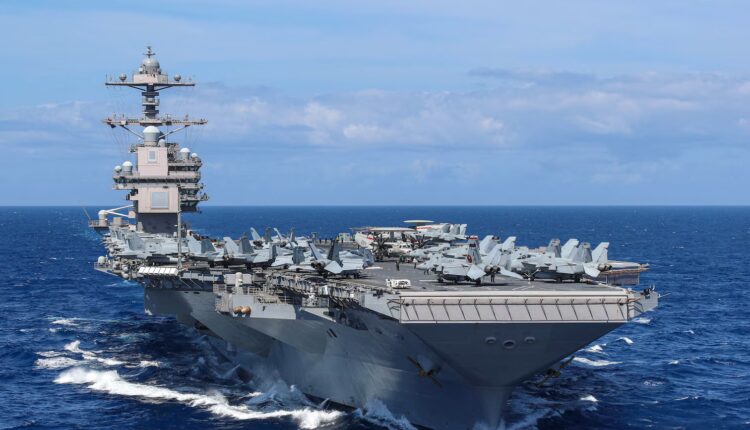
(DEFENCE SECURITY ASIA) — A prolonged onboard fire aboard the nuclear-powered aircraft carrier USS Gerald R. Ford (CVN-78) forced sailors to battle flames for more than 30 hours, displacing over 600 crew members and highlighting how even minor internal failures can generate strategic-level consequences during active carrier deployment operations.
Officials familiar with the incident confirmed that the blaze began in the ship’s main laundry area and spread through the ventilation network into multiple berthing compartments, while sailors and officers acknowledged that the damage forced hundreds of personnel to sleep on floors, tables, and temporary surfaces across the carrier.
The scale of the disruption, first detailed by sailors and officials speaking to The New York Times, illustrates how internal habitability failures aboard a deployed aircraft carrier can affect logistics endurance, crew readiness, and force-posture stability even when flight operations and combat missions continue without interruption.

Fire Origin Inside Laundry System Reveals Vulnerability in Internal Ship Infrastructure
The incident began in the carrier’s primary laundry facility, where a dryer vent reportedly experienced an electrical malfunction that ignited a fire capable of spreading through the ship’s ventilation ducts into several berthing compartments used by enlisted sailors.
Because modern aircraft carriers rely on interconnected ventilation networks to regulate temperature, smoke and flames were able to travel rapidly beyond the original compartment, forcing damage control teams to fight the fire across multiple living areas rather than containing it at the source.
Sailors battled the blaze for more than 30 hours before it was fully extinguished, demonstrating the scale of the internal spread and the difficulty of controlling fires inside large warships where confined spaces, wiring networks, and airflow systems create complex firefighting conditions.
During the extended response, dozens of crew members suffered smoke inhalation while conducting damage-control operations, indicating that the firefighting effort required prolonged exposure to hazardous conditions inside the carrier’s interior compartments.
Two sailors sustained non-life-threatening injuries during the response and received treatment onboard the ship, while a third sailor required medical evacuation, underscoring the operational risk faced by damage-control teams even during non-combat incidents.
The rapid propagation of the fire through ventilation pathways demonstrates how auxiliary systems such as laundry, plumbing, and air circulation can become critical vulnerability points inside high-density warships designed for continuous deployment.
Aircraft carriers contain thousands of compartments connected through ducts, cables, and piping, meaning that fires originating in support areas can spread far beyond their initial location if airflow systems remain active during early stages of the incident.
Damage to berthing areas rather than combat systems illustrates that habitability infrastructure plays a direct role in operational sustainability, because crew endurance and sleep cycles are essential for maintaining round-the-clock flight operations during deployment.
The event highlights the importance of internal damage-control readiness aboard carriers, where the ability to isolate compartments, control airflow, and maintain firefighting capability determines whether an incident remains local or becomes ship-wide.
Although the fire was ultimately contained, the duration of the response indicates that even advanced platforms such as the Ford-class carrier remain dependent on manual damage-control procedures executed by sailors rather than automated suppression alone.
READ: U.S. Naval Power Under Strain? USS Gerald R. Ford Crew Discontent Emerges as Trump Repositions Dual Carrier Strike Groups Toward Iran Showdown
More Than 600 Sailors Displaced as Berthing Compartments Become Unusable
More than 600 sailors lost access to their assigned berths after smoke, heat, and water damage rendered multiple sleeping compartments unusable, forcing personnel to relocate to temporary spaces throughout the carrier during ongoing deployment operations.
Crew members have reportedly been sleeping on floors, tables, and improvised surfaces in various compartments, demonstrating how habitability disruption can rapidly affect a large percentage of personnel aboard a warship carrying roughly 4,500 to 5,000 sailors and air wing staff.
The displacement of roughly one-eighth of the ship’s total complement shows that even limited compartment damage can have large-scale consequences because berthing spaces aboard aircraft carriers are densely packed to maximize operational capacity.
Loss of access to laundry facilities following the fire added a secondary logistical strain, because personal hygiene, clothing maintenance, and daily routines are critical factors in maintaining crew endurance during extended deployments at sea.
Living-space disruption forces command staff to reorganize watch rotations, sleeping schedules, and crew assignments to ensure that operational stations remain manned despite reduced rest capacity for affected sailors.
Extended periods of reduced sleep or uncomfortable living conditions can affect reaction time, decision-making, and fatigue levels, which in turn influences the effectiveness of flight deck operations, engineering watches, and combat information center staffing.
Aircraft carriers operate on continuous 24-hour cycles during deployment, meaning that crew habitability is not a comfort issue but a direct component of mission readiness and operational safety.
Temporary relocation of hundreds of sailors also increases congestion inside the ship, raising additional concerns about ventilation, sanitation, and overall living conditions while repairs are still pending.
Because berthing areas are distributed throughout the carrier, damage to several compartments can force crew members to move far from their assigned workstations, increasing transit time and reducing efficiency during high-tempo operations.
The scale of the displacement indicates that the fire affected not only infrastructure but also the human element that enables the carrier to sustain continuous air operations while deployed far from port support.
Operations Continue Despite Fire Damage and Ongoing Deployment Challenges
Despite the internal damage caused by the fire, officials confirmed that flight operations, aircraft launches, and mission activities aboard USS Gerald R. Ford have continued without interruption, indicating that combat systems and flight deck infrastructure were not affected.
Maintaining operational tempo after a major internal incident reflects the redundancy built into modern carrier design, where propulsion, aviation support, and command systems are separated from living compartments to preserve combat capability.
However, continuing operations while hundreds of crew members lack normal living conditions places additional strain on personnel, requiring commanders to balance mission requirements with crew welfare and long-term readiness.
The carrier has already faced other challenges during the same deployment, including earlier mechanical issues and ongoing plumbing and sewage problems, which together create cumulative stress on both equipment and personnel.
Repeated technical and habitability problems during extended deployment cycles can test the resilience of both the ship and its crew, particularly when the vessel remains on station without immediate access to major repair facilities.
Aircraft carriers deployed overseas must function as self-contained bases capable of sustaining thousands of personnel for months, meaning that even minor system failures can escalate into significant operational concerns if not resolved quickly.
The ability to continue flight operations despite internal damage demonstrates the robustness of the carrier’s combat systems, but it also shows how operational success can coexist with significant internal strain.
Deployment schedules, mission commitments, and regional force-posture requirements often limit the ability of naval commanders to withdraw a carrier for repairs, even when living conditions onboard are degraded.
As of March 17, 2026, there have been no official updates regarding repairs, crew relief measures, or confirmation of the exact root cause of the fire, indicating that the carrier remains in active service while investigations continue.
The absence of immediate repair timelines suggests that restoring full habitability may take longer than restoring operational capability, a distinction that reflects the priorities of deployed naval forces during ongoing missions.
Reporting Differences Reveal Wider Impact Than Initial Navy Statement
Initial official statements described the fire as being contained within the laundry area, but later reporting based on sailor accounts and official confirmations revealed that the damage extended into multiple berthing compartments and required more than 30 hours to control.
This difference between early statements and later details illustrates how internal incidents aboard warships can appear limited at first but later prove to have wider operational consequences once the full extent of the damage becomes known.
Multiple outlets have since confirmed the scale of the incident, including the duration of the firefighting effort and the displacement of hundreds of sailors, indicating that the situation was more serious than initially presented.
Long firefighting durations aboard large ships often indicate that smoke, heat, or water damage spread through interconnected compartments even when flames themselves remain localized.
The reliance on sailor testimony to reveal the full impact shows how habitability issues sometimes become visible only after crew members describe conditions inside the ship rather than through official operational updates.
Damage to living spaces may receive less immediate public attention than damage to weapons or propulsion systems, but it can have equally important consequences for long-term deployment capability.
The fact that operations continued uninterrupted may have contributed to the perception that the incident was minor, even though the internal impact on crew living conditions was substantial.
Modern aircraft carriers are designed to absorb damage without losing combat capability, but that design philosophy also means that significant internal disruption can occur without affecting mission output.
The reporting timeline demonstrates how operational readiness and internal strain can exist simultaneously, creating a situation where a carrier remains fully active while its crew operates under degraded conditions.
Such incidents highlight the complexity of maintaining large warships at sea, where the boundary between routine malfunction and operational crisis can depend on how long the ship must continue its mission without support.
Incident Highlights Logistical and Human Factors in Sustaining Carrier Force Posture
The fire aboard USS Gerald R. Ford underscores that sustaining a forward-deployed aircraft carrier requires not only advanced technology but also stable internal infrastructure capable of supporting thousands of personnel under continuous operational pressure.
Carrier strike groups represent a central element of U.S. naval force posture, meaning that maintaining their readiness depends as much on crew endurance and habitability systems as on aircraft, weapons, or propulsion performance.
Extended deployments place cumulative stress on mechanical systems, plumbing, ventilation, and electrical equipment, increasing the likelihood that small failures can escalate into incidents affecting large portions of the crew.
Damage to berthing compartments directly affects the ability of sailors to rest between watches, which can influence safety, efficiency, and decision-making during flight operations and engineering tasks.
Logistical strain becomes more significant when a carrier remains on station, because repair opportunities are limited compared with ships operating closer to major naval bases.
The incident demonstrates that internal support systems such as laundry, ventilation, and plumbing are not peripheral features but essential components of sustained combat capability during long deployments.
Force-posture requirements often require carriers to remain deployed even after onboard incidents, reinforcing the need for crews to manage repairs while continuing mission activities.
The ability of USS Gerald R. Ford to continue operations despite the fire shows the resilience of modern carrier design, but the displacement of hundreds of sailors illustrates the human cost of maintaining continuous readiness.
Until repairs are completed and normal berthing conditions are restored, the carrier will continue operating with reduced habitability margins, a situation that reflects the realities of sustaining high-tempo naval deployments.
The event serves as a reminder that the effectiveness of a carrier strike group ultimately depends not only on its technology but on the endurance of the sailors who keep the ship operational under demanding conditions.
Technical Specifications — USS Gerald R. Ford (CVN-78) Nuclear Aircraft Carrier
| Category | Specification | Operational / Strategic Significance |
|---|---|---|
| Ship Name | USS Gerald R. Ford (CVN-78) | Lead ship of the Ford-class aircraft carriers, representing the newest generation of U.S. Navy nuclear-powered supercarriers designed for long-duration global deployment |
| Class | Ford-class Nuclear Aircraft Carrier | Next-generation carrier designed to increase sortie rate, reduce crew workload, and support future weapons and sensor systems |
| Displacement | ~100,000 tons (full load) | Supercarrier size enables sustained air operations, large aviation fuel storage, and extended power projection without frequent resupply |
| Length | ~337 m | Large flight deck allows simultaneous launch and recovery operations during high-tempo combat missions |
| Propulsion | 2 × A1B nuclear reactors | Nuclear propulsion provides virtually unlimited range and high electrical output for advanced systems such as EMALS, radar, and future directed-energy weapons |
| Maximum Speed | 30+ knots | High speed allows rapid repositioning of the carrier strike group in response to regional crises or strategic signalling missions |
| Air Wing Capacity | ~75 aircraft (mission dependent) | Supports multi-role air operations including strike, air defence, electronic warfare, ISR, and airborne early warning |
| Aircraft Launch System | EMALS (Electromagnetic Aircraft Launch System) | Enables higher sortie generation rate, reduced mechanical stress on aircraft, and improved efficiency compared with steam catapults |
| Crew Complement | ~4,500–5,000 personnel (ship + air wing) | Large crew required for continuous flight operations, damage control, engineering, and combat system readiness during extended deployment |
| Primary Role | Nuclear-powered aircraft carrier / Carrier Strike Group flagship | Central platform of U.S. naval force posture, enabling global power projection, deterrence operations, and sustained combat air missions without reliance on land bases |
