
U.S. Naval Power Under Strain? USS Gerald R. Ford Crew Discontent Emerges as Trump Repositions Dual Carrier Strike Groups Toward Iran Showdown
Extended 300-day deployment, dual-carrier pressure against Iran, and rising morale concerns aboard America’s most advanced $13 billion aircraft carrier raise critical questions over U.S. naval readiness and global force sustainability.

(DEFENCE SECURITY ASIA) — The mounting reports of crew discontent aboard the USS Gerald R. Ford (CVN-78) surface at a moment when U.S. carrier strike groups are being repositioned under President Donald Trump’s directive toward West Asia, compressing operational tempo and intensifying global scrutiny over whether extended deployments are eroding the combat sustainability of America’s most powerful maritime assets.
Western media accounts cited in regional reporting describe a growing wave of dissatisfaction among sailors following repeated mission extensions, with one anonymous crew member stating, “The personnel are extremely angry; some have openly stated that they will leave the service as soon as they return home,” a declaration that, if accurate, directly intersects with U.S. Navy retention metrics and long-term force generation models.
Another sailor emphasized that “the repeated extensions have made this mission several times more difficult,” framing the deployment not as a singular operational surge but as a compounding cycle of uncertainty that disrupts family stability, psychological endurance, and expectations tied to the Navy’s preferred seven-month deployment construct.

Chief of Naval Operations Adm. Daryl Caudle previously acknowledged this structural strain when he cautioned, “I am a big non-fan of extensions, and because they do have a significant impact… People want to have some type of certainty that they’re going to do a seven-month deployment,” underscoring that operational unpredictability translates directly into measurable readiness penalties.
As the Ford approaches what could exceed 300 days at sea—potentially surpassing post-Vietnam benchmarks—the human dimension now intersects with strategic deterrence signaling against Iran, where dual-carrier presence alongside USS Abraham Lincoln recalibrates U.S. strike posture in the Persian Gulf.
The strategic urgency intensifies as President Trump publicly indicated he may decide on military strikes against Iran within days, linking carrier presence to nuclear-related intelligence assessments and elevating the Ford from a routine deployment asset to a forward-positioned coercive instrument.
The reported dissatisfaction therefore cannot be evaluated in isolation from the broader geopolitical escalation, where nuclear negotiations, Red Sea disruptions, and proxy militia activity converge to shape U.S. naval force allocation under high-visibility political directives.
With approximately 4,600 sailors embarked on a vessel representing more than USD 13 billion (approximately RM49.4 billion at USD1 = RM3.8) in acquisition costs, the Ford embodies not only advanced power projection but also the accumulated financial and human capital underpinning American maritime dominance.
The convergence of morale strain, prolonged sea days, and operational redirection from NATO exercises to Caribbean operations and now toward the Persian Gulf reveals a deployment arc that has repeatedly expanded beyond initial planning thresholds, amplifying institutional stress across both crew and command structures.
Within this context, the quotations emerging from sailors, naval leadership, and security analysts frame a central question for global defence observers: whether sustained high-tempo carrier deployments can remain strategically effective if human endurance becomes a limiting operational variable.
USS Gerald R. Ford: Technological Superiority Confronting Operational Strain
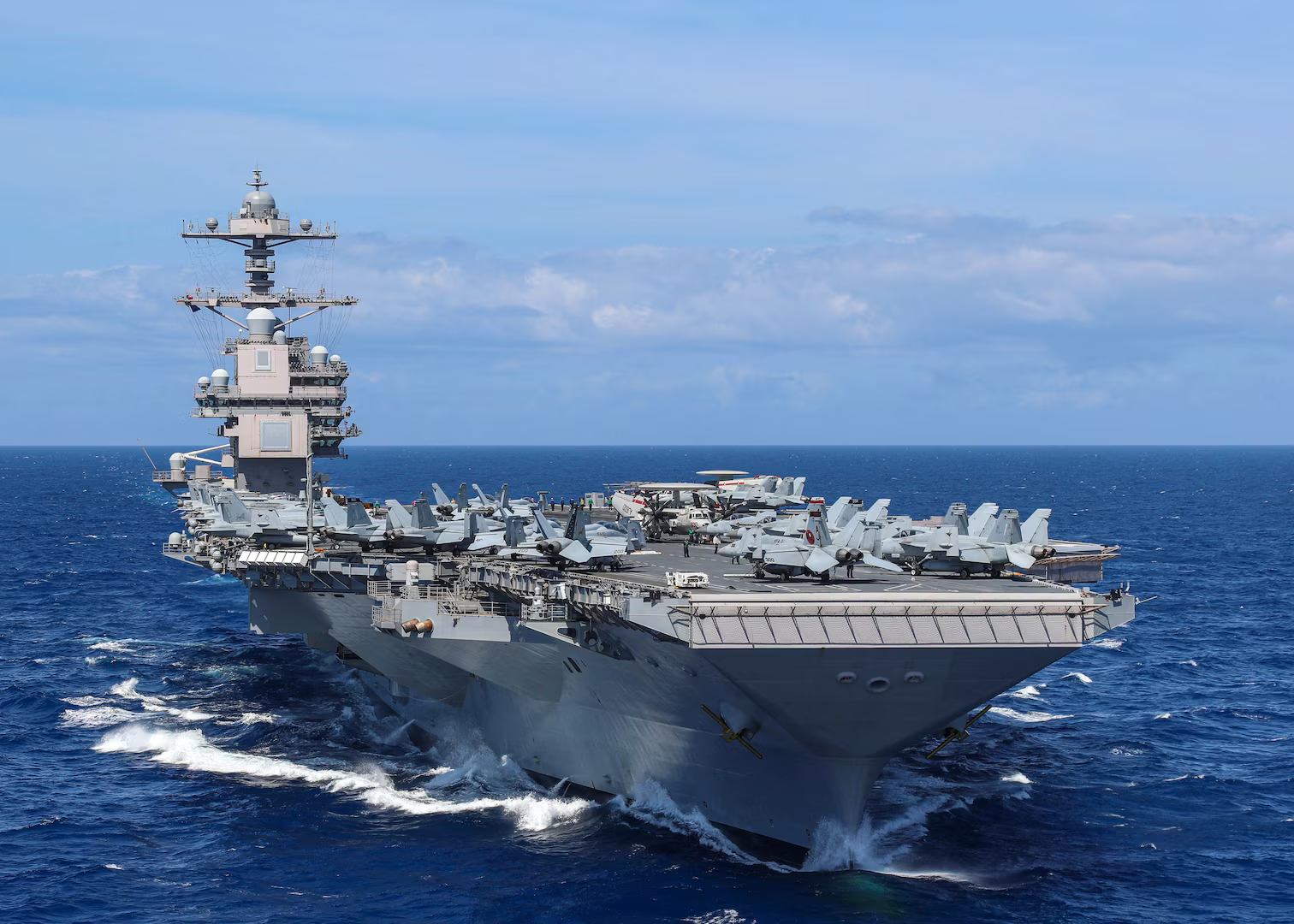
Commissioned in 2017 as the lead ship of its class, USS Gerald R. Ford was engineered to redefine carrier aviation efficiency through electromagnetic aircraft launch systems (EMALS), advanced arresting gear, and dual-band radar integration, positioning it as the technological cornerstone of 21st-century U.S. naval power projection.
Displacing approximately 100,000 tons and extending beyond 1,000 feet in length, the Ford can deploy up to 75 aircraft—including F-35C Lightning II stealth fighters, F/A-18 Super Hornets, and E-2D Hawkeye airborne early warning platforms—forming an integrated air wing capable of sustained strike, air superiority, and ISR operations.
Designed to reduce crew requirements by roughly 20 percent compared to Nimitz-class carriers while increasing sortie generation rates by approximately 33 percent, the Ford class was conceptualized to deliver higher operational output with lower long-term manpower burdens.
However, the ship’s development history—marked by cost overruns exceeding USD 13 billion (approximately RM49.4 billion) and technical complications involving elevators, propulsion components, and weapons handling systems—introduced early questions about reliability and lifecycle sustainability.
Although full operational capability was declared in 2022 following rectification of initial system deficiencies, the stress test of extended high-tempo deployments introduces new variables that differ significantly from controlled readiness cycles.
The current deployment began on 24 June 2025 with NATO-focused operations in the Atlantic and Mediterranean, aligning with alliance assurance missions before subsequent redirection altered its operational geography and tempo.
In October 2025, the carrier was reassigned to the Caribbean under U.S. Southern Command, supporting operations that culminated in the capture of Nicolás Maduro in January 2026, thereby extending the deployment beyond the Navy’s preferred seven-month window.
By mid-February 2026, the Ford had accumulated 241 days at sea, and the February redirection toward West Asia signaled the likelihood of further extension, compressing maintenance schedules and personnel rotation planning.
The transition through the Strait of Gibraltar on 20 February 2026 symbolized not merely geographic movement but strategic recalibration toward a potential high-intensity theater involving Iranian nuclear infrastructure and regional proxy dynamics.
In aggregate, the Ford’s technological sophistication now intersects with sustained operational demands, illustrating that advanced naval engineering does not eliminate the systemic pressures created by prolonged forward deployment in volatile theaters.
Strategic Escalation: Trump’s Directive and the Dual-Carrier Signal to Iran
President Donald Trump’s renewed “maximum pressure” posture toward Iran provides the political framework driving the Ford’s redirection, linking maritime force projection directly to nuclear negotiation leverage.
On 19 February 2026, Trump indicated that decisions regarding potential military strikes on Iran could be made within days, referencing intelligence assessments tied to uranium enrichment activities, thereby amplifying the immediacy of carrier-based strike readiness.
The deployment of the Ford alongside USS Abraham Lincoln constitutes a dual-carrier configuration capable of sustaining continuous air operations, expanding sortie capacity, and reinforcing deterrence messaging across the Persian Gulf.
Within this architecture, the Ford’s embarked air wing, supported by escort destroyers such as USS Winston S. Churchill and USS Bainbridge, contributes Tomahawk cruise missile capability, layered air defense, and anti-submarine warfare assets to a consolidated strike network.
The presence of over 90 aircraft across the combined strike groups enhances rapid response options, including precision strikes against hardened facilities, ISR dominance, and maritime interdiction enforcement.
However, analysts caution that prolonged deployments risk diminishing combat effectiveness, with one former U.S. Navy officer noting, “When you push a ship and its crew this hard, you’re gambling with readiness,” highlighting the causal relationship between human fatigue and mission execution risk.
The geopolitical signaling effect is clear: dual carriers project resolve not only to Iran but also to regional actors including Hezbollah and affiliated militias operating in Iraq and Syria.
Yet equal scrutiny must be applied to whether sustained operational intensity may introduce vulnerabilities through maintenance deferrals, supply chain strain, or cumulative crew fatigue.
In Indo-Pacific contexts, allies such as Japan and South Korea monitor these deployments as indicators of U.S. force allocation capacity, evaluating whether Middle East commitments constrain flexibility against China or North Korea.
Thus, the Ford’s deployment embodies both deterrent strength and strategic risk, where visible naval dominance must be balanced against the less visible but equally consequential variable of sustained readiness.
Morale Under Pressure: Human Factors in High-Tempo Naval Operations
Approximately 4,600 sailors serve aboard USS Gerald R. Ford, forming the human core that enables its advanced combat systems to function within the demanding environment of carrier strike group operations.
Extended deployments magnify isolation, compress personal timelines, and disrupt family stability, particularly for personnel based in Norfolk, Virginia, whose expectations were calibrated to defined deployment cycles.
Reports indicate that one service member missed the death of a relative due to deployment extensions, illustrating the personal cost embedded within strategic maritime operations.
Anonymous crew statements reflect frustration over unpredictability, with one sailor asserting that anger is widespread and that some intend to leave the service upon return, signaling potential attrition risk.
The Navy’s own assessments have previously correlated morale dips with elevated attrition rates among junior enlisted personnel, reinforcing that extended sea time carries measurable retention implications.
Compounding stress are technical issues linked to the ship’s vacuum collection holding and transfer sewage system, where documented trouble calls for clogs and repairs since June 2023 have created unsanitary conditions during prolonged voyages.
Media characterizations noting sailors “missing home and a functioning bathroom” encapsulate how logistical inefficiencies can erode morale within high-technology platforms designed to symbolize national power.
Adm. Caudle’s characterization of extensions as carrying “a significant impact” and a tangible “human cost” reflects institutional awareness that readiness penalties extend beyond hardware into personnel endurance.
Capt. David Skarosi’s correspondence to families acknowledged deployment impacts while affirming mission necessity, illustrating the tension between operational demands and welfare considerations.
In cumulative effect, morale dynamics aboard the Ford underscore that aircraft carriers operate not only as floating airbases but as complex human ecosystems whose stability directly shapes strategic reliability.
Historical Benchmarks and Fleet-Wide Implications
The possibility that USS Gerald R. Ford could surpass 294 days at sea, eclipsing USS Abraham Lincoln’s 2020 record, situates the deployment within a lineage of extended carrier operations reaching back to Vietnam-era patrol cycles.
Such benchmarks are not merely historical curiosities but reference points for evaluating sustainability within a shrinking carrier fleet facing maintenance backlogs and global tasking pressures.
The USS Theodore Roosevelt’s pandemic-era deployment illustrated how unforeseen crises can compound stressors, creating reputational, operational, and leadership challenges under intense scrutiny.
If the Ford approaches or exceeds 300 days, the precedent may normalize longer deployment baselines, potentially recalibrating expectations for carrier force employment.
Recruitment dynamics further complicate the picture, as competition from private sector employment intersects with perceptions of unpredictable service cycles.
The financial investment represented by Ford-class carriers—over USD 13 billion (RM49.4 billion) per unit—magnifies the strategic imperative of preserving readiness across both hardware and personnel dimensions.
Maintenance deferrals associated with prolonged sea time may extend post-deployment yard periods, temporarily reducing available carrier inventory and amplifying strain on remaining hulls.
Within Asia-Pacific theaters, where USS Ronald Reagan and other carriers anchor forward presence, similar patterns could introduce cumulative fatigue across the global fleet.
Regional observers in West Asia and Indo-Pacific security circles therefore interpret the Ford’s deployment as both a signal of strength and a stress test of U.S. naval endurance.
The broader implication is that extended carrier operations, while tactically powerful, generate second-order effects that reverberate across manpower, maintenance, and deterrence credibility.
Regional Security Ramifications and Strategic Sustainability
The Ford’s approach toward the Persian Gulf strengthens deterrence architecture supporting Israel, Saudi Arabia, and other regional partners amid Iranian missile and proxy capabilities.
Dual-carrier presence enables sustained sortie generation, reinforcing the capacity for continuous air patrols, strike contingencies, and rapid escalation control.
However, fatigue-related operational errors—ranging from flight deck mishaps to delayed maintenance responses—represent risk variables that adversaries may monitor closely.
Iranian state media amplification of reported crew dissatisfaction introduces an information warfare dimension, seeking to portray U.S. resolve as undermined by internal strain.
In broader Asian security calculations, the episode informs how emerging carrier powers such as India and Australia assess the balance between forward presence and crew welfare.
For Southeast Asian observers, including Malaysia within cooperative security frameworks, understanding the sustainability of U.S. maritime commitments shapes expectations in potential South China Sea contingencies.
Strategically, the Ford’s deployment illustrates the intersection of political directive, technological capability, and human endurance within modern naval operations.
President Trump’s calculus in leveraging carrier presence as coercive leverage against Iran must therefore be evaluated alongside readiness sustainability metrics.
Adm. Caudle’s reminder that “When our country calls, we answer” captures institutional commitment, yet also implies that answering repeated calls without structural recalibration may accumulate hidden readiness costs.
As USS Gerald R. Ford steams toward an uncertain operational horizon, the convergence of geopolitical escalation and crew morale pressures crystallizes a central defence question for 2026: whether sustained maritime dominance can be preserved if human capacity becomes the decisive constraint within high-tempo global power projection.
— DEFENCE SECURITY ASIA
