
U.S. Navy MQ-4C Triton Conducts High-Altitude Surveillance Near Iran
High-altitude ISR operations from Al Dhafra Air Base underscore Washington’s strategic focus on Iran as economic collapse and mass protests threaten regional stability in the Persian Gulf

(DEFENCE SECURITY ASIA) — The sighting of a U.S. Navy Northrop Grumman MQ-4C Triton unmanned aerial vehicle, bearing registration 169660 and operating under the callsign OVRD01, departing the United Arab Emirates on a high-altitude intelligence, surveillance and reconnaissance mission over the Persian Gulf represents a calculated signal of strategic vigilance by Washington at a moment when Iran’s internal stability is under unprecedented strain and regional power balances are increasingly fragile.
Operating from Al Dhafra Air Base, a core node in America’s Middle Eastern force projection architecture, the Triton’s flight profile—skirting international airspace along Iran’s coastline while monitoring critical maritime corridors—coincides with a surge in nationwide unrest across the Islamic Republic, linking domestic upheaval with heightened external scrutiny in a manner that underscores the indivisibility of internal legitimacy and regional security.

As protests intensified across Tehran, Isfahan, Mashhad and Tabriz following late-December 2025 strikes by merchants and industrial workers, the deployment of a strategic-level ISR asset capable of persistent wide-area maritime surveillance reinforces U.S. intent to pre-empt instability-driven escalation in one of the world’s most economically vital waterways.
This operational posture reflects a broader American assessment that Iran’s current crisis—driven by inflation approaching 50 percent, youth unemployment exceeding 30 percent, and a collapsing rial—has evolved beyond episodic dissent into a structural challenge with potential spillover effects across the Gulf security ecosystem.
The resignation of Iran’s central bank governor amid mass demonstrations has further sharpened perceptions within Western defence planning circles that economic implosion and political disaffection are converging into a legitimacy crisis with direct implications for Iran’s military behaviour and proxy strategy.
Against this backdrop, the Triton’s presence serves not merely as an intelligence collector but as a strategic stabiliser, reinforcing deterrence by ensuring that any anomalous Iranian naval movement, asymmetric maritime action or force dispersal is detected, tracked and contextualised in real time.
Senior U.S. military officials have consistently emphasised that such missions represent persistent surveillance rather than escalation, noting in previous briefings that “the Triton isn’t just eyes in the sky—it’s a data fusion hub relaying real-time intelligence to commanders and allied forces,” a capability that becomes indispensable when domestic unrest threatens to distort rational decision-making within authoritarian systems.
In this sense, the January 2026 mission underscores how advanced ISR platforms are increasingly deployed not in response to overt military aggression, but as anticipatory instruments designed to manage uncertainty during periods of internal political volatility.
The integration of high-altitude ISR operations with real-time monitoring of civil unrest reflects a maturation of U.S. strategic doctrine, recognising that regime instability in Tehran carries consequences as profound as overt kinetic action.
Economic Collapse and Structural Legitimacy Failure Fuel Iran’s Winter Protests
The protests sweeping Iran since 28 December 2025 represent not a transient outburst of anger but the cumulative eruption of long-standing structural economic failures that have steadily eroded public confidence in the Islamic Republic’s governing model.
What began with coordinated strikes by shopkeepers in Tehran’s Grand Bazaar rapidly metastasised into a nationwide mobilisation involving industrial labourers, students and disaffected middle-class citizens, illustrating the breadth of economic distress and the collapse of traditional social buffers.
The Iranian rial’s plunge to historic lows has driven the cost of basic commodities—bread, fuel, medicine and electricity—beyond the reach of ordinary households, transforming inflation from a macroeconomic statistic into an existential daily threat.
By early January 2026, demonstrations had been reported in more than 50 cities, with security forces responding through escalating use of tear gas, batons and live ammunition, reinforcing perceptions of a regime increasingly reliant on coercion rather than consent.
The deployment of the Islamic Revolutionary Guard Corps to suppress unrest marks a critical threshold, signalling that civilian law-enforcement mechanisms have proven insufficient to contain public fury rooted in material deprivation.
Chants demanding systemic change, rather than targeted economic reforms, highlight the political evolution of the protests, distinguishing them from previous cycles of dissent that focused primarily on subsidy reductions or fuel prices.
Western analysts assessing the unrest have characterised the situation as a legitimacy crisis rather than a temporary downturn, noting that decades of sanctions, compounded by domestic mismanagement and elite corruption, have hollowed out the regime’s social contract.
Iran’s ability to project power abroad—through proxies in Iraq, Syria, Lebanon and Yemen—now faces growing strain as domestic priorities consume financial, political and security bandwidth.
The intersection of economic collapse and mass mobilisation has thus transformed Iran’s internal crisis into a variable with direct implications for regional military stability.
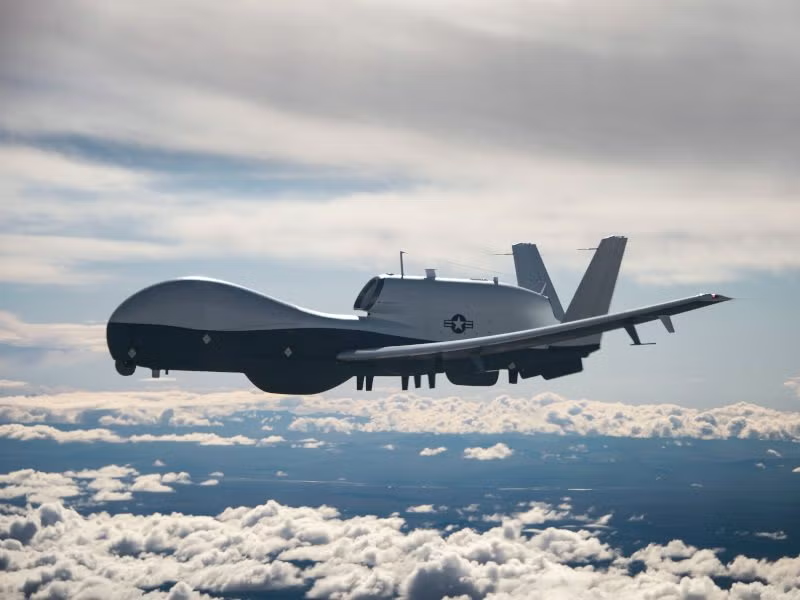
MQ-4C Triton: High-Altitude Maritime Surveillance as a Strategic Force Multiplier
The MQ-4C Triton, developed under the U.S. Navy’s Broad Area Maritime Surveillance programme, represents one of the most advanced unmanned intelligence platforms ever fielded for persistent maritime domain awareness.
Derived from the RQ-4 Global Hawk architecture yet extensively navalised, the Triton combines a wingspan of approximately 40 metres with endurance exceeding 30 hours at altitudes above 56,000 feet, enabling continuous coverage of vast oceanic expanses.
At the core of its sensor suite is the AN/ZPY-3 Multi-Function Active Sensor, capable of scanning up to 2.7 million square nautical miles per day, detecting, classifying and tracking surface contacts regardless of weather conditions.
This radar is complemented by electro-optical and infrared systems optimised for visual identification, alongside electronic support measures that allow the Triton to passively monitor emissions across the electromagnetic spectrum.
U.S. Navy planners have consistently described the platform as a networked intelligence node rather than a standalone asset, capable of fusing data from satellites, maritime patrol aircraft and allied sensors into a coherent operational picture.
In the confined and contested waters of the Persian Gulf, this capability becomes decisive, particularly as Iran continues to rely on asymmetric naval tactics involving fast-attack craft, unmanned surface vessels and coastal missile batteries.
The Triton’s persistence allows commanders to distinguish routine maritime activity from preparatory manoeuvres, reducing the risk of misinterpretation during periods of heightened tension.
Since achieving initial operational capability in 2018, Triton squadrons supporting U.S. Fifth Fleet have conducted near-continuous patrols over the Gulf, Strait of Hormuz and Gulf of Oman.
The January 2026 sortie by aircraft 169660 thus reflects not novelty but an intensification of an established surveillance architecture tailored for crisis management.
Historical Precedents and the Enduring Risk of Aerial Miscalculation
The current Triton mission inevitably recalls earlier episodes of aerial confrontation between Iran and the United States, most notably the June 2019 shoot-down of a U.S. high-altitude unmanned aircraft over the Strait of Hormuz.
That incident, which nearly precipitated direct military strikes, fundamentally reshaped U.S. operational protocols, reinforcing strict adherence to international airspace while maintaining persistent surveillance.
Iran’s repeated denunciations of foreign ISR flights reflect a strategic tension between deterrence and provocation, particularly as Tehran seeks to assert sovereignty amid perceived encirclement.
The Islamic Republic’s own expanding unmanned capabilities add further complexity, with Iranian UAVs increasingly deployed to shadow U.S. naval assets and monitor regional adversaries.
Recent Iranian exercises featuring cruise missile launches and ballistic demonstrations in the Gulf of Oman illustrate how domestic instability may incentivise external signalling as a means of projecting strength.
From Washington’s perspective, continuous ISR coverage mitigates the risk that such demonstrations translate into operational surprises.
The Triton’s altitude and standoff range significantly reduce vulnerability compared to earlier platforms, while its sensor reach ensures comprehensive situational awareness.
Nevertheless, the potential for miscalculation persists in an environment where internal unrest may distort threat perceptions and compress decision-making timelines.
The presence of advanced surveillance assets thus simultaneously deters escalation and underscores the delicacy of the strategic moment.
Geopolitical Reverberations Across Energy Markets and Regional Alliances
Iran’s internal crisis, when viewed through the lens of maritime security, carries implications far beyond its borders, particularly given the Persian Gulf’s centrality to global energy flows.
Approximately 20 percent of the world’s oil supply transits the Strait of Hormuz, rendering any disruption a matter of immediate international concern with direct economic consequences.
A temporary closure or even heightened risk perception could drive oil prices sharply upward, amplifying inflationary pressures across import-dependent economies.
Regional actors including Saudi Arabia, the United Arab Emirates and Israel are closely monitoring Iran’s domestic trajectory, calibrating their own security postures accordingly.
The UAE’s role as a host for U.S. ISR operations reflects a convergence of interests centred on maritime stability and deterrence of Iranian adventurism.
Meanwhile, Iran’s deepening strategic alignment with Russia and China provides political insulation but limited economic relief, constraining Tehran’s room for manoeuvre.
Moscow’s material support, including suspected military transfers, underscores a geopolitical alignment driven as much by shared isolation as by strategic affinity.
China’s interest in uninterrupted Gulf energy flows positions Beijing as a potential mediator, though its leverage over Tehran remains uncertain.
In this context, the Triton’s surveillance mission contributes to a broader effort to stabilise expectations and prevent crisis-induced escalation.
Strategic Vigilance in an Era of Regime Uncertainty
As Iran enters a prolonged period of socio-economic turbulence, the deployment of the MQ-4C Triton over the Persian Gulf encapsulates the evolving nature of deterrence in the twenty-first century.
Rather than responding to overt aggression, advanced ISR platforms are increasingly tasked with managing uncertainty, monitoring internal instability and pre-empting unintended escalation.
The January 2026 mission reflects an American assessment that Iran’s domestic crisis represents not merely a humanitarian or political challenge, but a strategic variable with profound military implications.
By maintaining persistent situational awareness, Washington seeks to ensure that any Iranian attempt to externalise internal pressure through maritime disruption is identified at its earliest stages.
The Triton’s silent endurance thus becomes a stabilising presence in an environment where miscalculation could carry global consequences.
Whether Iran’s leadership chooses reform, repression or diversionary confrontation remains uncertain, but the strategic chessboard is already shifting beneath the weight of internal dissent.
In this volatile landscape, surveillance becomes strategy, and information becomes deterrence.
The U.S. Navy’s Triton, circling high above the Gulf, stands as a reminder that in an era of interconnected crises, vigilance itself is a form of power. — DEFENCE SECURITY ASIA
