
Russia’s MC-21 Gamble: Moscow Accelerates Aircraft Production as Western Sanctions Test Aviation Sovereignty
Moscow is financing 18 MC-21-310 narrowbody jets and the first three Il-114-300 turboprops as Western sanctions intensify Russia’s strategic struggle to establish an independent aircraft-production, financing and maintenance ecosystem.

(DEFENCE SECURITY ASIA) — Russia is injecting new state funding into the MC-21-310 narrowbody and Il-114-300 turboprop programmes, transforming aircraft production continuity into a strategic test of whether Moscow can sustain an independent aviation ecosystem under prolonged Western sanctions.
Prime Minister Mikhail Mishustin announced the measures during a July 30, 2026 government meeting on aircraft manufacturing, six days after President Vladimir Putin inspected the Irkutsk Aviation Plant operated within Yakovlev, United Aircraft Corporation and Rostec.
The immediate objective is preventing assembly lines from stalling while Russia replaces foreign engines, avionics, systems and composite materials previously sourced through Western aerospace networks dominated by suppliers associated with Airbus, Boeing and Pratt & Whitney.

That industrial transition matters beyond commercial transport because aviation sovereignty depends upon interconnected design bureaux, engine manufacturers, composite producers, certification authorities, leasing structures, maintenance networks and skilled workforces capable of sustaining complex fleets across decades.
Funding has now been secured for 18 MC-21-310 aircraft at different assembly stages in Irkutsk, creating a production bridge between an import-substitution campaign still undergoing certification and Moscow’s planned airline orders extending through 2035 across Russia.
Mishustin said authorities must prevent the production line from stopping and take the measures required to fulfil planned orders, signalling that industrial rhythm has become a government priority rather than an ordinary manufacturer-level commercial calculation.
Aeroflot remains the launch customer with a firm initial order for 18 aircraft, while discussions concerning additional batches depend upon certification progress, manufacturing readiness and the credibility of production rates promised for the coming decade.
The MC-21-310 replaces imported equipment with Russian PD-14 turbofan engines, domestic avionics, locally sourced systems and composite structures, positioning the medium-haul aircraft as Moscow’s intended alternative to the Airbus A320 and Boeing 737 families for Russian airlines.
However, full type certification is targeted around June 2027 after repeated timetable slippage, meaning aircraft are being assembled alongside testing and exposing financing, storage, configuration management and delivery planning to continuing programme uncertainty at every stage.
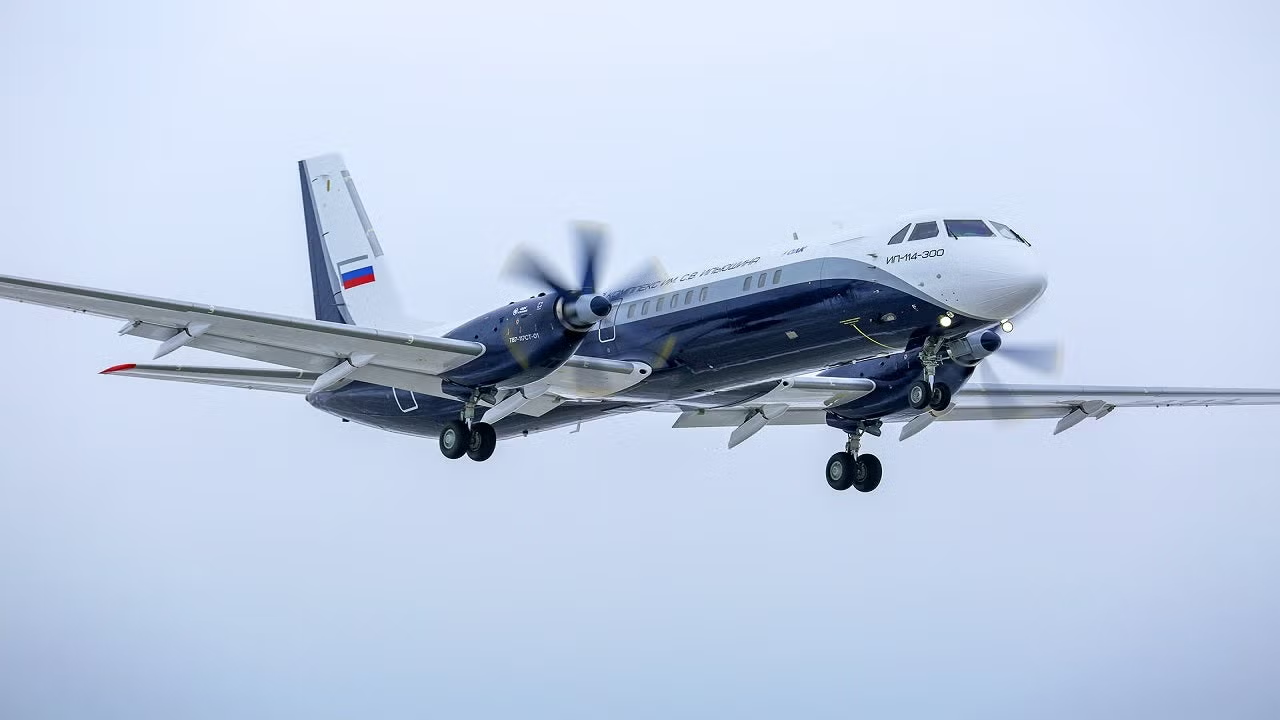
Russia simultaneously allocated another 2.6 billion rubles, approximately US$32 million or RM128 million, to complete three serial Il-114-300 aircraft intended for the Arkhangelsk Aviation Enterprise through leasing arrangements involving state-linked lessor GTLK and its financing structure.
Those turboprops address a different vulnerability: maintaining reliable short-haul connectivity across remote regions where ageing An-24 and An-26 aircraft require replacement, route economics favour smaller capacities, and operating infrastructure can impose demanding performance constraints during routine service.
Taken together, the funding packages connect industrial resilience, regional mobility and sanctions adaptation, but their strategic value will depend upon certified aircraft reaching operators reliably, production rates becoming sustainable and after-sales support matching fleet ambitions.
MC-21-310 Production Becomes Russia’s Central Aviation Sovereignty Test
The 18 MC-21-310 airframes already moving through Irkutsk provide visible evidence of manufacturing activity, yet unfinished inventories only become strategic capability when certified configurations, compliant systems, engines and documentation converge into aircraft airlines can operate economically.
Serial assembly conducted in parallel with flight testing can preserve workforce proficiency and supplier demand, but it also creates rework exposure whenever certification findings require design changes across aircraft positioned at different stages of the production sequence.
The PD-14 engine is central to the import-substituted configuration because propulsion independence removes a critical foreign dependency, although meaningful sovereignty also requires dependable serial output, spare engines, overhaul capacity, technical documentation and operational support across the fleet.
Domestic avionics, systems and composites similarly distribute risk across numerous suppliers, making the MC-21 programme a test of whether Russia can coordinate an entire aerospace value chain rather than merely substitute several highly visible imported components.
Putin’s July 24 inspection placed the Irkutsk production milestone within the Kremlin’s highest political attention, while Mishustin’s subsequent intervention indicated that maintaining line tempo and resolving bottlenecks are now treated as matters of national industrial policy.
The planned certification date around June 2027 remains an objective rather than a guaranteed outcome, and previous postponements demonstrate how sanctions-driven redesign can lengthen validation whenever replacement equipment alters aircraft performance, integration behaviour or compliance evidence.
Russia’s target of approximately 36 MC-21 aircraft annually by the early 2030s would require a substantial transition from limited initial deliveries toward repeatable production, supported by stable suppliers, trained labour, predictable financing and mature quality control.
If achieved, that rate could gradually reduce fleet-renewal pressure and constrain dependence upon Western narrowbodies, but it would still need to align with airline absorption capacity, maintenance readiness and the retirement profile of existing aircraft.
If delayed, Russia could face a widening mismatch between announced fleet requirements and deliverable domestic aircraft, increasing pressure on operators to extend older fleets while managing parts availability, maintenance burdens and operational reliability under sanctions.
The decisive metric is therefore not how many airframes appear inside factories, but how consistently certified MC-21-310s enter revenue service, accumulate dependable flight hours and receive timely technical support without reopening strategically sensitive foreign dependencies.
Aeroflot Orders, State Finance and the Economics of Fleet Renewal
Aeroflot’s firm order for the initial 18 MC-21s gives the programme an anchor customer, yet broader figures previously associated with approximately 100, 198 or 210 aircraft should not be treated as equivalent confirmed commitments currently.
Negotiations for follow-on batches will necessarily reflect certification timing, delivered performance and production confidence, because ambitious fleet plans cannot substitute for binding orders supported by financing, delivery slots, crew preparation and maintenance infrastructure at scale.
Preferential lending is intended to reduce financial pressure on airlines and leasing companies, linking factory output with customers capable of accepting aircraft despite elevated interest costs, uncertain delivery schedules and the operational risks surrounding a new domestic type.
This financing mechanism is strategically significant because aircraft production can stall even when demand exists if lessors cannot fund acquisitions, operators cannot carry transition costs or manufacturers cannot convert orders into predictable cash flow with consistency.
Advance payments for more than 70 aircraft under the wider 2026 aviation programme are designed to transmit government liquidity through factories and suppliers, stabilising procurement of materials, long-lead components and labour before completed aircraft generate delivery revenue.
However, state-supported demand can protect industrial capacity without automatically proving commercial competitiveness, so policymakers must distinguish between keeping production alive and establishing an aircraft whose operating economics remain viable across sustained airline service over time.
The MC-21-310’s intended competition with Airbus A320 and Boeing 737 families therefore concerns more than cabin capacity or aerodynamic performance, extending to dispatch reliability, fuel consumption, maintenance intervals, residual value and global support availability collectively.
Within Russia, the comparison is shaped by sanctions because access to Western aircraft, replacement parts and manufacturer support is constrained, increasing the strategic value of domestic availability even when programme costs or early operational burdens remain elevated.
For Aeroflot, fleet introduction will require pilots, engineers, simulators, spares, manuals and route-planning systems to mature together, making the logistics footprint surrounding each delivered aircraft nearly as consequential as the assembly rate itself operationally today.
The order book will become credible only as contractual commitments, certified production and operator acceptance reinforce one another, converting politically announced demand into a measurable fleet-renewal pathway rather than a sequence of revisable long-term aspirations.
Il-114-300 Funding Targets Russia’s Regional Connectivity Gap
The additional 2.6 billion rubles, approximately US$32 million or RM128 million, is directed toward completing the first three serial Il-114-300s, giving Russia a near-term test of turning certification into operational regional aircraft deliveries on schedule.
Russian type certification was granted on June 5, 2026 through an updated or reissued Il-114 certificate, but certification represents regulatory permission rather than proof that the production system can sustain reliable schedules and quantities reliably.
Configured for as many as 64 to 68 passengers, the modernised turboprop is intended for short-haul routes where lower traffic volumes and regional infrastructure make appropriately sized aircraft more practical than larger narrowbody jets operationally.
Its stated range of roughly 1,000 to 1,450 nautical miles, or about 2,000 kilometres in the programme description, supports distributed domestic connectivity, although payload, weather and operating conditions will influence practical route performance on routes.
The Klimov TV7-117ST-01 engines and updated Russian avionics make the aircraft another concentrated test of domestic propulsion and systems integration, where reliability, maintenance intervals and spare-part availability will determine operational confidence after delivery throughout service.
Replacing ageing An-24 and An-26 types carries strategic urgency because prolonged fleet extension can raise maintenance requirements and availability risks, while shrinking regional connectivity would weaken economic access across distant communities and industrial locations nationwide.
Potential future certification for unpaved-runway operations could expand the Il-114-300’s usefulness in regions with limited infrastructure, but that capability should remain identified as prospective until the relevant configuration, testing and regulatory approvals are completed eventually.
The three initial aircraft are destined for the Arkhangelsk Aviation Enterprise, also described as the Second Arkhangelsk United Aviation Division, with GTLK-linked leasing arrangements connecting state manufacturing support directly to defined regional airline operations locally.
Broader domestic demand has been estimated around 40 aircraft, although that figure signals potential market need rather than guaranteed production, financing or acceptance, and should be evaluated against delivery performance from the first serial examples.
For regional aviation, the critical outcome will be dependable daily utilisation across difficult operating environments, because a domestically produced aircraft delivers strategic mobility only when maintenance networks keep it available beyond major manufacturing centres reliably.
US$3 Billion Aviation Programme Builds a Wider Industrial Logistics Base
Russia plans to allocate more than 250 billion rubles during 2026, roughly US$3 billion or RM12 billion, to a comprehensive aviation development programme spanning aircraft procurement, factory preparation, supply chains, financing and operational support nationwide.
The programme includes increased advance payments covering more than 70 aircraft, allowing manufacturers and suppliers to secure inputs earlier while reducing the cash-flow discontinuities that could interrupt production before customers formally receive completed platforms eventually.
Government support also covers preparation of production facilities and supply chains, acknowledging that final assembly depends upon tooling, qualified vendors, transport links, testing equipment and workforce capacity distributed throughout the broader aerospace ecosystem across Russia.
Plans for more than 70 Mi-8MTV-1 helicopters for regional carriers widen the initiative beyond fixed-wing replacements, strengthening rotary-wing mobility where sparse infrastructure, remote settlements and demanding terrain can make helicopters operationally indispensable across Russia today.
Interest-rate subsidies for airline and lessor loans are intended to address the financial interface between manufacturing capacity and operator demand, particularly when capital-intensive aircraft acquisitions confront elevated borrowing costs and uncertain commercial returns over time.
Support for after-sales service recognises that sovereign production is incomplete without repair centres, replacement inventories, field engineering and technical information capable of sustaining aircraft availability throughout geographically dispersed operations and long service lives over time.
Investment projects serving the Far East, including references to the LMS-901 Baikal, connect aircraft policy with territorial access, because transport reliability influences regional development, emergency response, labour mobility and state presence across remote areas nationwide.
The programme therefore attempts to create a full cycle linking design, manufacturing, leasing, airline operation and maintenance, rather than treating new aircraft as isolated factory products detached from their long-term logistical and financial requirements over time.
Its scale shows that import substitution requires substantial public capital, but headline allocations alone cannot demonstrate results unless procurement milestones, delivered aircraft, operational reliability and supplier throughput become visible across successive reporting periods over time.
For global observers, Russia’s civil aviation campaign offers a measurable case study in whether a sanctioned industrial power can reconstruct complex supply networks while maintaining safety, production continuity and economically usable transport capacity over time.
Sanctions, Certification Risk and the Geopolitics of Aviation Independence
Western sanctions imposed after 2022 disrupted Russia’s access to foreign components, engines and systems, turning civil aviation from a commercially globalised sector into a contested arena of technological sovereignty, industrial endurance and economic security worldwide.
Moscow’s response prioritises fully or predominantly domestically sourced aircraft, seeking to reduce exposure to external licensing, export controls and supplier withdrawals that can constrain fleet availability even when existing airframes remain physically serviceable under sanctions.
The policy sends strategic signalling domestically and internationally: Russia intends to preserve national aviation capacity despite isolation, while demonstrating that sanctions pressure will be answered through state finance, redesign and sustained industrial mobilisation over time.
Yet political declarations cannot settle engineering questions, and equal scrutiny requires separating verified funding and certification milestones from production targets whose achievement depends upon testing outcomes, supplier maturity and sustained factory execution across multiple years.
The MC-21 schedule has slipped repeatedly during its migration toward Russian systems, establishing a factual warning against treating June 2027 certification or the early-2030s annual rate of 36 aircraft as assured endpoints for planning purposes.
The Il-114-300 has crossed an important regulatory threshold, but its strategic relevance now depends upon completing the three funded aircraft, transferring them to the intended operator and proving reliable performance through actual regional service over time.
Neither programme’s success can be judged solely through first delivery, because recurring production, fleet utilisation, maintenance turnaround, spare-part stocks and safe operational experience determine whether domestic designs can replace Western-dependent capacity at scale over time.
Production continuity also preserves specialised human capital across engineering, composites, avionics, engines and assembly, creating industrial options whose value extends beyond individual aircraft programmes and supports Russia’s broader high-technology manufacturing base throughout the coming decades.
Conversely, persistent bottlenecks could force greater public expenditure, delay fleet renewal and concentrate operational pressure on ageing aircraft, revealing how sanctions effects accumulate through maintenance cycles, financing constraints and slower replacement rather than immediate fleet collapse.
Russia’s additional funding consequently buys time and production momentum, not guaranteed aviation independence, leaving certification discipline, supplier performance, logistics depth and airline reliability as the decisive indicators of whether strategic self-reliance becomes operational reality in practice.
