
Pakistan Poised to Receive China’s J-35E Stealth Fighters by 2026–27, Signalling a Major Shift in South Asia’s Air Power Balance
Islamabad’s pursuit of China’s export-grade J-35E fifth-generation stealth fighter marks a decisive doctrinal shift toward low-observable, network-centric airpower aimed at countering India’s Rafale fleet and layered air-defence architecture.

(DEFENCE SECURITY ASIA) — The prospect that Pakistan could receive between four and twelve J-35E fifth-generation stealth fighters from China between early 2026 and early 2027 represents a potentially decisive inflection point in South Asia’s aerial balance, as Islamabad accelerates its pursuit of survivable, low-observable strike capabilities to offset India’s Rafale fleet and layered air-defence architecture.
This trajectory is underscored by Pakistan Air Force Chief Air Chief Marshal Zaheer Ahmed Baber Sidhu’s assertion that “the need for next-generation platforms to maintain deterrence” has become unavoidable, a statement that encapsulates Islamabad’s assessment that fourth-generation upgrades alone are no longer sufficient in an increasingly sensor-dense battlespace.

While Defence Minister Khawaja Asif previously characterised early reporting as “media chatter” and stated that “no formal procurement agreement exists,” the accumulation of preparatory indicators, training pipelines and infrastructure upgrades suggests that operational planning has advanced well beyond speculative discussion.
The Shehbaz Sharif administration’s public acknowledgment that Pakistan had been offered “40 fifth-generation Shenyang J-35 stealth aircraft, Shaanxi KJ-500 Airborne Early Warning and Control (AEW&C), and HQ-19 air defense systems from China” further signals a coherent, layered airpower concept rather than a standalone fighter acquisition.
Unnamed Pakistani officials have gone further, claiming deliveries would begin “within months,” a claim reinforced by the air chief’s January 2025 confirmation of an impending fifth-generation induction that would place Pakistan among a very small group of stealth-capable air forces outside the United States and its closest allies.
For Beijing, the prospective transfer represents a strategic opportunity to validate an export-configured fifth-generation platform in a high-threat operational environment, while for Islamabad it offers a pathway to restore deterrence credibility without dependence on Western political approval mechanisms.
The reported deal value of approximately USD 5–6 billion (around RM 23.5–28.2 billion) underscores both the scale of ambition and the financial gravity of the programme, particularly for a country navigating persistent fiscal stress and IMF-linked economic constraints.
Taken together, these converging signals suggest that the J-35E programme is no longer a notional aspiration but a maturing capability pathway that could reshape airpower calculus across the Indo-Pakistani theatre and beyond.
Deal Structure, Delivery Timeline and Financial Realities
Pakistan’s media reporting indicates that Pakistan’s acquisition plan centres on an initial batch of four to twelve J-35E fighters, with first deliveries expected in early 2026 and completion of the tranche by early 2027.
This phased induction strategy allows the Pakistan Air Force to manage pilot conversion, ground crew training and infrastructure adaptation without imposing unsustainable operational strain.
Pakistani media reporting suggests that the broader programme could ultimately encompass up to 40 aircraft, with options for an additional 30, positioning the J-35E as a long-term cornerstone rather than a token capability.
The overall programme cost is projected at USD 5–6 billion, equivalent to approximately RM 23.5–28.2 billion, a figure that includes aircraft, training, spares and support infrastructure.
On a per-unit basis, the J-35E is estimated to cost between USD 80–100 million, or roughly RM 376–470 million, significantly undercutting Western fifth-generation alternatives.
Financing is widely believed to involve Chinese state credit lines, extended repayment schedules and mechanisms linked to the China-Pakistan Economic Corridor, mitigating immediate fiscal pressure on Islamabad.
Speculation persists that Beijing may subsidise a substantial portion of the programme, potentially absorbing up to 50 percent of the cost in exchange for strategic leverage and operational validation.
Such arrangements would mirror earlier patterns seen in the JF-17 programme, where Chinese financing played a decisive role in enabling capability acquisition under constrained economic conditions.
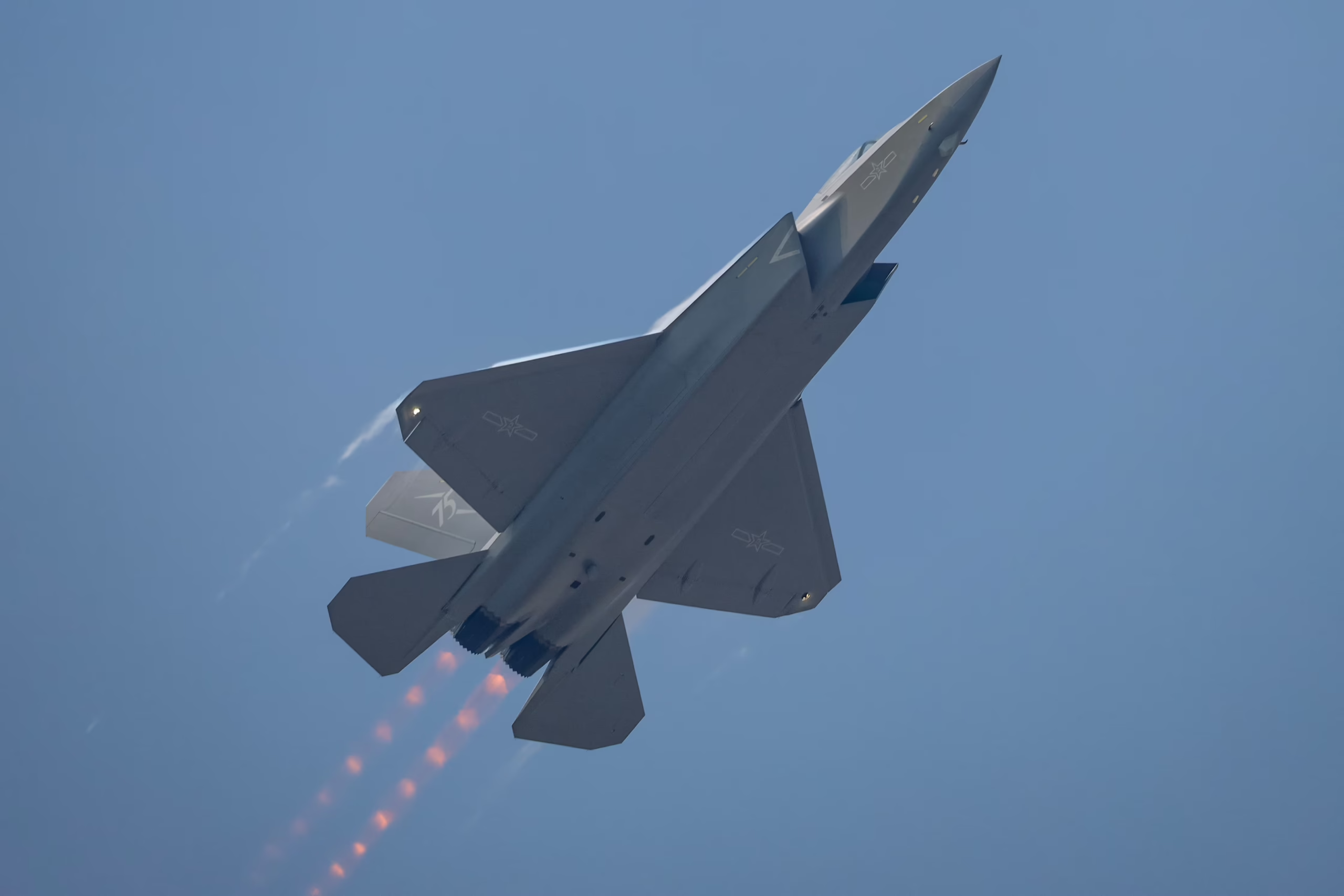
From FC-31 Demonstrator to Export-Ready Fifth-Generation Platform
The J-35E’s lineage traces directly to the Shenyang Aircraft Corporation’s FC-31 technology demonstrator first flown in 2012, a privately funded project initially conceived to penetrate export markets excluded from access to Western stealth aircraft.
Although the design was initially sidelined by the People’s Liberation Army Air Force in favour of the Chengdu J-20, iterative refinement transformed the airframe into the J-35 family, encompassing land-based and carrier-capable variants aligned with China’s expanding power-projection doctrine.
By 2023, limited numbers of the land-based J-35A were assessed to have entered PLAAF service, while the navalised J-35B conducted carrier compatibility trials aboard the Type 003 Fujian, signalling the platform’s maturation from experimental concept to operational system.
The export-oriented J-35E reflects a calibrated balance between capability retention and technology protection, incorporating downgraded mission systems where necessary while preserving core low-observable shaping, internal weapons carriage and sensor-fusion architecture.
Structurally, the aircraft’s twin-engine, medium-weight configuration—featuring a maximum take-off weight of roughly 28 tonnes—positions it as a complementary rather than direct analogue to heavier Western stealth fighters.
The J-35E’s propulsion, based on twin WS-19 turbofan engines generating approximately nine tonnes of thrust each, enables sustained supersonic performance approaching Mach 1.8 while supporting a combat radius exceeding 1,200 kilometres.
Crucially, the airframe’s design philosophy prioritises frontal and lateral radar cross-section reduction, leveraging advanced composites, radar-absorbent coatings derived from China’s Yinlong materials programme, and infrared signature suppression measures.
For export customers such as Pakistan, this evolutionary pathway offers a relatively mature fifth-generation platform that trades absolute technological parity with Western systems for affordability, availability and strategic alignment.
Sensors, Weapons and Networked Warfare Architecture
At the core of the J-35E’s combat relevance lies its integrated sensor and avionics suite, designed to operate within a highly networked battlespace where information dominance increasingly defines air superiority.
The aircraft is assessed to be equipped with an Active Electronically Scanned Array radar capable of long-range multi-target tracking, electronic attack functions and low-probability-of-intercept modes essential for survivability against modern air-defence systems.
Complementing the radar is a distributed aperture system providing spherical situational awareness, enabling missile launch detection, threat cueing and passive tracking without reliance on active emissions.
An electro-optical targeting system integrated into the forward fuselage supports precision strike missions, allowing the aircraft to prosecute ground and maritime targets while remaining within a reduced observability envelope.
Internally, the J-35E’s weapons bays can accommodate up to four medium- or long-range air-to-air missiles, including the export-configured PL-15E with a quoted range exceeding 200 kilometres and the more advanced PL-17, widely believed to approach or exceed 300 kilometres.
For non-stealth-critical missions, external hardpoints allow carriage of additional air-to-surface munitions and anti-ship weapons, enabling flexible loadouts across the spectrum of conflict.
The aircraft’s architecture is further enhanced by artificial intelligence-assisted decision aids and compatibility with unmanned systems such as the GJ-11, positioning the J-35E as a node within a broader manned-unmanned teaming construct.
While it may not yet match the software maturity of Western fifth-generation platforms, the J-35E’s integrated design offers Pakistan a qualitative leap in sensing, targeting and engagement reach.
Infrastructure, Training and Operational Integration
Parallel to acquisition discussions, tangible preparations within Pakistan indicate a serious commitment to integrating fifth-generation operations into its airpower doctrine.
Pakistan Air Force pilots are reported to be undergoing training in China, focusing on simulator-based instruction, mission planning and systems familiarisation tailored to low-observable operations.
Key air bases such as Kamra and Masroor are assessed to be undergoing upgrades, including climate-controlled hangars, specialised maintenance facilities for stealth coatings and hardened data infrastructure.
Secure datalinks compatible with Chinese command-and-control architecture are being prioritised to ensure seamless integration with platforms such as the KJ-500 AEW&C.
The KJ-500’s all-round AESA radar coverage is expected to play a critical role in cueing J-35E formations while minimising the need for the fighters to emit detectable radar energy.
Integration with existing assets such as the Erieye AEW&C and JF-17 Thunder fleet would allow the Pakistan Air Force to construct a layered, network-centric operational framework.
This architecture enhances survivability and engagement depth, enabling the J-35E to function as a forward sensor-shooter within a broader system-of-systems.
The cumulative effect is a force posture increasingly aligned with contemporary concepts of distributed, information-centric air warfare.
Strategic and Geopolitical Implications for South Asia
The induction of the J-35E into Pakistani service would carry profound implications for regional deterrence dynamics and crisis stability in South Asia.
From Islamabad’s perspective, the platform directly addresses qualitative asymmetries created by India’s Rafale fleet, Meteor beyond-visual-range missiles and S-400 air-defence systems.
The combination of stealth, long-range air-to-air weapons and networked targeting could enable Pakistan to contest airspace previously dominated by Indian defensive depth.
The J-35E’s potential to conduct standoff engagements and penetrate defended zones raises the prospect of a limited anti-access capability over critical areas such as the Arabian Sea and Kashmir.
For Beijing, the export reinforces the strategic “Iron Brotherhood,” extending Chinese influence while indirectly complicating India’s regional military calculus.
Indian analysts have warned that “such a supply will alter the air dominance dynamics in the sub-continent,” potentially forcing accelerated investment in indigenous programmes or interim acquisitions.
With India’s AMCA not expected to reach operational maturity before the mid-2030s, the J-35E timeline creates a window of relative advantage for Pakistan.
More broadly, the deal highlights a shifting global defence landscape in which non-Western fifth-generation platforms increasingly shape regional power balances.
A Calculated Stealth Leap
As early 2026 approaches, the anticipated arrival of an initial batch of J-35E fighters appears increasingly plausible rather than speculative, as the convergence of delivery timelines, pilot conversion pipelines and hardened base preparations indicates that the programme has crossed the threshold from strategic signalling into irreversible execution.
The alignment of official remarks, discreet but observable infrastructure upgrades, and sustained training activity in China suggests a capability acquisition programme advancing steadily toward operational reality, even as calibrated ambiguity is maintained to manage escalation risks and diplomatic sensitivities.
For Pakistan, the J-35E represents not merely the induction of a new combat aircraft but a fundamental doctrinal shift toward survivable, sensor-fused, network-centric airpower designed to operate inside highly contested electromagnetic and missile-dense environments.
This transition enables the Pakistan Air Force to move beyond platform-centric deterrence and toward a system-of-systems construct in which stealth fighters, AEW&C platforms, long-range missiles and data-linked command nodes collectively shape the battlespace before adversary forces can respond.
For China, the J-35E programme offers a high-stakes proving ground for export-grade fifth-generation technology under genuine geopolitical pressure, allowing Beijing to validate design philosophies, sustainment models and combat networking concepts against a peer-level regional competitor.
Operational feedback derived from Pakistani service is likely to inform iterative upgrades across China’s own J-20 and J-35 fleets, effectively using an allied air force as a live operational laboratory while reinforcing long-term strategic dependence.
Whether framed as defensive modernisation or strategic escalation, the programme underscores the accelerating pace of technological competition in Asia, where stealth, long-range sensing and kill-chain compression increasingly outweigh numerical superiority.
The induction of the J-35E is also likely to compress decision-making timelines during crises, as low-observable platforms armed with very-long-range missiles reduce warning windows and complicate escalation control.
In this context, Pakistan’s pursuit of the J-35E signals a deliberate, calculated effort to reshape deterrence in the skies by altering adversary cost-benefit calculations at the very outset of conflict rather than through attritional air campaigns.
The programme therefore represents not a symbolic leap but a structural rebalancing of regional airpower, one that regional actors can no longer afford to ignore without risking strategic surprise.— DEFENCE SECURITY ASIA
