
Trump Unveils Nuclear-Armed ‘Trump-Class’ Battleships, Marking the Most Radical Shift in U.S. Naval Power Since the Cold War
The Trump-class battleships will carry nuclear cruise missiles, hypersonic weapons and directed-energy systems, reshaping U.S. deterrence posture across the Indo-Pacific and global maritime chokepoints.
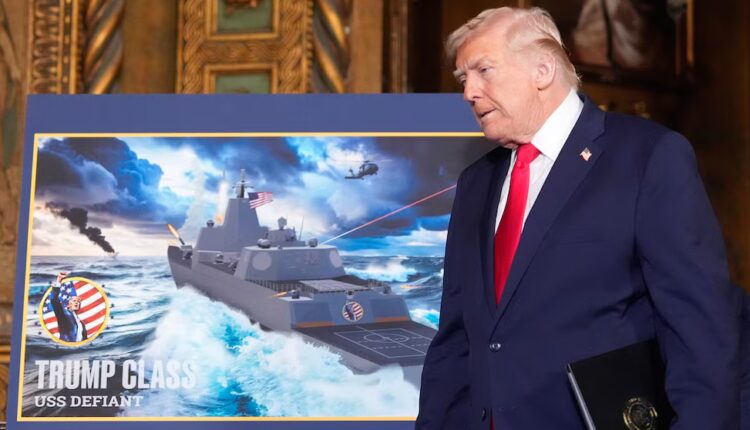
(DEFENCE SECURITY ASIA) — In a declaration deliberately calibrated to reverberate across the strategic consciousness of Beijing, Moscow and every contested maritime theatre from the Taiwan Strait to the Malacca chokepoint, U.S. President Donald J. Trump announced that the United States Navy will take delivery of newly built battleships—the largest surface combatants ever constructed for American service—signalling a fundamental recalibration of U.S. naval doctrine at a moment when sea control, denial and escalation dominance are once again colliding at the heart of great-power rivalry.
Unveiled before a tightly choreographed audience of senior defence officials and uniformed leadership, the initiative introduces the so-called “Trump-class” battleships, vessels explicitly designed to restore overwhelming surface lethality, nuclear signalling credibility and psychological dominance to an increasingly congested and weaponised maritime battlespace.
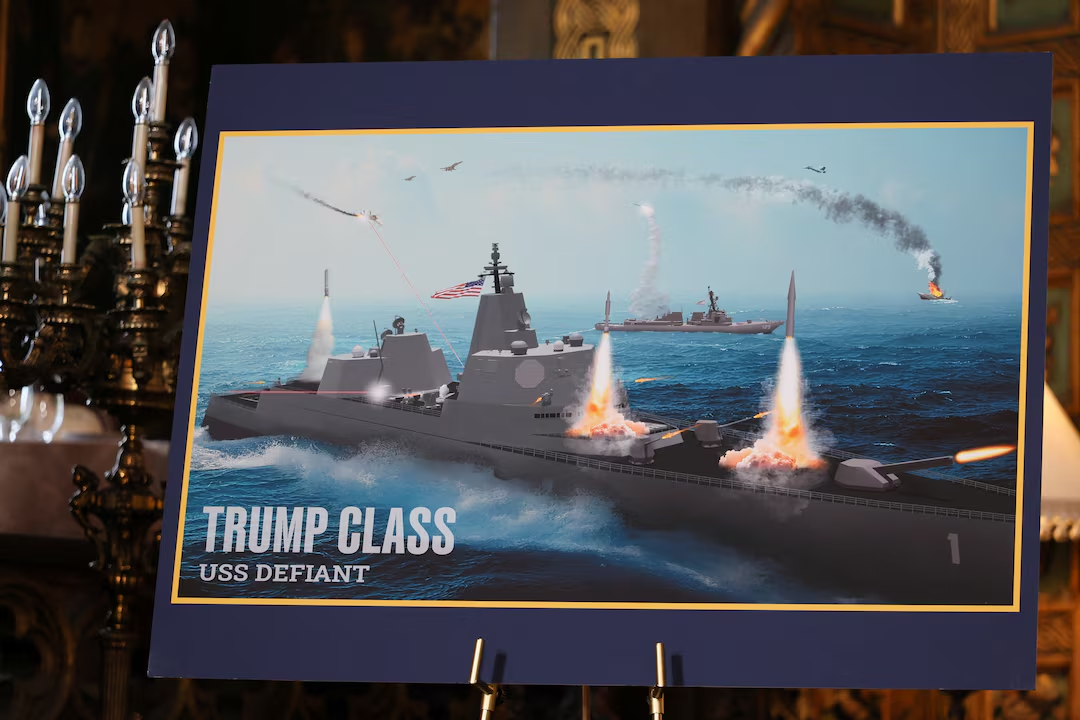
“These are the fastest, the biggest, and by far 100 times more powerful than any battleship ever built,” Trump declared, framing the programme not as an incremental fleet upgrade but as a deliberate rupture with three decades of post–Cold War naval restraint.
“There’s never been anything like these ships,” Trump added, reinforcing the message that the United States intends to reassert supremacy not through dispersion alone, but through mass, survivability and visible coercive power at sea.
Standing alongside the President, senior naval leadership confirmed that the Trump-class will for the first time in generations place nuclear-armed cruise missiles aboard U.S. surface combatants, a move that fundamentally alters the structure of American deterrence and injects a new layer of ambiguity into escalation ladders across the Indo-Pacific and beyond.
“For the first time in generations, we’ll have a new leg in America’s nuclear deterrence because the Trump-class battleship will carry the nuclear-armed sea-launched cruise missile,” the Navy’s civilian leadership confirmed, underscoring the doctrinal significance of restoring nuclear strike capability to surface fleets.
The announcement arrives against the backdrop of China’s rapid naval expansion, including the operational maturity of its Type 055 large destroyers, expanding carrier strike groups and an increasingly confident posture in the South China Sea, prompting Washington to revisit not only force structure but the very psychology of maritime deterrence.
Trump’s rhetoric, blending nostalgia with raw escalation logic, positioned the Trump-class not as a relic of past wars, but as a platform explicitly designed for future conflicts dominated by hypersonic weapons, drone swarms, electronic warfare saturation and AI-accelerated kill chains.
“These have been under design consideration for a long time,” Trump said, before adding, “It started with me in my first term because I said, why aren’t we doing battleships like we used to?”
By resurrecting the battleship concept in nuclear-armed form, the administration is effectively challenging the assumption that carriers and submarines alone can shoulder the burden of deterrence in an era where visibility, survivability and escalation signalling are becoming as decisive as stealth.
The Battleship Returns: From Iowa-Class Legacy to 21st-Century Escalation Platforms
For much of the twentieth century, battleships stood as the ultimate expression of national power at sea, embodying industrial capacity, technological confidence and the political will to impose outcomes far beyond a nation’s shores.
The U.S. Navy’s Iowa-class battleships, displacing roughly 45,000 tonnes at full load, armed with nine 16-inch guns capable of striking targets more than 32 kilometres away, and shielded by formidable armour, represented the zenith of gun-centric naval warfare.
The USS Missouri, aboard which Imperial Japan signed its surrender in 1945, immortalised the battleship as both a weapon of war and a symbol of strategic finality.
Yet as aviation, missiles and submarines rose to dominance, battleships gradually ceded relevance, with the last Iowa-class units decommissioned in the 1990s after contributing to conflicts ranging from Korea to the Gulf War.
In their place emerged a fleet architecture centred on aircraft carriers, guided-missile cruisers and destroyers, platforms optimised for power projection through air wings and precision strikes rather than sheer mass and endurance.
Today’s U.S. surface fleet relies heavily on Arleigh Burke-class destroyers, displacing approximately 9,700 tonnes, and ageing Ticonderoga-class cruisers, vessels that excel in versatility but lack the psychological and survivability heft once embodied by battleships.
Trump’s announcement explicitly rejects the assumption that lighter, more distributed platforms alone can guarantee maritime dominance in an era of peer adversaries armed with long-range precision weapons.
“These are bigger,” Trump emphasised, adding, “They’ll be 100 times the force, the power.”
The reintroduction of battleships is therefore not an exercise in nostalgia, but a calculated response to the erosion of uncontested U.S. naval superiority and the rise of adversaries willing to contest sea control with layered anti-access and area-denial architectures.
By fielding massive, heavily armed surface combatants designed to absorb punishment, deliver decisive firepower and remain operational under sustained attack, Washington is signalling that it intends to compete across the full spectrum of naval escalation rather than retreat into purely defensive postures.
This philosophical shift mirrors broader trends in global naval thinking, where survivability, redundancy and escalation resilience are regaining prominence alongside stealth and precision.
Inside the Trump-Class: Displacement, Nuclear Strike and Hypersonic Firepower
According to programme details disclosed during the announcement, the Trump-class battleships are expected to displace between 30,000 and 40,000 tonnes, placing them well above any existing U.S. surface combatant and approaching the scale of historical battleships while remaining smaller than Iowa-class vessels at full load.
With an estimated draft of 24 to 30 feet, the ships are designed for sustained blue-water operations across the Pacific, Indian and Atlantic Oceans, enabling long-duration deployments without reliance on frequent port access.
The lead ship, designated USS Defiant, will anchor an initial batch of two vessels, with Trump openly stating his ambition to expand the class to between 20 and 25 ships over time.
“We’re gonna very quickly do another eight,” Trump said, before adding, “And ultimately have a total of 20 to 25.”
If realised, such numbers would represent one of the most significant expansions of U.S. surface combat power since the Cold War, with cumulative costs likely reaching tens of billions of dollars, potentially exceeding US$80–100 billion (approximately RM380–RM475 billion), depending on final configuration and propulsion choices.
At the heart of the Trump-class concept lies its unprecedented weapons suite, which merges traditional naval firepower with cutting-edge strategic systems.
Central among these is the integration of nuclear-armed sea-launched cruise missiles (SLCM-N), marking the first deployment of nuclear weapons aboard U.S. surface ships since the Cold War and restoring a surface-based nuclear strike option to the American arsenal.
This capability effectively adds a new layer to the U.S. nuclear triad, complementing ballistic missile submarines, strategic bombers and intercontinental ballistic missiles with a flexible, forward-deployable nuclear option that complicates adversary targeting and escalation calculations.
Hypersonic weapons form the second pillar of the Trump-class armament, with Trump stating unequivocally that the ships “will be armed with hypersonic weapons,” enabling them to strike high-value targets at speeds exceeding Mach 5 from standoff distances that challenge existing missile defences.
Such weapons dramatically compress decision timelines for adversaries and reinforce the battleship’s role as a theatre-level escalation dominance platform rather than a purely tactical asset.
Directed-energy systems, including high-powered lasers, represent a third critical component, with Trump noting that the ships will carry “the high-power lasers that you’ve been starting to read about,” reflecting the Navy’s growing emphasis on cost-effective defences against drones, cruise missiles and saturation attacks.
Electronic railguns, long pursued by the U.S. Navy as a revolutionary alternative to conventional artillery, are also expected to feature prominently, offering hypervelocity projectiles capable of long-range precision strikes without explosive warheads.
Complementing these systems will be extensive vertical launch arrays capable of firing conventional cruise missiles, air-defence interceptors and potentially future unmanned systems, supported by AI-enabled combat management architectures designed to process vast volumes of sensor data in real time.
Trump underscored this digital dimension by stating plainly, “AI will be a big factor in development.”
While propulsion details remain undisclosed, the scale, endurance requirements and nuclear strike role of the Trump-class strongly suggest nuclear propulsion, aligning the ships with U.S. carriers and submarines in terms of operational reach and sustainability.
Such a choice would allow the battleships to remain deployed for extended periods without refuelling, a critical advantage in contested theatres where logistics chains are increasingly vulnerable.
Strategic Shockwaves Across the Indo-Pacific and Global Maritime Order
The strategic implications of deploying nuclear-armed battleships extend far beyond ship counts and tonnage figures, fundamentally reshaping deterrence dynamics across the world’s most contested waters.
China’s People’s Liberation Army Navy now fields the world’s largest fleet by hull numbers, with more than 370 vessels, including heavily armed destroyers, cruisers and an expanding carrier force, enabling sustained pressure across the South China Sea and Western Pacific.
By introducing Trump-class battleships, the United States is signalling that it intends to counter numerical advantage with qualitative escalation dominance, deploying platforms capable of surviving intense attack while delivering decisive, multidomain firepower.
In choke points such as the Taiwan Strait, the Luzon Strait and the Malacca Strait, the presence of a nuclear-armed battleship would dramatically alter adversary planning, forcing opponents to account for both conventional and nuclear responses at the tactical and operational levels.
For U.S. allies in Asia, including Japan, South Korea and the Philippines, the programme may be interpreted as a renewed commitment to forward deterrence and alliance reassurance at a time when doubts about U.S. staying power have periodically surfaced.
India, which is expanding its own naval capabilities across the Indian Ocean, may view the Trump-class as both a stabilising counterweight to Chinese naval expansion and a potential catalyst for deeper operational cooperation within frameworks such as the Quad.
At the same time, the escalation risks associated with placing nuclear weapons aboard surface ships cannot be ignored, particularly in environments where miscalculation, signalling ambiguity and crisis instability already loom large.
Critics argue that battleships, regardless of size, remain vulnerable to modern anti-ship missiles, submarines and asymmetric attacks, pointing to historical precedents such as the sinking of Japan’s Yamato during World War II.
Others draw comparisons to the U.S. Navy’s Zumwalt-class destroyers, which promised revolutionary capabilities but suffered from cost overruns, limited numbers and operational challenges.
Yet proponents counter that the Trump-class is explicitly designed to operate as part of an integrated force, protected by layered defences, unmanned systems and networked sensors that collectively enhance survivability.
From a political economy perspective, the programme promises to revitalise U.S. shipyards, generating thousands of skilled jobs and injecting capital into an industrial base strained by delays in submarine and destroyer programmes.
Trump himself highlighted the domestic dimension, framing the battleships as both strategic assets and symbols of national renewal, even joking about aesthetic elements such as a “golden” hue to reflect the broader “Golden Fleet” vision.
“Our adversaries will know when the Trump-class USS Defiant appears on the horizon, American victory at sea is inevitable,” Trump declared, encapsulating the psychological intent behind the programme.
Feasibility, Risks and the Future of U.S. Sea Power
Despite the programme’s bold ambition, significant challenges remain, ranging from technological maturity to fiscal sustainability and political consensus.
The development and integration of nuclear-armed cruise missiles, hypersonic weapons, railguns and high-energy lasers into a single hull represent an extraordinary engineering undertaking, one that will test the limits of current naval architecture and systems integration.
Directed-energy weapons, while promising, remain in relatively early stages of operational deployment, and scaling them for sustained, high-intensity combat will require further advances in power generation and thermal management.
Similarly, hypersonic weapons programmes continue to face technical hurdles, and their integration into surface combatants introduces additional complexity related to storage, launch systems and command-and-control.
From a budgetary perspective, expanding the Trump-class to 20–25 ships could place immense strain on defence spending, potentially exceeding US$100 billion (approximately RM475 billion) over the programme’s lifetime, depending on unit costs and support infrastructure.
Congressional approval will be essential, and while Trump’s political influence may accelerate early funding, sustained bipartisan support will be required to carry the programme through multiple budget cycles.
Strategically, the reintroduction of nuclear weapons to surface ships raises questions about escalation control and crisis stability, particularly in crowded maritime theatres where incidents can rapidly spiral.
Nevertheless, supporters argue that the very visibility and resilience of battleships enhance deterrence by reducing incentives for adversaries to gamble on quick, decisive strikes.
In this view, the Trump-class represents not a return to obsolete doctrine, but an adaptation of historical principles to contemporary realities, combining mass, survivability and technological dominance to impose costs on any challenger.
As Trump concluded, projecting confidence and inevitability, “We’re bringing strength back to the seas.”
Whether the Trump-class ultimately reshapes global naval power or becomes a contested experiment will depend on execution, funding and the evolving strategic environment, but its announcement alone has already forced allies and adversaries alike to reconsider the future of maritime warfare.
In an era defined by renewed great-power competition, the return of the battleship—now armed with nuclear, hypersonic and directed-energy weapons—signals that the age of overwhelming sea power is far from over, and that the oceans will once again serve as the central arena where strategic destinies are contested. — DEFENCE SECURITY ASIA
