
France Greenlights PANG Aircraft Carrier: Macron Signals a New Era of European Naval Power Projection
France’s approval of the €10.25 billion nuclear-powered Porte-Avions Nouvelle Génération (PANG) signals a decisive shift in European naval power projection, maritime deterrence, and strategic autonomy amid intensifying great-power competition.

(DEFENCE SECURITY ASIA) — “In this age of predators, we must be strong to be feared. And in particular, strong at sea!” declared French President Emmanuel Macron, his words deliberately calibrated to resonate far beyond the ranks of French troops assembled at the Abu Dhabi military base and into the broader strategic consciousness of an international system increasingly defined by coercive naval power, maritime choke points, and the re-militarisation of the global commons.
Speaking against the strategic backdrop of the Persian Gulf—one of the world’s most contested maritime theatres—Macron unveiled a decision of historic magnitude: France will proceed with the construction of its next-generation nuclear-powered aircraft carrier, the Porte-Avions Nouvelle Génération (PANG), formally anchoring Paris’s intent to remain a sovereign blue-water naval power well into the second half of the 21st century.
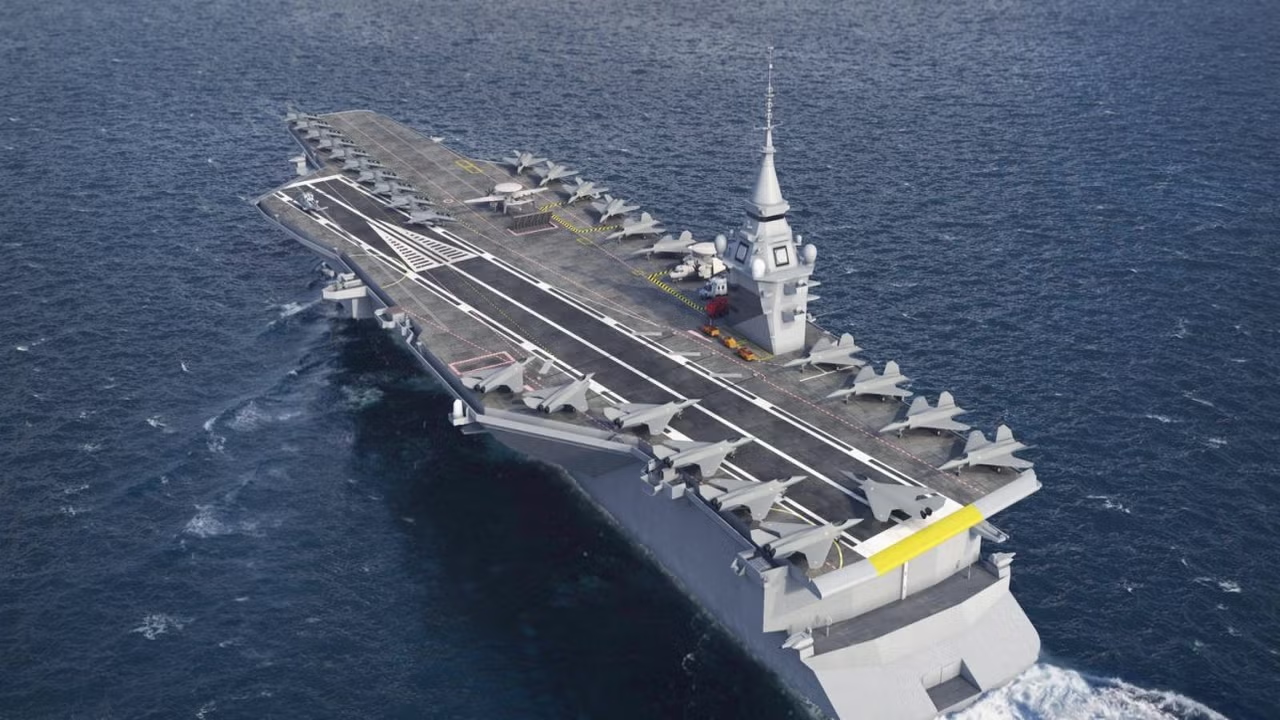
“The decision to launch this vast programme was taken this week,” Macron emphasised, framing the announcement not as a symbolic aspiration but as an irreversible industrial and strategic commitment now embedded within France’s latest military programming laws and long-term force structure planning.
With an estimated programme cost of €10.25 billion (approximately US$12.0 billion or RM56.6 billion), the PANG will replace the Charles de Gaulle by 2038, eliminating France’s long-standing vulnerability of single-carrier dependency while preserving continuous fixed-wing naval aviation capability for expeditionary, deterrence, and alliance operations.
As the only nuclear-powered aircraft carrier operator within the European Union, France’s decision immediately transcends national defence policy, injecting tangible substance into Europe’s long-discussed—but often under-delivered—pursuit of strategic autonomy amid intensifying uncertainty over transatlantic reliability and the protracted destabilisation triggered by Russia’s war in Ukraine.
“This new aircraft carrier will be a testament to our nation’s power, a power of industry and technology. Power at the service of freedom on the high seas. And in the turbulent waters of time,” Macron declared, encapsulating the dual military-industrial symbolism of PANG as both a kinetic warfighting platform and a sovereign instrument of geopolitical signalling.
From Charles de Gaulle to PANG: Continuity, Constraint, and Strategic Necessity
France’s modern naval aviation lineage, while stretching back to the early 20th century, reached its post-Cold War apex with the commissioning of the Charles de Gaulle in 2001, a 42,500-ton nuclear-powered carrier that has since served as the backbone of French expeditionary power projection across Afghanistan, Libya, the Levant, and counter-terrorism operations against ISIS.
Despite its operational pedigree, the Charles de Gaulle has also exposed the structural fragility inherent in maintaining a single-carrier navy, with periodic deep maintenance cycles repeatedly forcing France into carrier capability gaps that constrain both national autonomy and alliance contribution.
At nearly four decades of service life by the time of its planned retirement, the Charles de Gaulle faces escalating sustainment challenges that no longer align with the tempo, persistence, and technological demands of modern high-intensity maritime warfare.
The intellectual and industrial groundwork for its successor began in earnest in 2018, when studies were initiated under the direction of the Ministry of the Armed Forces to define a future carrier capable of operating next-generation manned and unmanned air systems under contested electromagnetic and anti-access/area-denial (A2/AD) conditions.
This effort crystallised into the PANG programme, publicly formalised by Macron in December 2020 during a visit to a nuclear propulsion facility, where the choice of nuclear propulsion was explicitly confirmed as non-negotiable for endurance, sortie generation, and sovereign operational independence.
The programme endured delays rooted in fiscal caution, industrial sequencing, and the legacy of the abandoned PA2 project—cancelled in 2013 after failed attempts at Anglo-French carrier cooperation—yet steadily matured through a €40 million (US$46.7 million / RM220 million) design and risk-reduction phase under the 2019–2025 military planning law.
“Today, the ship is designed on paper. We know what we want from the French Navy, it is now just a matter of a political decision to step forward,” one senior naval programme officer stated earlier in the year, a threshold now decisively crossed by Macron’s announcement.
With political authorisation secured, the PANG transitions from conceptual insurance policy to an industrial reality shaping France’s maritime posture through the 2060s.
PANG’s Architecture: A Quantum Leap in Naval Aviation Capability
Displacing 78,000 tonnes, nearly double that of the Charles de Gaulle, the PANG will be the largest warship ever constructed in Europe, with an overall length of 310 metres and a flight-deck beam of 85 metres, dimensions specifically optimised for sustained high-tempo air operations rather than symbolic prestige.
Its 17,200-square-metre flight deck will support an embarked air wing of up to 30 fixed-wing combat aircraft, centred on the Rafale M F5 standard—equipped for collaborative combat, network-centric warfare, and deep-strike missions—alongside E-2D Hawkeye airborne early warning aircraft and future unmanned combat aerial vehicles (UCAVs) expected to mature around 2040.
The inclusion of UCAVs signals a doctrinal shift toward distributed lethality, persistent ISR, and man-machine teaming, positioning PANG not merely as a carrier of aircraft but as a central node within France’s future maritime kill chain.
Five to six helicopters will complement the air group, enabling anti-submarine warfare, search and rescue, vertical replenishment, and special operations support across a spectrum of conflict intensities.
Propulsion will be provided by two K-22 pressurised water reactors, each generating 220 megawatts, granting the vessel virtually unlimited range, sustained high speed of 27 knots, and electrical power margins sufficient for future directed-energy systems and advanced sensors.
Developed by TechnicAtome, these reactors build upon the proven K-15 lineage while delivering enhanced safety, efficiency, and lifecycle performance aligned with France’s nuclear stewardship doctrine.
A defining technological feature is the adoption of Electromagnetic Aircraft Launch System (EMALS) catapults—three in total—paired with Advanced Arresting Gear (AAG), enabling the launch and recovery of heavier aircraft, higher sortie rates, and future unmanned platforms with greater operational flexibility than legacy steam systems.
“The Chinese have just developed electromagnetic catapults to launch aircraft,” noted a senior French defence official earlier this year, underscoring the strategic imperative for technological parity in a naval environment increasingly shaped by peer competitors.
The ship will feature two hangars, two deck-edge elevators rated at 40 tonnes, and a total complement of approximately 2,000 personnel, including air wing staff, reflecting a balance between manpower efficiency and operational resilience.
Construction is scheduled to begin at Saint-Nazaire in 2032, with transfer to Toulon for outfitting in 2035, sea trials in 2036, and operational commissioning in 2038, following a programme rhythm deliberately aligned to avoid capability gaps during the Charles de Gaulle’s decommissioning.
Strategic Impact: Deterrence, Autonomy, and Global Reach
The strategic implications of PANG extend far beyond fleet replacement, reinforcing France’s status as a global maritime power capable of independent action across the Indo-Pacific, Mediterranean, Atlantic, and Middle Eastern theatres.
In an era defined by renewed great-power competition, the carrier will anchor France’s Carrier Strike Group, enabling sustained power projection, deterrence signalling, and crisis response in environments increasingly contested by long-range missiles, submarines, and electronic warfare.
Macron’s reference to an “age of predators” reflects a strategic assessment shaped by China’s rapidly expanding carrier fleet, Russia’s naval assertiveness in the Black Sea and Arctic, and the weaponisation of maritime chokepoints from the Strait of Hormuz to the South China Sea.
For Europe, PANG represents a concrete step toward defence sovereignty, particularly as uncertainty persists over U.S. strategic commitment under fluctuating political leadership and competing global priorities.
While the United States maintains 11 aircraft carriers and China continues its acceleration toward blue-water parity, France—alongside the United Kingdom’s Queen Elizabeth-class and Italy’s smaller carriers—forms the backbone of Europe’s naval aviation credibility.
Integration with the Future Combat Air System (FCAS) ensures PANG remains relevant against evolving threats, linking sea-based aviation with next-generation air dominance concepts.
The announcement’s location in the United Arab Emirates was strategically deliberate, reinforcing France’s enduring role in securing Gulf sea lanes and sustaining a forward military presence near the Strait of Hormuz, through which a significant portion of global energy trade flows.
It also reinforces France’s deepening defence relationship with Abu Dhabi, building upon a €17.3 billion (US$18.7 billion / RM88.1 billion) Rafale deal and a broader framework of military, technological, and strategic cooperation.
Industrial Power and the Future of European Shipbuilding
Beyond its military impact, the PANG programme constitutes a generational investment in France’s industrial base, sustaining high-skill employment, nuclear expertise, and complex naval engineering capacity across decades.
Macron highlighted the involvement of approximately 800 suppliers, 80 percent of which are small and medium-sized enterprises, positioning the programme as a national industrial ecosystem rather than a singular defence project.
“Madam Minister of the Armed Forces, please accept my sincere thanks for the high-quality work carried out with the General Staffs, the DGA, the CEA, and industry partners,” Macron stated, framing PANG as a model of civil-military-industrial integration.
Long-lead components worth €600 million (US$702 million / RM3.3 billion) have already been ordered, anchoring the programme’s momentum and insulating it from short-term political fluctuations.
While critics cite fiscal pressures and opportunity costs, proponents argue the technological spillovers—from nuclear propulsion to digital ship design—will reinforce France’s strategic resilience across civilian and defence sectors alike.
Ministerial assurances reaffirm that “the carrier will enter operation in 2038 to replace the Charles de Gaulle,” concluding over 15 years of planning and setting the stage for Europe’s most ambitious naval undertaking of the modern era.
At a strategic-industrial level, PANG functions as a long-duration stabiliser for France’s sovereign shipbuilding and nuclear ecosystems, preventing skill atrophy in domains where discontinuity would impose irreversible national security costs.
The programme also reinforces Europe’s diminishing capacity to design and construct capital warships independently, ensuring that critical competencies in large-hull integration, naval nuclear safety, and carrier aviation architecture remain embedded on the continent rather than outsourced or lost.
By synchronising naval construction, reactor development, combat system integration, and digital ship design within a single programme, PANG effectively serves as an industrial stress-test for Europe’s ability to execute complex defence projects at scale under sovereign control.
In this context, the aircraft carrier transcends its role as a military platform and becomes an industrial instrument of state power, shaping supply chains, innovation pathways, and strategic autonomy far beyond the confines of the naval domain.
Conclusion
“This is why, in line with the last two military programming laws, and after a thorough and careful review, I have decided to equip France with a new aircraft carrier,” Macron concluded, cementing PANG as both a strategic necessity and a declaration of intent.
In an international system increasingly defined by maritime competition, technological acceleration, and contested global commons, the Porte-Avions Nouvelle Génération emerges not merely as a ship, but as a sovereign instrument of deterrence, autonomy, and enduring national ambition—ready to project power, reassure allies, and shape the balance of naval power well into the turbulent decades ahead.
Beyond its steel, reactors, and flight deck geometry, PANG represents a recalibration of France’s strategic psychology, signalling to both allies and adversaries that Paris intends to retain independent escalation control across the full spectrum of maritime conflict, from grey-zone coercion to high-intensity peer warfare.
The carrier’s sheer scale, nuclear endurance, and electromagnetic launch architecture collectively reposition France as the only European power capable of sustained, globally deployable carrier air operations without reliance on foreign basing or allied logistics.
In doing so, PANG strengthens Europe’s fragile deterrence architecture by anchoring collective security not in abstract policy declarations, but in a concrete, survivable, and forward-deployed instrument of hard power.
As naval warfare increasingly pivots toward long-range strike, unmanned systems, and integrated kill-chain competition, the carrier’s design anticipates not yesterday’s wars, but the data-driven, sensor-saturated battlespace of the 2040s and beyond.
The programme also insulates France from strategic surprise by preserving a national ecosystem capable of nuclear propulsion, carrier aviation, and complex naval integration at a time when such competencies are rapidly consolidating among only a handful of global powers.
Geopolitically, the PANG will function as a mobile fulcrum of French influence, enabling Paris to shape security outcomes from the Indo-Pacific to the Mediterranean while retaining freedom of manoeuvre amid uncertain alliance dynamics.
Ultimately, the decision to build PANG is not about replacing the Charles de Gaulle, but about ensuring that France—and by extension Europe—remains a consequential maritime actor in an era where control of the seas once again determines the hierarchy of global power.
— DEFENCE SECURITY ASIA
