
Pakistan Deploys 8,000 Troops, JF-17 Fighters and HQ-9 Missiles to Saudi Arabia — New Gulf Alliance Could Reshape Middle East Power Balance
Pakistan’s unprecedented deployment of troops, JF-17 Thunder fighter aircraft, drones and HQ-9 air defence systems to Saudi Arabia introduces a new military equation capable of reshaping Gulf deterrence, US influence, Iran calculations and Indo-Pacific strategic dynamics.

(DEFENCE SECURITY ASIA) — The sudden activation of a Saudi-Pakistan mutual defence framework during an already fragile post-ceasefire Middle East environment has introduced a new military variable capable of reshaping deterrence calculations from the Persian Gulf to South Asia.
Pakistan’s deployment of approximately 8,000 troops, a full squadron of JF-17 Thunder fighters, drone units, and Chinese-built HQ-9 air defence systems signals a force posture adjustment carrying implications extending beyond bilateral military cooperation.
The movement comes as Pakistan simultaneously attempts to preserve its role as a mediator between Washington and Tehran while visibly reinforcing Saudi Arabia’s strategic defence architecture, creating immediate questions regarding regional signalling, escalation thresholds, and alliance credibility.
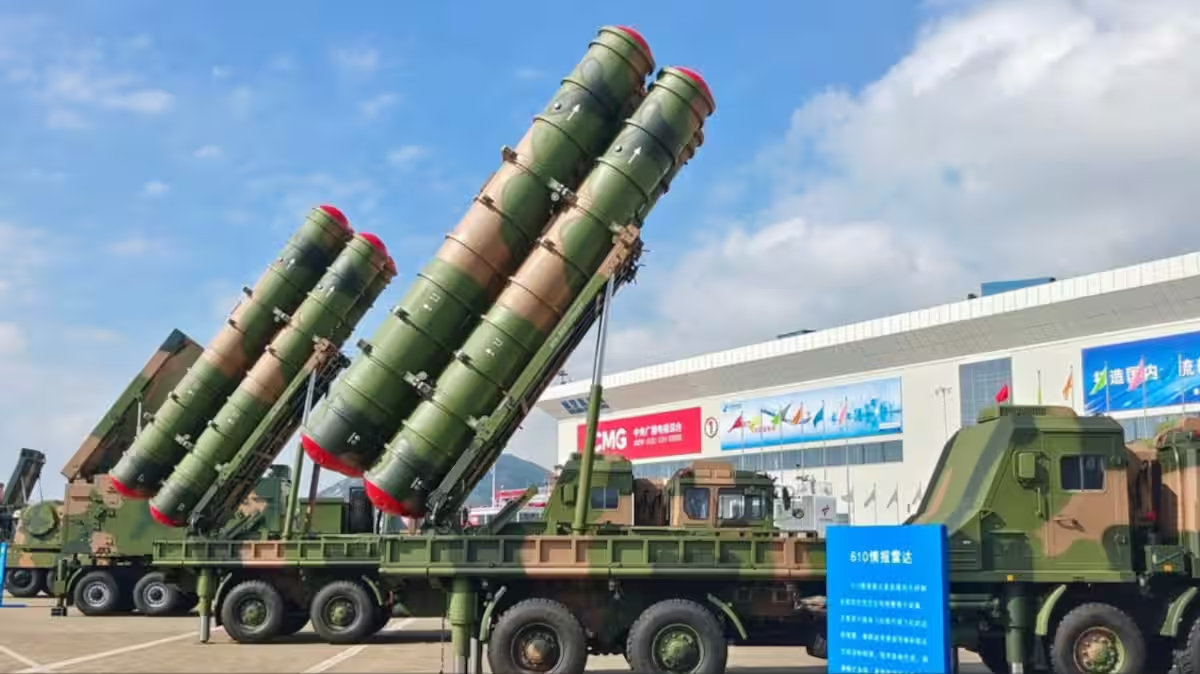
Saudi authorities earlier announced the arrival of Pakistani elements at air facilities in April, while more detailed disclosures now indicate a deployment scale substantially larger than previously understood and considerably beyond traditional training or advisory arrangements.
The deployment reportedly operates under the Strategic Mutual Defence Agreement signed in Riyadh on September 17, 2025, by Saudi Crown Prince Mohammed bin Salman and Pakistani leadership, with provisions reportedly treating attacks on either state as a collective security concern.
The reported force package includes approximately sixteen JF-17 Thunder fighters, two operational drone squadrons, and Chinese-origin HQ-9 long-range air defence systems operated entirely by Pakistani personnel under Saudi financing arrangements.
The concentration of forces around Saudi Arabia’s Eastern Province immediately elevates strategic attention because that region contains critical oil infrastructure, energy export facilities, and operational geography historically exposed to missile and drone threats.
The possibility that troop levels could expand from approximately 8,000 personnel toward a reported ceiling of 80,000 introduces an additional layer of uncertainty regarding long-term military intentions and operational scalability.
While multiple security sources reportedly support the deployment details, no official public confirmation or denial regarding the latest force numbers has emerged from Islamabad or Riyadh, creating analytical caution around some operational assumptions.
The deployment nevertheless represents one of the largest and most strategically consequential Pakistan-Saudi military arrangements in recent years amid a rapidly evolving Gulf security landscape.
The force concentration near the Gulf’s most economically critical energy corridor also introduces a new strategic tripwire dynamic because any future attack on Saudi infrastructure could now risk immediate multinational military entanglement involving external actors beyond the Arabian Peninsula.
For defence planners across Washington, Tehran, New Delhi, and Beijing, the deployment increasingly represents not merely a bilateral security arrangement but an emerging indicator that Middle Eastern force architecture is entering a more fragmented and multipolar strategic era.
READ: Pakistan Deploys Fighter Jets to Saudi Arabia, Raising Risk of Wider Iran War Across the Gulf
Strategic Mutual Defence Agreement Moves Beyond Symbolism
The Strategic Mutual Defence Agreement appears to represent a substantial evolution beyond decades of Saudi-Pakistani defence cooperation traditionally focused on advisory missions, training support, and rotational deployments.
Earlier security relationships often involved Pakistani military expertise supporting Saudi institutional capacity, but the present arrangement appears designed around deployable operational capabilities and integrated deterrence architecture.
The reported inclusion of combat-ready units rather than exclusively instructional elements suggests Riyadh increasingly seeks externally deployable military capacity capable of immediate operational activation.
Unlike symbolic military diplomacy, deployed fighter aircraft, drones, and strategic air defence systems create tangible deterrent infrastructure with measurable battlefield utility and visible geopolitical signalling effects.
The reported force package effectively creates a rapidly deployable external military shield positioned near strategically sensitive sectors of Saudi territory.
If provisions of the defence pact interpret attacks on one state as attacks on both, the framework potentially alters adversarial calculations regarding escalation risk.
The broader strategic implication involves operational integration rather than ceremonial alliance management because deployed combat assets create shared defence obligations beyond political declarations.
The scale-up provision toward approximately 80,000 troops suggests planners incorporated contingency pathways for prolonged regional instability rather than temporary crisis response measures.
That scalability dimension transforms the arrangement from a narrow defence cooperation agreement into a potentially expandable regional security mechanism.
The shift indicates Saudi security calculations increasingly emphasize diversified partnerships rather than dependence upon singular external guarantors.

JF-17 and HQ-9 Create a New Military Footprint in the Gulf
The deployment of JF-17 Thunder fighter aircraft introduces an operational capability jointly developed by Pakistan and China into one of the world’s most strategically contested security environments.
A full squadron of roughly sixteen fighters creates a deployable air combat capability with air defence, interception, and precision strike utility under Pakistani operational control.
The deployment also allows Pakistani aviation units to gain operational exposure within a complex threat environment involving drones, cruise missiles, and regional air defence challenges.
The Chinese-built HQ-9 system introduces another strategic variable because long-range air defence capability directly influences survivability and regional anti-access calculations.
Positioning HQ-9 systems near critical infrastructure in eastern Saudi Arabia could strengthen layered defensive coverage against missile or drone threats.
Because all systems reportedly remain operated exclusively by Pakistani personnel, Saudi Arabia avoids immediate training burdens and command integration complications.
Operational control retained by Pakistani crews also reduces technology transfer sensitivities while preserving military effectiveness.
The deployment effectively creates a self-contained expeditionary package consisting of troops, airpower, drones, and integrated air defence architecture.
Such force design suggests planning centred around rapid operational readiness rather than gradual force-building assistance.
The broader military-technical significance lies in placing Chinese-origin systems into a high-visibility theatre where strategic observers will closely monitor performance and reliability.
Fragile Ceasefire Raises Risks of Escalatory Signalling
The deployment arrives amid an uneasy environment shaped by conflict involving the United States and Iran and a ceasefire reportedly remaining intact for approximately six weeks.
Iran previously conducted missile and drone strikes targeting Saudi infrastructure while broader regional tensions raised concern regarding horizontal escalation pathways.
Saudi retaliatory actions reportedly occurred during the crisis, though details surrounding those responses remain unclear publicly.
Pakistan meanwhile reportedly hosted direct peace discussions involving Washington and Tehran while attempting to preserve diplomatic access across competing regional actors.
That balancing effort becomes increasingly complicated when a mediator simultaneously reinforces one participant in an unresolved strategic rivalry.
Military deployments often produce signalling effects extending beyond intended audiences because force concentrations can reshape adversary threat perceptions.
Pakistani troops and strategic systems positioned near Dhahran could be interpreted as a deterrent presence or alternatively as escalation infrastructure.
Such ambiguity often creates heightened risk during fragile post-conflict environments because military intentions may be interpreted differently across capitals.
Regional actors frequently assess not only current deployments but future scalability potential when calculating strategic responses.
Consequently, the reported pathway toward substantially larger force numbers may influence Iranian planning beyond the immediate operational environment.
Saudi Arabia Gains Strategic Insurance Beyond Traditional Partners
For Riyadh, the deployment provides immediate force multiplication without requiring lengthy procurement cycles or domestic capability generation.
The Eastern Province remains strategically sensitive because of its concentration of energy facilities and geographic proximity to regional security flashpoints.
External military reinforcement positioned near critical infrastructure enhances resilience against missile saturation and drone attack scenarios.
The arrangement additionally broadens Saudi Arabia’s strategic options by reducing excessive dependence upon any single external security provider.
Riyadh increasingly appears focused on diversified defence partnerships capable of absorbing policy uncertainty among traditional allies.
The deployment may therefore represent strategic insurance rather than alliance replacement within Saudi long-term planning.
Operationally, Saudi Arabia receives deployable military capability without assuming additional personnel burdens or extended training requirements.
The arrangement also provides opportunities for joint operational learning and expanded interoperability between Saudi and Pakistani forces.
Longer-term implications could include expanded defence-industrial cooperation and possible co-production arrangements involving military technologies.
Such diversification aligns with broader regional patterns where Gulf states increasingly distribute security relationships across multiple international partners.
READ: Pakistan Signals ‘Islamic NATO’ Expansion as Türkiye and Qatar Move Toward Saudi-Led Mutual Defence Pact Amid Post-Iran War Crisis
Pakistan, China and Regional Powers Face a New Strategic Equation
Pakistan gains strategic advantages extending beyond immediate military cooperation because Saudi financial support remains important during periods of economic pressure.
Operational deployments inside the Gulf provide Pakistani forces with experience under realistic threat conditions involving complex air and missile environments.
The deployment additionally creates visibility for Pakistani-operated systems and Chinese-developed platforms within an internationally scrutinized operational theatre.
For Beijing, indirect exposure of Chinese-origin systems through Pakistani deployment creates strategic benefits without direct military involvement.
Chinese systems functioning inside a contested security environment may generate perceptions regarding export reliability and operational maturity.
The deployment also appears to extend broader China-Pakistan strategic alignment into Gulf security architecture without overt Chinese force commitments.
For India, deeper military integration between Pakistan and Saudi Arabia introduces a regional development likely monitored carefully in New Delhi.
A closer Saudi-Pakistan strategic relationship potentially complicates broader regional calculations involving economic corridors, defence diplomacy, and long-term geopolitical alignment.
Washington meanwhile may view Riyadh’s diversification efforts as evidence that Gulf security structures increasingly reflect multipolar strategic realities rather than exclusive dependency patterns.
The result is a rapidly evolving regional equation where military manpower, strategic deterrence, Chinese-origin technology, and geopolitical hedging increasingly define the future architecture of Middle Eastern security.
The broader strategic concern for international observers involves whether expanding Saudi-Pakistan military integration could gradually evolve into a more institutionalized security bloc capable of influencing future crisis dynamics across both the Middle East and the wider Indo-Pacific theatre.
Should the deployment eventually expand toward its reported 80,000-troop ceiling alongside potential naval participation, regional powers may be compelled to reassess force posture assumptions, alliance structures, and contingency planning across multiple operational fronts simultaneously.
