
Pakistan Signals ‘Islamic NATO’ Expansion as Türkiye and Qatar Move Toward Saudi-Led Mutual Defence Pact Amid Post-Iran War Crisis
Islamabad’s push to expand its Strategic Mutual Defence Agreement with Saudi Arabia into a four-state military bloc involving Türkiye and Qatar could reshape Gulf deterrence, nuclear security calculations, and the balance of power across the Middle East and South Asia.

(DEFENCE SECURITY ASIA) — Pakistan’s public signal that Türkiye and Qatar could join the Strategic Mutual Defence Agreement with Saudi Arabia has injected new volatility into an already fragile post-US-Iran war security landscape stretching from the Strait of Hormuz to the Eastern Mediterranean.
The statement by Pakistan’s Defence Minister Khawaja Muhammad Asif indicates that Islamabad is no longer treating the 2025 Saudi-Pakistan security pact as a narrowly bilateral arrangement but increasingly views it as the foundation of a broader Sunni strategic-security architecture.
Asif’s declaration that the arrangement “has been partially finalized” and remains “in the process” has amplified speculation that a multi-domain military bloc combining nuclear deterrence, Gulf financial leverage, Turkish defence-industrial capabilities, and Qatari strategic basing access may now be entering an advanced political coordination phase.
The timing of the statement has intensified geopolitical attention because it emerged amid continuing instability following the US-Iran war that erupted in February 2026 and triggered regional missile strikes, shipping disruptions, fragile ceasefires, and renewed uncertainty surrounding Gulf energy security.
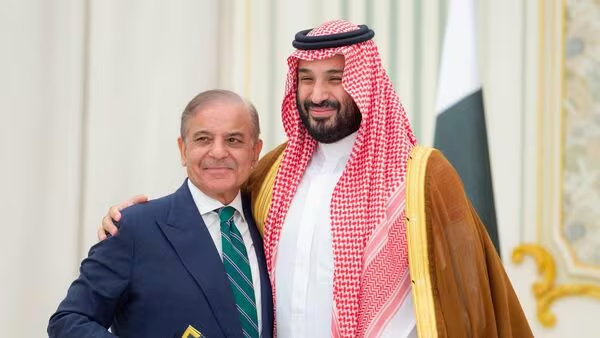
The original Strategic Mutual Defence Agreement signed in Riyadh on September 17, 2025 by Pakistani Prime Minister Shehbaz Sharif and Saudi Crown Prince Mohammed bin Salman formalized decades of military cooperation that had previously operated largely through unofficial or bilateral defence arrangements.
The agreement reportedly established a NATO-style mutual defence clause under which aggression against one signatory would be interpreted as aggression against both signatories, fundamentally elevating Pakistan-Saudi military coordination into a treaty-based deterrence structure.
Asif’s latest remarks now suggest Islamabad believes the pact could evolve into a larger coalition among “like-minded” Muslim-majority states seeking to reduce long-term dependence on external security guarantors while retaining sovereign political autonomy.
The Strategic Mutual Defence Agreement represented Pakistan’s first formal defence pact with a Gulf Arab state and immediately transformed Islamabad’s role within the wider Middle Eastern security environment.
The agreement institutionalized military training, intelligence cooperation, joint exercises, defence-industrial coordination, and strategic deterrence planning between Pakistan and Saudi Arabia under a structured treaty framework.
Pakistan’s decades-long history of deploying military personnel to Saudi Arabia provided the operational foundation that allowed Riyadh and Islamabad to formalize cooperation without requiring extensive force integration adjustments.
Saudi Arabia’s decision to elevate relations with Pakistan into a treaty-level defence partnership reflected growing concerns regarding regional instability following escalating Iran-related tensions and uncertain long-term American strategic commitments.
Pakistan’s deployment of a military contingent to Saudi Arabia’s King Abdulaziz Air Base in recent months reinforced perceptions that the agreement is already transitioning from political symbolism into operational military coordination.
The bilateral pact also positioned Pakistan as a security guarantor capable of contributing large-scale conventional manpower, missile capabilities, strategic planning expertise, and nuclear deterrence ambiguity to Gulf defence calculations.
Although Pakistani officials later moderated earlier suggestions regarding nuclear-related dimensions of the pact, repeated references to Pakistan’s strategic capabilities have continued influencing regional perceptions regarding the agreement’s deterrent depth.
The absence of a publicly released treaty text has generated continued uncertainty regarding activation thresholds, operational obligations, command structures, and escalation management mechanisms embedded within the agreement.
That ambiguity has simultaneously enhanced the pact’s deterrent signalling value while increasing anxiety among rival regional actors attempting to assess the alliance’s true operational scope.

Türkiye’s Entry Could Transform the Bloc’s Military-Industrial Reach
Türkiye’s possible participation would dramatically increase the alliance’s technological sophistication, expeditionary capability, and defence-industrial self-sufficiency across multiple military domains.
Ankara’s combat-tested drone ecosystem, including advanced unmanned combat aerial vehicle technologies and network-centric operational doctrine, would significantly strengthen the bloc’s intelligence-surveillance-strike architecture.
Türkiye’s NATO-standard military infrastructure would also provide interoperability advantages unavailable to many regional military coalitions operating outside Western alliance systems.
The inclusion of Turkish aerospace manufacturing capabilities would accelerate discussions surrounding joint procurement standardization, indigenous defence production, and technology-transfer frameworks among participating states.
Türkiye’s KAAN fifth-generation fighter development program has already emerged as a major symbol of Ankara’s ambition to reduce dependence on Western aerospace suppliers while expanding defence exports across Muslim-majority markets.
A four-state alliance structure involving Pakistan, Saudi Arabia, Türkiye, and Qatar could therefore create an integrated military-industrial ecosystem linking Gulf financing, Turkish manufacturing, Pakistani manpower, and Qatari strategic logistics.
The January 2026 reports regarding draft trilateral defence discussions between Pakistan, Saudi Arabia, and Türkiye demonstrated that preliminary strategic consultations had already progressed significantly before stalling politically.
Asif’s latest remarks indicate Islamabad believes the geopolitical environment created by the US-Iran conflict may now provide stronger momentum for reviving those earlier negotiations.
Türkiye’s participation would nevertheless create complex diplomatic balancing pressures because Ankara remains a NATO member possessing obligations and operational relationships embedded deeply within Western alliance architecture.
Washington may therefore interpret deeper Turkish involvement in a nuclear-linked regional defence framework as evidence of increasing strategic autonomy emerging among key American security partners.
Qatar’s Role Adds Strategic Basing and Diplomatic Complexity
Qatar’s inclusion would introduce a uniquely complicated strategic dimension because Doha simultaneously hosts America’s largest regional military installation while pursuing an independent diplomatic posture across multiple geopolitical fault lines.
The Al Udeid Air Base remains central to American military operations across the Middle East, making Qatar one of Washington’s most important Gulf security partners despite periodic regional tensions.
Doha’s participation in a broader security arrangement involving Pakistan, Saudi Arabia, and Türkiye would therefore create overlapping alliance structures operating simultaneously inside and outside traditional Western security frameworks.
Qatar’s financial resources derived from liquefied natural gas exports would significantly enhance the bloc’s ability to sustain long-term procurement programs, defence-industrial investments, and military modernization initiatives.
Pakistani Prime Minister Shehbaz Sharif’s April 2026 visits to Saudi Arabia, Türkiye, and Qatar reinforced perceptions that Islamabad has been quietly coordinating a wider strategic realignment across multiple regional capitals.
Reports indicating Qatari interest in expanded training and advisory cooperation with Pakistan suggested that defence integration discussions had already advanced beyond symbolic diplomatic engagement.
Qatar’s traditionally flexible foreign policy posture could also allow the bloc to maintain communication channels with actors otherwise isolated diplomatically during periods of regional escalation.
That flexibility may prove strategically valuable if future Iran-Gulf crises threaten maritime traffic through the Strait of Hormuz or disrupt global hydrocarbon supply chains.
However, Qatar’s participation could simultaneously create internal contradictions if alliance obligations clash with American operational priorities linked to Al Udeid’s regional military mission structure.
Iran, India and the Emerging Regional Deterrence Equation
Iran is likely to perceive any expansion of the Strategic Mutual Defence Agreement as part of a broader encirclement dynamic emerging after the 2026 US-Iran war.
A four-state bloc spanning South Asia, the Gulf, and the Eastern Mediterranean would geographically compress Iran’s strategic operating environment while increasing coordinated military pressure across multiple fronts.
The alliance’s combination of missile capabilities, naval access, airpower, intelligence sharing, and drone warfare expertise would significantly complicate Iranian deterrence calculations during future regional crises.
The maritime dimension is especially significant because Hormuz-related disruptions during the 2026 conflict demonstrated how rapidly Gulf instability can threaten global energy flows and international shipping routes.
Joint maritime security coordination among Pakistan, Saudi Arabia, Türkiye, and Qatar could therefore evolve into one of the alliance’s most strategically consequential operational missions.
India is also likely monitoring developments closely because any deeper Gulf-Turkish security alignment with Pakistan would alter regional military balancing calculations affecting South Asian deterrence dynamics.
New Delhi would particularly scrutinize whether Gulf financial support or Turkish defence technology transfers could accelerate Pakistan’s military modernization trajectory following recent regional tensions.
Pakistan’s large conventional military structure combined with strategic missile capabilities already presents a major planning challenge for Indian defence planners managing simultaneous China-related security concerns.
The possibility of Pakistan operating within a broader military-industrial coalition involving Gulf financing and Turkish defence production could therefore intensify Indian anxieties regarding future regional force asymmetries.
At the same time, the alliance’s leaders continue publicly insisting that the arrangement remains defensive in nature and is not directed against any specific third country.
READ: Pakistan-Qatar Defence Pact Nears Breakthrough: Doha’s Strategic Shift Beyond U.S. Security Could Redraw Gulf Military Balance
The Rise of a Multipolar “Islamic NATO” Concept
The phrase “Islamic NATO” has increasingly circulated across regional media because the alliance concept resembles a collective-security arrangement built around mutual defence commitments among major Muslim-majority powers.
While no unified command structure currently exists, the symbolic significance of a treaty-based military coalition linking Pakistan, Saudi Arabia, Türkiye, and Qatar is already reshaping strategic narratives across the Middle East and South Asia.
The proposed structure differs from earlier pan-Islamic security initiatives because it combines financially sustainable Gulf states with operationally experienced militaries and increasingly sophisticated indigenous defence industries.
Pakistan contributes nuclear deterrence ambiguity, Saudi Arabia contributes strategic financing capacity, Türkiye contributes advanced military technology, and Qatar contributes strategic basing access and diplomatic flexibility.
Collectively, those capabilities would create one of the most powerful non-Western security frameworks operating outside direct great-power command structures.
The alliance also reflects broader global trends toward multipolar security architectures emerging independently from traditional American-led alliance systems.
Saudi Arabia’s willingness to diversify security relationships beyond exclusive reliance on Washington mirrors similar strategic recalibrations visible across multiple Gulf capitals over the past decade.
For Pakistan, the arrangement enhances international strategic relevance while reinforcing its role as a military and diplomatic power broker within the Muslim world.
For Türkiye, participation would expand influence across the Gulf and South Asia while strengthening defence-export opportunities tied to its expanding indigenous weapons sector.
Despite the growing momentum, the alliance remains politically fluid because no official confirmation has yet emerged from Riyadh, Ankara, or Doha regarding formal accession negotiations, leaving the future structure, obligations, and operational realities of the proposed bloc uncertain.
