
Malaysia Becomes First in Asia to Procure Thales HF XL Radios at DSEI 2025
Malaysia sets a regional precedent at DSEI 2025 by becoming the first Asian nation to procure Thales HF XL radios, strengthening secure long-range communications and boosting Indo-Pacific defence resilience.
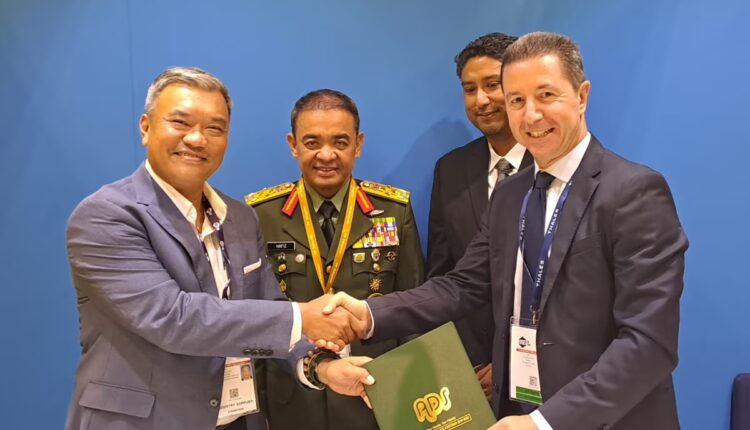
(DEFENCE SECURITY ASIA) — Malaysia has made history at the Defence and Security Equipment International (DSEI) 2025 exhibition by becoming the first Asian nation to procure Thales’ cutting-edge HF XL tactical radios, a breakthrough that redefines the future of long-range communications across the Indo-Pacific.
The landmark agreement was signed on the opening day of DSEI 2025 between Thales and its established local partner, Advanced Defence Systems (ADS) Sdn. Bhd., covering the delivery of complete HF XL TRC 3900 vehicle-mounted radio stations.

The package includes radios, amplifiers, and high-performance antennas, offering Malaysia the most advanced iteration of high-frequency communications unveiled only a year earlier at Eurosatory 2024.
By adopting HF XL technology, Malaysia secures a regional first, underscoring Kuala Lumpur’s ambition to leapfrog legacy communications systems and establish sovereign resilience in a contested and increasingly complex strategic environment.
HF XL provides ten times the data rate of current high-frequency systems, enabling secure voice, data, and multimedia transfers across thousands of kilometres, even in environments poorly served by satellites.
This is particularly critical for Malaysia, where tropical jungles, mountainous terrain, and remote maritime zones demand robust communications architectures resistant to jamming, interception, and cyber compromise.
The system allows the transfer of imagery and live video streams over HF links, a capability previously regarded as impossible without satellite relays.
It also provides cost-effective, beyond-line-of-sight communications for forward-deployed forces operating in austere or denied environments, offering Malaysia a powerful asymmetric advantage in an era of hybrid and electronic warfare.
The TRC 3900 family includes 20W manpack radios supporting autonomous units up to 1,000 km away, as well as 400W and 1kW stations capable of linking deployed command posts to national headquarters and allied partners over distances of up to 5,000 km.
For Malaysia’s Army, Navy, and joint commands, this represents a scalable and flexible solution that can connect platoon-level patrols deep in Sabah’s jungles to operational hubs in Kuala Lumpur, or maritime task groups in the South China Sea to naval command in Lumut.
Thales’ longstanding footprint in Malaysia is a decisive enabler, with more than 10,000 radios already delivered to the Malaysian Armed Forces, creating a baseline of trust and interoperability unmatched by competitors.
The new HF XL systems are designed to be fully interoperable with the Army’s existing radio inventory, avoiding costly fleet replacement and ensuring seamless operational transition.
This partnership is further strengthened through ADS, a proven Malaysian defence and security player, ensuring localisation, sovereign support, and lifecycle sustainment for the Armed Forces.
Malaysia’s adoption also positions it as a showcase reference customer in Asia, potentially accelerating regional interest from Southeast Asian neighbours seeking cost-effective, non-satellite-dependent long-range communications solutions.
In an Indo-Pacific increasingly defined by grey-zone operations, contested spectrum, and anti-access/area-denial (A2/AD) strategies, such a capability enhances deterrence and ensures operational continuity even under electronic warfare attack.
The acquisition also carries geo-strategic significance, with Malaysia signalling its intent to invest in advanced communications that support coalition operations while maintaining sovereignty in system ownership and sustainment.
“This first export success confirms the relevance of HF XL in meeting the needs of armed forces operating in constrained environments. By combining innovation with interoperability with existing fleets, Thales provides its customers with a robust, high-performance and future-ready solution,” said Christophe Groshenry, Vice President Business Line Radiocommunications Products, Thales in a statement released by the company.
For Thales, Malaysia’s early adoption validates HF XL as a global export success, while for Kuala Lumpur it represents a forward-looking investment that enhances tactical agility, strategic resilience, and operational independence in a volatile region.

Thales on HF XL: A Decade-Defining Leap in High-Frequency Communications
According to Thales, the development of HF XL technology delivers a tenfold increase in bandwidth and a significant improvement in quality of service, while retaining all the traditional advantages of HF such as long-range coverage and reliable operation in constrained environments.
At the heart of the system is a cognitive engine that automatically scans and selects optimal frequencies, rejecting those jammed by hostile interference and replacing them with free channels, thereby ensuring link stability and optimised data rates even in contested electromagnetic environments.
This built-in adaptability not only enhances resilience against electronic warfare but also makes the radios intuitive and user-friendly for operators in the field.
The company highlights that its 1 kW and 400 W HF XL radios, which are fully interoperable with existing wideband HF systems, enable deployed command posts to maintain secure connectivity with national headquarters or other forward units across operational theatres extending up to 10,000 km.
Thales further confirmed that in 2025 the range will expand with new radios designed for vehicles and dismounted soldiers, completing the tactical ecosystem and offering full-spectrum solutions for land, naval, and joint-force applications.
Plans are also underway to extend HF XL’s capabilities into aerial and critical infrastructure domains, ensuring that the technology supports integrated communications architectures across all operational environments.
“These new radios are the culmination of several years of consistent innovation and design efforts to provide our customers with a mature solution that represents the state of the art in wideband HF technology,” said Christophe Groshenry, Vice-President Radiocommunication Products, Thales.
READ HERE: New Thales GM400α Long-Range Radar Deal Strengthens RMAF’s Edge Amid South China Sea Tensions
Why HF XL Matters for Malaysia
HF XL represents a generational leap in secure battlefield communications by delivering ten times the data throughput of traditional high-frequency systems, a performance jump that fundamentally transforms command-and-control for the Malaysian Armed Forces.
Unlike legacy HF radios that are often constrained to narrowband voice or low-rate data transmission, HF XL enables the movement of high-volume digital files including imagery, reconnaissance data, and even live video streaming.
This means a platoon operating in the dense rainforests of Sabah or patrolling the porous land borders with Kalimantan could transmit encrypted video or sensor feeds directly to divisional headquarters without relying on vulnerable satellite links.
Malaysia’s geography makes this particularly important, as its military must operate across diverse and challenging environments including the dense jungles of Borneo, the mountainous terrain of the central peninsula, and vast maritime zones spread across the South China Sea.
Satellite communications (SATCOM), while valuable, are often unreliable in such terrains due to canopy coverage, terrain masking, or bandwidth congestion, and are increasingly vulnerable to cyber intrusion and anti-satellite (ASAT) threats.
HF XL provides a terrestrial-based alternative that is far less susceptible to orbital denial, ensuring resilient communications in situations where satellites may be degraded, jammed, or destroyed.
In the South China Sea, where Malaysia faces overlapping maritime claims with China, Vietnam, and the Philippines, this resilience translates directly into sustained maritime domain awareness and uninterrupted naval command-and-control.
HF XL radios also support integration with unmanned systems, enabling the secure relay of intelligence gathered by drones such as the ANKA-S UAVs recently acquired by Malaysia, ensuring persistence in intelligence, surveillance, and reconnaissance (ISR) missions.
Perhaps most importantly, the system’s resilience against jamming and interception provides Malaysia with an asymmetric advantage in hybrid conflict scenarios, where electronic warfare has increasingly emerged as a decisive factor.
Adversaries may attempt to deny communications as part of grey-zone tactics, but HF XL ensures Kuala Lumpur maintains a sovereign communication backbone even under hostile electromagnetic conditions.
READ HERE: Thales to Build Radar, Optical Constellation for Indonesian Defence Purposes
Military Impact: From Sabah’s Jungles to the South China Sea
For the Malaysian Army, HF XL radios revolutionise command chains by enabling platoon-level units operating in remote regions of Sabah and Sarawak to transmit imagery, intelligence, and situation reports in real time to brigade and divisional headquarters.
This eliminates traditional delays in battlefield reporting and enhances the Army’s capacity to conduct coordinated counter-insurgency, counter-smuggling, and border security operations across the porous frontiers of East Malaysia.
The radios also support special operations forces conducting clandestine missions deep in jungle terrain, where low probability of detection, long endurance, and secure links are critical to mission success.
For the Royal Malaysian Navy (RMN), HF XL addresses a long-standing vulnerability in the South China Sea by ensuring task groups operating near the Spratly Islands, Luconia Shoals, or Natuna region maintain unbroken connectivity with command posts in Lumut or Kuala Lumpur.
This is vital in an era when China’s People’s Liberation Army Navy (PLAN) maintains a near-constant presence in disputed waters and where communication resilience directly translates to operational confidence and deterrence.
HF XL enables deployed RMN vessels to share radar tracks, maritime patrol aircraft (MPA) feeds, and surveillance drone data across a secure long-range backbone without the risk of satellite denial.
For the Royal Malaysian Air Force (RMAF), the radios strengthen long-range patrols conducted by maritime surveillance aircraft and UAVs, including ISR assets monitoring approaches to Malaysian airspace in the South China Sea.
The ability to stream sensor data and imagery in real time from the maritime edge back to air force command enhances Malaysia’s capacity for early warning, airspace management, and rapid decision-making in contested environments.
In a broader regional context, HF XL ensures Malaysia sustains joint-force interoperability, linking its Army, Navy, and Air Force into a coherent command architecture even under electronic warfare or cyber disruption.
This is especially relevant as Indo-Pacific military planners anticipate a future battlespace where cyber attacks, spectrum denial, and electronic warfare are used as primary tools to paralyse opponents before kinetic action is initiated.
For Malaysia, the adoption of HF XL is not merely a technical upgrade—it is a strategic hedge that ensures the Armed Forces remain operationally relevant and resilient in a future conflict where the ability to communicate may decide the outcome of battles. — DEFENCE SECURITY ASIA
