
Astra’s Quantum Leap: Did India’s Indigenous BVRAAM Break the 240 km Barrier Alone—or in the Shadow of a Captured Chinese PL-15?
As India claims a dramatic expansion in Astra’s beyond-visual-range lethality to rival China’s PL-15, recovered missile wreckage from the 2025 India-Pakistan conflict fuels speculation over reverse-engineering, indigenous propulsion breakthroughs, and the shifting balance of airpower across South Asia and the Indo-Pacific.

(DEFENCE SECURITY ASIA) — India’s announcement in early 2026 that its indigenous Astra beyond-visual-range air-to-air missile family has undergone a dramatic leap in engagement envelope has sent shockwaves through South Asia’s aerial warfare calculus, particularly as these claims emerge less than a year after a kinetic India-Pakistan air confrontation in which Chinese-supplied PL-15E missiles were recovered intact on Indian soil, triggering intense regional and global scrutiny over the true source of New Delhi’s technological acceleration.
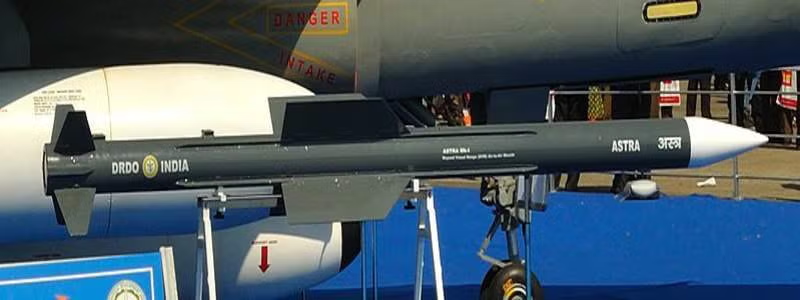
The Defence Research and Development Organisation’s disclosure that Astra Mk-1 has expanded its effective range from approximately 110 kilometres to 160 kilometres, while the forthcoming Mk-2 is projected to reach an extraordinary 240 kilometres, immediately places the missile within striking proximity of China’s PL-15 class and raises unavoidable questions about whether indigenous propulsion breakthroughs alone can credibly account for such gains within such a compressed development timeline.
This controversy has been further amplified by confirmed battlefield recoveries during the May 2025 India-Pakistan conflict, where multiple PL-15E missiles—lacking self-destruct mechanisms—were found in relatively intact condition within Indian territory, creating what many analysts describe as one of the most significant intelligence windfalls in modern South Asian military history.
Air Chief Marshal AP Singh publicly acknowledged the recovery and exploitation of these missile remnants, stating unequivocally, “Some of their missiles have fallen in our territory. We have recovered a lot of wreckage, which is now being studied so that we can make out… what features they have,” a remark that instantly became the fulcrum of speculation surrounding potential reverse-engineering pathways.
Simultaneously, Indian defence officials have mounted an uncompromising rebuttal to any suggestion of technological appropriation, with ARDE Director Ankathi Raju asserting, “Speculation linking the Indian Air Force’s Astra Mark-1 and Mark-2 range enhancements to the recovery of a Chinese PL-15 missile is inaccurate and unfounded,” framing the missile’s evolution as the product of long-term indigenous research rather than opportunistic exploitation.
The stakes of this debate extend far beyond technical curiosity, as the perceived origin of Astra’s performance leap carries profound implications for India’s Atmanirbhar Bharat narrative, Pakistan’s confidence in Chinese aerospace exports, and China’s strategic credibility as a supplier of high-end air-to-air weaponry across the Global South.
In an era where beyond-visual-range dominance increasingly determines air superiority before pilots ever enter merge distance, the ability of a missile to outrange, outpace, and out-network its adversary directly reshapes deterrence postures across contested airspaces stretching from the Line of Control to the Himalayas and the wider Indo-Pacific.
The Astra programme’s evolution, whether purely indigenous or subtly informed by battlefield intelligence, now sits at the intersection of military technology, geopolitical signaling, and narrative warfare, where perception can be as decisive as propulsion chemistry or seeker resolution.
Ultimately, this unfolding controversy forces a deeper examination of how modern conflicts blur the line between innovation and exploitation, particularly in a region where captured hardware, accelerated R&D cycles, and strategic ambiguity have become intrinsic features of contemporary arms races.
The Astra Missile Programme: From Indigenous Aspiration to Long-Range Contender
The Astra missile programme, formally initiated in 2001, was conceived as a cornerstone of India’s long-term ambition to reduce dependency on imported beyond-visual-range air-to-air missiles such as the Russian R-77 and the French MICA, both of which imposed operational, political, and supply-chain constraints on the Indian Air Force during periods of heightened regional tension.
Designed as an active radar-guided BVRAAM capable of engaging highly maneuverable aerial targets at supersonic closure rates, Astra Mk-1 entered limited production in 2023 with a stated engagement range of approximately 110 kilometres, a terminal velocity exceeding Mach 4.5, and full compatibility with frontline platforms including the Su-30MKI, Rafale, and Tejas fighter fleets.
At the heart of Astra Mk-1’s original design philosophy was a dual-pulse solid rocket motor architecture, enabling mid-course energy management and late-stage maneuverability, thereby improving probability of kill against evasive targets employing electronic countermeasures or aggressive defensive kinematics.
The 2026 announcement that Astra Mk-1’s range has been extended by nearly 45 percent to 160 kilometres—without any visible change in missile dimensions—represents a non-trivial leap in propulsion efficiency, aerodynamic optimization, and flight-path energy management, suggesting significant advances in high-energy propellant chemistry and digital guidance algorithms.
DRDO officials have indicated that these improvements were achieved through refinements in burn sequencing, lofted trajectory optimization, and software-driven energy conservation rather than brute-force enlargement of the propulsion section, a claim that aligns with global trends in missile design emphasizing smart kinematics over raw thrust.
The Astra Mk-2, projected to reach an engagement envelope of approximately 240 kilometres, pushes the programme decisively into the same operational class as heavyweight Chinese and Western BVRAAMs, fundamentally altering the Indian Air Force’s ability to contest airspace well beyond traditional visual and radar horizons.
This performance tier would allow Indian fighters to launch from positions of relative sanctuary while threatening adversary aircraft deep within contested zones, particularly when networked with airborne early warning platforms and off-board targeting data.
Beyond Mk-2, the Astra Mk-3—also known as Gandiva—is envisioned to employ solid-fuel ramjet propulsion to achieve ranges approaching 350 kilometres, a capability that would place India among a very small group of nations fielding true ultra-long-range air-to-air weapons.
Collectively, this progression transforms Astra from a stopgap replacement for imported missiles into a central pillar of India’s future air combat doctrine, provided that the performance claims withstand operational validation and sustained production scalability.

Operation Sindoor and the PL-15 Capture: A Battlefield Intelligence Windfall
The May 2025 India-Pakistan aerial confrontation, referred to in Indian strategic discourse as Operation Sindoor, marked one of the most technologically consequential air engagements in South Asian history, not because of confirmed shootdowns alone but due to the unprecedented recovery of advanced Chinese air-to-air missile hardware on Indian territory.
During the conflict, Pakistani Air Force fighters armed with Chinese-supplied J-10C and JF-17 aircraft deployed the PL-15E export-variant missile, a system widely regarded as one of the most capable beyond-visual-range weapons available outside Western inventories.
The PL-15E is understood to feature an active electronically scanned array seeker, advanced electronic counter-countermeasure capabilities, and a nominal engagement range exceeding 200 kilometres, although export variants are generally assessed to be range-limited compared to their domestic Chinese counterparts.
Multiple PL-15E missiles reportedly malfunctioned or failed to self-destruct after launch, landing in relatively intact condition within Indian territory, with at least one near-complete specimen recovered near Hoshiarpur in Punjab on May 9, 2025.
The absence of self-destruct mechanisms—common in Western missile designs—exposed a critical vulnerability in Chinese export controls, effectively handing Indian engineers a rare opportunity to examine seeker architecture, propulsion layout, and internal electronics firsthand.
Air Chief Marshal AP Singh confirmed the strategic significance of these recoveries, stating, “Some of their missiles have fallen in our territory. We have recovered a lot of wreckage, which is now being studied so that we can make out… what features they have,” a declaration that immediately fueled global debate over the potential exploitation of captured technology.
For India, this recovery represented not merely tactical intelligence but strategic insight into Chinese missile design philosophies, electronic warfare resilience, and propulsion trade-offs, all of which are invaluable for developing countermeasures even in the absence of direct replication.
For Pakistan, however, the episode raised uncomfortable questions about the survivability, reliability, and export-grade limitations of its most prized long-range air-to-air weapon, potentially undermining confidence in Chinese aerospace support.
The PL-15 capture thus became a defining moment in South Asia’s evolving airpower competition, blurring the line between battlefield success and technological acquisition.
Reverse-Engineering Speculation: Accelerated Innovation or Strategic Myth-Making?
Following the disclosure of Astra’s enhanced range figures, several media reports and defence commentators advanced the hypothesis that DRDO had successfully reverse-engineered key elements of the captured PL-15E missile, integrating these insights into the Astra Mk-2 programme to achieve rapid performance gains.
Claims circulated that technologies such as miniaturized AESA seekers, high-energy propellant formulations, dual-pulse motor sequencing, and anti-jamming algorithms had been studied and selectively incorporated, with some outlets asserting, “The integration of PL-15-derived technologies into India’s Astra Mark-2 marks a rare case of successful reverse-engineering.”
The argument gained traction due to the apparent alignment of timelines, with missiles recovered in May 2025, analyzed over subsequent months, and range enhancements announced by January 2026, a sequence that appeared to suggest an unusually fast technology infusion cycle.
Supporters of this view further pointed to the PL-15’s reported Mach 5-plus terminal velocity and extended engagement envelope as evidence that India’s sudden leap from 110 kilometres to 240 kilometres could not plausibly be achieved without external technological stimulus.
Social media amplified these assertions, with viral posts claiming that “DRDO to incorporate advanced features PL-15 AAM into its indigenous Astra Mk2 program,” reinforcing public perception that battlefield spoils had directly fueled India’s missile advancements.
However, such narratives often overlook the inherent complexity of reverse-engineering modern missile systems, where materials science, embedded software, and manufacturing tolerances cannot simply be copied from recovered debris.
Moreover, the PL-15E export variant itself is believed to be deliberately downgraded relative to China’s domestic PL-15, limiting the degree of technological advantage it could realistically confer.
As one analyst bluntly summarized on social platforms, “Can’t ‘incorporate’ or copy tech just like that. The article wording is misinformed imo,” highlighting skepticism even within technically literate defence communities.
Indigenous Rebuttals and Technical Realities of Missile Development
Indian defence authorities have categorically rejected claims of PL-15-derived enhancements, emphasizing that Astra’s range improvements are the culmination of long-running indigenous research programs initiated well before the 2025 conflict.
ARDE Director Ankathi Raju directly addressed the controversy, stating, “Speculation linking the Indian Air Force’s Astra Mark-1 and Mark-2 range enhancements to the recovery of a Chinese PL-15 missile is inaccurate and unfounded,” underscoring institutional confidence in domestic R&D capabilities.
He further clarified that, “These figures are not pulled from thin air or borrowed from foreign designs; they are based on extensive simulation work and new propellant formulations developed in-house,” pointing to computational modeling and high-energy chemistry as the primary drivers of improvement.
From a technical standpoint, experts note that reverse-engineering solid rocket propellants from residue is extraordinarily difficult, as combustion fundamentally alters molecular structures, rendering precise replication virtually impossible.
Similarly, extracting usable software or guidance logic from damaged missile electronics presents immense challenges, particularly when encryption, tamper-resistant hardware, and thermal damage are factored in.
Indian analysts argue that while studying PL-15 wreckage undoubtedly aids the development of countermeasures and threat libraries, it does not equate to wholesale technology transfer into an operational missile program.
DRDO’s work on dual-pulse motors, advanced seekers, and lofted trajectory optimization reportedly predates the PL-15 recovery by several years, with Astra Mk-2 conceptualization already underway by 2020.
As one strategic communication assessment summarized, “The claim that it can extract significant R&D technology is mostly false,” reinforcing the view that indigenous momentum, rather than opportunistic copying, underpins Astra’s evolution.
Strategic and Geopolitical Implications for South Asian Airpower Balance
Regardless of its origins, Astra’s enhanced range profoundly alters the regional air combat equation, enabling the Indian Air Force to contest Pakistani and Chinese aircraft at distances previously dominated by PL-15-equipped platforms.
A 240-kilometre engagement envelope allows Indian fighters to exploit off-board targeting from airborne early warning systems while remaining outside the effective response range of many adversary missiles, fundamentally reshaping engagement geometry.
For Pakistan, the episode exposes potential vulnerabilities in reliance on Chinese export systems, particularly if perceived performance advantages are eroded or matched by indigenous Indian alternatives.
For China, the controversy raises uncomfortable questions about the strategic consequences of exporting advanced weaponry into contested theatres where capture and exploitation risks are non-trivial.
At the doctrinal level, Astra’s maturation supports India’s shift toward network-centric air warfare, where missiles act as nodes within a broader sensor-shooter ecosystem rather than standalone weapons.
Economically, indigenous missile production reduces long-term procurement costs, with estimates suggesting locally produced BVRAAMs could cost significantly less than imported equivalents, potentially saving hundreds of millions of US dollars—equivalent to billions of Malaysian Ringgit—over fleet-wide acquisition cycles.
In strategic messaging terms, India’s insistence on indigenous achievement reinforces the Atmanirbhar Bharat narrative, projecting technological self-sufficiency to both domestic and international audiences.
As one geopolitical commentary observed, “This diminishes the advantage of PL-15’s on paper range of 200 km,” signaling a narrowing of the capability gap that once favored Pakistan and China.
Ultimately, Astra’s evolution—whether accelerated by battlefield insight or driven purely by indigenous innovation—marks a decisive moment in South Asia’s accelerating aerial arms race, where technology, perception, and power projection are increasingly inseparable. — DEFENCE SECURITY ASIA
