
Boeing Withdraws from Indonesia’s F-15EX Fighter Deal, Dealing a Major Blow to Jakarta’s Air Power Ambitions
Boeing’s decision to halt its F-15EX campaign underscores procurement fragility, geopolitical recalibration, and the growing challenges facing Indonesia’s bid to field a high-end air superiority force amid intensifying Indo-Pacific competition.
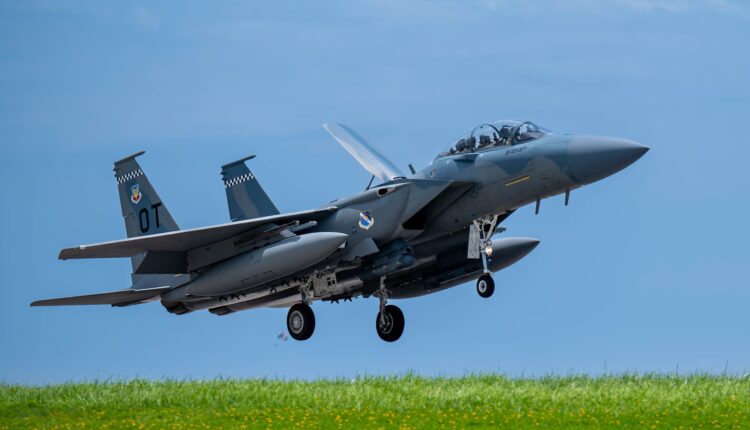
(DEFENCE SECURITY ASIA) — The decision by Boeing to formally terminate its pursuit of the F-15EX fighter jet sale to Indonesia marks a defining inflection point in Jakarta’s long-term airpower modernisation trajectory, signalling the collapse of what had been envisioned as a cornerstone programme to elevate the Indonesian Air Force’s high-end combat capability within an increasingly contested Indo-Pacific security environment.
Confirming the strategic reversal at the Singapore Airshow, Boeing Defense Vice President for Business Development and Strategy Bernd Peters stated, “I will tell you it is no longer an active campaign for the Boeing company,” a declaration that underscores a decisive shift in U.S. defence-industrial engagement with Southeast Asia’s largest military and highlights the growing friction between strategic ambition and procurement reality.
The collapse of the F-15EX campaign effectively ends Indonesia’s aspiration to field a heavy, long-range air superiority platform capable of reshaping regional air dominance, despite earlier ambitions under President Prabowo Subianto’s administration to position the Indonesian Air Force (TNI-AU) as a credible Indo-Pacific power projection force aligned with advanced Western combat aviation standards.

Originally structured around a 2023 memorandum of understanding for up to 24 F-15EX aircraft valued at approximately US$13.9 billion, or roughly RM66.0 billion including training, weapons, logistics, and sustainment packages, the proposed acquisition was framed as a strategic leap toward enhanced interoperability with U.S. and allied air forces operating across the Indo-Pacific theatre.
The timing and venue of Peters’ confirmation, delivered during Asia’s premier aerospace exhibition, amplified the geopolitical significance of Boeing’s withdrawal, signalling not merely a stalled procurement but a broader recalibration of U.S. defence export priorities amid intensifying competition with China for strategic influence across ASEAN air forces.
For Jakarta, the end of the F-15EX pursuit represents more than a failed transaction, exposing structural vulnerabilities in Indonesia’s procurement ecosystem where budget constraints, bureaucratic inertia, and geopolitical balancing increasingly collide with the urgent operational demands imposed by South China Sea tensions and persistent airspace incursions near the Natuna Islands.
The announcement also reinforces enduring scepticism within Southeast Asian defence circles regarding the reliability of Foreign Military Sales pathways for high-end combat aircraft, particularly for non-treaty partners navigating complex political sensitivities, export controls, and congressional oversight embedded within U.S. arms transfer frameworks.
Critically, Boeing’s exit deprives Indonesia of a platform optimised for long-range strike, payload flexibility, and advanced sensor fusion, capabilities uniquely suited for archipelagic defence across more than 17,000 islands, where airpower endurance and rapid response remain decisive factors in sovereignty enforcement.
Indonesia’s inability to translate strategic intent into contractual finality in the F-15EX programme also underscores a deeper misalignment between Jakarta’s declaratory defence ambitions and the institutional capacity of its procurement machinery to execute complex, high-value acquisitions involving stringent foreign oversight, long lead times, and politically sensitive export-control regimes.
From a military-operational perspective, the loss of the F-15EX option constrains Indonesia’s ability to generate a credible high-end deterrent layer above its existing mixed fleet, limiting options for long-range air policing, deep maritime strike, and high-payload missions essential for shaping adversary calculations in contested air and sea spaces.
At a geostrategic level, Boeing’s withdrawal subtly signals a recalibration in Washington’s risk calculus toward non-allied partners, where commercial opportunity is increasingly weighed against political friction, congressional scrutiny, and the strategic imperative to prioritise treaty allies facing more acute and immediate Chinese military pressure.
For Southeast Asia more broadly, the episode reinforces a growing perception that access to top-tier Western combat aircraft is no longer purely a function of military need or financial capacity, but is increasingly conditioned by alignment politics, human rights considerations, and long-term strategic reliability as perceived in Washington.
Ultimately, the collapse of Indonesia’s F-15EX ambitions may accelerate a structural shift in Jakarta’s airpower strategy toward diversified, non-Western, or co-development pathways, reshaping the future balance of influence within the regional fighter aircraft market while redefining how Indonesia hedges its sovereignty amid intensifying great-power competition.
Indonesia’s Prolonged F-15EX Courtship and the Strategic Logic Behind the Eagle II
Indonesia’s interest in the F-15EX emerged in the early 2020s as Jakarta confronted the accelerating obsolescence of its Sukhoi Su-27SK, Su-30MK, and legacy F-16 fleets, prompting the search for a heavy multirole fighter capable of sustaining air dominance across vast maritime approaches and contested exclusive economic zones.
The F-15EX Eagle II, as an advanced derivative of the proven F-15 lineage, offered Indonesia an unmatched combination of payload capacity, extended combat radius, digital backbone architecture, and open mission systems designed to integrate next-generation weapons, electronic warfare suites, and advanced AESA radar technologies.
From a doctrinal standpoint, the platform aligned with Indonesia’s evolving airpower concept that prioritised deterrence through reach, allowing TNI-AU to conduct persistent patrols over the Natuna Sea while retaining the ability to rapidly mass combat power in response to coercive grey-zone activities.
The August 2023 MoU signed during U.S. Defense Secretary Lloyd Austin’s visit to Jakarta was publicly framed by Defence Minister Prabowo as a “milestone” in bilateral defence cooperation, reflecting expectations that the F-15EX would serve as a strategic anchor for deeper U.S.–Indonesia military alignment.
For Boeing, the Indonesian campaign represented a critical opportunity to expand its defence footprint in Southeast Asia, positioning the F-15EX as a “game-changer” that could anchor follow-on sustainment, training, and industrial cooperation pipelines over multiple decades.
However, the absence of a binding contract, coupled with unresolved financing structures and competing procurement priorities, steadily eroded momentum, exposing the fragility of ambition unbacked by assured fiscal and political commitment.
By mid-2025, the lack of tangible progress increasingly signalled that Indonesia’s strategic intent had collided with structural constraints, setting the conditions for Boeing’s eventual disengagement.
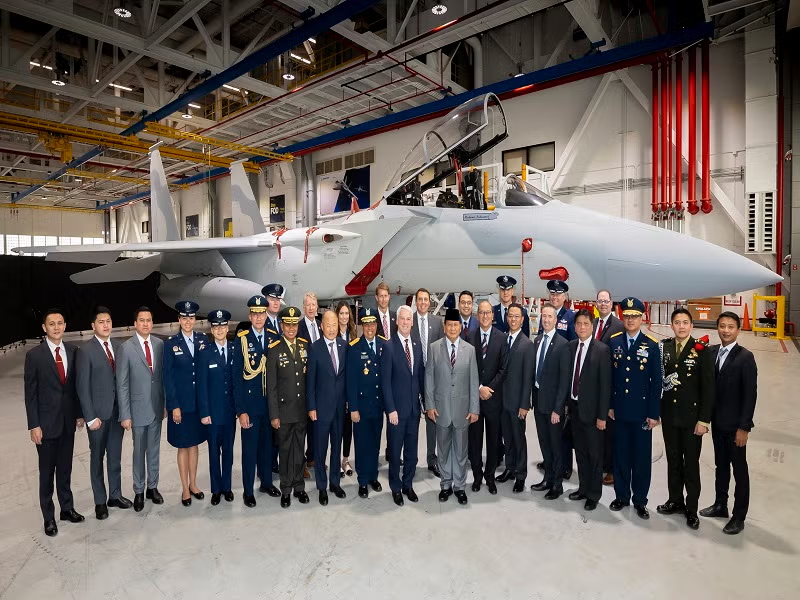
Financial Pressures, Bureaucratic Friction, and the Reality of Indonesia’s Defence Budget
At the core of the F-15EX collapse lies the hard arithmetic of Indonesia’s defence spending, with the 2026 defence budget estimated at approximately US$9.5 billion, or around RM45.1 billion, rendering the US$13.9 billion F-15EX package fiscally disproportionate within Jakarta’s multi-year procurement envelope.
The scale of the proposed F-15EX acquisition inevitably competed with Indonesia’s parallel commitment to acquire 42 Dassault Rafale fighters valued at roughly US$8.1 billion, or RM38.5 billion, a deal already consuming a significant share of available capital expenditure capacity.
Indonesia’s post-pandemic fiscal recovery, combined with major national investments in infrastructure, social programmes, and industrial development, further constrained defence capital allocations, intensifying internal scrutiny over high-cost, single-platform acquisitions with limited domestic industrial spillover.
Compounding these pressures, the Foreign Military Sales framework subjected the deal to prolonged approval cycles, introducing political risk and uncertainty amid persistent U.S. congressional sensitivities regarding Indonesia’s internal security operations, particularly in Papua.
These dynamics created a widening gap between operational urgency and procurement execution, frustrating Indonesian planners while simultaneously diminishing Boeing’s confidence in securing a timely and bankable contract.
In this context, Boeing’s strategic decision to reallocate resources toward more mature and politically secure campaigns elsewhere in the Asia-Pacific reflects rational industrial calculus rather than abrupt disengagement.
Strategic Repercussions for TNI-AU and the Search for Viable Alternatives
The termination of the F-15EX pursuit leaves the Indonesian Air Force reliant on a heterogeneous fleet of 33 upgraded F-16s, 11 Su-30MKs, five Su-27SKs, and FA-50 light fighters, a force structure increasingly strained by maintenance complexity, interoperability challenges, and divergent sustainment ecosystems.
Operationally, the absence of a heavy air superiority platform constrains Indonesia’s ability to project credible airpower across extended maritime distances, particularly in scenarios involving simultaneous airspace incursions and maritime coercion near the Natuna Exclusive Economic Zone.
The Rafale acquisition, with initial aircraft delivered in 2025 and squadron transition underway in early 2026, partially mitigates this gap, with Indonesian Air Force Chief Marshal Fadjar Prasetyo stating, “The Rafale will enhance our operational readiness and sovereignty in the skies,” reinforcing confidence in the platform’s multirole versatility.
However, Rafale alone cannot replicate the payload and endurance advantages envisioned under the F-15EX concept, necessitating supplementary solutions to sustain long-range deterrence and air dominance.
Alternative pathways, including revisiting Russia’s Su-35 or accelerating participation in South Korea’s KF-21 Boramae programme, remain constrained by sanctions risk, funding disputes, and technology transfer friction.
Emerging interest in cost-effective platforms such as Pakistan’s JF-17 Thunder Block III reflects pragmatic recalibration, with one analyst observing, “The JF-17 Thunder gives Indonesia a modern, independent, and flexible fighter jet,” highlighting its sanctions-free profile and manageable lifecycle costs.
Indo-Pacific Implications and the Erosion of U.S. Defence Influence in ASEAN
Boeing’s withdrawal reverberates beyond Indonesia, raising questions about the durability of U.S. defence influence in ASEAN as regional states increasingly diversify suppliers to hedge against political conditionality and procurement uncertainty.
In the South China Sea, Indonesia’s airpower modernisation delays risk weakening collective deterrence dynamics, particularly as neighbouring states accelerate fighter acquisitions to counter China’s expanding air and naval footprint.
The episode underscores how non-aligned states like Indonesia must carefully balance strategic autonomy against the operational necessity of advanced Western platforms, navigating a narrowing corridor between Washington and Beijing.
For the United States, the loss of the F-15EX campaign highlights structural limitations within its export model when engaging partners unwilling or unable to absorb prolonged approval cycles and political oversight.
Despite this setback, Boeing remains focused on a projected US$65 billion Asia-Pacific defence market, with Peters emphasising, “Despite this, we see tremendous opportunities,” signalling a pivot toward partners with more predictable procurement trajectories.
Ultimately, Indonesia now faces a decisive strategic moment, determining whether Boeing’s withdrawal becomes a catalyst for diversified self-reliance or a lingering vulnerability within one of the Indo-Pacific’s most contested security environments.
More broadly, the unraveling of the F-15EX campaign reinforces a perception within ASEAN defence establishments that U.S. arms transfers increasingly carry strategic strings that complicate long-term force planning, encouraging regional air forces to pursue multi-vendor procurement strategies as insurance against political disruption or export control reversals.
This dynamic risks diluting Washington’s traditional leverage within Southeast Asia’s defence ecosystem, as European, Korean, and even South Asian aerospace suppliers position themselves as politically lower-risk alternatives capable of delivering advanced capabilities without the same degree of strategic conditionality.
From an Indo-Pacific security architecture perspective, Indonesia’s stalled high-end fighter modernisation weakens the cumulative airpower balance that underpins regional deterrence, particularly in scenarios requiring coordinated responses to coercive air and maritime actions by major powers in the South China Sea.
Over time, such procurement outcomes may incrementally reshape ASEAN’s strategic alignment patterns, not through overt geopolitical realignment, but through the quiet, structural reconfiguration of defence supply chains that ultimately determines interoperability, doctrine, and strategic influence across the region.
— DEFENCE SECURITY ASIA
