
India Declares Massive Arabian Sea Missile Zone Days After Pakistan’s SMASH Test, Triggering New India-Pakistan Naval Standoff
India’s four-day missile firing and naval aviation exercise across the Arabian Sea has transformed Pakistan’s recent SMASH anti-ship ballistic missile launch into a wider naval confrontation between South Asia’s nuclear-armed rivals.
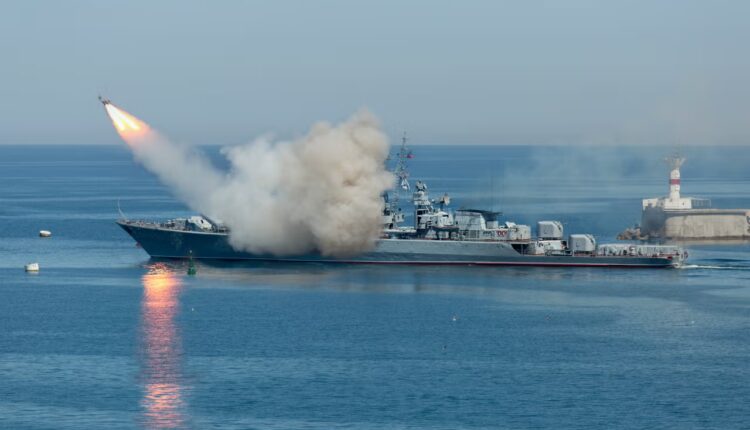
(DEFENCE SECURITY ASIA) — The Indian Navy’s decision to declare a four-day missile firing and naval aviation exercise across a vast Arabian Sea exclusion zone has transformed Pakistan’s recent SMASH anti-ship ballistic missile test into a broader regional confrontation.
Issued only days after Pakistan’s live-fire demonstration, India’s new NOTAM establishes a restricted operating area extending roughly 400 kilometres offshore, immediately intensifying military signalling between South Asia’s nuclear-armed rivals.
The sequence has strategic significance because it reveals an increasingly deliberate pattern in which Pakistan demonstrates offensive capability, India collects intelligence, and both governments subsequently reinforce deterrence through carefully calibrated maritime exercises.

Indian naval planners have deliberately scheduled the exercise between 22 and 25 April 2026, creating a sustained four-day operational window intended to maximise combat readiness, weapons integration and maritime surveillance opportunities.
The exclusion zone stretches from sea level to 30,000 feet near India’s western coastline, encompassing waters adjacent to critical naval infrastructure around Goa, Karnataka and India’s broader western seaboard.
Although Indian authorities have not publicly identified the missile systems involved, the scale, duration and geometry of the restricted zone strongly suggest combined aircraft, warship and missile coordination drills.
The timing has amplified international concern because Pakistan’s Navy had only recently completed live-fire testing of the SMASH anti-ship ballistic missile in the northern Arabian Sea.
Pakistan’s naval chief, Admiral Naveed Ashraf, personally observed the missile trial, underscoring Islamabad’s intention to present SMASH as a credible asymmetric capability against larger Indian surface combatants.
Indian planners responded before the Pakistani launch window even concluded, deploying the specialised missile-tracking and ocean-surveillance vessel INS Dhruv into international waters on 13 April.
That rapid deployment demonstrated that the real contest inside the Arabian Sea now extends beyond missiles themselves toward intelligence gathering, signature collection, targeting databases and long-term maritime deterrence calculations.
READ: Pakistan’s New P-282 SMASH Missile Could Force India’s Aircraft Carriers Out of the Arabian Sea
Pakistan’s SMASH Missile Has Forced India Into A Wider Maritime Response
Pakistan’s mid-April exclusion zones covered waters near Karachi, Ormara, Gwadar and Sonmiani, establishing a large operational corridor ranging between approximately 200 and 450 kilometres offshore.
The initial warning covered 14 to 15 April, while a follow-on restricted area between 20 and 21 April suggested continuing missile preparation, telemetry monitoring and post-launch naval activity.
Islamabad subsequently confirmed successful testing of SMASH, an indigenously developed ship-launched anti-ship ballistic missile designed specifically to threaten hostile surface vessels at extended range.
Unlike conventional anti-ship cruise missiles, anti-ship ballistic missiles travel along high-speed trajectories, creating shorter warning periods and increasing pressure on naval defensive systems and command networks.
Pakistan’s smaller navy has increasingly embraced such asymmetric capabilities because anti-ship ballistic missiles potentially threaten expensive Indian carriers, destroyers and logistics vessels without matching India numerically.
The strategic logic is clear because even a limited Pakistani anti-ship ballistic missile inventory could complicate Indian naval planning across the Arabian Sea and northern Indian Ocean.
Pakistan therefore appears determined to create an anti-access environment in which Indian warships must operate farther offshore, reducing operational freedom during any future crisis.
India’s new exercise zone, almost twice the size of Pakistan’s most recent restricted area, appears intended to demonstrate that New Delhi retains escalation dominance at sea.

INS Dhruv Reveals That Intelligence Collection Is The Real Battlefield
The most consequential Indian response did not involve a missile launch but rather the forward deployment of INS Dhruv into international waters before Pakistan’s exercise began.
INS Dhruv carries large radomes housing advanced active electronically scanned array radars, telemetry receivers and electronic intelligence equipment designed specifically to monitor missile launches.
By positioning the vessel near Pakistan’s exercise area, India gained an opportunity to collect valuable information regarding SMASH launch procedures, trajectory behaviour and electronic signatures.
Such information can later strengthen India’s ballistic missile defence architecture, improve radar discrimination algorithms and refine future naval interception or counter-targeting plans.
Modern missile tests are therefore rarely isolated military events because every launch simultaneously becomes an intelligence opportunity for hostile observers, satellites, aircraft and specialised surveillance ships.
Pakistan’s demonstration of SMASH may consequently have revealed more than Islamabad intended, particularly if INS Dhruv successfully recorded emissions, radar cross-sections and terminal manoeuvre characteristics.
The contest resembles a maritime intelligence duel in which each side deliberately stages exercises while simultaneously attempting to exploit the other’s operational transparency.
That dynamic increasingly transforms the Arabian Sea into a contested intelligence battlespace where ships, satellites and electronic warfare systems compete continuously beneath the threshold of open conflict.
India’s Exercise Area Signals Broader Force Projection Beyond Pakistan
India’s newly declared restricted zone occupies waters near the western coastline, close to important naval air facilities including INS Hansa and the broader Kadamba maritime complex.
The location provides India with the ability to coordinate maritime patrol aircraft, naval fighters, surface combatants and potentially land-based missile systems within a single operational framework.
Because the exercise remains within India’s broader maritime zone yet overlaps heavily used international waters, it also communicates India’s ability to control strategic approaches rapidly.
The zone’s reported triangular geometry extending approximately 400 kilometres offshore suggests planners are testing long-range targeting, fleet coordination and layered maritime strike procedures.
A four-day exercise window allows repeated launch cycles, continuous aircraft sorties and prolonged command-and-control operations, providing greater training value than a shorter demonstration.
The decision to establish a vertical restriction extending from the surface to 30,000 feet also indicates close integration between naval aviation and ship-based missile operations.
India has recently tested systems such as the Medium-Range Surface-to-Air Missile in the Arabian Sea, making it plausible that air-defence validation remains part of the exercise.
New Delhi’s broader objective appears to involve demonstrating not merely retaliatory capability against Pakistan but also a wider capacity for sustained blue-water naval operations.
The Arabian Sea Is Becoming The New Frontline In India-Pakistan Rivalry
For decades, India and Pakistan concentrated their strategic competition primarily along land borders and contested airspace, while the maritime domain remained comparatively secondary.
That balance is now shifting because the Arabian Sea increasingly offers both governments opportunities for deterrence, intelligence gathering and military signalling without immediate escalation.
The region is strategically important because it contains critical sea lines of communication supporting oil imports, container traffic and naval access to the wider Indian Ocean.
Any future crisis involving the Arabian Sea would therefore carry consequences extending far beyond South Asia, potentially affecting global shipping routes and international energy markets.
The recent sequence demonstrates how both sides increasingly rely upon published NOTAMs and maritime warnings to conduct controlled competition beneath the nuclear threshold.
These warnings reduce the risk of accidental collisions or airspace violations, yet they also normalise increasingly frequent military activity across crowded commercial waters.
Pakistan’s growing maritime relationship with China adds another dimension because Chinese-origin systems, technology and naval cooperation continue strengthening Islamabad’s seaborne deterrent posture.
India meanwhile seeks to preserve maritime superiority by expanding surveillance, missile defence and long-range naval aviation capabilities throughout the Arabian Sea and wider Indian Ocean.
READ: Arabian Sea Flashpoint: India Deploys Missile-Tracking Ship INS Dhruv as Pakistan Prepares Strategic Missile Launch
Neither Side Wants War, But Both Are Preparing For One
Despite heightened military signalling, neither government has issued statements explicitly linking India’s exercise to Pakistan’s missile launch or suggesting imminent confrontation.
Indian officials have described the exclusion zone as a standard safety measure supporting naval aircraft and ship firing activity within designated maritime training areas.
Pakistan likewise framed its SMASH launch as a routine demonstration of indigenous capability intended to validate combat readiness rather than initiate escalation.
Nevertheless, the sequencing creates a powerful strategic narrative because Pakistan showcased offensive capability, India monitored the launch, then India staged an even larger exercise.
That progression allows both governments to reassure domestic audiences, deter adversaries and signal operational confidence without crossing the threshold into direct military confrontation.
The Arabian Sea consequently represents a textbook example of managed competition, where both militaries deliberately balance aggressive signalling with sufficient restraint to avoid crisis instability.
Such competition remains expensive because sustained naval deployments, missile exercises and intelligence collection missions consume substantial operational resources, fuel and maintenance funding.
India’s four-day exercise likely involves assets collectively worth several billion dollars, while Pakistan’s SMASH programme offers a comparatively inexpensive method of challenging those formations.
If a single Indian destroyer costs approximately US$1 billion, equivalent to RM3.8 billion, Pakistan’s strategy increasingly relies upon forcing expensive countermeasures through lower-cost missile threats.
The result is an increasingly dangerous but carefully managed rivalry in which the Arabian Sea has become the newest frontier for South Asia’s enduring strategic competition.
The geography of the latest Indian exclusion zone is especially significant because it sits astride approaches linking Pakistan’s coastline with critical shipping lanes leading toward the Gulf and western Indian Ocean.
Any future Indian ability to monitor or dominate these waters would complicate Pakistan’s wartime access to imported energy, commercial shipping and reinforcement routes supporting naval operations.
Pakistan’s recent emphasis upon Gwadar, Ormara and Karachi during its own missile activity indicates that Islamabad increasingly views these ports as frontline strategic infrastructure.
The involvement of areas near Sir Creek further heightens sensitivity because the disputed maritime boundary has repeatedly served as an enduring flashpoint between both countries.
Indian naval aircraft operating from western coastal bases can reach the northern Arabian Sea rapidly, allowing India to sustain high sortie rates during any prolonged maritime confrontation.
Pakistan, by contrast, must increasingly depend upon missile-based denial strategies because its fleet remains substantially smaller and less capable of maintaining continuous blue-water presence.
That imbalance explains why systems such as SMASH carry disproportionate strategic importance, since even limited missile inventories could force India to disperse warships and complicate carrier operations.
The continuing cycle of Pakistani missile tests, Indian surveillance deployments and reciprocal naval exercises therefore suggests that future India-Pakistan crises may unfold first at sea rather than along traditional land borders.
