
USS ‘Hunger Games’: Viral Photos From USS Abraham Lincoln and USS Tripoli Expose Dangerous Weakness in U.S. Navy Iran War Logistics
Sparse meal trays aboard two frontline U.S. warships enforcing the Iran blockade are triggering global concern over American naval readiness, morale and long-term combat sustainability.

(DEFENCE SECURITY ASIA) — The viral photographs emerging from USS Abraham Lincoln and USS Tripoli have rapidly transformed from an embarrassing morale issue into a broader warning about America’s ability to sustain prolonged naval operations against Iran.
The images, showing sparse meals aboard two frontline warships enforcing a blockade against Iranian ports, immediately raised questions about whether the U.S. Navy’s logistical network is already approaching operational strain.
Because both vessels remain locked into extended Middle East deployments without scheduled port visits, food shortages now carry consequences extending beyond morale toward readiness, endurance, and sustained combat effectiveness.
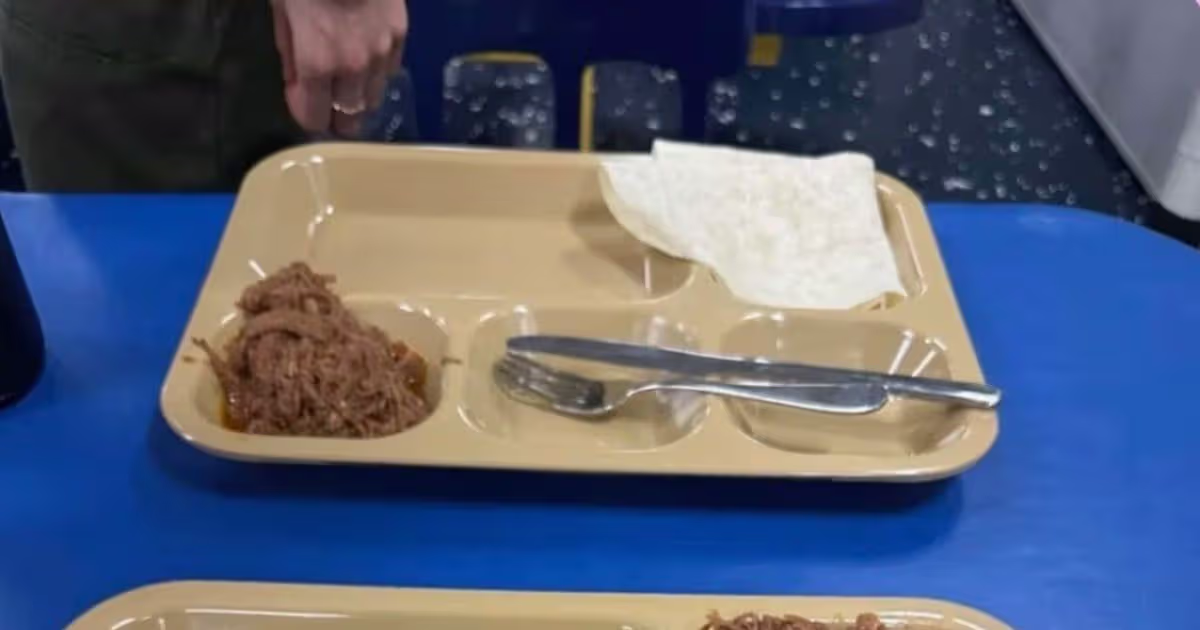
One sailor’s lunch tray aboard USS Tripoli reportedly contained only a small scoop of shredded meat and a folded tortilla, while another dinner aboard USS Abraham Lincoln featured boiled carrots, processed meat and a dry patty.
Those images circulated globally within hours under the phrase “USS Hunger Games,” creating a powerful narrative that the world’s most sophisticated navy may be confronting unexpectedly basic supply limitations.
The controversy intensified after family members revealed that mail deliveries to twenty-seven military ZIP codes across the Middle East have remained suspended since April because of regional airspace disruptions.
That suspension has trapped thousands of care packages containing food, hygiene products, socks and morale items inside secure storage facilities, preventing families from supplementing increasingly inadequate shipboard supplies.
A Texas mother whose son serves aboard USS Tripoli warned that supplies were “going to get really low,” while Karen Erskine-Valentine described USS Abraham Lincoln meals as tasteless and insufficient.
Their remarks have become strategically significant because neither the Pentagon nor the U.S. Navy has publicly denied the allegations, clarified supply levels or outlined corrective measures.
The absence of an official rebuttal has allowed adversaries, especially Iran-aligned media and social-media networks, to weaponise the controversy as evidence of American logistical vulnerability.
Viral Meal Photos Are Revealing a Deeper Naval Sustainment Problem
The USS Abraham Lincoln, a Nimitz-class aircraft carrier carrying approximately 5,000 personnel, and USS Tripoli, an America-class amphibious assault ship carrying roughly 3,500 sailors and Marines, depend entirely upon continuous resupply.
Unlike short-duration crisis deployments, current blockade operations against Iran require both vessels to remain at sea for extended periods without predictable access to regional ports.
That operational pattern forces commanders to rely heavily upon at-sea replenishment, whereby supply ships transfer food, fuel and ammunition while both vessels remain underway.
Although at-sea replenishment can sustain combat operations for weeks, fresh food remains especially difficult because produce deteriorates quickly and refrigeration space aboard warships remains limited.
Families connected to both crews described sailors dividing food portions equally whenever serving sizes differed, indicating that scarcity may already be influencing daily routines aboard ship.
Reports that fresh produce has largely disappeared from shipboard menus further suggest commanders may have already shifted toward preserving remaining stocks for future contingencies.
Such decisions are militarily significant because reduced calorie intake and declining food quality directly affect alertness, endurance, reaction times and long-term psychological resilience during sustained deployments.
For aviation crews, weapons handlers and watchstanders operating around the clock, even minor nutritional degradation can gradually reduce overall combat effectiveness across an entire carrier strike group.

Mail Suspension Has Created a Second Logistics Crisis Across the Middle East
The suspension of military mail deliveries has deepened the crisis because care packages often compensate for shortcomings within official shipboard supply systems during prolonged deployments.
The U.S. Postal Service and Military Postal Service Agency halted deliveries to twenty-seven military ZIP codes after regional airspace closures disrupted established transportation routes across the Middle East.
Officials described the measure as a standard wartime precaution, yet they have not provided a timeline for restoring service despite the subsequent ceasefire.
That uncertainty matters because many sailors and Marines have now spent weeks expecting packages that never arrived, creating an additional layer of frustration and helplessness.
Families reportedly spent thousands of dollars shipping cookies, protein bars, deodorant, instant food, socks and hygiene products before learning those packages remained indefinitely trapped.
One father reportedly sent two care boxes nearly a month earlier, only to discover both remained suspended inside an undisclosed distribution facility.
Churches, veterans’ groups and community organisations have also assembled packages for deployed personnel, meaning the disruption extends beyond individual households toward broader national support networks.
Strategically, the mail suspension demonstrates how even modest interruptions to civilian logistics systems can magnify military supply problems during extended naval operations.
Iran and America’s Rivals Are Exploiting the Narrative for Information Warfare
Iranian media outlets and pro-Iran social-media accounts quickly amplified the photographs because they provide an unusually effective propaganda tool against American regional credibility.
For Tehran, the images support a broader narrative that the United States can deploy overwhelming firepower yet struggles sustaining those forces during protracted confrontation.
Russian and Chinese commentators have likewise circulated the photographs extensively because they reinforce long-standing arguments about the fragility of American expeditionary logistics.
The phrase “USS Hunger Games” proved especially damaging because it converted a complex logistical issue into a memorable slogan easily understood across multiple languages and audiences.
Information warfare increasingly depends less upon battlefield victories than upon emotionally powerful imagery that appears to expose institutional weakness or declining morale.
A nearly empty lunch tray therefore carries strategic significance far beyond its immediate nutritional value because it symbolises a perceived failure of planning and preparation.
The controversy also arrives during a period when American naval credibility already faces scrutiny because of extended deployments, maintenance delays and rising operational demands elsewhere.
Without a clear official explanation, adversaries can continue portraying the photographs as evidence that American military power remains more vulnerable than Washington publicly acknowledges.
Extended Iran Operations Are Beginning to Strain the Broader U.S. Force Posture
USS Abraham Lincoln and USS Tripoli are not operating alone because additional American naval forces, including other carrier groups, remain deployed or moving toward the region.
USS Gerald Ford and other major vessels reportedly face their own maintenance pressures, extended deployments and compressed preparation cycles as Washington sustains its regional presence.
That broader operational picture matters because prolonged crises frequently expose the cumulative effect of small logistical failures across multiple formations simultaneously.
When several major warships remain deployed beyond their originally planned schedules, resupply networks become increasingly stretched and contingency margins begin disappearing.
The current crisis therefore suggests the United States may be approaching the outer limits of sustainable naval pressure against Iran without meaningful operational pauses.
A blockade campaign requires continuous aviation operations, weapons readiness, intelligence collection, maritime patrols and around-the-clock watchstanding, all of which consume supplies relentlessly.
If commanders must simultaneously conserve food, ration amenities and manage declining morale, their capacity to sustain intensive operations gradually weakens over time.
That possibility could eventually influence Washington’s strategic calculations because force posture becomes increasingly difficult to maintain when logistical pressure exceeds available replenishment capacity.
American logistics planners now face an additional complication because carrier strike groups operating near Iran require far greater replenishment frequency than comparable peacetime deployments.
Each day at sea demands thousands of kilograms of frozen food, fresh water, aviation fuel and packaged rations for nearly 8,500 personnel aboard USS Abraham Lincoln and USS Tripoli.
Because both vessels remain continuously engaged in blockade patrols, helicopter operations and combat air patrol support, their fuel and supply consumption rates have reportedly accelerated significantly.
That tempo increases dependence upon Military Sealift Command replenishment ships, which themselves become vulnerable bottlenecks if regional ports, airspace or sea lanes remain contested.
Any interruption affecting only one replenishment vessel could rapidly cascade across the entire American naval presence because multiple warships often depend upon identical supply schedules.
The lack of scheduled port visits also removes opportunities for crews to purchase supplementary food, hygiene products and comfort items normally obtained during liberty ashore.
Historically, even during the Iraq War and operations after September 11, American warships periodically entered regional ports, allowing logistical pressure and morale problems to ease temporarily.
The present deployment appears different because commanders increasingly prioritise continuous operational presence near Iran over traditional rotation patterns and port access.
That decision may strengthen immediate strategic signalling toward Tehran, yet it simultaneously increases the long-term risk of exhaustion, declining morale and cumulative logistical degradation.
The Food Controversy Has Become a Warning About Future Maritime Warfare
The broader significance of the controversy extends beyond Iran because modern maritime warfare increasingly depends upon sustaining forces rather than simply deploying them.
Future conflicts in the Persian Gulf, South China Sea or western Pacific would likely involve similarly contested logistics routes and prolonged operational isolation.
A warship can carry sophisticated missiles, advanced radar systems and strike aircraft, yet those advantages become progressively less useful if basic sustainment begins deteriorating.
The lesson emerging from USS Abraham Lincoln and USS Tripoli is therefore fundamentally about resilience, endurance and the hidden vulnerability of global military supply chains.
Even the strongest navy in the world remains dependent upon a vast logistical architecture linking warehouses, transport aircraft, replenishment ships and civilian postal systems.
The reported food shortages and mail suspension reveal how quickly that architecture can come under pressure once conflict disrupts established movement patterns.
Because the United States has built its global power around long-distance expeditionary operations, maintaining those supply chains may ultimately prove as important as winning battles.
The images from two American warships therefore represent more than an embarrassing viral story because they expose a strategic vulnerability every future adversary will now study carefully.
