
China’s DF-27 Hypersonic Missile Launchers Spotted in Busy City Streets, Signaling Beijing’s New Long-Range Strike Readiness
New footage of suspected DF-27 transporter-erector-launchers moving through crowded Chinese streets suggests the PLA Rocket Force is preparing its most powerful conventional hypersonic missile for routine operational deployment.

(DEFENCE SECURITY ASIA) — A convoy of heavily camouflaged military launch vehicles moving through crowded Chinese city streets has provided the clearest public indication yet that China’s DF-27 hypersonic missile force is transitioning from theoretical capability toward routine operational deployment.
The footage, recorded by civilians and circulating across Chinese social media since April 19, appeared amid intensifying concern throughout the Indo-Pacific regarding Beijing’s growing ability to threaten regional bases, naval formations, and distant logistical infrastructure.
Although Chinese authorities have issued no public statement, the apparent movement of suspected DF-27 transporter-erector-launchers through an ordinary urban environment effectively confirms confidence within the PLA Rocket Force regarding operational readiness and survivability.

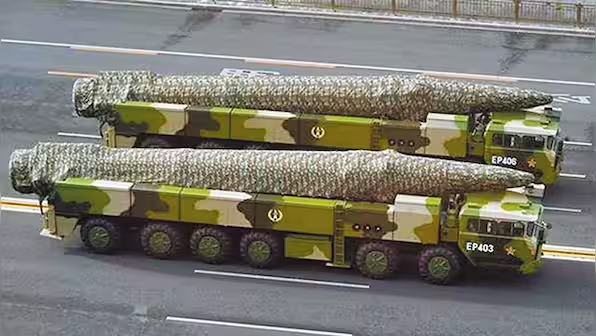
Several open-source analysts assessed the convoy as probable DF-27 launchers because the vehicles appear significantly larger than previously observed DF-17 systems, with an unusually long twelve-wheel, multi-axle chassis configuration.
The vehicles were photographed traveling beside civilian traffic, road barriers, overhead bridges, trees, and modern commercial buildings, creating an unusually revealing snapshot of how China intends to conceal strategic missile systems.
One widely circulated assessment concluded that the launcher dimensions, axle arrangement, and extensive camouflage netting closely match previous imagery associated with the DF-27 program photographed during late 2025.
The sighting also reinforces previous Pentagon assessments describing the DF-27 as China’s longest-range conventionally armed strike missile and potentially the first conventionally armed intercontinental-range system fielded anywhere.
Because the convoy appeared without visible security cordons, military escorts, or major road closures, the footage suggests Chinese planners increasingly rely upon dispersal, unpredictability, and civilian infrastructure for missile survivability.
The absence of confirmed geolocation has further amplified international attention because uncertainty regarding the launchers’ exact position directly contributes to the strategic ambiguity central to Chinese missile doctrine.
For Washington and allied planners, the convoy underscores how China’s expanding road-mobile missile force could complicate pre-emptive targeting, surveillance persistence, and crisis-response timelines across the wider Indo-Pacific battlespace.
The sighting is particularly significant because the DF-27 reportedly combines conventional precision-strike capability with hypersonic speed, allowing Beijing to threaten distant military infrastructure without immediately crossing the nuclear threshold.
By revealing only the launcher chassis while concealing the missile itself beneath dense camouflage netting, the PLA appears to have deliberately maximized deterrent value while preserving uncertainty regarding exact payload and readiness.
READ: China’s DF-27A Hypersonic Missile Test Redefines Strategic Strike Warfare as Mach 8.6 Glide Vehicle Challenges U.S. Missile Defences
The Convoy Reveals a Missile Force Designed for Mobility and Concealment
The convoy consisted of multiple green digital-camouflage trucks carrying long, rectangular payload containers concealed beneath dark camouflage netting stretched tightly across the launcher structure.
Analysts identified at least six visible axles in several frames, while others argued the complete transporter configuration probably includes twelve wheels, indicating a significantly heavier missile than earlier Chinese systems.
That physical scale matters because the DF-27 reportedly combines a large solid-fueled missile booster with a hypersonic glide vehicle requiring greater internal volume and launch support.
Unlike silo-based missiles, road-mobile transporter-erector-launchers can relocate repeatedly across highways, secondary roads, and urban corridors, making pre-emptive targeting substantially more difficult during a regional crisis.
The footage showed the convoy moving in disciplined formation alongside civilian vehicles, suggesting the movement represented a routine readiness drill rather than an emergency deployment or heightened alert.
Chinese missile forces have historically used public roads to mask movements because major highways, rail corridors, and industrial routes naturally intersect densely populated urban areas.
The lack of overt security presence therefore should not be interpreted as negligence, because concealment within ordinary traffic may itself constitute the intended protective measure.
By permitting such movements to remain partially visible while obscuring the missile payload beneath camouflage netting, the PLA appears to balance operational secrecy with deliberate strategic signaling.
Why the DF-27 Matters More Than Earlier Chinese Missile Systems
The DF-27 occupies an unusually important position within China’s missile inventory because it bridges the gap between traditional intermediate-range ballistic missiles and longer-range intercontinental systems.
Current assessments place the missile’s range between 5,000 and 8,000 kilometers, giving the weapon potential reach across the entire Western Pacific and beyond.
From launch positions inside mainland China, the system could theoretically threaten Guam, Alaska, Hawaii, northern Australia, and portions of the continental United States.
That reach dramatically expands the strategic depth of Chinese conventional strike operations because the missile can hold distant logistics hubs and reinforcement routes at risk.
The DF-27 reportedly carries a hypersonic glide vehicle capable of maneuvering above Mach 5, allowing unpredictable flight paths that complicate existing missile-defense architectures.
Unlike conventional ballistic missiles following relatively predictable trajectories, hypersonic glide vehicles can alter altitude, direction, and terminal approach during the final phase.
Those characteristics reduce warning time for defending forces and complicate interception by systems optimized for traditional ballistic or cruise missile threats.
The missile reportedly possesses both land-attack and anti-ship roles, making it particularly significant for any future confrontation involving carrier strike groups operating inside the Pacific.
The Sighting Suggests the DF-27 Is Already Fully Operational
The latest footage is strategically important because it supports previous assessments that the DF-27 has moved beyond development and entered active military service.
Similar launcher vehicles covered beneath camouflage netting were photographed during November 2025, although those earlier images provided fewer visible details regarding configuration and operational movement.
The April 2026 convoy therefore represents the second major public appearance of the system within six months, significantly strengthening confidence among independent analysts.
That pattern aligns closely with previous official assessments describing the DF-27 as already fielded within the PLA Rocket Force rather than remaining experimental.
The launcher size also corresponds with previous descriptions identifying the missile as substantially larger than the DF-17, which uses a smaller transporter configuration.
If the launcher truly carries the DF-27, the footage would represent indirect confirmation that multiple launchers already exist and are sufficiently operational for regular road deployment.
Such a development would indicate that China is rapidly expanding the number of survivable, mobile hypersonic systems available during a regional contingency.
It would also reinforce broader concerns that China now possesses the world’s largest and most diversified inventory of operational hypersonic weapons.
Beijing’s Strategic Message Extends Beyond the Missile Itself
The most important element of the convoy may not be the missile itself, but the strategic message conveyed through its visible movement.
By allowing civilians to record the convoy while avoiding any official explanation, Chinese authorities created a carefully controlled mixture of exposure and uncertainty.
That approach strengthens deterrence because foreign militaries are forced to assume the launchers are genuine while remaining unable to verify precise capabilities.
The uncertainty surrounding the missile’s payload, deployment location, and operational status therefore becomes a strategic asset rather than an intelligence failure.
The convoy also demonstrates that China intends to protect critical missile forces through constant movement, concealment, and geographic dispersion rather than fixed installations.
Such an approach complicates the targeting calculations of the United States and its regional allies because launchers can disappear rapidly inside civilian infrastructure.
The apparent willingness to move strategic missile systems through densely populated urban areas further suggests Beijing accepts substantial operational risk to preserve survivability.
That decision reflects a broader Chinese doctrine emphasizing mobility, ambiguity, and the ability to sustain missile operations despite enemy surveillance or pre-emptive attack.
READ: Hypersonic Arms Race: Is the United States Losing to Russia and China?
The Urban Convoy Highlights a New Phase in Indo-Pacific Missile Competition
The appearance of suspected DF-27 launchers inside an ordinary Chinese city will likely intensify ongoing missile-defense planning throughout the Indo-Pacific.
Military planners in the United States, Japan, Australia, and other regional states already view hypersonic weapons as among the most difficult emerging threats.
The DF-27 is especially concerning because its combination of long range, maneuverability, and road mobility challenges every stage of existing defensive planning.
Fixed bases, logistics nodes, fuel depots, and naval facilities become more vulnerable when launchers can relocate quickly and strike from unpredictable positions.
The system’s anti-ship role is equally significant because it potentially extends Chinese “carrier killer” coverage much farther beyond the traditional First Island Chain.
If operationally mature, the missile could force American and allied naval forces to operate farther from contested areas during a future regional crisis.
That would increase transit times, complicate reinforcement schedules, and potentially weaken the credibility of extended deterrence across the Western Pacific.
Until higher-resolution imagery, verified geolocation, or official Chinese acknowledgment emerges, uncertainty will remain regarding the precise launcher and missile configuration.
Yet even without definitive confirmation, the convoy has already achieved its strategic effect by demonstrating that China’s hypersonic missile force appears increasingly mobile, survivable, and operationally credible.
The emergence of such launchers will likely accelerate regional investment in distributed basing, hardened infrastructure, and next-generation missile-defense systems designed specifically to counter maneuvering hypersonic threats.
It may also intensify pressure upon the United States to deploy additional long-range strike assets, interceptor networks, and persistent surveillance platforms across Guam, Japan, and Australia.
More broadly, the footage suggests the Indo-Pacific missile competition is entering a new phase in which mobility, ambiguity, and survivable conventional hypersonic weapons increasingly shape the regional balance of power.
