
New American Fighter Giant Emerges as USAF Selects Anduril and General Atomics for Autonomous Airpower War Against China
The U.S. Air Force’s selection of Anduril’s FQ-44 Fury and General Atomics’ FQ-42 Dark Merlin signals a transformational shift toward autonomous loyal wingman warfare, scalable combat mass, and next-generation Indo-Pacific air superiority operations against advanced Chinese A2/AD networks.

(DEFENCE SECURITY ASIA) — The United States Air Force has formally selected Anduril Industries and General Atomics to enter engineering and manufacturing development alongside production for the Collaborative Combat Aircraft program, triggering the most consequential restructuring of American tactical airpower doctrine since the introduction of stealth combat aircraft during the Cold War.
The decision positions Anduril’s FQ-44 “Fury” and General Atomics’ FQ-42 “Dark Merlin” as the first operationally relevant semi-autonomous combat aircraft designed specifically for high-intensity warfare against peer adversaries operating advanced anti-access and area-denial battlespaces.
The contract award simultaneously marks the first time in more than five decades that a newly established defence technology company has secured a U.S. fighter aircraft program, disrupting an industrial structure historically dominated by legacy aerospace primes since the 1970s.
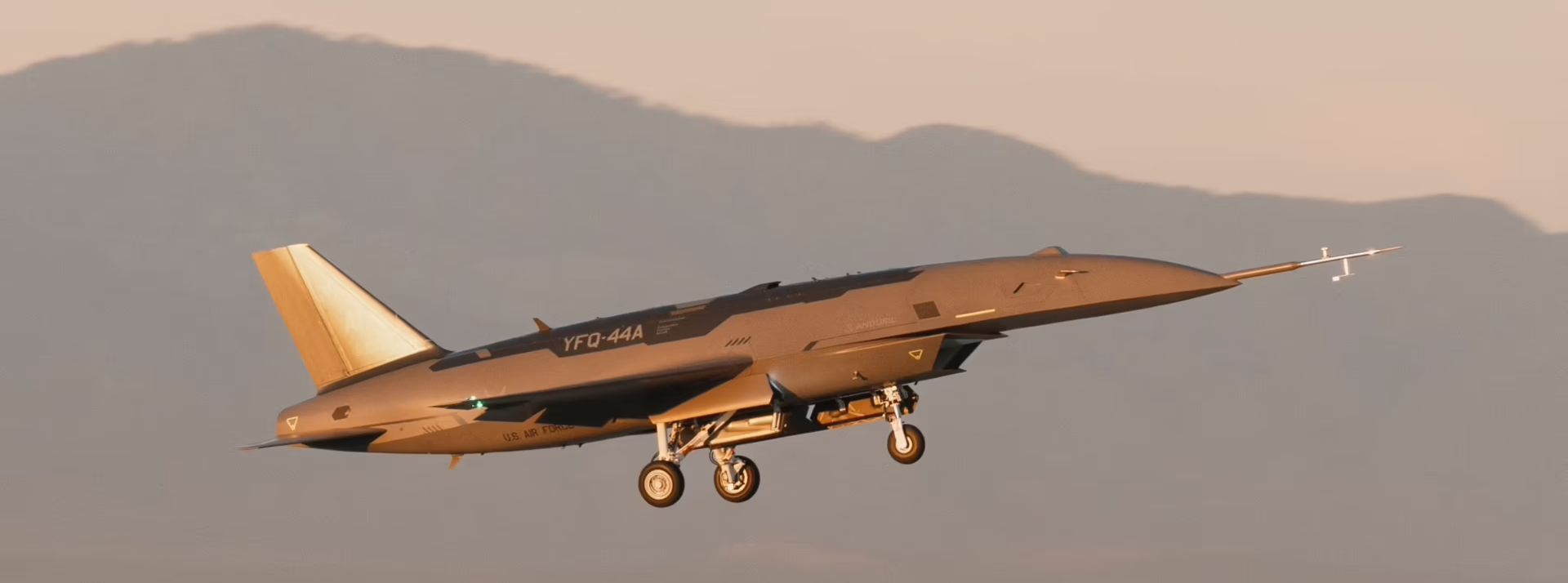
The rapid emergence of Anduril from a 2017 software-focused defence startup into a Pentagon-backed producer of next-generation combat aircraft reflects a deeper institutional shift toward software-defined warfare, scalable autonomous mass, and accelerated military innovation cycles.
The U.S. Air Force confirmed that Increment 1 of the Collaborative Combat Aircraft initiative will focus on production-representative aircraft intended for operational testing, force integration, validation, and eventual frontline deployment alongside manned combat aircraft formations.
The program directly supports future manned-unmanned teaming operations involving the F-35 Lightning II, F-22 Raptor, F-15EX Eagle II, and future sixth-generation combat systems associated with the Next Generation Air Dominance architecture.
American military planners increasingly view semi-autonomous collaborative combat aircraft as essential for sustaining air superiority against China’s rapidly expanding fighter inventory, integrated sensor networks, and superior industrial-scale military production capacity.
The development timeline behind the FQ-44 Fury has intensified international attention because the aircraft advanced from prototype award to production contract within approximately two years, representing the fastest fighter-class aircraft transition in more than half a century.
Anduril revealed that the clean-sheet aircraft progressed from semi-autonomous prototype development to first flight in only 556 days, compressing timelines traditionally associated with multi-decade tactical fighter acquisition programs.
The Pentagon’s accelerated endorsement of autonomous combat aviation reflects growing concern that conventional crewed fighter procurement cannot generate sufficient numerical mass, operational survivability, or sortie sustainability for prolonged high-end conflict against peer competitors.
The Air Force intends to field more than 150 combat-capable Collaborative Combat Aircraft by the end of the decade while longer-term planning envisions approximately 1,000 semi-autonomous aircraft operating through successive competitive production increments.
That force structure objective fundamentally alters the future balance between expensive high-end crewed aircraft and lower-cost autonomous combat systems capable of distributed operations, sensor extension, electronic warfare support, decoy missions, and missile carriage in contested theatres.
Affordable Mass and the Return of Scalable Tactical Airpower
The Collaborative Combat Aircraft program is designed to restore what Pentagon planners increasingly describe as “affordable mass,” addressing decades of shrinking fighter inventories caused by escalating procurement costs associated with advanced crewed combat aircraft.
Modern fifth-generation fighters including the F-35 and F-22 routinely exceed USD100 million per aircraft or approximately RM380 million, while sustainment costs, pilot training burdens, and maintenance requirements continue constraining fleet expansion rates.
China’s aerospace industry meanwhile has dramatically expanded production of advanced fighters including the J-20 stealth aircraft and increasingly sophisticated support systems, creating mounting concern regarding American force availability during prolonged Indo-Pacific contingency operations.
The CCA program therefore represents a strategic attempt to offset Chinese numerical advantages through large-scale deployment of semi-autonomous aircraft capable of augmenting crewed fighter operations at significantly lower acquisition and operational costs.
Pentagon planners estimate that Collaborative Combat Aircraft could cost roughly one-third or less than advanced crewed fighters while simultaneously reducing long-term sustainment expenditures, pilot pipeline pressures, and operational risk exposure in high-threat environments.
That affordability enables the Air Force to pursue distributed force posture concepts involving larger aircraft numbers operating across dispersed bases under Agile Combat Employment doctrines designed for Pacific theatre survivability.
The FQ-44 Fury’s relatively compact configuration supports rapid deployment, short-field operations, modular mission adaptation, and scalable production strategies intended to generate combat mass unavailable through traditional fighter procurement models alone.
Estimated specifications indicate the aircraft measures approximately 20 feet or 6.1 metres in length with a wingspan of roughly 17 feet or 5.2 metres while maintaining maximum takeoff weight near 5,000 pounds or 2,268 kilograms.
The aircraft reportedly employs a Williams FJ44-4M turbofan generating approximately 4,000 pounds of thrust, enabling speeds approaching Mach 0.95 alongside operational ceilings reaching approximately 50,000 feet in contested operational environments.
Military planners increasingly assess that scalable autonomous aircraft numbers may prove strategically more decisive than small fleets of highly exquisite manned platforms during sustained attritional conflict against technologically sophisticated peer adversaries.
The broader shift toward affordable mass therefore reflects not simply budgetary efficiency but a fundamental recognition that industrial production scale, sortie generation rates, and combat replenishment capacity increasingly define modern military advantage.

FQ-44 Fury and the Evolution of Loyal Wingman Warfare
The FQ-44 Fury is specifically designed as a semi-autonomous unmanned combat aerial vehicle optimized for manned-unmanned teaming operations where autonomous aircraft cooperate directly with crewed fighters during combat missions.
This “loyal wingman” operational concept allows human pilots flying crewed aircraft to command, coordinate, or collaborate with multiple autonomous platforms simultaneously, dramatically expanding battlespace awareness, survivability, and combat reach during high-intensity operations.
The aircraft’s modular architecture supports rapid integration of mission-specific payloads including intelligence, surveillance, reconnaissance systems, electronic warfare packages, decoy systems, and air-to-air missile carriage depending upon operational requirements.
Available information indicates the FQ-44 incorporates low-observability design elements intended to reduce detection vulnerability during penetration operations against integrated air defence systems and advanced enemy sensor networks.
The platform also features open-system architecture enabling rapid software upgrades through Anduril’s Lattice autonomy ecosystem, allowing mission algorithms, sensor fusion capabilities, and command-and-control functions to evolve continuously alongside emerging threats.
The aircraft can reportedly switch between different autonomy software suites during flight operations, demonstrating unusually flexible mission adaptation capacity compared with conventional tactical aviation software integration models.
Anduril confirmed that multiple Fury prototypes are already conducting regular flight operations involving varied mission profiles, airfield conditions, and operational configurations intended to accelerate validation for operational deployment.
The aircraft has additionally demonstrated integration with inert air-to-air munitions including AIM-120 Advanced Medium-Range Air-to-Air Missile-compatible carriage configurations supporting future combat integration scenarios.
The Fury originated from Blue Force Technologies’ earlier “Grackle” and “REDmedium” aggressor aircraft concepts before Anduril acquired the program during 2023 and rapidly transformed it into a Collaborative Combat Aircraft contender.
That transition illustrates how commercial-style acquisition agility and software-centric engineering increasingly enable defence startups to compress development timelines traditionally dominated by bureaucratic aerospace procurement structures.
Operationally, loyal wingman aircraft are expected to perform high-risk missions including forward sensor penetration, enemy radar suppression, missile absorption, escort operations, decoy deployment, and distributed targeting support for crewed strike formations.
Countering China’s A2/AD Battlespace and Indo-Pacific Kill Chains
The strategic logic behind the Collaborative Combat Aircraft program is heavily shaped by China’s anti-access and area-denial architecture designed to restrict American air operations across the Western Pacific and Taiwan contingency environments.
Chinese military doctrine increasingly relies upon integrated long-range missile systems, advanced air defence networks, airborne early warning platforms, electronic warfare assets, and distributed sensor architectures intended to disrupt American force projection capability.
American wargaming assessments reportedly indicate that traditional crewed fighter formations operating without autonomous support face escalating survivability challenges against dense Chinese missile engagement zones and integrated kill-chain structures.
Collaborative Combat Aircraft therefore provide the Air Force with scalable semi-autonomous systems capable of complicating adversary targeting cycles while expanding operational flexibility across contested airspace environments.
Military planners envision FQ-44 aircraft leading forward sweep operations intended to overwhelm enemy air defence networks through distributed targeting, electronic warfare support, decoy activity, and sensor disruption operations.
Autonomous aircraft could additionally identify targets for follow-on crewed strike packages while exposing hostile radar systems, missile batteries, and airborne surveillance aircraft to precision engagement opportunities.
The ability to absorb enemy missile expenditure using lower-cost semi-autonomous aircraft substantially alters exchange-ratio calculations that currently favour adversaries targeting expensive crewed platforms with comparatively cheaper interceptor systems.
The CCA architecture also supports distributed operational concepts under Agile Combat Employment strategies where autonomous aircraft can operate from dispersed airfields complicating enemy targeting against concentrated American airpower infrastructure.
The FQ-44’s relatively compact size, short-field capability, and modular logistics footprint align directly with Indo-Pacific operational requirements involving austere basing, rapid dispersal, and contested sustainment conditions across island chains.
American commanders increasingly believe that hybrid formations pairing crewed stealth aircraft with large autonomous support fleets could impose unacceptable operational uncertainty upon Chinese military planners during potential regional crises.
The strategic objective therefore extends beyond platform acquisition because the Pentagon is effectively redesigning future air combat doctrine around distributed autonomy, resilient force posture, and scalable attritable combat mass capable of surviving peer warfare.
Breaking America’s Traditional Defence Industrial Structure
Anduril’s contract victory represents one of the most important industrial disruptions within the American aerospace sector because major fighter aircraft programs historically remained dominated by established defence primes for more than fifty years.
The Pentagon’s willingness to entrust a new entrant with production responsibilities signals mounting frustration regarding the speed, cost structures, and innovation limitations associated with traditional military procurement ecosystems.
Anduril’s transition from prototype award during April 2024 to production contract during June 2026 dramatically contrasts with legacy tactical fighter development cycles frequently extending across decades before operational deployment occurs.
Ground testing reportedly began during April 2025 before the Fury conducted its first semi-autonomous flight on October 31, 2025, establishing one of the fastest development timelines recorded for fighter-class aircraft.
The Air Force announced the production decision approximately four months ahead of the expected schedule, reinforcing institutional confidence regarding both the platform’s technical maturity and Anduril’s manufacturing readiness.
Central to that confidence is Anduril’s Arsenal-1 hyperscale manufacturing facility located in Columbus, Ohio, which was specifically designed for high-volume autonomous aircraft production using modern industrial automation principles.
The company states the facility’s current configuration supports annual production capacity reaching approximately 150 aircraft while enabling parallel design iteration and rapid manufacturing adaptation for evolving operational requirements.
That manufacturing strategy intentionally differs from conventional fighter production approaches because autonomous systems require scalable throughput, rapid software integration, and continuous configuration evolution rather than static multi-decade platform standardisation.
The split award structure involving both Anduril and General Atomics additionally reduces programmatic risk while preserving competitive pressure intended to improve performance and suppress long-term procurement costs.
The broader industrial implication is that future military advantage may increasingly depend upon software adaptability, production scalability, and development speed rather than solely aerodynamic sophistication or exquisite platform survivability.
The Pentagon’s endorsement of software-native defence companies therefore represents a calculated effort to inject commercial technology-sector agility into American military modernization and strategic competition against rapidly advancing adversary defence industries.
Deterrence, Autonomous Warfare, and America’s Future Force Posture
The Collaborative Combat Aircraft initiative ultimately represents a doctrinal transformation rather than a conventional aircraft procurement program because it fundamentally changes how the United States intends to generate combat power during peer conflict.
American defence planners increasingly assess that future air superiority will depend upon integrating autonomous systems, distributed operations, resilient logistics, and scalable production capacity into a unified force architecture.
The emergence of semi-autonomous combat aircraft introduces new deterrence dynamics because adversaries must now account for potentially large autonomous formations capable of conducting coordinated operations across multiple contested operational domains.
That uncertainty complicates enemy operational planning by expanding the number of airborne threats, sensors, decoys, and strike vectors confronting integrated air defence systems during high-intensity conflict scenarios.
The Pentagon additionally views autonomy as a mechanism for reducing pilot exposure during high-risk missions involving heavily defended airspace where attrition rates for conventional crewed operations could become strategically unacceptable.
The operational integration of autonomous aircraft alongside crewed fighters also accelerates the evolution toward system-of-systems warfare where combat effectiveness derives increasingly from networked collaboration rather than individual platform performance alone.
Anduril’s emphasis on open architectures and rapid upgrade pathways reflects recognition that future threats will evolve faster than traditional procurement cycles can accommodate using conventional acquisition methodologies.
The Air Force’s objective of operational capability before the end of the decade demonstrates growing urgency regarding the Indo-Pacific military balance and the perceived narrowing timeline for maintaining credible deterrence against China.
Strategically, the CCA program aligns directly with broader National Defense Strategy priorities emphasizing force survivability, Indo-Pacific deterrence, distributed combat operations, and scalable military modernization under conditions of accelerating great-power competition.
The emergence of autonomous loyal wingman aircraft therefore represents not simply technological innovation but a foundational restructuring of future American airpower doctrine, industrial mobilization strategy, and operational force posture for high-end warfare.
If operational integration succeeds at projected scale, the FQ-44 Fury and broader Collaborative Combat Aircraft ecosystem may ultimately redefine the relationship between autonomy, air superiority, force projection, and deterrence throughout twenty-first century military competition.
