
China’s J-16 Fighters Reach Egypt, Expanding Beijing’s Combat Reach
Six J-16 fighters supported by KJ-500 airborne command-and-control and Y-20 strategic airlift are testing China’s expeditionary combat reach across Pakistan, Egypt and the strategically vital Suez corridor.
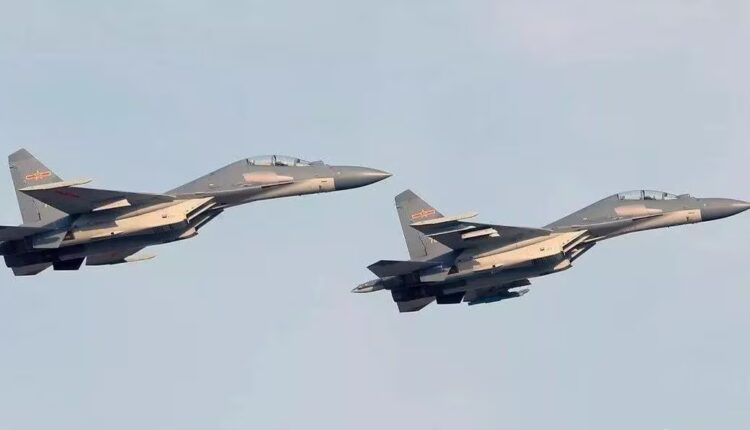
(DEFENCE SECURITY ASIA) — China’s deployment of at least six J-16 multirole fighters towards Egypt represents a consequential test of expeditionary airpower, extending the People’s Liberation Army Air Force’s operational footprint across Asia, Africa, and the Middle East.
The aircraft are assigned to Eagles of Civilization 2026, the second China-Egypt bilateral air exercise, scheduled from mid-August until early September and focused on air superiority, combat tactics, force employment, and personnel recovery.

Unlike the lighter J-10C formation deployed during the inaugural 2025 exercise, the heavier J-16 package demonstrates greater combat radius, payload capacity, sensor integration, and endurance across a geographically demanding deployment corridor linking China with Egypt.
The core formation photographed in Pakistan comprised at least six J-16 fighters, one KJ-500 airborne early-warning and control aircraft, and one Y-20 strategic transport, although individual aircraft identities remain incompletely verified.
A possible Yun-9LG electronic-warfare aircraft has also been reported, but available information remains insufficient for confirmation, requiring the platform’s presence and operational role to be treated cautiously until clearer evidence emerges.
China’s official announcement identified the exercise dates and training objectives without specifying participating aircraft, leaving open-source imagery as the principal basis for assessing force composition, transit movements, and the deployment’s military significance.
The fighters were photographed at Karachi’s Jinnah International Airport on August 20, creating unusually visible evidence of a Chinese combat-aircraft deployment normally expected to receive greater operational security at military-controlled facilities.
Their presence in Pakistan exposes the logistical architecture supporting China’s westward airpower projection, with friendly transit access reducing deployment risk while connecting PLAAF bases with strategically positioned partners across the Eurasian operating corridor.
The deployment therefore extends beyond bilateral training because it tests route planning, ground servicing, command-and-control connectivity, personnel support, and heavy-aircraft sustainment across several thousand kilometres from established Chinese military infrastructure.
Egypt’s control of the Suez Canal gives the exercise wider geopolitical weight, positioning Chinese combat aviation near a maritime chokepoint connecting European markets with the Indian Ocean, Red Sea, and Asian manufacturing centres.
For Cairo, deeper engagement with Beijing expands operational and procurement options alongside American, French, and Russian systems, reinforcing Egypt’s ability to diversify defence relationships without abandoning its established multi-supplier force structure.
For China, Eagles of Civilization 2026 measures whether increasingly capable combat formations can deploy, integrate, train, and return across distant theatres while supporting Beijing’s broader diplomatic interests throughout Africa and the Middle East.
(CLICK HERE):China’s J-16 “Missile Truck” Unleashes 8× PL-15 Beast Mode: New PLAAF Air Combat Doctrine Could Redefine Taiwan Strait And Indo-Pacific Air Superiority
J-16 Deployment Tests China’s Expeditionary Combat-Air Architecture
The Shenyang J-16 is a tandem-seat, 4.5-generation Flanker-derived multirole fighter designed to combine long-range interception, air-superiority, precision-strike, and networked combat functions within a heavier platform than the J-10C deployed previously.
Substituting J-16s for the earlier J-10C package raises the exercise’s operational ceiling because Egypt can evaluate a larger combat aircraft capable of supporting extended air-control, maritime-strike, and complex force-employment scenarios.
The platform’s substantial internal fuel capacity supports an estimated ferry range between 3,000 and 4,000 kilometres, making the approximately 3,500-kilometre Karachi-to-Egypt sector operationally plausible following ground refuelling in Pakistan.
Most available imagery showed the fighters in a clean ferry configuration without visible external fuel tanks, indicating that internal fuel, carefully managed routing, and possible tanker availability could sustain the westward movement.
That configuration reduces aerodynamic drag while preserving external stations, but imagery alone cannot establish actual fuel planning, reserve requirements, tanker participation, flight profiles, diversions, or contingency arrangements across the transit corridor.
The J-16’s arrival would represent its first participation in the China-Egypt exercise series and only its third confirmed overseas deployment, underscoring how selectively Beijing has exposed this strategically important combat platform abroad.
Its rarity makes the movement more significant than routine defence diplomacy because every foreign deployment tests maintenance reliability, mission planning, aircrew endurance, navigation procedures, and interoperability outside familiar domestic support networks.
Deploying six fighters also creates a tactically meaningful formation capable of conducting opposing-force scenarios, mixed packages, escort missions, air-superiority drills, and coordinated operations under KJ-500 airborne battle-management direction during the exercise.
However, no public confirmation had established the main fighter package’s arrival in Egypt by August 20, meaning its final destination, Egyptian operating base, training configuration, and complete support footprint remained unresolved.
The deployment should consequently be assessed as an expeditionary capability demonstration in progress, not evidence of permanent basing, combat commitment, or unrestricted Chinese capacity to sustain large fighter forces continuously overseas.

KJ-500 and Y-20 Reveal the Mission’s Operational Backbone
The KJ-500 is central to the package because airborne early warning transforms six independently capable fighters into a networked force able to detect threats, distribute tracks, coordinate engagements, and manage contested airspace.
Its presence enables the exercise to move beyond elementary formation flying towards sensor-led air combat, where aircraft can receive broader battlespace awareness and prosecute targets without relying exclusively upon their organic radar coverage.
Whether the aircraft is a baseline KJ-500 or upgraded KJ-500A remains uncertain, preventing definitive conclusions regarding specific communications, endurance, refuelling, sensor, or data-fusion capabilities assigned to the Egyptian training mission.
A KJ-500 observed departing Islamabad towards Egypt demonstrates that the deployment architecture may involve distributed Pakistani transit locations, potentially separating fighter staging, command aircraft movements, logistics activity, and operational-security requirements.
The Y-20 strategic transport supplies the essential logistics mass behind the visible fighter deployment, carrying personnel, spares, maintenance equipment, ground-support systems, and other material required to sustain high-performance aircraft away from China.
At least one Y-20A reportedly reached Egypt on August 18 as an advance element, suggesting that Chinese planners positioned technicians and equipment before the combat formation attempted the longer final transit sector.
Advance logistics are strategically important because fighter deployments depend upon serviceable runways, specialised tools, trained ground crews, replacement components, fuel-quality assurance, communications support, accommodation, security, and coordinated host-nation access.
The combined J-16, KJ-500, and Y-20 structure therefore resembles a compact expeditionary air package, integrating combat mass, airborne command-and-control, and strategic lift instead of presenting fighters as an isolated diplomatic symbol.
Possible tanker support would further strengthen that structure, although available information does not confirm tanker participation during the 2026 transit, and operational feasibility should not be mistaken for verified aerial-refuelling activity.
The package demonstrates that strategic airlift and airborne battle management are force multipliers for overseas fighter operations, determining whether China can translate aircraft range into sustained, coordinated, and politically usable military presence.
Pakistan Transit Exposes a Strategic Air Bridge Towards Egypt
Pakistan’s role as a transit partner provides China with a geographically valuable staging point between East Asia and Egypt, shortening individual flight sectors while enabling refuelling, technical inspections, crew recovery, and logistical reorganisation.
Jinnah International Airport’s use instead of nearby Pakistan Air Force facilities generated extensive public photography, but the decision’s operational rationale remains unknown and should not automatically imply permanent procedures or unrestricted civilian-airport access.
Local observers recorded parked aircraft, taxiing activity, flight movements, and loud afterburner departures, providing evidence of transit activity while offering limited insight into mission planning, payloads, readiness, or technical condition.
Civilian-airport staging can offer runway capacity and established services, yet it also increases visibility, complicates operational security, and exposes aircraft movements to commercial passengers, local residents, aviation enthusiasts, and foreign intelligence collection.
Partial serial markings visible on several airframes have not been conclusively resolved, leaving uncertainty over their parent units, maintenance histories, crew affiliations, and whether every photographed aircraft continued towards Egypt.
Pakistan’s position converts bilateral military trust into practical access, demonstrating how diplomatic partnerships can generate operational depth by providing intermediate infrastructure for long-distance Chinese deployments towards Africa and the Middle East.
This transit architecture does not equal an overseas basing network, because temporary access lacks the assured infrastructure, legal arrangements, stockpiles, permanent personnel, protection systems, and political durability associated with established foreign installations.
Nevertheless, repeated Chinese activity in Pakistan could build familiarity with local procedures, airspace coordination, maintenance requirements, emergency handling, and route management, progressively reducing friction during subsequent westward deployments or multinational exercises.
The 2024 Indus Shield-Chinese exercise already involved J-16s, J-10Cs, a KJ-500, an electronic-warfare platform, and HQ-22 air defences, giving both air forces experience coordinating advanced Chinese systems under bilateral training conditions.
Pakistan consequently functions as more than a refuelling stop because previous interoperability provides a foundation for handling Chinese combat formations, although the scope of direct Pakistani operational support during this deployment remains undisclosed.
Egypt Exercise Links Airpower with Suez Canal Geopolitics
Eagles of Civilization 2026 concentrates on air-combat tactics, air-superiority operations, combat search and rescue, and force employment, collectively testing how Chinese and Egyptian personnel coordinate aircraft, sensors, missions, and recovery procedures.
These subjects matter operationally because air superiority depends upon detecting, assigning, engaging, and recovering forces under pressure, requiring compatible procedures even when participating air forces operate fundamentally different aircraft and support ecosystems.
Egypt fields American F-16s, French Rafales, Russian MiG-29s, and older aircraft, creating a diversified force whose separate supply chains and operating doctrines complicate integration but provide unusual opportunities for comparative tactical learning.
Chinese aircraft give Egyptian personnel direct exposure to another advanced combat ecosystem, potentially informing future training, doctrine, or equipment evaluations, although participation does not establish an acquisition decision or formal technology-transfer programme.
The 2025 exercise included J-10C fighters, trainers, a KJ-500, YY-20 tankers, and Y-20 transports conducting air-superiority, suppression, battlefield-recovery, and mixed-formation activities, establishing the foundation for the heavier 2026 package.
Progressing from J-10Cs to J-16s suggests growing confidence in Egyptian support arrangements and Chinese deployment planning, while enabling more demanding scenarios involving longer endurance, heavier mission loads, and broader sensor-supported force employment.
Egypt became the first Arab and African country to recognise the People’s Republic of China in 1956, giving the exercise additional diplomatic significance during the seventieth anniversary of bilateral relations in 2026.
Contemporary cooperation operates through bilateral diplomacy and wider mechanisms including the Belt and Road Initiative, BRICS, and China-Africa engagement, allowing military exercises to reinforce relationships spanning trade, infrastructure, politics, and security.
Suez Canal geography elevates this defence relationship because disruption around Suez, the Red Sea, or Bab el-Mandeb can affect commercial flows linking China with European, African, and Middle Eastern markets.
Military training near this corridor therefore carries strategic signalling beyond Egypt, demonstrating Chinese interest in cultivating defence relationships around waterways essential to global trade without confirming any commitment to provide regional security guarantees.
(CLICK HERE): China Simulates J-16 vs IAF Rafale Air Combat: Inside the PLAAF’s High-Stakes War Gaming and Indo-Pacific Power Signalling
Rare Overseas History Signals a Wider PLAAF Transformation
Before the Egyptian movement, the J-16 had made only two confirmed overseas appearances, first during Aviadarts 2021 in Russia and subsequently during the combat-oriented Indus Shield-Chinese exercise held in Pakistan during 2024.
In Russia, the PLAAF deployed eleven aircraft across five types, including J-10B and J-16 fighters, H-6K bombers, a Y-20 strategic transport, and a Y-9 tactical transport for international competition.
The J-16 entered the bomber category, where one Chinese crew recorded 323.5 points and finished behind a Russian Su-30SM, testing live-fire ground attack, navigation, and low-level flying over unfamiliar terrain.
Although competition differs from combat training, Aviadarts marked the type’s first operation from a foreign airfield, exposing crews and maintainers to overseas deployment procedures within the relatively supportive Russian military environment.
Indus Shield-Chinese represented a more operationally demanding progression, pairing Chinese J-16 and J-10C fighters with KJ-500 airborne surveillance, electronic warfare, and ground-based air defence during contemporary multi-domain air-combat scenarios.
Pakistani J-10C and JF-17 Block III fighters provided opposing or interacting forces, allowing both sides to examine interoperability among active electronically scanned-array radars, long-range engagements, command networks, and coordinated force employment.
Egypt now extends that progression farther west, moving the J-16 from neighbouring strategic partners towards an Arab and African power positioned beside one of the world’s most consequential maritime passages.
Simultaneous August exercises with Egypt, Thailand, and Belarus further suggest that the PLAAF is testing institutional capacity to coordinate international training across multiple relationships, although their locations, forces, and objectives differ substantially.
Swift Eagle 2026 involved Belarusian airborne and counter-terrorism training in China, while Falcon Strike 2026 combined Chinese J-10Cs, support aircraft, and ground-based air defences with Thai Gripens in another distinct operational setting.
Collectively, these exercises indicate expanding strategic reach beyond homeland defence, but the decisive measure will be whether China can repeatedly sustain complex packages overseas without relying upon exceptional access or heavily scripted conditions.
