
US Clears Potential $4.5 Billion KC-46A Sale to Qatar, Reshaping Gulf Airpower
The potential sale of four Boeing KC-46A Pegasus tankers would extend Qatar’s combat-aircraft endurance, reinforce Al Udeid Air Base and deepen United States-led coalition interoperability across the Middle East.
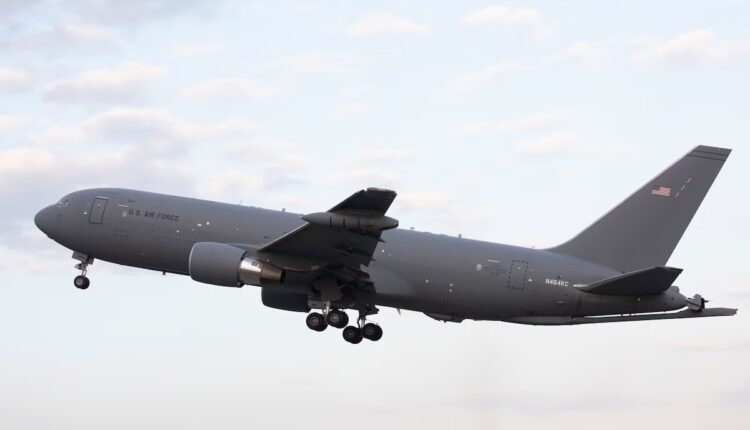
(DEFENCE SECURITY ASIA) — Washington has approved a potential $4.5 billion Foreign Military Sale covering four Boeing KC-46A Pegasus tankers for Qatar, creating a consequential pathway toward longer-range Gulf air operations and deeper United States-led interoperability.
The August 20, 2026 congressional notification is not a completed contract, yet it converts Qatar’s previously declared tanker interest into a formal acquisition process whose final price, configuration, schedule, and implementation remain negotiable.

If concluded, the purchase would give the Qatar Emiri Air Force an organic aerial-refuelling capability able to extend fighter endurance, reposition combat aircraft, sustain distant patrols, and support coalition operations beyond national airspace.
The proposed package reaches far beyond four airframes, incorporating spare engines, radar-warning receivers, infrared countermeasures, secure communications, training, construction, fuel, transportation, software, technical documentation, maintenance, and long-term logistics support infrastructure.
That breadth makes the case strategically significant because modern tanker power depends less upon aircraft ownership than upon trained crews, protected bases, secure mission systems, spare components, certification pathways, and dependable sustainment networks.
Qatar’s proposed acquisition also reinforces Al Udeid Air Base, where approximately 8,000–10,000 American personnel support United States Central Command’s forward headquarters, coalition air coordination, regional logistics, and expeditionary combat operations.
The notification follows Qatar’s 2025 commitment to invest $10 billion supporting Al Udeid and a wider defence framework involving prospective missile defence, combat aircraft, armoured vehicles, maritime security capabilities, and MQ-9B drones.
This linkage does not prove a single transactional bargain, but it indicates an expanding bilateral architecture in which Qatari infrastructure spending, American basing access, weapons procurement, and coalition burden-sharing increasingly reinforce one another.
Regional urgency has intensified following the 2026 United States-Israel-Iran conflict, Iranian missile and drone attacks against Gulf facilities, damage affecting Al Udeid, and strikes exposing vulnerabilities across military and energy infrastructure.
Against that environment, protected aerial refuelling becomes an operational enabler for dispersed basing, defensive counter-air patrols, long-distance interception, rapid reinforcement, and sustained sorties when fixed installations face surveillance or precision attack.
The State Department describes Qatar as a strategic regional partner contributing to political stability and economic progress, while assessing that Doha can absorb the systems without changing the Middle East’s basic military balance.
That official judgment deserves scrutiny because four tankers cannot independently overturn regional power, yet their enabling effect could substantially multiply Qatar’s fighter reach, coalition availability, air mobility, and strategic relevance during future crises.
(CLICK HERE) Qatar Captured Three Iranian Su-24 Pilots After Al Udeid Mission, Tehran Claims
Four KC-46A Tankers Would Multiply Qatar’s Combat Reach
The KC-46A, derived from Boeing’s 767 freighter, combines boom and probe-and-drogue refuelling, allowing Qatar to support differently configured receivers during one sortie while reducing dependence upon foreign tanker allocations during compressed emergencies.
Its approximate 212,299-pound fuel capacity and fly-by-wire boom, capable of transferring up to 1,200 gallons per minute, would enable sustained fighter packages, rapid top-offs, and more flexible patrol geometry.
Wing-mounted and centreline drogues transferring approximately 400 gallons per minute broaden receiver compatibility, an important feature for coalition operations involving aircraft whose refuelling interfaces, mission profiles, and national operating restrictions differ significantly.
Because the tanker can itself receive fuel airborne, mission planners could construct extended refuelling chains, preserve aircraft availability over distant sectors, and reduce predictable returns to bases vulnerable to missiles, drones, or surveillance.
The aircraft’s multi-role design accommodates up to eighteen 463L cargo pallets, normally 58 passengers, as many as 114 during contingencies, or aeromedical evacuation, turning each tanker into a strategic mobility asset.
Rapid reconfiguration reportedly requiring under two hours would let Doha shift scarce airframes between fuel transfer, personnel movement, logistics delivery, and casualty evacuation as operational priorities evolve during a regional confrontation.
Its approximate 415,000-pound maximum takeoff weight exceeds the older KC-135’s roughly 322,500 pounds, providing greater payload flexibility while reflecting the larger runway, parking, maintenance, fuel-storage, and ground-support demands accompanying modern tanker operations.
The KC-46A’s digital cockpit and remote boom operation improve information management, but they also require specialised training, software support, sensor calibration, mission-data governance, and disciplined human-machine procedures to achieve dependable operational performance.
For Qatar, the decisive capability would therefore be persistence rather than numerical mass, enabling a relatively small combat fleet to remain airborne longer, cover wider approaches, and integrate more effectively with American-led formations.
Four aircraft nevertheless impose availability constraints because training, scheduled maintenance, unscheduled repairs, and configuration changes will reduce mission-ready numbers, making spare parts, contractor responsiveness, and Qatari maintenance proficiency essential to credible wartime output.
Defensive Systems Push the Tanker Closer to Contested Airspace
The package includes ten AN/ALR-69A digital radar-warning receivers, with four installed and six spares, providing 360-degree threat detection, emitter identification, prioritisation, and improved awareness within dense electromagnetic environments containing hostile and friendly signals.
Greater warning range and frequency coverage could help crews recognise surveillance or engagement radars earlier, alter routing, coordinate escorts, or withdraw, although detection alone cannot make a large, non-stealthy tanker safe near advanced air defences.
Fifteen Guardian Laser Transmitter Assemblies are proposed for Large Aircraft Infrared Countermeasure systems, with twelve installed and three spare units, indicating three steerable laser transmitters intended for near-spherical protection on each aircraft.
Ultraviolet missile-warning sensors would cue coded multi-band infrared energy against heat-seeking missile seekers, improving survivability against weapons including man-portable air-defence systems that threaten large aircraft during departure, approach, or lower-altitude operations.
Eight replacement LAIRCM processors would support system resilience and future maintenance by managing warning sensors, laser transmitters, and aircraft interfaces, underscoring that countermeasure availability depends upon processors, software, databases, calibration, and technical support.
The defensive suite could permit operations closer to contested zones than an unprotected commercial derivative, but it cannot neutralise long-range surface-to-air missiles, fighter interception, runway attacks, cyber disruption, or coordinated electronic warfare.
Operational doctrine must therefore combine onboard protection with stand-off tanker tracks, fighter escorts, airborne warning, electronic-support measures, route unpredictability, dispersed recovery options, and real-time intelligence concerning adversary missile engagement zones.
The notification’s electronic-warfare database support is strategically important because warning receivers depend upon current emitter libraries, while incomplete or outdated threat data can delay classification and produce dangerously misleading crew responses.
Secure KIV-77 modules, KY-100M terminals, key loaders, AN/APX-119 identification systems, and precision navigation equipment would support protected communications and coalition identification, reducing fratricide risks while strengthening integration with American command networks.
These technologies introduce continuing dependencies upon cryptographic management, software releases, controlled technical data, and approved support channels, giving Washington enduring influence over readiness even after Qatar formally owns and operates the tankers.
Al Udeid Turns the Sale Into a Force-Posture Decision
Al Udeid’s Combined Air Operations Center, United States Central Command presence, and 379th Air Expeditionary Wing make Qatar central to regional air-tasking, logistics, surveillance, and coalition coordination rather than merely another Gulf weapons customer.
Qatari KC-46As operating from this ecosystem could access established runways, fuel systems, command relationships, maintenance expertise, and multinational planning processes, potentially accelerating integration compared with building an isolated tanker enterprise elsewhere.
The proposed facilities and construction support indicates that airfield adaptation forms part of the acquisition problem, potentially encompassing secure maintenance areas, mission-planning spaces, spares storage, specialised test equipment, fuel handling, and protected communications infrastructure.
No additional American government or contractor personnel are officially required in Qatar, although the package includes engineering, technical, logistics, training, site-survey, and contractor services whose duration and operating model remain publicly undefined.
That distinction matters because temporary teams, rotational specialists, remote support, and contractor visits can sustain sophisticated fleets without a formally declared permanent increase, leaving the eventual personnel footprint uncertain until implementation arrangements emerge.
Al Udeid’s exposure during 2026 also changes the basing calculation, demonstrating that concentrated command, fuel, aircraft, and communications assets can attract missile and drone attacks whose effects extend beyond physical aircraft losses.
Tanker survivability consequently begins on the ground through hardened shelters, distributed parking, rapid runway repair, redundant fuel storage, layered air defence, decoying, cyber resilience, and alternate operating locations across the coalition network.
The KC-46A’s ability to carry cargo and personnel could support dispersal by moving maintainers, components, communications equipment, and mission crews between regional bases, although four aircraft would remain insufficient for large-scale independent airlift demands.
Qatar’s $10 billion Al Udeid investment represents burden-sharing in American political terms, while Doha gains stronger security ties, institutional access, and a military infrastructure ecosystem capable of supporting increasingly sophisticated national capabilities.
The resulting posture is mutually reinforcing but asymmetric: Washington benefits from resilient regional access, whereas Qatar remains dependent upon American approvals, technology, munitions, software, training, and political continuity for high-end force generation.
Sustainment, Training and Spares Define the Real $4.5 Billion Capability
Eight Pratt & Whitney PW4062 engines are listed, comprising four installed powerplants and four spares, an unusually visible redundancy that could shorten grounding periods when engines require inspection, overhaul, repair, or replacement.
Each PW4062 produces approximately 62,000 pounds of thrust and draws upon the commercial PW4000 family, offering mature support experience while still demanding certified technicians, specialised tooling, controlled components, and disciplined maintenance planning.
High on-wing time exceeding 16,000 hours before major shop visits may support availability, but actual performance will depend upon operating tempo, environmental conditions, maintenance standards, supply access, and Qatar’s eventual support agreement.
The package also covers consumables, repair-and-return arrangements, instruments, laboratory equipment, warranties, publications, maps, software, modifications, training devices, transportation vehicles, clothing, jet fuel, and essential airlift support needed for sustained operations.
These apparently secondary items determine whether the tankers generate repeatable sorties after initial delivery, because aircraft without technicians, mission data, test equipment, replacement parts, or certified procedures quickly become strategically impressive but operationally brittle.
Training Qatari pilots, boom operators, maintainers, mission planners, logisticians, and security personnel will take time, while qualification standards and instructor availability could shape initial operating capability more strongly than the aircraft delivery date.
Full operational capability would additionally require receiver-aircraft certification, coalition exercises, refuelling doctrine, emergency procedures, secure-network integration, maintenance accreditation, and realistic sortie-generation testing across peacetime conditions and demanding high-threat combat scenarios.
The total $4.5 billion estimate therefore cannot be interpreted as a simple four-aircraft unit price, because it aggregates airframes, defensive systems, spares, facilities, training, sustainment, integration, transportation, software, and programme support.
Boeing would lead aircraft integration, Pratt & Whitney would provide engines, RTX would supply radar-warning technologies, and Northrop Grumman would support LAIRCM elements, creating a multi-company industrial chain requiring coordinated delivery and certification.
No offset agreement is presently known, leaving uncertain whether Qatar will seek domestic maintenance participation, workforce development, infrastructure investment, or industrial workshare during negotiations between Doha and the principal American contractors.
(CLICK HERE): Israel’s Hidden Missile Shield Inside Saudi and Qatar Air Forces Signals New Gulf Airpower Alliance Against Iran
Strategic Signalling, Congressional Review and the Gulf Balance
The congressional notification initiates review under the Arms Export Control Act rather than guaranteeing delivery, after which negotiations over a Letter of Offer and Acceptance could revise quantities, equipment, pricing, schedules, or support provisions.
This procedural distinction is essential because announced maximum values frequently describe broad ceilings, while final contracts can differ as requirements mature, negotiations progress, congressional concerns emerge, and implementation risks become better understood.
The proposal advances the tanker component of a broader 2025 defence agenda that also referenced THAAD, F-16 Desert Vipers, armoured and amphibious vehicles, MQ-9B aircraft, counter-drone systems, and maritime-security capabilities.
Together, those prospective capabilities suggest Qatar is pursuing a networked force able to detect threats, defend bases, sustain aircraft, project fighters, move personnel, and contribute specialised assets to multinational operations.
The 2025 transfer of a Qatari Boeing 747-8 to the United States generated ethical, constitutional, and security criticism, while American officials presented it as a separate, cost-saving bridge aircraft arrangement for presidential transport.
Temporal proximity between that aircraft transfer, infrastructure commitments, and defence notifications invites political scrutiny, but the provided information establishes no direct quid pro quo and requires the issues to remain analytically separated.
For neighbouring states, four KC-46As would signal expanding Qatari operational ambition without independently creating air superiority, since combat effect still depends upon receiver aircraft, weapons, intelligence, basing resilience, trained personnel, and coalition authorisation.
For Washington, the sale strengthens interoperability and distributes selected enabling burdens while anchoring Qatar more deeply within American technology, training, logistics, and command ecosystems during an increasingly volatile Middle Eastern security cycle.
For Doha, the acquisition would offer strategic reach and diplomatic relevance, but also expose critical dependence upon a small tanker fleet whose readiness could be constrained by maintenance bottlenecks, base attacks, or external support interruptions.
The decisive question is therefore not whether Qatar obtains four advanced tankers, but whether it can transform aircraft, defensive systems, infrastructure, personnel, and coalition access into resilient sortie generation under sustained regional attack.
