
U.S. Supercarrier Forced to Flee Red Sea: USS George H.W. Bush Takes 6,000-Mile Detour Around Africa as Houthi Threat Rewrites Global Naval Strategy
The USS George H.W. Bush carrier strike group is bypassing the Red Sea and Bab el-Mandeb Strait, revealing how Houthi missile and drone attacks are forcing even the U.S. Navy’s most powerful assets to reroute around Africa.
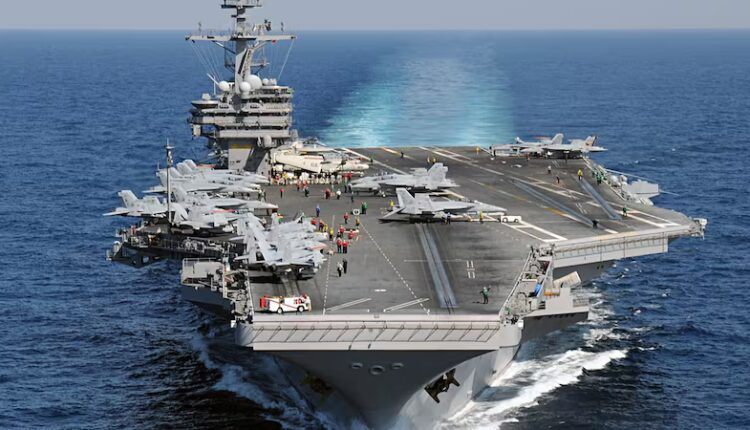
(DEFENCE SECURITY ASIA) — The United States has quietly acknowledged that even its most powerful naval formation can no longer assume safe passage through the Red Sea, forcing the USS George H.W. Bush carrier strike group into a dramatically longer route around Africa.
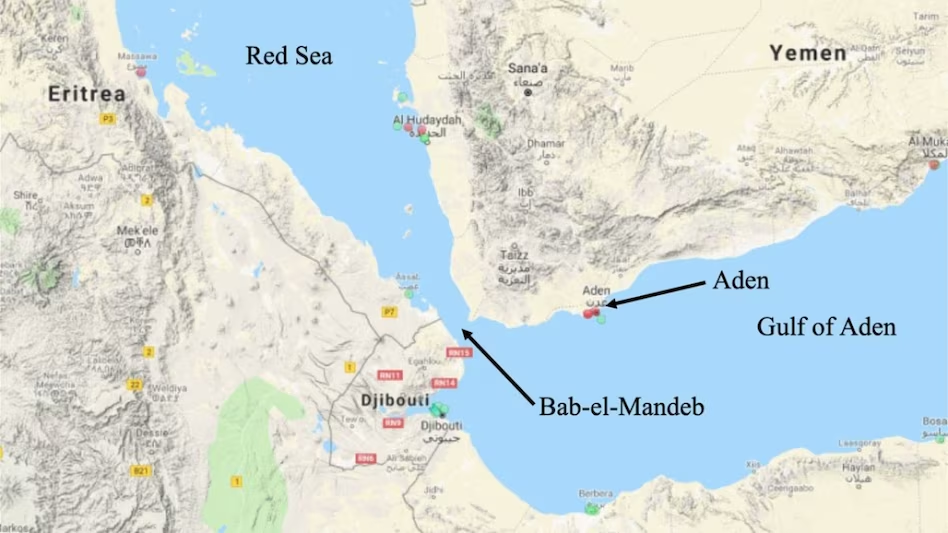
Operating off Namibia in mid-April 2026, the nuclear-powered carrier and accompanying warships are bypassing the Bab el-Mandeb Strait because sustained Houthi missile, drone and small-boat threats have transformed the corridor into a prohibitive battlespace.
The decision carries consequences far beyond a single deployment because it demonstrates that an Iranian-backed non-state force has succeeded in reshaping American naval movement across one of the world’s most strategically essential maritime chokepoints.
U.S. officials confirmed that the USS George H.W. Bush strike group departed Naval Station Norfolk during late March, yet deliberately rejected the traditional Mediterranean, Suez Canal and Red Sea transit route toward CENTCOM.
Instead, the Nimitz-class carrier, accompanied by roughly 5,000 sailors and aviators from Carrier Air Wing Seven, is circling the Cape of Good Hope before entering the Indian Ocean and Arabian Sea.
The revised deployment route reflects an operational calculation that preserving the combat credibility of a high-value naval asset outweighs the political symbolism traditionally associated with uninterrupted carrier freedom of navigation.
President Donald Trump’s announcement of a U.S. blockade around the Strait of Hormuz on April 12 has amplified that urgency because the George H.W. Bush strike group is now sailing toward an increasingly volatile regional theatre.
Its arrival will reinforce an already expanding American maritime posture centred upon the Arabian Sea, where multiple carrier groups, amphibious forces and destroyers are converging following the collapse of an early-April ceasefire.
That concentration of naval power now risks creating the densest American carrier presence near Iran since the opening stages of the Iraq War, significantly increasing the possibility of miscalculation or unintended escalation.
By forcing Washington to reroute a supercarrier before it even enters the combat theatre, the Houthis have already achieved a strategic effect disproportionate to their conventional military capabilities.
The longer transit also provides Iran additional time to reposition naval, missile and air-defence assets around the Strait of Hormuz before the George H.W. Bush enters operational range.
For American planners, the episode underscores that future naval supremacy will depend increasingly upon protecting maritime logistics corridors rather than merely dominating battlespace through superior firepower.
READ: German Warships Directed to Avoid Red Sea Amid Fears of Houthi Attacks
The Longest Carrier Transit in Years
The USS George H.W. Bush carrier strike group was photographed earlier during Atlantic transit before open-source ship-tracking indicators placed the formation near Namibia between April 13 and April 14.
Rather than crossing Gibraltar, transiting the Mediterranean and entering the Suez Canal, the strike group is now executing a route extending thousands of additional nautical miles around southern Africa.
That detour significantly increases fuel consumption, maintenance demands, crew fatigue and logistical complexity, even though the carrier itself is nuclear-powered and therefore less constrained by conventional refuelling requirements.
The strike group includes the guided-missile destroyers USS Donald Cook, USS Mason and USS Ross, alongside the Supply-class fast combat support ship USNS Arctic supporting sustained operations.
USNS Arctic is particularly important because the extended route requires additional replenishment capacity for aviation fuel, precision-guided munitions, spare parts and high-tempo carrier aviation operations.
The deployment follows completion of Composite Training Unit Exercise activities during early March, meaning the strike group departed the United States fully prepared for immediate operational employment.
Even so, the detour will likely delay the group’s arrival inside the U.S. Fifth Fleet area by several weeks compared with a conventional Red Sea transit.
That delay underscores a new strategic reality whereby geography increasingly favours irregular missile and drone forces capable of threatening traditional maritime arteries without challenging American naval supremacy directly.

Bab el-Mandeb Has Become a High-Risk Battlespace
The Bab el-Mandeb Strait links the Red Sea with the Gulf of Aden and Indian Ocean, making it one of the world’s most heavily trafficked maritime chokepoints.
Nearly every major naval deployment between Europe, the Mediterranean and the Indo-Pacific traditionally depends upon that narrow corridor because it provides the fastest route toward the Arabian Sea.
Since late 2023, however, Houthi forces have repeatedly targeted U.S. warships and commercial vessels using anti-ship cruise missiles, one-way attack drones and explosive-laden fast boats.
No American aircraft carrier has attempted a Bab el-Mandeb transit since the USS Dwight D. Eisenhower crossed the strait during December 2023 shortly after attacks intensified.
Subsequent destroyer transits reportedly faced repeated engagement attempts, demonstrating that even highly capable Aegis-equipped warships remain vulnerable to persistent asymmetric harassment inside confined waters.
The USS George H.W. Bush itself represents a military asset worth more than US$13 billion, equivalent to approximately RM49.4 billion, excluding embarked aircraft and escorting vessels.
American commanders therefore appear unwilling to expose such a valuable formation to an environment where multiple low-cost threats can compress reaction time dramatically.
The decision mirrors commercial shipping behaviour because many container lines, tanker operators and insurance providers already shifted traffic toward the Cape of Good Hope throughout 2024 and 2025.
Red Sea Instability Is Reshaping Global Naval Logistics
The George H.W. Bush detour demonstrates that maritime logistics and naval force posture are becoming inseparable because operational planners must increasingly route fleets according to missile threat envelopes.
For decades, American naval doctrine assumed carrier strike groups could move rapidly between theatres using the world’s principal chokepoints without facing sustained interdiction by non-state actors.
The Red Sea crisis has challenged that assumption because the Houthis have shown they can impose significant costs without destroying a carrier or permanently closing maritime traffic.
Instead, their strategic effect comes from forcing adversaries to accept longer transit routes, slower deployment cycles and higher sustainment expenditures across multiple theatres simultaneously.
Every additional week spent circling Africa reduces operational flexibility because carriers spend more time travelling and less time conducting deterrence patrols or combat operations.
The revised route also places greater strain upon support infrastructure stretching from Atlantic replenishment points to Indian Ocean logistics hubs supporting sustained carrier aviation operations.
Washington must now dedicate more escort vessels, aerial surveillance assets and replenishment shipping merely to preserve the same regional naval presence previously achieved through shorter routes.
That dynamic favours adversaries seeking strategic disruption because relatively inexpensive missile and drone campaigns can generate disproportionate economic and military consequences across global maritime networks.
The Bush Strike Group Is Heading Toward a Larger Confrontation
The George H.W. Bush carrier strike group is not merely conducting a routine deployment because it is sailing directly toward an expanding American military concentration near Iran.
Upon reaching the Arabian Sea, the carrier will join the USS Abraham Lincoln strike group already operating near the U.S. Fifth Fleet theatre.
The USS Gerald R. Ford also remains deployed near the Eastern Mediterranean following an extended mission, creating a three-carrier American presence spanning two connected maritime theatres.
Additional forces already positioned nearby include the USS Tripoli Amphibious Ready Group and several independently deployed guided-missile destroyers supporting regional missile-defence requirements.
These deployments are linked directly to Operation Epic Fury and the U.S.-led maritime blockade around the Strait of Hormuz announced on April 12.
According to American officials, the blockade is designed to intercept vessels travelling toward Iranian ports while allowing neutral shipping to continue after inspection procedures.
The collapse of a short-lived ceasefire during early April has increased the likelihood that the incoming carrier group could arrive during an active escalation cycle.
Consequently, the Bush strike group’s prolonged route around Africa represents not merely caution, but preparation for possible sustained combat operations once reaching the Arabian Sea.
READ: Houthi Missiles Trigger Chaos: US F/A-18 Super Hornet Falls Overboard from Nuclear Carrier in Combat Zone
What the Detour Reveals About Future Maritime Warfare
The rerouting of the USS George H.W. Bush offers an unusually clear demonstration that modern maritime warfare increasingly revolves around denial rather than outright destruction.
The Houthis have not sunk an American aircraft carrier, yet they have still influenced U.S. strategic behaviour by making one critical route politically and operationally unacceptable.
That outcome illustrates how relatively inexpensive anti-access capabilities can challenge vastly superior naval forces when concentrated around narrow and geographically constrained waterways.
Carrier strike groups remain among the most powerful military formations ever assembled, yet even they must adapt when adversaries exploit chokepoints with layered missile and drone attacks.
The lesson extends beyond the Red Sea because similar vulnerabilities exist around the Strait of Hormuz, the Taiwan Strait and sections of the South China Sea.
Future naval planners will therefore likely place greater emphasis upon dispersed logistics, alternative transit routes and longer-range aviation capable of operating farther from threatened coastlines.
The George H.W. Bush deployment may ultimately be remembered less for where the carrier sailed than for what its detour revealed about declining maritime sanctuary.
Even the world’s most formidable naval power is now acknowledging that chokepoints controlled by irregular forces can reshape global strategy, fleet movements and the timing of major military operations.
