
U.S. Advises Personnel to Leave Al Udeid Air Base as Iran Crisis Pushes Gulf Toward Strategic Flashpoint
A calibrated U.S. posture adjustment at its largest Middle Eastern air base signals mounting concern over Iranian retaliation, regional instability, and the narrowing margin for strategic miscalculation across the Gulf.
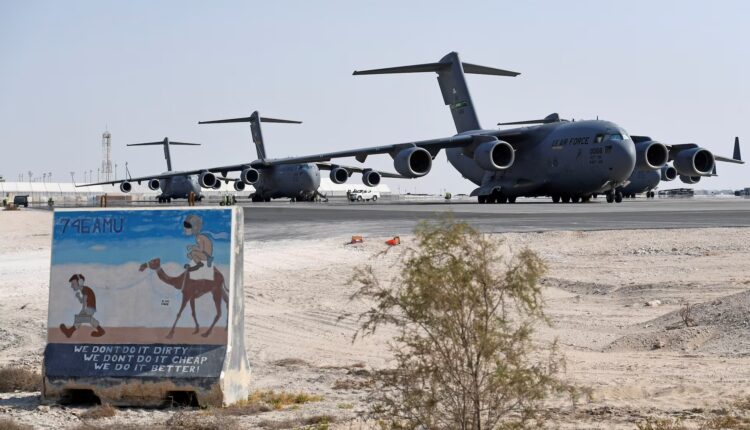
(DEFENCE SECURITY ASIA) –U.S. personnel has been advised to depart Al Udeid Air Base, a stark and strategically charged move that underscores a finely calibrated posture adjustment amid a rapidly deteriorating Gulf security environment, as Washington signals acute concern over potential Iranian retaliation while simultaneously striving to preserve uninterrupted operational continuity at its most indispensable Middle Eastern military hub, with one diplomat stressing, “It’s a posture change and not an ordered evacuation,” a formulation that deliberately frames the move as escalation management rather than a precursor to imminent conflict.
This posture change unfolds against a backdrop of intensifying unrest inside Iran, where widespread protests driven by economic hardship, water scarcity, and political grievances have reportedly resulted in more than 2,600 deaths, prompting U.S. President Donald Trump to issue unusually blunt warnings toward Tehran, including the remarks “Iran should behave” and “Help is on its way,” statements that have been interpreted regionally as thinly veiled references to possible military intervention.

Qatar’s International Media Office reinforced the gravity of the moment by confirming that the advisory was linked to “current regional tensions,” while emphasizing that Doha’s actions were aligned with safeguarding citizens, residents, and critical infrastructure, a formulation that quietly acknowledges the unique vulnerability of host nations accommodating U.S. military power projection assets amid rising Iranian threat perceptions.
Al Udeid Air Base’s centrality to U.S. Central Command’s regional warfighting architecture magnifies the significance of even limited personnel movements, as the installation houses approximately 10,000 U.S. troops and hosts the Combined Air Operations Center, which coordinates air operations across Iraq, Syria, Afghanistan, and the wider Gulf, making any adjustment there a signal scrutinized closely by allies and adversaries alike.
The advisory has revived memories of June 2025, when similar personnel relocations preceded U.S. strikes on Iranian nuclear facilities and were followed by Iranian missile attacks on Al Udeid itself, an episode that demonstrated both Tehran’s willingness to retaliate directly and Washington’s confidence in layered missile defenses and early warning systems that minimized damage and casualties.
Iranian officials have since amplified their deterrent messaging, with a senior Iranian figure warning that “any attack on Iran will result in strikes on U.S. assets in their territories,” a statement explicitly designed to pressure Gulf host nations by tying their internal security directly to U.S. military decision-making, thereby widening the strategic costs of escalation beyond Washington and Tehran alone.
From a broader geopolitical perspective, the unfolding crisis is reverberating across Asia, where energy-import-dependent economies are acutely sensitive to instability in the Strait of Hormuz, through which roughly one-fifth of global oil flows, making any disruption there a potential trigger for inflationary shocks, currency volatility, and strategic recalibration from New Delhi to Beijing to Tokyo.
For defence planners, the Al Udeid advisory is being interpreted as a real-time test of U.S. crisis management credibility, echoing long-standing anxieties about alliance reliability that also shape perceptions of American resolve in other contested theatres such as the South China Sea.
As Washington closes diplomatic channels and places Iran on what officials describe as the highest alert posture, the movement of personnel from Al Udeid stands not as an isolated administrative decision but as an early indicator of a rapidly narrowing margin for error in one of the world’s most militarised and strategically consequential regions.
Al Udeid Air Base: The Strategic Keystone of U.S. Power Projection in the Middle East
Al Udeid Air Base’s significance extends far beyond its physical footprint southwest of Doha, as it functions as the nerve centre for U.S. airpower across the Middle East, integrating command, control, intelligence, surveillance, reconnaissance, and strike coordination in a single installation whose uninterrupted operation is vital to sustaining American military influence from the Levant to Central Asia.
Established in the 1990s and massively expanded after the 2003 Iraq War, Al Udeid has benefited from Qatari investments amounting to billions of U.S. dollars, equivalent to tens of billions of Malaysian ringgit, reflecting Doha’s strategic calculus that hosting U.S. forces provides both a security guarantee and geopolitical leverage despite Qatar’s complex and pragmatic relationship with Iran.
The base’s infrastructure is optimised for high-intensity operations, featuring runways capable of supporting heavy bombers such as the B-52 Stratofortress, extensive hardened shelters, advanced radar coverage, and integrated missile defence systems designed to counter short- and medium-range ballistic missile threats originating from Iran.
At the heart of Al Udeid lies the Combined Air Operations Center, whose real-time coordination of coalition air missions enables rapid target prosecution, airspace deconfliction, and dynamic force allocation, making it indispensable for any contingency involving Iran, regional militias, or state-on-state conflict scenarios.
This concentration of command capability, however, also creates a strategic vulnerability, as Iranian planners have long identified Al Udeid as a high-value target whose disruption could complicate U.S. operational tempo even if physical damage remains limited.
Iran’s ballistic missile inventory, including systems assessed to include Fateh-class and Qiam-type missiles, places Qatar well within reach, with flight times measured in minutes, compressing decision-making timelines and elevating the importance of early warning, missile defence integration, and personnel dispersal.
The advisory for select personnel to depart therefore aligns with established U.S. force protection doctrine, which prioritises reducing non-essential exposure while retaining combat-critical functions, ensuring that operational capability is preserved even under elevated threat conditions.
For Qatar, facilitating this posture adjustment reinforces its role as a reliable security partner while delicately managing domestic and regional perceptions, particularly given Iranian sensitivity to any actions perceived as enabling U.S. strikes.
In strategic terms, Al Udeid’s continued operation amid rising tensions sends a dual message: reassurance to allies that U.S. command and control remains intact, and deterrence to adversaries that precautionary measures do not equate to retreat or loss of resolve.

Iran’s Deterrent Signalling and the Shadow of Missile Retaliation
Iran’s response to perceived U.S. escalation has been characterised by increasingly explicit deterrent signalling aimed at both Washington and its regional partners, with officials reiterating that American bases across the Gulf remain legitimate targets in the event of U.S. military action.
The warning that “any attack on Iran will result in strikes on U.S. assets in their territories” is strategically calibrated to exploit the political sensitivities of Gulf host nations, transforming them from passive bystanders into stakeholders directly exposed to the consequences of U.S.-Iran confrontation.
This approach reflects Iran’s long-standing asymmetric doctrine, which seeks to offset conventional inferiority by leveraging missile forces, proxy networks, and geographic proximity to impose costs on adversaries and complicate coalition cohesion.
The precedent set in June 2025, when Iranian missiles struck Al Udeid following U.S. attacks on nuclear facilities, demonstrated Tehran’s willingness to absorb escalation risks while carefully managing thresholds to avoid all-out war, a pattern that continues to shape current assessments.
Iranian military spokespersons’ claims of “peak readiness” are supported by observable force postures, including heightened activity among Revolutionary Guard missile units, dispersed launcher deployments, and reinforced air defence coverage around critical infrastructure.
From a deterrence perspective, Iran’s missile forces serve not merely as retaliatory tools but as instruments of political messaging, designed to remind regional capitals that their security calculus is inseparable from U.S. military actions undertaken from their soil.
The inclusion of distant facilities such as Diego Garcia in Iranian rhetoric further broadens the geographic scope of the crisis, signalling that Tehran views the confrontation as global rather than confined to the Gulf.
For U.S. planners, these dynamics necessitate a delicate balance between demonstrating resolve and avoiding moves that could be interpreted as preparation for imminent strikes, a balance reflected in the carefully worded description of the Al Udeid advisory as a “posture change.”
Ultimately, Iran’s deterrent strategy seeks to exploit uncertainty, raising the perceived costs of escalation sufficiently to constrain U.S. freedom of action without crossing thresholds that would trigger overwhelming retaliation.
Washington’s Strategic Calculus and the Logic of Risk Mitigation
The advisory for select personnel to depart Al Udeid exemplifies a classic risk mitigation strategy designed to reduce potential casualties while preserving combat effectiveness, a logic articulated by regional analysts who view the move as precautionary rather than escalatory.
By thinning non-essential personnel, including potential civilians or support staff, the U.S. limits the human and political costs of any Iranian missile attack while maintaining the operational core required for sustained air and command operations.
This approach aligns with broader U.S. force protection practices observed during previous crises, where dispersal, redundancy, and selective withdrawal were employed to complicate adversary targeting without signalling weakness.
The absence of detailed public explanations has, however, fuelled speculation across regional and social media platforms, with observers noting elevated alert statuses at other U.S. facilities in Bahrain and the United Arab Emirates.
Such ambiguity is not accidental, as strategic uncertainty can enhance deterrence by denying adversaries clear indicators of intent or thresholds, thereby increasing the risks associated with miscalculation.
At the same time, President Trump’s blunt rhetoric, including the statement “Iran should behave,” injects a degree of unpredictability into the equation, amplifying Iranian threat perceptions while reassuring domestic audiences of U.S. resolve.
The issuance of Level 4 travel advisories for Iran, Iraq, and Lebanon further underscores Washington’s assessment that the regional security environment has entered a phase of elevated and sustained risk.
From an operational standpoint, the repositioning of high-end assets such as F-22 Raptors and C-17 Globemasters enhances U.S. flexibility, enabling rapid response options ranging from defensive countermeasures to precision strikes.
Collectively, these measures reflect a strategic posture aimed at controlling escalation pathways while retaining credible military options, a balancing act that defines U.S. crisis management doctrine in the Middle East.
Asian Strategic Exposure: Energy Security and Maritime Stability at Risk
The implications of rising Gulf tensions extend far beyond the Middle East, resonating acutely across Asia, where economic stability remains tightly coupled to uninterrupted energy flows from the region.
With approximately 20 percent of global oil transiting the Strait of Hormuz, any disruption triggered by U.S.-Iran confrontation would reverberate through Asian economies, driving up energy prices, weakening currencies, and complicating post-pandemic recovery trajectories.
China, as Iran’s largest oil customer, faces a particularly delicate balancing act, prompting official calls for restraint such as the statement “All parties must avoid actions that exacerbate tensions,” reflecting Beijing’s interest in stability over confrontation.
India’s strategic calculus is similarly complex, as New Delhi seeks to protect vital sea lanes in the Arabian Sea while maintaining diplomatic space with both Washington and Tehran.
Japan and South Korea, heavily dependent on Gulf energy imports, are likewise monitoring developments closely, factoring potential supply shocks into national security and economic planning.
The crisis reinforces concerns about the fragility of global supply chains and the indirect exposure of Indo-Pacific security to Middle Eastern instability.
Naval deployments and maritime patrols across the Indian Ocean are likely to intensify as Asian powers seek to hedge against worst-case scenarios involving shipping disruptions or regional spillover.
In strategic terms, the Al Udeid advisory serves as a reminder that regional crises are increasingly interconnected, with decisions taken in the Gulf shaping threat perceptions and defence postures thousands of kilometres away.
This interconnectedness underscores the growing importance of holistic security planning that integrates energy security, maritime stability, and alliance management across regions.
Human, Political, and Strategic Endgames in a Narrowing Window
Beyond military calculations, the advisory carries significant human implications for U.S. personnel and their families, many of whom recall the uncertainty of previous crises when dependents were hastily relocated amid fears of imminent attack.
While no mass evacuations have been reported, the prioritisation of non-combatants reflects a recognition that political tolerance for casualties in an ambiguous escalation scenario remains limited.
The closure of diplomatic channels and placement of Iran on the highest alert posture heighten the risk that misinterpretation or isolated incidents could trigger rapid escalation.
Public anxiety is palpable, captured succinctly in the social media query, “Something big is about to happen?” which mirrors broader global unease as deadlines approach and rhetoric hardens.
For Iran, sustained protests at home and external pressure abroad create incentives to project strength without provoking catastrophic retaliation, a delicate balance that has historically proven difficult to maintain.
For the United States, the challenge lies in deterring Iranian aggression while avoiding steps that could unify domestic Iranian opinion or entangle Washington in another protracted regional conflict.
The advisory at Al Udeid thus represents more than a tactical adjustment, signalling a potential inflection point in U.S.-Iran relations with cascading implications for Middle Eastern and Indo-Pacific security.
As President Trump remarked, “The killing looks like it’s significant, but we don’t know yet for certain,” a statement that encapsulates both the gravity and uncertainty defining the current moment.
In strategic terms, the world is witnessing a high-stakes contest of signalling and restraint, where the margin between deterrence and disaster remains perilously thin. — DEFENCE SECURITY ASIA
