
US Navy Faces Hormuz Kill Zone: Iran’s Asymmetric Trap in the Strait of Hormuz Could Trigger Historic Naval Losses and Global Oil Shock
Narrow chokepoint, drone swarms, coastal missiles and swarm boats create a battlespace where Iran could neutralise U.S. naval superiority and force Washington into coalition strategy to avoid catastrophic losses.

(DEFENCE SECURITY ASIA) — The possibility that the United States Navy could be drawn into a confined battlespace inside the Strait of Hormuz has triggered renewed strategic concern among defence planners because the narrow maritime chokepoint creates a geographic environment where asymmetric warfare could neutralise conventional naval superiority with potentially historic operational consequences.
Iran’s evolving maritime denial strategy is being assessed as a deliberate attempt to shape the battlespace in advance by exploiting the strait’s restricted width, forcing large surface combatants into predictable transit corridors where manoeuvre space is limited and layered attacks can be synchronised across multiple domains.
The strategic urgency of the scenario has intensified after long-standing warnings from U.S. naval analysis resurfaced, including a study by Colin Karl Boynton of the U.S. Naval War College in 2009 that predicted Iran would intentionally provoke naval intervention by disrupting commercial shipping in order to lure superior forces into a pre-prepared kill zone.
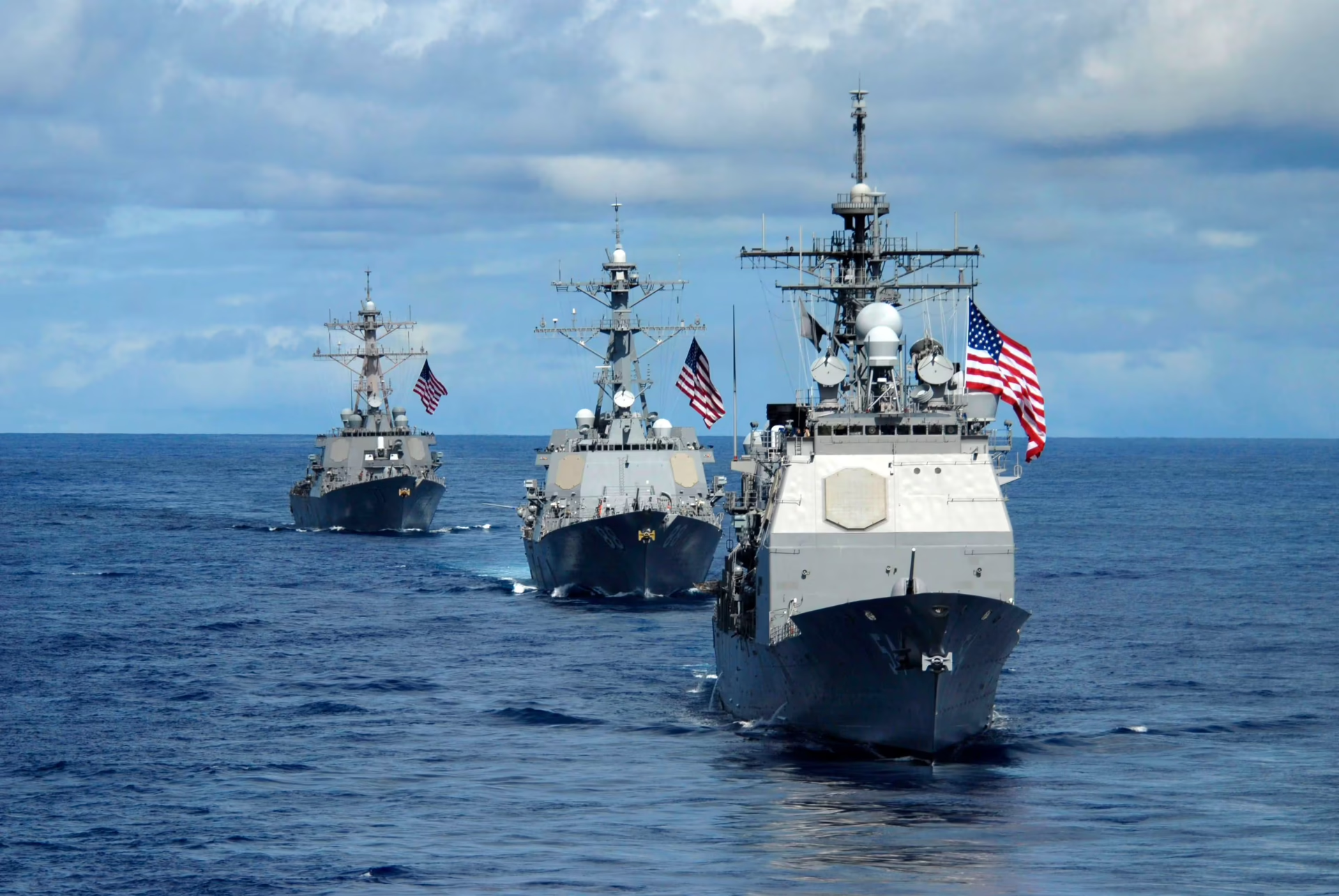
According to the study, such a confrontation would not rely on matching American naval power directly but instead on creating conditions where geography, timing, and asymmetric assets combine to generate a concentrated attack envelope capable of inflicting disproportionate losses on larger and more technologically advanced fleets.
Recent operational signalling indicates that Washington is increasingly cautious about unilateral naval escort operations in the Gulf region, instead urging allied participation in coalition formations, a posture interpreted as an effort to distribute risk across multiple navies rather than expose U.S. warships to a battlespace already configured in favour of the defender.
The core of the concern lies in the physical characteristics of the Strait of Hormuz itself, where the navigable corridor narrows to roughly 21 miles, leaving limited lateral manoeuvre space for large warships whose size, draft, and turning radius restrict their ability to evade coordinated missile, drone, and swarm attacks launched from multiple directions.
Iran’s concept of operations appears designed to exploit this limitation by combining unmanned aerial systems, fast attack craft, mobile coastal missile batteries, and fixed shoreline defences into a multi-axis strike network that can compress reaction time and overwhelm defensive systems through simultaneous engagement from air, sea, and land.
Such a scenario would place even the most advanced naval task group under extreme pressure because defensive sensors, interceptors, and close-in weapon systems must divide attention across multiple vectors, increasing the probability that at least some incoming threats penetrate the protective envelope around high-value units.
Strategic planners therefore assess the Strait of Hormuz not simply as a shipping route but as a potential denial zone deliberately structured to force adversaries into disadvantageous tactical positions where numerical or technological superiority becomes less decisive than terrain, timing, and coordination.
The risk calculation is further complicated by the fact that Iran does not need to defeat an entire fleet to achieve strategic effect, since damaging or disabling even a single major warship inside a confined chokepoint could create global economic shockwaves by disrupting energy transit through one of the world’s most critical maritime arteries.
READ: US Navy’s New Strait of Hormuz Nightmare: Iran’s ‘Azhdar’ Stealth Underwater Drone Could Disrupt Global Shipping and Redefine Naval Warfare
Geography as a Weapon: Why the Strait of Hormuz Favors the Defender
The defining feature of the Strait of Hormuz as a battlespace is its narrow width, which reduces the operational flexibility of large naval formations and forces vessels to transit through predictable lanes where pre-positioned coastal assets can track and engage targets with minimal warning.
In such conditions, the defender gains a structural advantage because fixed launch sites, mobile missile batteries, and concealed positions along the coastline can maintain constant coverage over the transit corridor without needing to match the mobility or endurance of blue-water naval forces.
This geographic compression also limits the ability of large warships to disperse, forcing them to remain within mutual support distance, which increases the density of targets inside a small area and raises the effectiveness of saturation attacks designed to overwhelm defensive systems through sheer volume.
The confined environment reduces reaction time for incoming threats, meaning radar detection, fire control, and interceptor launch cycles must occur within seconds, placing extreme stress on command-and-control networks and increasing the chance of system overload during multi-axis engagements.
For a navy accustomed to operating in open ocean conditions where manoeuvre space is abundant, the transition into a narrow chokepoint transforms the tactical equation by making avoidance and repositioning far more difficult once an engagement begins.
The defender, by contrast, can plan attack geometry in advance, selecting engagement points where missile flight paths, drone approach angles, and fast-boat swarming routes converge on the same location to create a layered strike envelope that compresses the defender’s response options.
Because the strait functions as a mandatory transit route for commercial shipping, the attacking side can also blend military activity with civilian maritime traffic, complicating identification and increasing the difficulty of distinguishing hostile assets from neutral vessels until the moment of engagement.
This combination of geographic constraint, traffic density, and pre-planned firing positions creates the conditions for what naval analysts describe as a kill zone, where even highly capable fleets may struggle to maintain situational awareness across all threat axes simultaneously.
Under such circumstances, the side controlling the coastline effectively controls the tempo of the engagement, deciding when and where to initiate contact while the transiting force is constrained by navigation requirements and mission objectives.

Asymmetric Warfare Architecture: Drones, Fast Boats, and Coastal Missiles
Iran’s maritime denial doctrine is built on the principle that a layered network of relatively small, mobile, and inexpensive platforms can collectively create a threat environment capable of challenging far larger and more expensive naval assets operating in confined waters.
Unmanned aerial systems provide persistent surveillance and targeting capability, allowing coastal missile units and fast attack craft to receive real-time positional data on ships moving through the strait, thereby shortening the time between detection and engagement.
Fast attack boats operating in swarms can approach from multiple directions at high speed, forcing defensive weapons to engage numerous small targets simultaneously while leaving less capacity to respond to incoming missiles or drones arriving from other vectors.
Mobile missile batteries positioned along the coastline add another layer to the engagement envelope because they can relocate after firing, making counter-battery strikes more difficult and prolonging the defender’s ability to sustain pressure over extended periods.
Coastal defence systems positioned to cover the transit corridor can launch anti-ship weapons at close range, reducing warning time and increasing the probability that at least some missiles reach their targets before interception.
The cumulative effect of these capabilities is a multi-axis kill box in which air, surface, and land-based threats converge on the same naval formation, forcing defensive systems to divide attention and increasing the likelihood of saturation.
Such an approach does not require technological parity with a major naval power, because the objective is not to win a traditional fleet engagement but to create conditions where the cost of entering the battlespace becomes strategically unacceptable.
By concentrating attacks within a narrow corridor, the defender maximises the effectiveness of each weapon launched, turning limited resources into a force multiplier that can threaten even the most advanced naval platforms when manoeuvre space is restricted.
This architecture is particularly effective in a chokepoint environment where the attacking side can prepare firing positions in advance while the transiting force must react in real time to rapidly evolving threats.
War College Warning: The 2009 Scenario That Predicted Today’s Crisis
A study conducted in 2009 at the U.S. Naval War College by Colin Karl Boynton outlined a scenario in which Iran would deliberately provoke naval intervention by disrupting merchant shipping, knowing that the United States would feel compelled to protect oil tankers moving through the Strait of Hormuz.
The analysis warned that such disruption would not be intended to stop shipping permanently but to trigger a predictable response in which U.S. warships enter the strait to escort commercial vessels, thereby placing themselves inside a pre-prepared engagement zone.
Once the escort mission begins, the defending side could exploit the confined environment to launch coordinated asymmetric attacks designed to inflict losses disproportionate to the size of the force involved.
The study emphasised that the psychological and political impact of damaging a major warship inside the strait could exceed the tactical significance of the loss itself because of the global importance of the shipping route.
By targeting vessels during escort operations rather than open-ocean patrols, the defender would ensure that the attacking force remains within a constrained corridor where manoeuvre options are limited and defensive systems must operate under maximum stress.
The scenario also highlighted the difficulty of maintaining continuous protection for commercial traffic in such a narrow waterway, since the number of ships requiring escort could exceed the number of warships available to provide coverage.
This imbalance would force the escorting navy to spread its assets across multiple convoys, reducing the concentration of defensive capability and increasing vulnerability to simultaneous attacks at different points along the route.
The warning concluded that the defender does not need to defeat the escorting force outright, but only to create enough risk that continued operations become politically and operationally unsustainable.
More than a decade later, the scenario described in the study is being revisited because current developments suggest that the conditions outlined in the analysis may now exist in practice rather than theory.
Coalition Strategy: Why Washington Avoids Going Alone
Recent signals from Washington indicate a preference for coalition-based maritime security operations rather than unilateral escort missions, a posture interpreted by analysts as an effort to distribute risk across multiple partners in a high-threat environment.
By involving allied navies, the operational burden of protecting shipping can be shared, reducing the exposure of any single fleet to concentrated asymmetric attacks inside the strait.
A coalition presence also complicates the defender’s targeting decisions, because striking one vessel risks escalation involving multiple countries rather than a single adversary.
However, coalition operations introduce their own challenges, including the need to coordinate command structures, communication systems, and rules of engagement among forces with different equipment and operational doctrines.
The decision to avoid unilateral escorts suggests that planners recognise the potential danger of sending a limited number of ships into a confined battlespace where the defender has prepared layered attack options.
Distributing forces among several nations allows the operational footprint to be spread more widely, making it harder for a single coordinated strike to achieve decisive results.
At the same time, coalition participation signals political unity, which may be intended to deter escalation by demonstrating that any attack would have broader consequences than a bilateral confrontation.
This approach reflects a calculation that the strategic cost of operating alone in the Strait of Hormuz may be higher than the logistical complexity of organising multinational naval patrols.
The shift toward coalition strategy therefore highlights the extent to which the geography and threat environment of the strait influence not only tactical decisions but also alliance politics and force posture planning.
From Theory to Reality: Precision Missiles and Drone Swarms Change the Equation
Advances in precision-guided weapons and unmanned systems have increased the effectiveness of asymmetric tactics, making the scenario described in earlier naval studies more plausible in current operational conditions.
Modern missiles with improved guidance and range allow coastal units to engage targets with greater accuracy, reducing the number of shots required to threaten high-value ships.
Drone swarms add another layer of complexity because they can be used simultaneously for surveillance, targeting, and attack, forcing defensive systems to handle multiple functions at once.
The integration of drones with missile units and fast attack craft enables coordinated strikes in which each platform supports the others, increasing the overall effectiveness of the attack.
In a confined chokepoint, these capabilities allow the defender to maintain constant pressure on transiting ships, since new threats can appear from different directions without warning.
The result is a battlespace where the defender controls the timing and geometry of engagements, while the transiting force must react under severe time constraints.
Such conditions increase the probability that even a technologically superior navy could suffer losses if caught inside a concentrated attack envelope.
This transformation from theoretical vulnerability to practical threat has forced planners to reconsider how naval power should be used in narrow waterways dominated by land-based weapons.
The Strait of Hormuz therefore represents not only a geographic chokepoint but also a strategic test of whether traditional naval dominance can survive in an era defined by precision weapons, unmanned systems, and asymmetric warfare.
