
Why the U.S. Hasn’t Struck Iran Yet: USS Abraham Lincoln, Trump’s “Massive Armada,” and China’s Intelligence Shadow Reshaping Middle East War Calculations
Despite deploying the USS Abraham Lincoln carrier strike group, THAAD and Patriot missile defenses, F-35 fighter jets, and dozens of warships across the Arabian Sea and Gulf of Oman, Washington has refrained from striking Iran—raising critical questions about deterrence, Chinese satellite surveillance, and the true escalation risks in the Middle East.

(DEFENCE SECURITY ASIA) — The United States has amassed a formidable concentration of naval, air, and missile defense assets around Iran, yet the absence of kinetic action reveals a far more intricate strategic calculus shaped by deterrence dynamics, intelligence compromise risks, and the growing specter of Chinese military-technical support to Tehran that fundamentally alters escalation modeling across the Middle East battlespace.
President Donald Trump has repeatedly framed potential intervention as both moral and strategic—linking support for Iranian demonstrators crushed during the 2025–2026 protests to his uncompromising demand of “NO NUCLEAR WEAPONS”—while simultaneously referring to the deployed forces as a “massive armada,” a phrase that underscores political signaling but conceals the operational fragility inherent in modern high-intensity conflict scenarios.
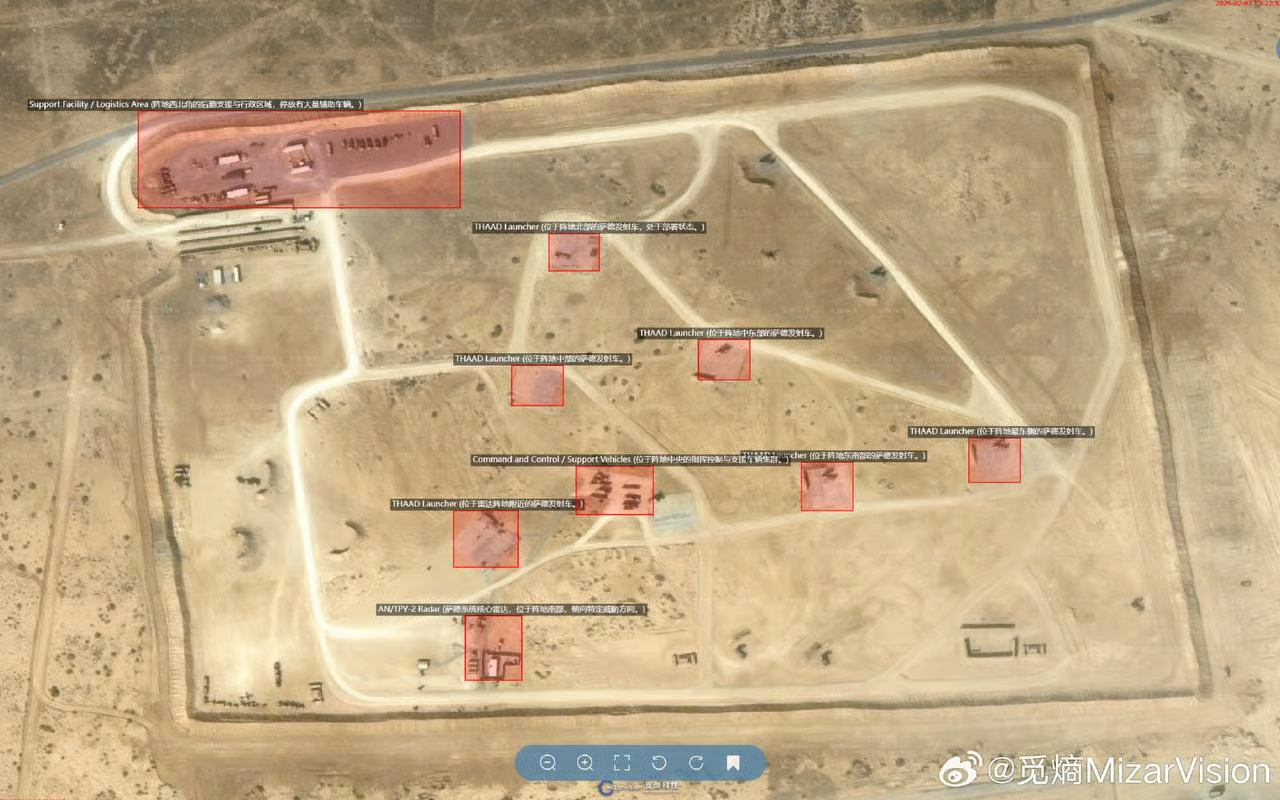
The presence of the USS Abraham Lincoln carrier strike group in the Arabian Sea and Gulf of Oman, supported by guided-missile destroyers, fifth-generation aircraft, and layered missile defenses including THAAD and Patriot batteries, reflects a readiness posture consistent with pre-strike sequencing doctrine, yet the absence of follow-through suggests strategic deterrence rather than imminent offensive execution.

Behind the visible hardware lies a deeper concern that any strike package—whether targeting nuclear infrastructure, command nodes, or proxy networks—would unfold under unprecedented levels of Chinese-enabled surveillance, eroding the surprise element that remains central to U.S. power-projection doctrine in contested theaters.
Western analysts increasingly assess that Beijing’s provision of near real-time satellite data, maritime domain awareness inputs, and secure communications architecture to Tehran complicates operational planning, raising the probability that U.S. aircraft, naval formations, and forward bases would be tracked before strike authorization is executed.
The presence of the Chinese research vessel Dayang Yihao operating in proximity to U.S. naval elements—under escort by advanced Type 055 and Type 052D surface combatants—represents not symbolic solidarity but an intelligence posture designed to map electromagnetic emissions, naval movement patterns, and air sortie rhythms across the Sea of Oman corridor.
The political memory of the June 2025 Operation Midnight Hammer strikes—conducted by B-2 bombers and precision-guided munitions against Natanz, Fordow, and Isfahan—still reverberates across Tehran, yet the rebuilding phase since then has been accompanied by Iranian vows to retaliate and reconstitute enrichment capacity under the direction of Supreme Leader Ayatollah Ali Khamenei.
The brutal suppression of protests in late 2025 and early 2026, described by human rights monitors as a “massacre” with death toll estimates exceeding 12,000, intensified calls within Washington for action, yet regime consolidation after the crackdown reduced the plausibility of internal collapse as a complementary vector to military pressure.
The financial implications of a renewed Middle East conflict—where a limited strike campaign could cost tens of billions of U.S. dollars (potentially exceeding USD50 billion, approximately RM235 billion, depending on duration and escalation)—intersect uncomfortably with Trump’s political brand of opposition to “forever wars,” creating domestic constraints alongside battlefield uncertainties.
The result is a precarious equilibrium in which visible military buildup coexists with strategic hesitation, shaped less by lack of capability than by the convergence of Chinese intelligence shadowing, Iranian retaliatory capacity, regional oil vulnerability, and the escalating costs of miscalculation in an era of multi-domain surveillance warfare.
Operation Midnight Hammer and the Fragile Ceasefire: Lessons from 2025
The June 2025 U.S.–Israeli strikes under Operation Midnight Hammer demonstrated the potency of precision strike integration between stealth bombers and advanced ISR networks, yet they also exposed the limits of airpower in compelling long-term behavioral change from an ideologically entrenched regime determined to restore its nuclear leverage.
The deployment of B-2 Spirit bombers, supported by stand-off munitions and electronic warfare assets, temporarily degraded uranium enrichment facilities at Natanz, Fordow, and Isfahan, but the subsequent 12-day conflict concluded not with regime capitulation but with a ceasefire that allowed Tehran to recalibrate rather than surrender.
Iran’s rapid reconstruction efforts, reportedly bolstered by access to foreign technical components and solid-fuel missile precursors, signaled that destruction of infrastructure does not equate to elimination of strategic intent, particularly when national survival narratives strengthen domestic cohesion against perceived external aggression.
Following the ceasefire, Ayatollah Ali Khamenei vowed to rebuild and retaliate, embedding nuclear persistence into the regime’s ideological framework and signaling that external strikes would reinforce rather than weaken Tehran’s resolve to maintain deterrent capabilities.
The U.S. military presence in early 2026—far exceeding the approximate 40,000 personnel deployed during the 2025 crisis—now spans eight major regional bases and includes expanded maritime, air, and missile defense assets, suggesting readiness for sustained operations rather than a single punitive raid.
Satellite imagery showing F-15E Strike Eagles at Muwaffaq Salti Air Base in Jordan, coupled with the probable integration of F-35 Lightning II aircraft and EA-18G Growler electronic attack platforms, indicates strike package composition optimized for suppression of enemy air defenses and deep penetration operations.
Cargo surge patterns, including dozens of C-17 Globemaster III transport flights delivering munitions and personnel to Al Udeid and other installations, reveal logistical prepositioning consistent with offensive contingency planning, yet logistics alone do not guarantee favorable escalation control once hostilities begin.
Iran’s layered missile arsenal—including precision-guided ballistic systems and evolving hypersonic glide vehicle prototypes—poses credible threats to U.S. carrier strike groups and fixed regional bases, complicating assumptions of rapid dominance in the opening days of conflict.
The operational assessment articulated by analysts—that “The overall force posture suggests the US intends to carry out an initial strike to neutralize key targets like air defenses and airbases, followed by several days or even weeks of further strikes”—illustrates planning depth, yet planning sophistication does not negate the unpredictability introduced by external intelligence interference.
Thus, the lessons of Operation Midnight Hammer underscore a paradox: while the United States can inflict severe damage on Iranian infrastructure, the strategic end-state remains ambiguous when adversaries retain resilience, external backing, and the capacity to escalate asymmetrically.

Military Risks and Strategic Bind: Why Airpower Alone May Not Suffice
Despite the scale of deployed assets, Pentagon assessments highlighting “gaps in regional defenses” reveal institutional caution about launching offensive operations before ensuring adequate protection against retaliatory missile barrages targeting forward bases and naval formations.
Iran’s inventory of short- and medium-range ballistic missiles—potentially enhanced through access to advanced guidance components and surveillance inputs—introduces the possibility of saturation attacks capable of overwhelming even layered defenses such as THAAD and Patriot systems under certain conditions.
Limited strikes risk rallying nationalist sentiment around the regime, transforming internal dissent into unified resistance and undermining the original justification of supporting the Iranian populace against authoritarian repression.
A full-scale invasion remains strategically implausible given Iran’s geography, population size exceeding 85 million, mountainous terrain, and deeply entrenched Revolutionary Guard infrastructure, rendering occupation scenarios politically and militarily untenable.
Ali Vaez of the International Crisis Group captured the uncertainty surrounding intervention, stating, “It’s hard to imagine that a strike is imminent – the protests have already been crushed… military strikes on Iran would be expensive, and the end goal of such a costly intervention for the US is not clear,” a caution that resonates amid fiscal and political constraints.
Energy market volatility further constrains decision-making, as even limited strikes could trigger Iranian retaliation against Gulf oil infrastructure or maritime chokepoints, driving crude prices sharply upward and amplifying global economic instability.
Regional partners such as Saudi Arabia, while privately concerned about Iran’s nuclear trajectory, publicly emphasize de-escalation due to fears that proxy networks—including remnants of Hezbollah and Houthi-aligned elements—could target civilian infrastructure and strategic assets.
Trump’s strategic narrative—balancing deterrence with avoidance of prolonged conflict—creates a tension between projecting strength and avoiding entrapment in a conflict that could expand beyond the initial target set into a regional conflagration.
Indirect diplomacy in Oman persists as a parallel track, where Washington’s insistence on “NO NUCLEAR WEAPONS” collides with Iran’s continued enrichment activities, demonstrating that coercive signaling and negotiation are unfolding simultaneously within a volatile strategic ecosystem.
This convergence of military risk, political cost, and uncertain end-state renders hesitation not a sign of weakness but a manifestation of a rational calculus that weighs tactical feasibility against strategic unpredictability.
China’s Intelligence Shadow: Surveillance as Strategic Deterrent
China’s expanding role in supporting Iran since 2025 has reshaped the intelligence environment by integrating satellite surveillance, secure communications software replacement, and potential radar transfers into Tehran’s defensive architecture.
Reports that Beijing is replacing Western-origin digital systems in Iran with secure Chinese platforms aim to reduce vulnerability to CIA and Mossad cyber penetration, thereby hardening command-and-control networks against pre-strike disruption.
The provision of high-resolution satellite imagery by Chinese commercial and state-linked entities allows Iranian planners to track U.S. force movements in near real-time, undermining operational secrecy essential to stealth-based strike doctrine.
One assessment bluntly notes, “Chinese satellites are now intensively monitoring the region and detecting troop movements in and out, in real-time,” underscoring how ISR dominance can neutralize technological asymmetry if surprise evaporates.
The Dayang Yihao vessel’s presence near U.S. naval formations, protected by advanced surface combatants, suggests maritime intelligence collection extending beyond scientific research into electromagnetic mapping and fleet pattern analysis.
The potential transfer of systems such as the YLC-8B anti-stealth radar—designed to detect low observable platforms—could erode the operational advantages of F-35 and B-2 aircraft, forcing planners to assume higher attrition risks in contested airspace.
Joint drills involving China, Russia, and Iran, including Maritime Security Belt exercises in the North-West Indian Ocean, demonstrate a symbolic and practical alignment that complicates unilateral U.S. escalation calculations.
A western onserver said that “China’s involvement in Iran and the wider region remains largely pragmatic… but it is unlikely to do so in the event of a possible US military intervention,” yet pragmatic support can still alter deterrence balances without direct confrontation.
The infusion of missile propellant precursors and drone components sufficient for hundreds of systems suggests long-term rebuilding of Iran’s strike capabilities, amplifying the potential cost of renewed conflict.
In aggregate, China’s intelligence and technical backing does not guarantee Iranian immunity, but it raises the cost curve of U.S. intervention to levels that demand extraordinary certainty before escalation is authorized.
Geopolitical Implications: From Middle East Crisis to Global Power Contest
The deepening Iran–China alignment embeds Middle Eastern flashpoints within a broader strategic contest between Washington and Beijing, where surveillance, technology transfer, and economic interdependence intersect with military signaling.
U.S. warnings to allies about overreliance on Chinese partnerships contrast with ongoing diplomatic engagement plans, including potential high-level visits, illustrating the complexity of managing competition without direct confrontation.
An analyst warned that “The risks of a military intervention are significant, and there are no guarantees that Iranians would be better off,” highlighting humanitarian and stability considerations often overshadowed by military metrics.
Ilan Berman emphasized technological dimensions, noting, “There are also signs that China has been providing Iran with key technology,” a statement that reinforces the perception of gradual capability enhancement rather than dramatic escalation.
Iran’s integration into an informal “axis” alongside China, Russia, and North Korea magnifies deterrence ambiguity, as indirect support structures create resilience without formal alliance commitments.
Any U.S. strike would now unfold within an environment where satellite transparency, maritime ISR, and hardened command networks limit operational surprise and expand escalation pathways beyond the immediate theater.
The U.S. National Defense Strategy’s assessment that “Iran’s regime is weaker… but intent on reconstituting its conventional military forces” underscores that weakness does not equate to passivity when backed by external support.
For Asian security observers, China’s willingness to project influence into the Middle East through intelligence and technology channels signals a maturation of global strategic ambition beyond the Indo-Pacific.
The financial scale of sustained Middle East operations—potentially surpassing USD100 billion (approximately RM470 billion) if escalation spirals—further incentivizes caution within Washington’s strategic calculus.
Ultimately, Washington’s restraint reflects not incapacity but recognition that in an era of real-time surveillance and multipolar alignment, the threshold for launching a strike against Iran has risen dramatically, transforming visible military buildup into a theater of deterrent signaling rather than immediate war initiation. — DEFENCE SECURITY ASIA
