
US Deploys Patriot and THAAD to Middle East as Trump Signals ‘Decisive’ Military Options Against Iran
Deployment of Patriot and THAAD missile systems reflects Washington’s shift from crisis containment to escalation control as Iran unrest, missile threats and regime-change rhetoric converge

(DEFENCE SECURITY ASIA) — The United States has decided to deploy additional Patriot and Terminal High Altitude Area Defense (THAAD) missile systems into the Middle East in a move that constitutes a calculated strategic escalation, deliberately fusing urgent defensive requirements with coercive signalling aimed at reshaping the regional military balance.
This decision comes as President Donald Trump openly demands “decisive” military options against Iran while denouncing Supreme Leader Ayatollah Ali Khamenei as “a sick man who should run his country properly and stop killing people,” language that senior U.S. officials interpret not as rhetorical excess but as intentional political framing designed to condition both domestic and international audiences for possible escalation.
Senior U.S. officials involved in regional security planning have privately acknowledged that the current deployments are not merely force protection measures but are intended to reshape Iran’s risk calculus following Tehran’s violent suppression of protests that U.S. Ambassador to the United Nations Mike Waltz said has resulted in up to 18,000 deaths, a figure that dramatically undercuts Iran’s official narrative and strengthens Washington’s case for expanded military and economic pressure.
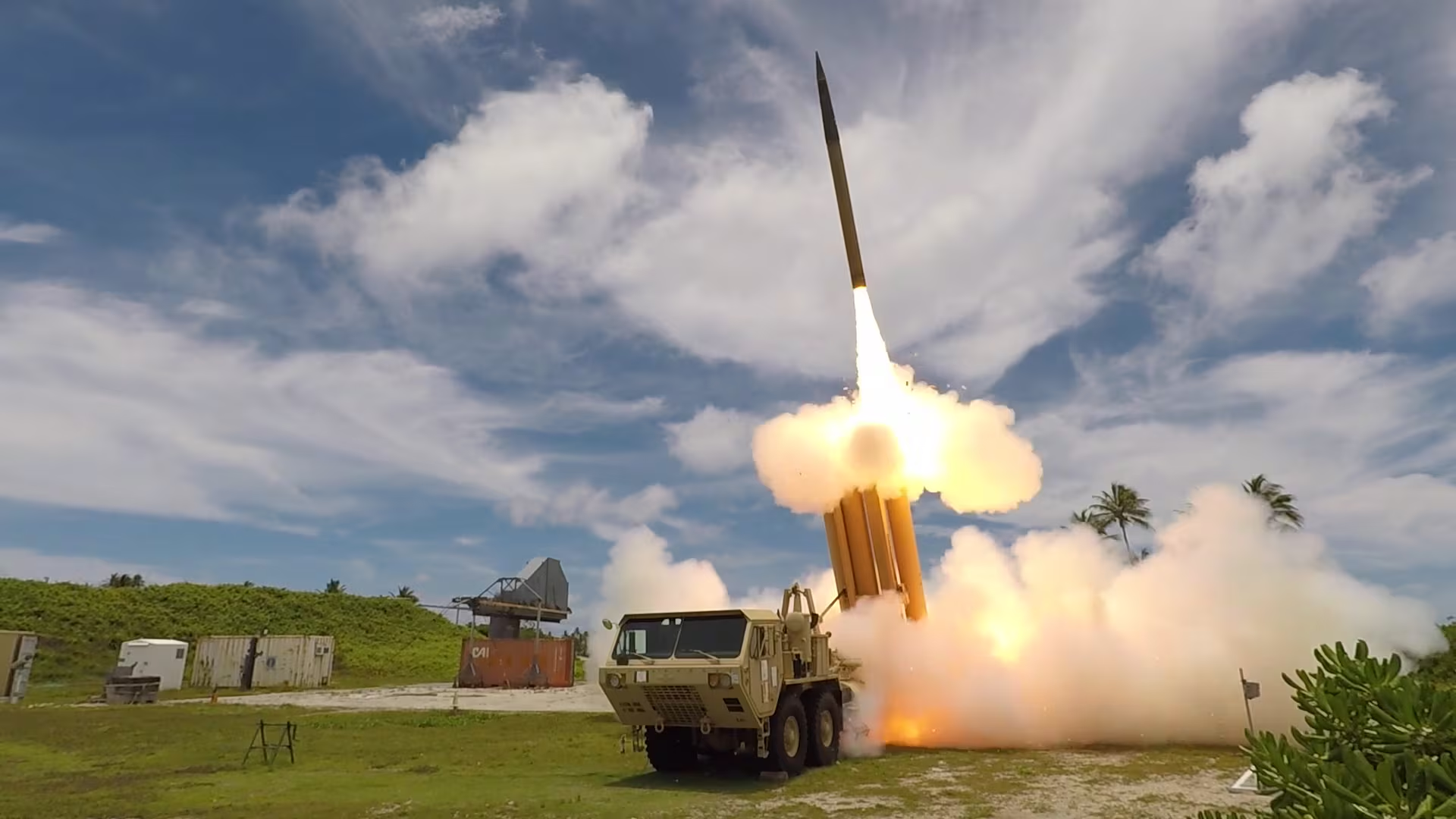
The reinforcement comes against the backdrop of President Trump’s explicit assertion in a Politico interview that “It’s time to look for new leadership in Iran,” a statement that senior defense planners interpret as a soft declaration of strategic intent that lowers the political threshold for regime-targeting options while preserving ambiguity over whether Washington seeks deterrence, coercion, or outright political transformation in Tehran.
By integrating Patriot and THAAD systems into an already dense regional air and missile defense network, Washington is deliberately reducing the operational risks associated with Iranian retaliation, thereby expanding the menu of credible military options available to U.S. decision-makers while signalling to allies and adversaries alike that the United States is prepared for escalation management rather than crisis containment.
The strategic messaging embedded in these deployments is inseparable from the lessons learned during the June 2025 Israel-Iran conflict, when Iranian missile and drone barrages exposed both the strengths and sustainability limits of Israel’s interceptor-heavy defense architecture, forcing Washington to reassess regional stockpiles, interceptor burn rates, and the long-term feasibility of high-intensity missile defense operations.
For Asian observers, particularly energy-import-dependent economies and U.S. allies in the Indo-Pacific, Washington’s actions underscore how Middle Eastern crises can rapidly divert American military assets, reshape global energy markets, and indirectly affect regional security balances far beyond the immediate theatre of conflict.
These deployments also reflect Washington’s assessment that Iran’s expanding ballistic missile inventory and post-2025 production surge have shifted the regional offense–defense balance, requiring the United States to reinforce layered missile defenses not only to protect forward-deployed forces but to preserve freedom of action for precision strike and deterrence operations under conditions of sustained missile pressure.
At a strategic-industrial level, the move implicitly acknowledges the limits of interceptor stockpiles and production capacity, as the high cost and rapid expenditure rates of Patriot and THAAD interceptors force U.S. planners to balance immediate operational necessity against longer-term readiness for concurrent contingencies involving China and other peer competitors.
Taken together, the deployment signals that Washington is transitioning from reactive crisis response toward a posture of anticipatory escalation control, in which missile defense is used not merely as a shield but as an enabling instrument that shapes adversary decision-making, alliance cohesion, and the credibility of U.S. power projection across multiple theatres simultaneously.
The Strategic Legacy of the June 2025 Israel-Iran War
The June 2025 Israel-Iran war, widely referred to as the “Twelve-Day War,” fundamentally reshaped regional threat perceptions after Israel’s pre-emptive Operation Rising Lion targeted Iranian nuclear facilities at Natanz, Fordow, and Isfahan, alongside ballistic missile infrastructure and senior military leadership, in what Israeli planners framed as a last-ditch effort to prevent Iran from crossing an irreversible nuclear threshold.
Iran’s response, which involved the launch of approximately 574 ballistic missiles and more than 1,100 drones toward Israel, demonstrated both the scale and persistence of Tehran’s strike capabilities, even as Israel’s Iron Dome, David’s Sling, and Arrow systems—augmented by U.S. support—achieved interception rates of approximately 86 percent for missiles and 99 percent for drones.
Despite these high interception rates, Israeli defense officials quietly acknowledged that the sheer volume of Iranian launches imposed unsustainable demands on interceptor inventories, a concern that has since driven urgent discussions with Washington over replenishment timelines, production capacity constraints, and the strategic risks of future saturation attacks.
The U.S. decision to strike three Iranian nuclear sites on June 21 using bunker-buster munitions marked a critical escalation, with Trump administration officials claiming the attacks “significantly hindered” Iran’s uranium enrichment efforts, even as subsequent international assessments suggested the disruption may have been limited to several months rather than years.
Iran’s retaliatory strike on Al Udeid Air Base in Qatar, involving 14 missiles but resulting in no casualties, was widely interpreted by military analysts as a calibrated response designed to preserve deterrence credibility without triggering uncontrollable escalation with the United States.
The June 24 ceasefire, brokered under U.S. pressure and mediated by Qatar, produced sharply divergent victory narratives, with Iranian President Masoud Pezeshkian declaring a “total victory” while Israeli Prime Minister Benjamin Netanyahu argued the campaign had prevented the emergence of a nuclear-armed Iran.
The conflict’s asymmetric casualty figures—approximately 1,062 deaths in Iran versus 29 in Israel—exposed deep vulnerabilities in Iran’s defensive posture while simultaneously accelerating Tehran’s post-war missile production, setting the conditions for renewed confrontation and driving Israel’s urgent calls for additional U.S. defensive support.

Patriot and THAAD: The Architecture of Layered Deterrence
At the core of Washington’s current reinforcement strategy is the deployment of the MIM-104 Patriot and THAAD missile defense systems, which together form a layered defensive architecture designed to counter Iran’s diverse missile and drone arsenal while preserving escalation control under high-intensity conflict conditions.
The Patriot system, developed by Raytheon, operates primarily at lower altitudes and engages threats at ranges of up to approximately 150 kilometers using PAC-3 hit-to-kill interceptors, making it particularly effective against tactical ballistic missiles, cruise missiles, and advanced aircraft operating within contested airspace.
THAAD, produced by Lockheed Martin, complements Patriot by intercepting ballistic missiles in their terminal phase at altitudes reaching approximately 200 kilometers, providing wide-area coverage that protects critical infrastructure, population centers, and forward-deployed forces from medium- and intermediate-range ballistic threats.
A single THAAD battery typically consists of six launchers carrying up to 48 interceptors, supported by an advanced radar and fire control system capable of tracking and discriminating complex threat clusters, a capability that proved indispensable during the 2025 conflict when U.S. forces reportedly expended more than 150 THAAD interceptors in defense of Israel.
U.S. officials have emphasized that these systems are “essential for fending off any Iranian counter blows,” language that underscores not only their defensive function but also their role in enabling offensive operations by reducing the perceived costs of Iranian retaliation.
The financial implications of these deployments are substantial, with a single THAAD interceptor costing approximately USD 11 million (around RM52 million), while PAC-3 interceptors cost roughly USD 4 million each (around RM19 million), raising long-term sustainability concerns as interceptor consumption rates continue to outpace production capacity.
By reinforcing missile defenses now, Washington is effectively buying strategic decision-space, allowing policymakers to contemplate a wider range of military options without immediately confronting the domestic and alliance costs associated with large-scale U.S. casualties.
From an operational perspective, the integration of Patriot and THAAD into a unified command-and-control architecture enhances sensor fusion, threat discrimination, and engagement sequencing, allowing U.S. and allied forces to manage complex, multi-vector Iranian missile and drone salvos with greater efficiency and reduced risk of interceptor saturation.
Strategically, this layered missile defense posture alters Iran’s attack calculus by raising the probability that even large-scale barrages will fail to achieve decisive military or psychological effects, thereby undermining Tehran’s reliance on missile mass as its primary asymmetric deterrent against U.S. and allied power.
At the geopolitical level, the deployment also serves as a reassurance mechanism for regional partners whose confidence in U.S. security guarantees was tested during the 2025 conflict, reinforcing alliance cohesion while simultaneously signalling to adversaries that Washington is prepared to sustain prolonged, high-intensity defensive and offensive operations if escalation proves unavoidable.
Air and Naval Power Shifts Signal Strategic Trade-Offs
Beyond missile defenses, Washington’s reinforcement of the Middle East includes the deployment of F-15E Strike Eagles to Jordan on January 18, aircraft whose dual-role capabilities and advanced anti-drone rocket systems—integrated since 2024—make them particularly suited for countering Iran’s evolving mix of manned and unmanned threats.
These F-15E deployments are complemented by the redirection of the USS Abraham Lincoln carrier strike group from the South China Sea to the Persian Gulf, a move that includes F-35 stealth fighters, guided-missile destroyers, and electronic warfare aircraft, collectively enhancing U.S. strike, air superiority, and suppression of enemy air defenses capabilities.
While militarily logical in the context of Middle Eastern escalation, the redeployment highlights the strategic trade-offs inherent in global force management, as assets originally earmarked for Indo-Pacific contingencies are reassigned to address immediate threats from Iran.
Asian allies, particularly those reliant on U.S. presence to deter Chinese assertiveness in the South China Sea and Taiwan Strait, are acutely aware that such shifts create temporary gaps that regional competitors may seek to exploit.
Defense planners in Washington have long argued that the United States can manage simultaneous crises, yet the Lincoln’s redeployment underscores the finite nature of high-end naval and air assets in an era of great-power competition.
From a deterrence perspective, these movements signal to Tehran that Washington is prepared to accept strategic opportunity costs elsewhere in order to stabilize—or dominate—the Middle Eastern theatre.
At the same time, they reinforce long-standing concerns among Asian partners that Middle Eastern crises continue to exert disproportionate influence over U.S. global military posture.
Escalation Risks and the Regime-Change Question
The reinforcement of U.S. defenses has reignited debate over whether Washington is edging toward regime change in Iran, a prospect that retired Air Force Lt. Gen. David Deptula has warned would require “significant air and ground operations,” far exceeding the scope of limited airstrikes or missile campaigns.
Analysts such as Ramzy Mardini have raised critical post-conflict questions, asking, “Who polices the streets? Who secures the weapons and military installations and nuclear sites?”—concerns that highlight the absence of a clearly articulated end-state strategy.
Iranian leaders have responded with uncompromising rhetoric, with President Masoud Pezeshkian warning that “Any aggression against the Supreme Leader of our country is tantamount to all-out war against the Iranian nation,” a statement designed to harden domestic resolve while deterring external intervention.
Foreign Minister Abbas Araghchi reinforced this stance by declaring, “Our powerful armed forces have no inhibition about responding with everything we have if we face a new attack,” language that underscores Tehran’s willingness to escalate despite its recent military setbacks.
Within Washington, Treasury Secretary Scott Bessent has emphasized non-military tools, describing sanctions and financial pressure at the World Economic Forum as “economic statecraft, no shots fired,” yet the scale of military deployments suggests economic measures alone are no longer viewed as sufficient.
President Trump’s earlier inaugural pledge to avoid “undefined wars” and “regime change” now sits uneasily alongside his demand for “decisive” options, reflecting the inherent tension between political restraint and strategic ambition.
This ambiguity, while politically useful, increases the risk of miscalculation by both sides in an already volatile strategic environment.
Global and Asian Strategic Implications
The implications of Washington’s reinforcement strategy extend far beyond the Middle East, particularly for Asia, where economies remain heavily dependent on energy flows from the Persian Gulf and are acutely vulnerable to price shocks triggered by regional instability.
Any disruption to shipping lanes or energy infrastructure could drive oil prices sharply higher, compounding inflationary pressures across Asia and placing additional strain on economies already grappling with post-pandemic recovery challenges.
From a security perspective, prolonged U.S. engagement in the Middle East risks diluting deterrence in the Indo-Pacific, where China continues to expand its military footprint and test regional resolve through increasingly assertive actions.
There is also growing concern that Iran’s accelerated missile production following the 2025 war could intersect with other proliferation pathways, potentially mirroring North Korea’s trajectory and raising the specter of technology transfers that would further destabilize Asia’s security environment.
Countries such as Japan and South Korea, which host significant U.S. military forces and missile defense systems, may find themselves indirectly affected by shifts in U.S. global force posture and evolving threat perceptions.
These dynamics underscore how Middle Eastern crises are no longer regionally contained events but catalysts with far-reaching strategic consequences.
As Washington fortifies its defenses and President Trump weighs his next move, the world stands at a critical inflection point where deterrence, escalation, and global stability hang in precarious balance. — DEFENCE SECURITY ASIA
