
“A Watershed Moment”: U.S. Army Fires First-Ever Tomahawk from Philippines to Reshape South China Sea Power Balance
From Tacloban to the South China Sea: The 1st Multi-Domain Task Force validates ground-based precision strike lethality, bridging the intermediate-range capability gap in a historic alliance milestone.

(DEFENCE SECURITY ASIA) — The successful live-fire validation of the Typhon Mid-Range Capability (MRC) on Philippine soil signifies a watershed moment for the U.S. Army’s Long Range Precision Fires (LRPF) program, fundamentally altering the strategic geometry of the South China Sea.
This inaugural Tomahawk Land Attack Missile (TLAM) launch from Tacloban Airport, executed at 12:10 a.m. on May 5, 2026, marks the first time a ground-based intermediate-range cruise missile has been deployed and fired within the first island chain.
Colonel Dennis Hernandez, the official Balikatan spokesperson, emphasized the tactical significance of this evolution by noting the missile’s extreme precision to “hit a window from a far distance,” while framing the capability as a cornerstone for future interoperability.

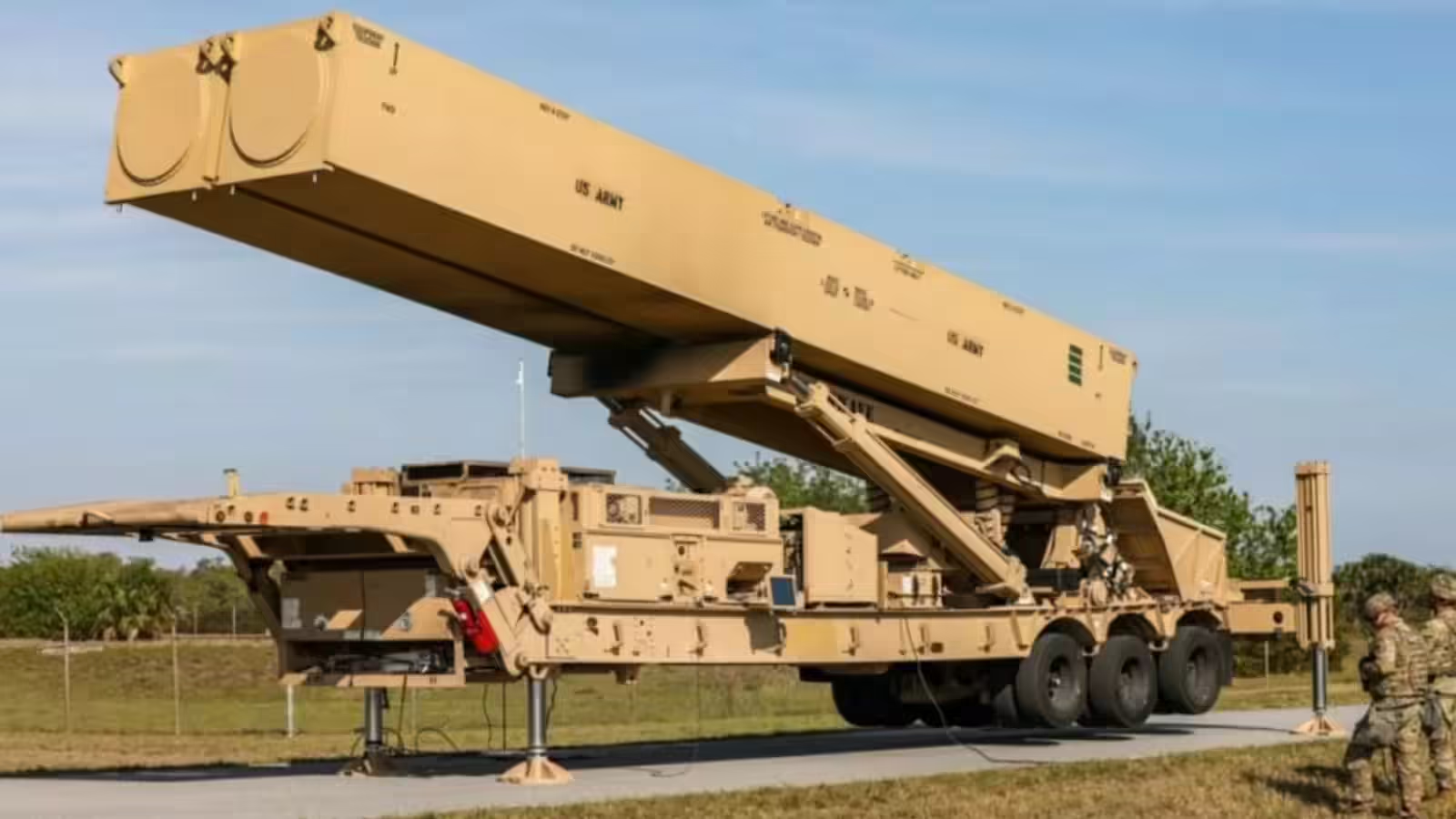
Exercise Balikatan 41-2026, involving approximately 17,000 multi-national personnel, served as the operational crucible for this demonstration, showcasing the rapid deployment of a containerized Mk 41 Vertical Launch System (VLS) mounted on mobile HEMTT truck chassis.
The strategic calculus of utilizing Leyte Island as a launch point enables U.S. and Philippine forces to hold high-value maritime and terrestrial targets at risk across a 1,600 km (roughly 1,000 miles) radius through sustained precision strike operations.
Philippine Defense Secretary Gilberto Teodoro Jr. has defended the deployment against domestic criticism, asserting that the integration of the Typhon system is essential for strengthening Armed Forces of the Philippines (AFP) capabilities and bolstering credible national defense.
By bridging the “mid-range gap” created after the 2019 dissolution of the Intermediate-Range Nuclear Forces (INF) Treaty, the U.S. Army Pacific (USARPAC) has effectively re-established a land-based deterrent against escalating regional maritime assertiveness and contested sovereignty claims.
The deployment also introduces a persistent anti-access/area-denial (A2/AD) dimension into the operational environment of the western Pacific, complicating adversary naval maneuver planning and compressing reaction timelines for hostile surface combatants operating near critical chokepoints in the South China Sea.
From a geopolitical standpoint, the live-fire event sends a calibrated but unmistakable strategic signal that Manila is steadily transitioning from a purely territorial defense posture toward a more integrated allied deterrence architecture closely aligned with evolving U.S. Indo-Pacific warfighting doctrine.
Military analysts further assess that the operationalization of the Typhon MRC inside the Philippine archipelago could accelerate a broader regional missile deployment competition, particularly as China continues expanding its long-range precision strike inventory and anti-ship ballistic missile umbrella across the Indo-Pacific theatre.
READ: Philippines Plans to Acquire Mid-Range Capability (MRC) “Typhon” Missile Launcher
Tactical Execution and Multi-Domain Task Force Integration
The 1st Multi-Domain Task Force (1st MDTF) spearheaded the kinetic demonstration by deploying the Typhon battery to Tacloban Airport, verifying the system’s air-transportable nature via C-17 Globemaster III aircraft for rapid expeditionary littoral operations.
Operating under a simulated high-intensity combat scenario, the joint U.S. and Philippine artillery units successfully engaged a hypothetical opposing force position located at the Fort Magsaysay impact area approximately 630 km (391 miles) from the launch site.
The Tomahawk Land Attack Missile utilized an inert payload to focus specifically on the complex telemetry, mid-course guidance corrections, and terminal phase accuracy required for supporting ground maneuvers led by the U.S. Army’s 25th Infantry Division.
Filipino troops from the Army Artillery Regiment and Philippine Marines were fully embedded within the command center, gaining critical hands-on experience in the digital fire-control architecture necessary to manage multi-role missile systems in contested environments.
This live-fire event, costing millions in operational overhead—roughly USD 2 million (RM 7.6 million) per missile unit—highlights the significant financial and logistical commitment the U.S. is making to modernize the Philippine defense posture through advanced technology.
The Typhon system’s ability to utilize the SM-6 multi-role missile alongside the Tomahawk provides a flexible “quiver” for commanders, allowing for simultaneous air defense, anti-ship, and land-attack missions from a single, highly mobile, containerized platform.
The flight duration of approximately one hour provided extensive data for analysts regarding the missile’s performance in tropical atmospheric conditions, ensuring that the Strategic Mid-range Fires (SMRF) units can operate effectively within the Indo-Pacific’s unique climate.
Technical integration between the U.S. Army and the Philippine Navy’s maritime domain awareness sensors was a key secondary objective, ensuring that target acquisition data can flow seamlessly across the combined joint force during future regional contingencies.
Geopolitical Friction and the Architecture of Deterrence
The deployment of a 1,600 km-range strike system in the Philippines has drawn sharp condemnation from Beijing, with Chinese officials characterizing the presence of the Typhon battery as a “provocative” and “destabilizing” escalation of regional tensions.
From its current rotation in the northern and central Philippines, the Typhon system provides the U.S.-Philippine alliance with the capacity to reach deep into the South China Sea and touch coastal facilities along China’s southern military district.
International observers note that this capability provides a land-based alternative to carrier-borne aviation, effectively turning the Philippine archipelago into a series of “unsinkable” missile platforms that complicate the anti-access/area-denial (A2/AD) strategies of regional adversaries.
Despite the strategic benefits, the Makabayan coalition and other domestic Philippine lawmakers have voiced concerns that the country is being transformed into a “playground” for U.S. military activities, potentially inviting pre-emptive strikes during a wider conflict.
The U.S. Army has remained largely silent on the specific long-term basing of the Typhon, yet the repeated extension of its “rotational” presence since April 2024 suggests a permanent shift toward a persistent mid-range strike posture.
Strategic signaling is a central component of Balikatan 41-2026, as the inclusion of allies from Australia, Japan, and France reinforces a multilateral commitment to a “Free and Open Indo-Pacific” through the demonstration of high-end kinetic capabilities.
The Typhon’s successful launch serves as a potent deterrent against gray-zone tactics, as the presence of a “precise hit” capability from 630 km away forces regional actors to reconsider the costs of maritime coercion against Philippine assets.
Maintaining factual neutrality is essential when evaluating these claims, as the U.S. views the system as a defensive deterrent while other regional powers view it as an offensive tool capable of destabilizing the delicate balance of power.
Evolution of the Typhon System Post-INF Treaty
The development of the Typhon Mid-Range Capability was a direct response to the U.S. withdrawal from the INF Treaty in 2019, which previously prohibited ground-launched cruise and ballistic missiles with ranges between 500 and 5,500 kilometers.
By leveraging the proven Mk 41 Vertical Launch System—a staple of U.S. Navy destroyers—the Army has created a cost-effective, land-based variant that utilizes existing missile inventories like the Tomahawk and the Raytheon-manufactured SM-6.
Each Typhon battery typically consists of four launchers and a mobile command post, representing a significant logistics footprint that requires specialized transport and hardened infrastructure to maximize the system’s survivability against modern electronic warfare threats.
The transition from testing in the United States in 2023 to live-firing in Australia in 2025 and finally the Philippines in 2026 demonstrates the rapid maturation of the U.S. Army’s long-range precision strike enterprise.
Integrating these systems into the Philippine defense architecture involves substantial investment in “paving the way” for future Philippine acquisitions, as Manila seeks to modernize its Horizon 3 defense procurement program with USD-denominated military hardware.
Valued at several million dollars per launcher unit—equivalent to over RM 30 million—the Typhon system represents a high-end capability that may eventually be operated independently by the Philippine Army to secure its coastal defense and maritime borders.
The “inert” nature of the May 5 launch payload was a calculated decision to minimize environmental impact at Fort Magsaysay while still validating the complex software handshakes required for the missile’s waypoint-based navigation and terminal engagement.
Analysts remain focused on the “dwell time” of these systems in-country, as the logistical challenge of maintaining high-tech missile batteries in a humid, maritime environment provides a real-world test for the Army’s sustainment and maintenance units.
Logistics Footprint and Expeditionary Force Posture
The successful deployment of the Typhon system to Tacloban City highlights the U.S. military’s ability to utilize “spoke-and-hub” logistics to move heavy precision-strike assets to remote airfields with minimal lead time or permanent infrastructure.
Utilizing the HEMTT truck chassis ensures that the Typhon battery can move rapidly along the Philippines’ existing road networks, making it difficult for an adversary to track or target the launchers via satellite or aerial reconnaissance.
This mobility is central to the U.S. Army’s concept of “Agile Combat Employment,” where small, lethal units are distributed across a wide geographic area to increase survivability while maintaining a unified, networked strike capability across the theater.
The participation of the Philippine Army Artillery Regiment is not merely symbolic; it represents a deepening of the technical “human-to-human” interface required for sophisticated joint fire support in a high-intensity conflict scenario.
Logistical planners must account for the specialized storage of Tomahawk missiles, each costing approximately USD 2 million (RM 7.6 million), requiring climate-controlled facilities and rigorous security protocols to ensure the integrity of the sensitive guidance electronics.
The May 5 launch verified that the Philippine military’s domestic infrastructure can support the electronic signatures and communication bandwidth required to host and operate the world’s most advanced ground-based cruise missile systems.
Future iterations of Exercise Balikatan are expected to see more complex firing geometries, potentially involving multiple Typhon batteries operating in tandem with naval assets to demonstrate a truly integrated “maritime strike” capability from the shore.
The U.S. Army Pacific’s reliance on the 1st Multi-Domain Task Force as the “center of gravity” for these operations underscores a shift toward a mission-tailored force structure designed specifically for the unique geography of the Indo-Pacific.
READ: Philippines, U.S. Continue Deployment of Typhon Missile System. Is China the Target?
Strategic Implications for Regional Security Architectures
The historic Tomahawk launch in the Philippines serves as a definitive signal that the U.S. military intends to maintain its tactical edge through the deployment of land-based “long-reach” weapons that offset the numerical advantages of regional competitors.
By establishing a “missile-dense” environment within the first island chain, the U.S.-Philippine alliance effectively creates a buffer zone that protects vital international shipping lanes and upholds the United Nations Convention on the Law of the Sea (UNCLOS).
The precision demonstrated during the 600-km flight to Fort Magsaysay proves that the Typhon system can reliably strike moving or stationary targets with a high degree of confidence, reducing the likelihood of collateral damage in complex littoral zones.
While the current deployment is framed as part of Exercise Balikatan 41-2026, the strategic reality is that the “infrastructure of presence” established by these drills allows for a rapid transition to a permanent deterrent posture if regional security degrades.
Regional allies such as Japan and Australia are closely monitoring the Philippine experience, as they weigh their own requirements for ground-based long-range strike capabilities to counter the proliferation of advanced ballistic and cruise missiles in the region.
The financial cost of this deterrence is substantial, with the U.S. requesting billions in USD (tens of billions in RM) for the continued expansion of the Pacific Deterrence Initiative to fund the deployment and sustainment of such advanced systems.
There remains a significant “information gap” regarding the rules of engagement and command-and-control authority for the Typhon system during a crisis, a detail that defense analysts will continue to scrutinize as the alliance evolves.
Ultimately, the first-ever live-fire of a Tomahawk from the Typhon system in the Philippines has moved the regional security dialogue from the theoretical to the kinetic, setting the stage for a new era of land-based precision power projection.
