
U.S. Army Picks South Korea’s K9MH in $262.9 Million Artillery Shift
Hanwha’s automated K9 Mobile Howitzer could replace selected M777s as the U.S. Army shifts toward protected, wheeled 155mm firepower built for drone-saturated counter-battery warfare.
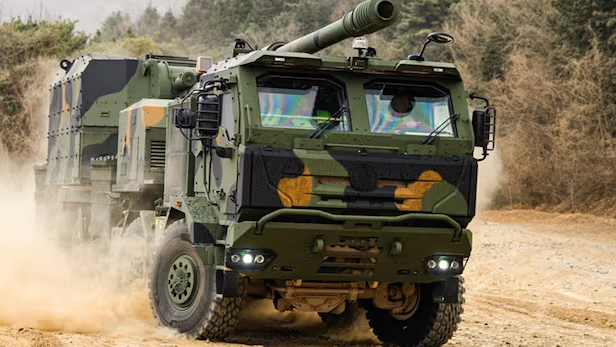
(DEFENCE SECURITY ASIA) — South Korea’s Hanwha Defense USA has secured a potentially $262.9 million U.S. Army agreement to deliver K9 Mobile Howitzer prototypes, inserting Korean artillery technology directly into America’s long-range fires transformation.
The firm-fixed-price Other Transaction Authority agreement initially provides $100.3 million for six accelerated prototypes, while options covering another 12 systems could expand the Mobile Tactical Cannon evaluation fleet to 18 vehicles.
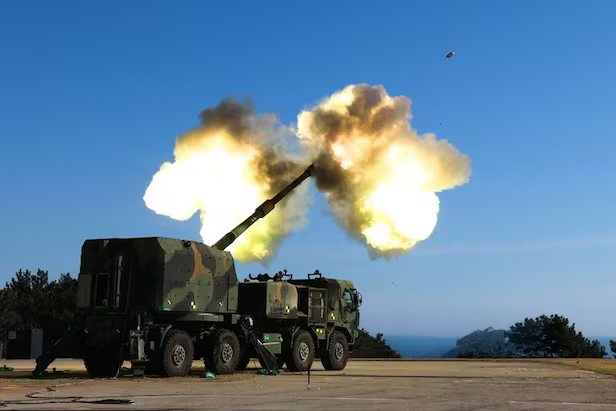
Although the selection does not guarantee production, it gives the wheeled K9MH a consequential opportunity to replace vulnerable M777 towed howitzers within selected formations confronting drones, sensors, and increasingly lethal counter-battery networks.
The decision reflects an operational shift from exposed, comparatively slow-displacing artillery toward armored, automated platforms capable of firing rapidly, leaving within seconds, and surviving inside transparent battlespaces shaped by persistent aerial surveillance.
For U.S. lighter formations, the K9MH could combine 155mm firepower exceeding 40 kilometres with 100-kilometre-per-hour road mobility, creating a more survivable fires architecture without duplicating the tracked M109 Paladin’s armored-force mission.
For South Korea, the award represents Hanwha Defense USA’s first major U.S. Army contract and a strategic breakthrough into the world’s largest defence market, where foreign platforms face demanding operational and industrial scrutiny.
The K9MH combines an automated, unmanned turret derived from the K9A2 with an 8×8 wheeled chassis, placing two or three soldiers inside a protected forward cab instead of exposing loaders around the weapon.
Its proposed fire cycle—eight to nine rounds per minute, three rounds within 15 seconds, and displacement within roughly 50–60 seconds—directly addresses the narrowing survival window confronting artillery crews after detection.
Hanwha describes the platform as a “total artillery solution,” but that proposition remains subject to Soldier experimentation examining reliability, supportability, network integration, ammunition compatibility, safety, and performance under realistic combat conditions.
The Army selected the system after market research and demonstrations involving several mature candidates, favouring rapid assessment of available technology following technical and cost difficulties that ended the Extended Range Cannon Artillery programme.
Localization plans centred on an integration and test facility in Opelika, Alabama, connect battlefield requirements with supply-chain resilience, technology transfer, domestic production capacity, and long-term sustainment across the K9 family.
If testing validates Hanwha’s performance claims, the programme could reshape U.S. mobile artillery doctrine, deepen U.S.–South Korean defence-industrial integration, and intensify competition among the K9MH, CAESAR, RCH 155, Archer, and Sigma.
(READ): CAESAR 155mm Self-Propelled Howitzer Becomes King of Southeast Asia’s Artillery Race as Malaysia Joins Indonesia and Thailand Amid South China Sea Tensions
Why the U.S. Army Needs the K9MH Mobile Tactical Cannon
The M777 remains strategically deployable because of its light weight, but its separate towing vehicle, exposed crew, setup requirements, and slower withdrawal create vulnerabilities once reconnaissance drones identify firing positions.
Modern counter-battery warfare compresses the sequence between muzzle detection and retaliatory attack, making tactical survival increasingly dependent upon automated fire control, brief occupation, protected loading, and immediate displacement rather than concealment alone.
The K9MH is intended to stop, establish stability through four outriggers, deliver its first round within 30 seconds, complete a concentrated mission, and vacate before enemy sensors close the targeting cycle.
This shoot-and-scoot mechanism could let Stryker and evolving mobile or infantry formations generate heavier indirect fires while preserving the operational tempo expected from units that cannot depend upon tracked artillery support.
Its 155mm, 52-calibre CN98 gun substantially extends the baseline reach available from the M777’s 39-calibre barrel, allowing commanders to disperse firing units while influencing targets across a wider operational frontage.
Conventional ammunition can reach approximately 40 kilometres, while rocket-assisted or base-bleed projectiles may exceed 60 kilometres and potentially approach 70 kilometres, depending upon the specific round and firing conditions.
Compatibility with the Army’s 155mm ammunition portfolio, including M795, M107, XM1113 and M549A1 projectiles, could reduce integration risk, although formal testing must verify performance across weapons, charges, networks, and safety requirements.
The 40-projectile onboard capacity supports repeated missions without immediate resupply, while a proposed wheeled K10 companion could carry two turret loads and replenish a K9-family weapon in approximately 18 minutes.
That ammunition depth offers meaningful lethality but enlarges the logistics signature, requiring commanders to protect resupply routes, modular charges, maintenance nodes, and wheeled support vehicles against drones and long-range precision strikes.
Consequently, the programme concerns more than replacing one howitzer: it tests whether lighter American formations can sustain dispersed, protected, networked fires at sufficient speed and volume during large-scale multi-domain combat.
K9MH Firepower, Automation and Shoot-and-Scoot Survivability
The K9MH transfers the K9A2’s fully automated and unmanned artillery module onto a heavy 8×8 platform, separating soldiers from ammunition handling while preserving the mature K9 family’s fire-control and mechanical foundation.
A redesigned dual-feed autoloader independently manages projectiles and modular propellant charges, supporting approximately eight to nine rounds per minute and reducing physical workload, crew size, exposure, and firing-cycle variability.
Demonstrations indicating firing intervals near 7.5 seconds and nine rounds delivered slightly beyond 59 seconds suggest the system could concentrate effects rapidly, although Army trials must establish repeatability under operational stress.
Three rounds fired within 15 seconds also support multiple-round simultaneous-impact techniques, permitting projectiles launched on different trajectories to arrive together and compress an adversary’s warning, dispersal, and protective-response timeline.
Sustained firing rates will necessarily fall as barrel temperature, ammunition expenditure, crew endurance, and resupply demands accumulate, making headline burst performance only one element of operational artillery effectiveness.
The armored forward cab keeps the commander, driver and gunner protected while the turret operates without occupants, improving survival against fragments and small-arms threats compared with crews serving an exposed towed system.
However, armor cannot neutralize top-attack munitions, loitering weapons, electronic detection, or precision counter-battery fire, so survivability still depends upon deception, emissions discipline, air defence, dispersion, and consistently rapid displacement.
With a claimed road speed reaching 100 kilometres per hour and operational range near 700 kilometres, the wheeled configuration supports rapid theatre movement and reduces reliance upon heavy equipment transporters.
Those advantages are strongest across developed road networks, whereas axle loading, terrain softness, bridge capacity, vehicle dimensions, and deployed outriggers may constrain access and survivability within difficult or heavily cratered environments.
The Army’s experiments must therefore measure the complete kill-chain contribution—arrival, network connection, targeting, firing, departure, replenishment and repair—because impressive weapon performance becomes irrelevant when support systems cannot preserve tempo.
From M777 Vulnerability to a New U.S. Fires Architecture
Replacing M777s only within selected formations indicates differentiation rather than wholesale substitution, preserving lightweight artillery where strategic lift matters while assigning protected wheeled systems to units facing denser surveillance and counter-battery threats.
The heavier tracked M109 Paladin would continue supporting armored formations, leaving the Mobile Tactical Cannon to fill an intermediate role between air-portable towed weapons and protected tracked artillery with greater cross-country performance.
This layered structure could give commanders platform choices matched to terrain, lift, threat, and manoeuvre requirements, but it would also add training, maintenance, vehicle, and spare-parts complexity across the artillery enterprise.
The Army’s prototype-first approach places soldiers inside realistic experiments before committing to fielding, allowing crews and maintainers to expose ergonomic, tactical, reliability, and supportability weaknesses that controlled demonstrations may conceal.
Data from six initial vehicles should inform senior decisions, while the option for 12 additional systems provides room for broader experimentation without treating the initial selection as an irreversible procurement commitment.
The estimated four-year performance period creates space for safety characterization, ammunition and network integration, unit issuance, operational experimentation, and design refinement, although exact delivery dates and milestone payments remain undisclosed.
That uncertainty matters because rapid fielding depends upon more than a mature cannon: software compatibility, communications security, digital fire-control integration, ammunition certification, training pipelines, technical manuals, and repair infrastructure must mature together.
Cancellation of the XM1299 effort after challenges involving longer gun tubes strengthens the attraction of production-ready systems, but choosing lower development risk may limit the maximum range once anticipated from clean-sheet American artillery.
Hanwha has nevertheless designed growth margin for a 58-calibre barrel potentially supporting ranges beyond 70–80 kilometres with advanced ammunition, though this remains a future pathway rather than a demonstrated MTC capability.
Successful experimentation could eventually support requirements numbering in the hundreds, but any such scale remains conditional upon operational evidence, affordability, production readiness, sustainment performance, and Army decisions not contained in the prototype award.
Alabama Localization and the U.S.–South Korea Industrial Link
Hanwha’s three-year lease for an Opelika integration and test facility establishes an initial American foothold intended to support K9MH assessment, customer-specific integration, and a phased transition toward broader localized production and sustainment.
Localization gives the Army potential access to a mature foreign design while directing testing, jobs, technical knowledge, and lifecycle support into the United States, balancing rapid availability against domestic industrial-security expectations.
The modular artillery unit uses standardized mechanical and electrical interfaces and is described as chassis-agnostic, potentially allowing alternative heavy 8×8 vehicles when payload, stability, protection, and integration requirements are satisfied.
The currently associated third-generation Tatra Force chassis and armored cab provide an established mobility solution, although an Americanized configuration could alter suppliers, technical characteristics, cost, schedule, and qualification requirements.
Hanwha’s wider plans include a proposed $1.3 billion facility near Pine Bluff Arsenal producing energetic materials and modular charges, linking artillery-platform localization with U.S. efforts to expand constrained ammunition manufacturing capacity.
These investments could strengthen supply resilience during prolonged conflict, yet announced facilities and planned capacity must be distinguished from completed production lines, certified output, secure suppliers, and delivered wartime volumes.
More than 2,500 K9-series howitzers have been built or ordered across roughly 10–12 countries, giving Hanwha an international operator base that may support parts commonality, training cooperation, engineering maturity, and economies of scale.
American adoption would add exceptional market validation, but the Army must ensure foreign-origin components, intellectual property arrangements, cybersecurity protections, technical data access, and surge capacity remain compatible with national mobilization requirements.
For Seoul, the contract reinforces South Korea’s emergence as a major defence exporter offering operationally mature equipment, active production lines, rapid delivery, localization, and technology-transfer flexibility rather than relying solely upon novel specifications.
For Washington, selecting a Korean-derived platform signals alliance pragmatism: trusted partners may contribute directly to American rearmament when their manufacturing depth and available technology address capability gaps faster than domestic development programmes.
(READ): Pakistan Set to Test 1,000km Fatah-5 Rocket in 2026, Transforming Rocket Artillery into Strategic-Depth Strike Weapon
Global Artillery Competition and the Strategic Stakes
The K9MH now enters U.S. evaluation against the strategic backdrop of intense global demand for mobile 155mm artillery, where battlefield experience has elevated range, automation, ammunition availability, survivability, and manufacturing throughput as decisive criteria.
Its strongest differentiators include a mature K9 ecosystem, high onboard ammunition capacity, protected reduced crew, rapid firing, swift displacement, and industrial localization, rather than a single unprecedented technical feature.
France’s CAESAR offers a lighter, simpler and combat-proven alternative, Germany’s Boxer-based RCH 155 emphasizes deep automation and firing while moving, while Sweden’s Archer provides automated handling and rapid engagement cycles.
Elbit’s Sigma adds another mature competitor, ensuring the broader market will compare not merely acquisition price, but delivery speed, ammunition integration, crew requirements, mobility, protection, sustainment, and sovereign production arrangements.
A successful U.S. trial could elevate K9MH credibility in future tenders because Army validation would signal interoperability with American networks and munitions, although prototype selection alone cannot establish operational superiority over competing systems.
Shared K9-family fleets among the United States and allies including Poland, Romania, Norway and Finland could improve coalition familiarity, training exchanges, spares availability, maintenance knowledge, and potentially ammunition logistics during multinational operations.
Common platforms do not automatically create interoperability, because national fire-control networks, communications standards, ammunition certifications, vehicle configurations, tactical doctrine, and export restrictions can preserve substantial differences across allied fleets.
Strategically, the award signals that Washington may accept proven allied technology when urgent battlefield requirements outpace domestic programmes, provided foreign suppliers deliver American industrial participation, secure integration, and sustainable lifecycle support.
The central question is therefore whether K9MH can convert compelling specifications into repeatable combat output while maintaining mobility, reliability, ammunition flow, network connectivity, and repair capacity under persistent surveillance and attack.
If Soldier experimentation confirms that equation, South Korea’s wheeled howitzer could transform selected U.S. artillery formations, accelerate bilateral industrial integration, and reset competitive expectations across the global market for mobile long-range fires.
K9MH Technical Specifications
| Technical item | Specification |
|---|---|
| System type | Wheeled self-propelled howitzer |
| Main armament | CN98 155mm/52-calibre NATO-standard gun |
| Platform | Heavy 8×8 wheeled chassis, typically Tatra Force |
| Combat weight | Approximately 40 tonnes or less |
| Crew | Two to three personnel inside an armored forward cab |
| Maximum rate of fire | Approximately eight to nine rounds per minute |
| Ammunition capacity | 40 projectiles with associated modular propellant charges |
| Maximum firing range | About 40km with conventional ammunition; more than 60km with extended-range ammunition |
| Maximum road speed | Up to 100km/h |
| Operational range | Approximately 700km |
