
Mystery U.S. C-17 Flight Into Moscow Raises Pentagon Questions
The unexplained arrival of USAF C-17 REACH 4555 in Moscow exposes a rare U.S.-Russia logistics corridor as Ukraine diplomacy stalls and speculation intensifies over the aircraft’s Pentagon-linked mission.
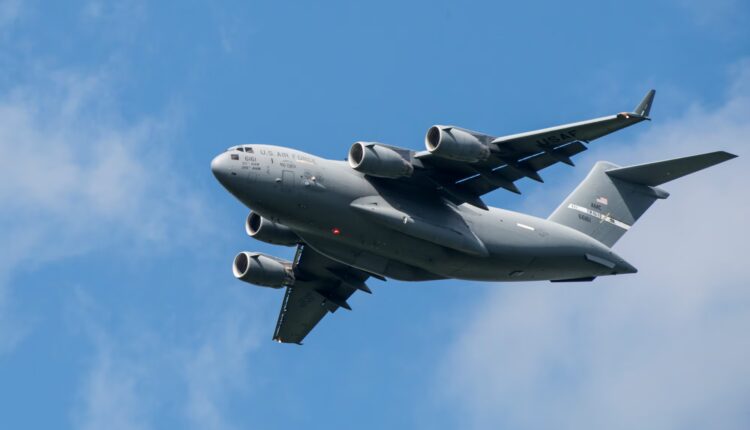
(DEFENCE SECURITY ASIA) — A U.S. Air Force C-17A Globemaster III landed at Moscow’s Vnukovo Airport on August 25, creating a military-airlift event amid stalled Ukraine diplomacy and constrained communications between Washington and Moscow.
Operating as REACH 4555, aircraft 07-7181 reached Vnukovo at about 10:04 a.m. Moscow time after departing Riga, completing a U.S. military flight into Russia whose purpose, passengers and cargo remain undisclosed.

The landing was confirmed through ACARS initialization messages and complete approach data, overcoming early uncertainty caused by terrestrial multilateration tracking that produced position gaps, questionable speeds and inconsistent headings during the aircraft’s eastward movement.
This distinction matters because the confirmed arrival transforms an ambiguous radar trace into a verifiable force-mobility event, while leaving unresolved whether the mission supported diplomacy, embassy logistics, personnel movement or another tightly controlled government requirement.
The aircraft reportedly carried a “SECDEF support” designation associated by aviation trackers with Pentagon logistics, but that classification has not been independently confirmed by the U.S. Air Force, Department of Defense or flight documentation.
Such a designation ordinarily indicates advance movement of communications equipment, vehicles, security teams, spare parts or support personnel, rather than proving that Defense Secretary Pete Hegseth or another senior official travelled aboard the aircraft.
Kremlin spokesman Dmitry Peskov said, “I do not have such information,” while adding that no meetings with U.S. administration representatives were planned at the Kremlin that week, sustaining rather than resolving the mission’s ambiguity.
Washington offered no corresponding explanation, with no public confirmation from the Pentagon, White House, State Department or Air Force concerning the aircraft’s tasking, manifest, diplomatic clearance, passengers, onward schedule or planned departure.
The silence surrounding a visible strategic airlifter is operationally significant because C-17 missions require coordinated airspace access, ground handling and security, meaning the flight necessarily involved practical arrangements despite the absence of political disclosure.
Direct U.S. heavy-airlift missions into Russia have become uncommon since Russia’s 2022 invasion of Ukraine, making the Vnukovo arrival a signal even if its underlying task proves administrative rather than diplomatic.
Theories include a prisoner exchange, embassy resupply, personnel rotation, advance support for senior-level engagement or quiet confidence-building, yet no passenger list, cargo manifest, official itinerary or corroborating government announcement supports any explanation.
The central issue is therefore not whether speculation appears plausible, but how a rare C-17 movement demonstrates that controlled logistical access remains possible between adversarial powers when an important operational or diplomatic requirement emerges.
(CLICK HERE): UAE Deploys Eight C-17s to Airlift South Korea’s M-SAM-II Missile Shield as Iran’s Hormuz Blockade Reshapes Gulf Warfare
REACH 4555’s Route Reveals a Deliberately Staged Strategic Airlift Mission
The aircraft’s movement began August 22 at Joint Base McGuire-Dix-Lakehurst, proceeded to Joint Base Charleston, repositioned to Joint Base Andrews, crossed the Atlantic to Riga and finally entered Russia through a sequenced itinerary.
That progression connected an American mobility installation, a C-17 operating hub, an executive-airlift gateway and a NATO-region staging point, creating a logistics chain compatible with government support rather than commercial transportation.
Aircraft 07-7181 departed McGuire-Dix-Lakehurst at about 6:36 p.m. Eastern time and reached Charleston around 8:08 p.m., establishing the domestic positioning leg before its movement toward the U.S. capital region.
On August 23, the Globemaster departed Charleston and landed at Joint Base Andrews at about 5:36 p.m., placing the aircraft at an installation associated with government travel, executive support and international missions.
It left Andrews at about 8:38 p.m. UTC and landed at Riga Airport at 5:18 a.m. UTC on August 24 after roughly eight hours and 41 minutes of flight.
The C-17 remained in Riga until the next morning, providing time for crew rest, coordination, clearances, cargo preparation or synchronization, although the information establishes none of those possibilities as the confirmed reason.
REACH 4555 departed Riga at about 5:48 to 5:50 a.m. UTC on August 25, moved eastward across Latvia and near Lithuanian airspace, then entered Russia for the approach toward Moscow.
Its Riga-to-Vnukovo sector lasted about one hour and 14 minutes, a short tactical leg that converted Riga from a transatlantic destination into the forward staging point for Russian access.
A Boeing C-40 using callsign REACH 790 also arrived in Riga from Andrews on August 23 and was observed parked nearby, suggesting related activity without proving passengers, cargo, command relationships or mission objectives.
The route’s architecture shows how air mobility can assemble personnel, equipment and secure support through several nodes, allowing governments to preserve flexibility while withholding the political purpose of the final movement.
Why the C-17 Globemaster III Changes the Meaning of the Moscow Landing
The C-17 Globemaster III is more than a diplomatic transport, being a heavy strategic airlifter capable of moving cargo, vehicles, personnel and specialized mission equipment across intercontinental distances through a limited logistics network.
Its appearance at Vnukovo consequently carries different military-technical implications from a business jet, because the aircraft can deliver an enabling package large enough to establish communications, security, transportation and sustainment for complex official activity.
Advance-support missions commonly position equipment and teams before a senior leader arrives separately, ensuring that protected communications, local mobility and contingency support are operational before the principal enters a sensitive environment.
This means the reported SECDEF association, even if accurate, would indicate a support relationship rather than establish Hegseth’s presence, an imminent visit or direct Pentagon participation in negotiations concerning Ukraine, Iran or bilateral security.
Senior officials may travel aboard specialized aircraft including the E-4B, C-32 or a C-17 configured with a Silver Bullet command-and-control module, separating executive movement from the heavier logistics footprint preceding or accompanying it.
Four-digit REACH callsigns are often associated by aviation-monitoring communities with special, diplomatic, VIP or support tasking, but callsign patterns alone cannot identify cargo, passengers, destination purpose or the authority directing a specific mission.
Air Mobility Command support for senior leadership can involve mobility readiness spares packages, vehicles, communications systems and security personnel, enabling protected operations where local infrastructure or host-nation arrangements cannot meet American requirements.
Specific security procedures can also place dedicated protection teams aboard executive-support aircraft when destination conditions are judged inadequate, reinforcing why a heavy airlifter may precede political activity without carrying the policymaker personally.
However, no publicly available document defines the internal designation reportedly attached to REACH 4555, requiring analysts to distinguish established mobility practices from unverified claims about this aircraft’s specific tasking and command priority.
The mechanism is nevertheless clear: strategic airlift converts political intent into deployable capability by moving the secure infrastructure, specialists and sustainment assets required to make sensitive engagement feasible on short notice.
Official Silence Turns a Logistics Flight Into Strategic Signalling
Moscow’s response combined informational distance with a narrow scheduling denial, as Peskov said Russian authorities lacked information about the aircraft and that no U.S. administration meetings were planned at the Kremlin that week.
That wording did not explain the flight, deny that Russian agencies authorized its arrival or exclude activity outside the Kremlin, leaving analytical space while carefully avoiding confirmation of diplomatic, military or exchange-related coordination.
No explanation emerged from Russia’s Foreign Ministry, civil aviation authorities or other government institutions concerning flight clearance, ground handling, passengers or cargo, preventing assessment of Moscow’s institutional role beyond permitting access.
The United States remained completely silent, issuing no public account of the mission and providing no confirmation from agencies that would ordinarily possess knowledge of a military aircraft flying directly into Russian territory.
Mutual opacity can protect sensitive diplomacy, security or detainee movements, but it can surround routine government logistics, making absence of disclosure an indicator of sensitivity rather than proof of geopolitical breakthrough.
Authorizing an American military aircraft to land near Moscow requires a channel for aviation, security and administrative coordination, demonstrating that communication persists beneath the confrontation over Ukraine and European security.
The episode therefore signals controlled compartmentalization: Washington and Moscow can maintain strategic hostility publicly while enabling defined operational cooperation when both governments judge disclosure unnecessary, premature or potentially disruptive to a sensitive process.
For NATO members observing the flight through Riga, the movement illustrates Latvia’s role as a logistical bridge, where allied infrastructure can support onward government access while preserving separation between transatlantic and Russian flight segments.
For Russia, allowing the Globemaster to arrive creates an image of selective access without conceding diplomatic momentum, while Washington gains operational reach without committing itself to a negotiation, exchange or leadership visit.
Strategic signalling thus resides in the flight’s execution rather than an announced message: despite confrontation, sanctions and limited trust, both sides retained sufficient procedural control to complete a rare, visible and sensitive air-mobility operation.
Ukraine Diplomacy and Prisoner-Exchange Theories Face Major Evidence Gaps
The timing intersects with stalled U.S.-Russia contacts over Ukraine, delayed travel involving envoys Steve Witkoff and Jared Kushner, and discussion of a new proposal prepared by Ukraine alongside American and European officials for presentation to Moscow.
The circumstances explain heightened interest but do not establish causation, because no itinerary places either envoy aboard or behind REACH 4555, while Russia stated that no American administration meetings were scheduled at the Kremlin.
Hegseth was documented conducting a domestic tour in Nebraska and Wisconsin on August 24, weakening claims that the C-17 carried him toward Moscow, although advance logistics could precede travel announced only later.
A prisoner or detainee exchange remains another circulated explanation because Vnukovo has supported previous transfers, including cases involving American teacher Marc Fogel and former U.S. Marine Robert Gilman, released on August 11, 2026.
Precedent establishes airport suitability, not evidence of a new exchange, and no identified detainee, negotiated arrangement, manifest, receiving delegation or onward aircraft movement has been disclosed in connection with the Globemaster’s arrival.
Embassy support offers a credible possibility, because the aircraft could move equipment, cargo or personnel for the U.S. mission in Moscow where direct military access is rare and logistics conditions remain constrained.
Yet that theory also lacks confirmation, illustrating the danger of converting platform capability into mission certainty merely because the C-17 can transport outsized cargo, security assets, communications equipment or rotating government personnel.
Suggestions of back-channel coordination or confidence-building are unverified, particularly because concurrent Ukraine and Iran-related pressures could create reasons for communication while simultaneously increasing incentives for secrecy, misdirection and cautious public messaging.
Discipline therefore requires separating three layers: the confirmed aircraft movement, the unconfirmed SECDEF-support interpretation and the speculative political narratives connecting the flight to negotiations, exchanges, embassy activity or senior-leader travel.
Until authorities release manifests, tasking information or related diplomatic announcements, the conclusion is limited: an unusual U.S. military airlift mission reached Moscow through Riga during a period of strategic confrontation.
(CLICK HERE): Russia’s MC-21 Gamble: Moscow Accelerates Aircraft Production as Western Sanctions Test Aviation Sovereignty
A Rare Moscow Airlift Exposes the Logistics Behind High-Level Statecraft
The flight underscores how diplomacy between nuclear powers depends on infrastructure, secure communications, protected mobility and reliable sustainment, elements concealed behind political announcements but essential for negotiations, exchanges or crisis-management missions.
Riga’s staging role reduced the final sector’s distance and concentrated the sensitive Russian entry into a short movement, offering greater flexibility for clearance timing, crew management, payload adjustments and response to changing political instructions.
Andrews provided access to the American executive-support ecosystem, while Charleston and McGuire-Dix-Lakehurst connected the aircraft to strategic-airlift capacity, producing a force posture extending from domestic bases through NATO territory to Moscow.
That footprint demonstrates how Air Mobility Command can generate significant access without deploying combat power, using transport aircraft, support crews and multinational airspace coordination to create options for policymakers under compressed timelines.
The mission also exposes the vulnerability of secrecy in an era of flight tracking, ACARS interception and distributed open-source analysis, where even incomplete signals can trigger geopolitical narratives before governments provide contextual information.
Early MLAT uncertainty showed the risk of misinterpretation, because degraded positional data can generate false confidence about route, speed or destination until technical evidence, including communications messages and approach records, confirms the movement.
For planners, the episode illustrates that logistics platforms themselves generate strategic effects: aircraft selection, staging location, callsign pattern and ground time can communicate urgency or sensitivity even when the payload remains unknown.
For policymakers, withholding explanation preserves negotiating space but allows speculation to dominate public interpretation, potentially complicating allied coordination, adversary assessments and domestic expectations if the mission proves narrower than initially assumed.
For Indo-Pacific and European security observers, the lesson is transferable: air mobility provides the connective tissue between distant command centres, forward hubs and politically restricted destinations, allowing selective engagement without changing declared force posture.
REACH 4555 ultimately changes the battlespace informationally rather than kinetically, proving that Washington and Moscow retain a logistics corridor while exposing how uncertainty surrounding one C-17 can become an instrument of ambiguity.
