
“Shadow War Explodes”: UAE Secretly Strikes Iran as Gulf Conflict Pushes Strait of Hormuz Toward Global Energy Crisis
Covert Emirati airstrikes on Iran’s Lavan Island refinery signal a dangerous transformation in Gulf military doctrine as missile warfare, maritime disruption, and regional escalation threaten global energy security.

(DEFENCE SECURITY ASIA) — The revelation that the United Arab Emirates secretly conducted military strikes inside Iran has dramatically altered strategic assumptions surrounding Gulf security architecture, exposing a previously undisclosed escalation path within the broader 2026 U.S.-Israel-Iran regional conflict.
The reported Emirati strike against Iran’s Lavan Island refinery demonstrated that Abu Dhabi has shifted from a primarily defensive counter-missile posture into direct offensive operations employing advanced Western-supplied combat aircraft, surveillance assets, and precision-strike capabilities against Iranian infrastructure.
The Wall Street Journal report published on May 11 cited individuals familiar with the operation and described the UAE as an increasingly active combatant after absorbing sustained Iranian missile, drone, ballistic, and cruise missile attacks targeting airports, ports, energy infrastructure, and maritime logistics corridors throughout the Gulf.
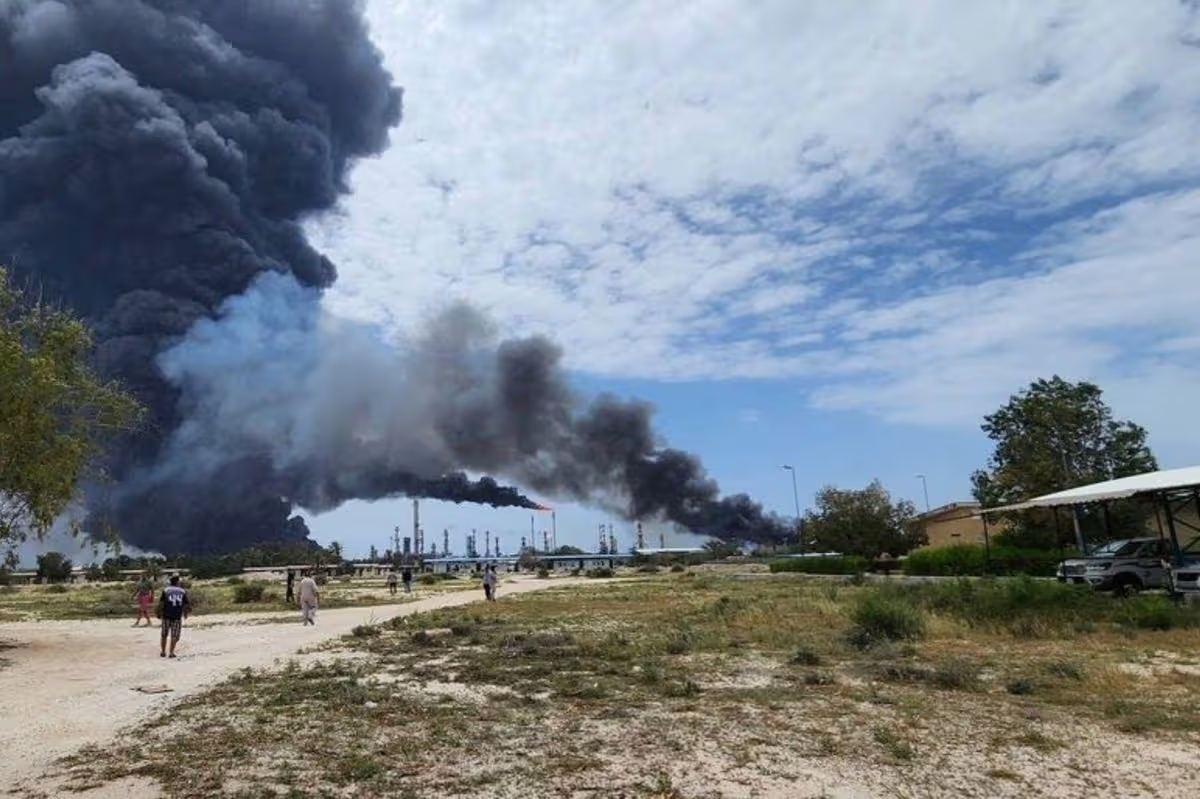
Iran’s retaliatory missile and drone strikes against Gulf states had already disrupted shipping flows through the Strait of Hormuz, generating fuel shortages, maritime insurance instability, and mounting concerns regarding global energy supply chains linking Asia, Europe, and international financial markets.
The reported Emirati operation emerged shortly after U.S. President Donald Trump publicly announced a fragile ceasefire following a five-week air campaign involving U.S. and Israeli military operations against Iranian-linked strategic targets across the wider region.
Iran reportedly attributed the attack on Lavan Island to UAE-operated Mirage 2000 fighter aircraft and immediately launched retaliatory missile and drone barrages against the UAE and Kuwait, intensifying fears that Gulf escalation dynamics were rapidly entering an uncontrolled retaliatory cycle.
The strike reportedly caused extensive fires and disabled a significant portion of the refinery’s operational processing capacity for several months, highlighting the vulnerability of critical energy infrastructure throughout the Persian Gulf despite layered regional air defence systems.
The covert nature of the Emirati operation also underscored how Gulf powers are increasingly relying on deniable precision-strike doctrines and intelligence-driven targeting frameworks to avoid triggering immediate full-scale interstate warfare while still imposing measurable strategic costs on adversaries.
Regional defence analysts believe the reported strikes may accelerate a broader military recalibration among Gulf Cooperation Council states, particularly regarding offensive airpower integration, hardened infrastructure resilience, and long-range counter-strike deterrence capabilities against Iranian missile networks.
The revelation further intensified scrutiny over the effectiveness of existing ceasefire mechanisms because continued drone interceptions, maritime disruptions, and covert retaliatory operations collectively indicate that the operational tempo of the regional conflict has not meaningfully declined despite formal diplomatic announcements.
Strategically, the emergence of the UAE as an active offensive actor inside Iranian territory signals a potentially historic transformation in Gulf security behaviour, where economic survival, energy infrastructure protection, and maritime trade continuity are increasingly driving regional states toward more aggressive military postures.
READ: Egypt Deploys Rafale Fighters to UAE as Anti-Iran Gulf Air Shield Expands Amid Escalating Missile Threat
Abu Dhabi’s Strategic Shift From Defence to Offensive Airpower
For years, the UAE had focused heavily on integrated air defence, missile interception, counter-drone capabilities, and strategic infrastructure protection due to persistent Iranian missile threats directed against Gulf energy and financial hubs.
The alleged Lavan Island strike now indicates that Abu Dhabi has recalibrated its military doctrine toward pre-emptive and retaliatory precision-strike operations designed to impose direct economic costs on Iranian strategic infrastructure.
Such a transition represents one of the most consequential changes in Gulf military posture since the regional drone and missile attacks against Saudi Arabian oil facilities fundamentally transformed Middle Eastern threat calculations several years earlier.
The UAE’s advanced combat aviation fleet, including Mirage 2000 and F-16 variants equipped with precision-guided munitions, provides Abu Dhabi with one of the most technologically sophisticated airpower capabilities among Gulf Cooperation Council states.
The reported operation also demonstrated the increasing importance of persistent intelligence, surveillance, reconnaissance, and target acquisition networks supporting modern Gulf air campaigns against hardened strategic infrastructure targets.
Iran’s previous missile and drone barrages against Emirati airports, logistics centres, and energy facilities had already exposed the limitations of purely defensive interception strategies against large-scale saturation attacks involving multiple vectors and launch platforms.
The Emirati leadership appears increasingly convinced that deterrence credibility now requires the demonstrated ability to strike Iranian strategic assets directly rather than solely relying upon defensive interception systems and diplomatic signalling.
The UAE Foreign Ministry neither confirmed nor denied the Wall Street Journal report but referenced earlier statements affirming Abu Dhabi’s right to respond militarily against hostile attacks threatening national security and economic stability.
That ambiguity reflects a broader Gulf strategy aimed at maintaining escalation flexibility while avoiding immediate public acknowledgement that could force Tehran into larger retaliatory responses under domestic political pressure.

Lavan Island’s Strategic Importance in the Gulf Energy Battlespace
Iran’s Lavan Island occupies an important position within the Persian Gulf energy network because the island supports oil processing infrastructure connected to wider regional export and maritime logistics systems.
Targeting Lavan Island therefore carried significance extending beyond physical refinery damage because the operation demonstrated the vulnerability of Iranian energy infrastructure located close to critical Gulf maritime transit corridors.
The strike reportedly disabled a substantial portion of the refinery’s processing capability for several months, creating economic and symbolic pressure against Tehran during an already volatile regional confrontation with the United States and Israel.
The absence of reported casualties suggests the operation may have been calibrated to maximise strategic signalling and infrastructure disruption while limiting immediate civilian escalation pressures associated with mass fatalities.
Military analysts increasingly assess that infrastructure warfare has become central to the evolving Gulf conflict because energy facilities represent both economic lifelines and politically sensitive strategic targets for all regional actors.
Iran’s repeated attacks against Gulf shipping and energy infrastructure had already produced serious concerns regarding the resilience of global hydrocarbon supply routes crossing the Strait of Hormuz chokepoint.
Approximately one-fifth of global oil shipments transit through the Strait of Hormuz, meaning even limited disruptions can trigger immediate fluctuations in energy markets, maritime insurance costs, and strategic reserve calculations among major economies.
The UAE’s decision to strike Iranian energy infrastructure may therefore reflect an emerging doctrine designed to convince Tehran that attacks against Gulf export systems will invite reciprocal economic consequences inside Iranian territory.
That logic mirrors broader deterrence frameworks increasingly visible across modern regional conflicts where economic infrastructure, logistics corridors, and industrial processing facilities have become central components of strategic warfare.
Fragile Ceasefire Faces Growing Risk of Collapse
The reported Emirati strike occurred near the timeframe of the U.S.-announced ceasefire, intensifying concerns that the truce was already deteriorating before meaningful de-escalation mechanisms could stabilise the regional security environment.
Despite formal ceasefire declarations, Iranian drone and missile activity reportedly continued throughout May while Gulf air defence systems maintained repeated interception operations against incoming aerial threats targeting regional infrastructure.
The Wall Street Journal report suggested that the Emirati operations were not isolated incidents, indicating the possibility of additional covert actions designed to degrade Iranian strategic capabilities without triggering immediate full-scale conventional war.
Regional military planners increasingly view the current ceasefire less as a stable peace arrangement and more as an operational pause between continuing phases of strategic confrontation involving covert, cyber, missile, and proxy warfare.
The persistence of Iranian missile launches and Gulf countermeasures underscores the enormous difficulty associated with imposing escalation control once regional actors have transitioned into sustained retaliatory military cycles.
The Pentagon reportedly reacted positively to the Emirati operations despite their proximity to the ceasefire timeline, suggesting Washington quietly accepted Gulf participation in wider pressure campaigns against Iranian strategic assets.
Reports indicating that President Trump welcomed broader regional participation against Iran also reinforced perceptions inside Tehran that Gulf states were increasingly aligned with U.S. and Israeli operational objectives.
Such perceptions could significantly increase the likelihood that Iran expands future retaliatory targeting against Gulf energy infrastructure, military installations, and maritime commerce nodes throughout the wider region.
The ceasefire therefore remains operationally fragile because neither side appears willing to abandon coercive military signalling despite mounting risks of escalation miscalculation involving missiles, drones, naval incidents, or infrastructure attacks.
Missile Warfare and the Transformation of Gulf Security Architecture
Iran reportedly launched more than 2,800 missiles and drones against the UAE during the wider conflict, fundamentally transforming Gulf defence calculations regarding infrastructure survivability and sustained wartime resilience.
Those attacks targeted airports, ports, energy infrastructure, and economic facilities critical to the UAE’s role as one of the Middle East’s primary financial, logistics, and aviation hubs connecting Europe, Asia, and Africa.
The sheer scale of Iranian missile activity exposed the strategic limitations of traditional point-defence systems when confronted by prolonged saturation campaigns combining ballistic missiles, cruise missiles, and one-way attack drones.
Consequently, Gulf states have accelerated efforts to integrate layered missile defence systems, persistent airborne surveillance, electronic warfare capabilities, and hardened infrastructure protection measures into national security planning.
The UAE’s willingness to conduct covert retaliatory strikes also suggests regional leaders increasingly believe deterrence cannot rely exclusively upon interception technologies without credible offensive response capabilities.
Military planners across the Gulf are now reassessing force posture requirements concerning long-range strike assets, dispersal strategies, airbase survivability, and redundancy within critical national infrastructure systems.
The regional conflict has simultaneously elevated the importance of intelligence-sharing arrangements involving the United States, Gulf partners, and wider allied surveillance networks operating throughout the Middle East maritime theatre.
The growing integration of Gulf airpower into wider regional operations also reflects broader trends toward coalition-based missile defence and coordinated strike planning against Iranian-linked threats across multiple operational domains.
That evolution may permanently reshape Gulf military doctrine by reducing reliance upon purely defensive security guarantees and encouraging greater independent offensive operational planning among regional partners.
READ: Historic First: Netanyahu Deploys Israel’s Iron Dome to UAE as Iranian Missile Barrage Reshapes Gulf War Alliance
Global Economic and Strategic Implications of the Gulf Escalation
The revelation of covert Emirati strikes inside Iran carries implications extending far beyond the Gulf because the region remains central to global energy markets, shipping lanes, aviation corridors, and international economic stability.
Even limited military disruptions around the Strait of Hormuz can produce immediate consequences for oil prices, maritime insurance rates, commercial shipping schedules, and broader inflationary pressures affecting major global economies.
The wider conflict has already generated fuel shortages linked to Iranian maritime disruption operations, highlighting how regional military escalation rapidly translates into economic consequences extending across international markets.
Global energy traders and strategic planners are increasingly concerned that sustained Gulf instability could threaten long-term confidence in maritime security arrangements protecting commercial shipping throughout the Persian Gulf.
The UAE’s emergence as an active strike participant also complicates diplomatic efforts aimed at preventing direct state-on-state warfare between Iran and multiple Gulf governments simultaneously aligned with U.S. regional strategy.
Iran meanwhile faces mounting strategic pressure because retaliatory attacks against Gulf infrastructure risk encouraging broader regional military coordination against Tehran while simultaneously intensifying economic isolation pressures.
At the same time, uncertainty surrounding additional covert operations creates substantial risks of miscalculation because incomplete attribution and deniable military actions often generate unstable escalation dynamics between rival regional powers.
No independent public verification regarding additional Emirati strikes beyond the Lavan Island operation has yet emerged, underscoring continuing uncertainty surrounding the scale and operational scope of Abu Dhabi’s reported covert campaign.
Nevertheless, the exposure of even a single confirmed Emirati strike inside Iranian territory has already transformed strategic perceptions throughout the Middle East by demonstrating that Gulf states are increasingly prepared to impose direct military costs upon Tehran rather than absorbing repeated missile barrages without reciprocal escalation.
