
Israel Alarmed as Türkiye Expands Eurofighter Fleet to 56 Jets: Is Ankara Rewriting the Eastern Mediterranean Air Power Balance?
Türkiye’s expansion to 56 Eurofighter Typhoon jets—including advanced Tranche 4 variants equipped with CAPTOR-E AESA radar and Meteor missiles—has triggered strategic debate in Israel over deterrence credibility, force posture recalibration, and the long-term balance of air power in the Eastern Mediterranean.

(DEFENCE SECURITY ASIA) — Israeli media reaction to Türkiye’s decision to pursue an expanded fleet of Eurofighter Typhoon fighter jets reflects deeper anxieties about shifting regional force posture, signalling concerns that Ankara’s acceleration of airpower modernization could recalibrate the Eastern Mediterranean’s operational balance in ways that erode Israel’s long-standing qualitative military edge.
Reports in Tel Aviv framing the acquisition under the headline “Is Türkiye moving toward air dominance? Concern in Israel!” illustrate how media narratives are amplifying strategic uncertainty, linking the potential procurement of up to 56 Eurofighter Typhoons to broader anxieties over air superiority, deterrence credibility, and future crisis stability in multi-theatre contingencies.
Israeli opposition leader Yair Lapid escalated the debate by declaring, “If Israel had a functioning Foreign Ministry or a normal government, it would have already intervened diplomatically to prevent this arms deal from advancing,” thereby transforming a defence procurement matter into a political critique of diplomatic posture and strategic foresight.

Lapid further warned, “Türkiye has the largest and most powerful naval fleet in the Middle East and now aims to achieve parity with Israel in airspace,” framing Ankara’s airpower modernization as a cumulative multi-domain expansion that could compress Israel’s operational flexibility across maritime, aerial, and intelligence theatres.
An unnamed senior Israeli defence official offered a calibrated assessment, stating, “This isn’t a game-changing threat to our Air Force,” while simultaneously acknowledging that the Eurofighter Typhoon constitutes “a clear and worrying signal that Turkey is accelerating its arms buildup,” highlighting a nuanced distinction between immediate tactical superiority and longer-term strategic trajectory.
Türkiye’s plan to acquire 20 new Tranche 4 Eurofighter Typhoons under an October 2025 agreement with the United Kingdom valued at approximately 8 billion pounds (USD 10.7 billion / RM40.66 billion) represents not merely a procurement contract but a deliberate logistics and force-structure decision designed to bridge capability gaps before indigenous fifth-generation platforms reach maturity.
The reported expansion from an initial 40 aircraft to a potential 56-unit fleet, including refurbished Tranche 1 platforms sourced from Qatar and Oman, underscores Ankara’s prioritisation of delivery timelines and operational continuity, with early integration from 2026 intended to mitigate readiness risks within the Turkish Air Force’s ageing F-16 inventory.
This acceleration must be assessed against Türkiye’s exclusion from the F-35 Lightning II programme in 2019 following its acquisition of the Russian S-400 air defence system, a decision that disrupted Ankara’s fifth-generation roadmap and forced a recalibration toward hybrid solutions combining domestic innovation and European procurement.
Within this context, the Eurofighter Typhoon functions as a bridge capability, filling the temporal gap before the KAAN fifth-generation fighter achieves projected operational maturity in the 2030s, while preserving NATO interoperability and sustaining air superiority credentials during a volatile period of Eastern Mediterranean security competition.
The strategic question confronting Israeli planners is therefore not whether the Typhoon surpasses the F-35I Adir in stealth or sensor fusion, but whether Türkiye’s layered modernization—combining upgraded F-16s, Tranche 4 Typhoons, indigenous drones, and naval expansion—collectively alters the calculus of deterrence, escalation management, and multi-front air campaign planning.
Türkiye’s Modernization Imperative: Bridging Capability Gaps After the F-35 Exclusion
Türkiye’s reliance on more than 200 F-16 Fighting Falcons, many delivered during the 1980s and 1990s, created structural lifecycle pressures that made fleet renewal unavoidable, particularly as airframe fatigue, avionics obsolescence, and sustainment costs began constraining long-term operational availability.
The 2019 exclusion from the F-35 programme following Ankara’s S-400 procurement removed a planned fifth-generation replacement pathway, compelling Türkiye to reconfigure its modernization roadmap around incremental upgrades, indigenous development, and alternative Western platforms that preserve NATO-compatible logistics architecture.
The S-400 decision, viewed by Washington as incompatible with alliance air defence integration, exposed the tension between Türkiye’s pursuit of strategic autonomy and its NATO commitments, a tension that continues to shape procurement diversification and risk hedging across airpower and missile defence portfolios.
In response, Türkiye accelerated the KAAN programme under Turkish Aerospace Industries, with two prototypes completing flight tests and a third anticipated, yet projected initial deliveries in 2028 do not equate to immediate full operational capability, extending reliance on interim fourth- and 4.5-generation platforms.
The Eurofighter Typhoon therefore operates within a transitional force-structure model, providing high-end multirole performance without the political conditionalities associated with U.S. fifth-generation exports, while maintaining compatibility with NATO data-link and mission-planning ecosystems.
From a logistics perspective, integrating Tranche 1 aircraft from Qatar and Oman as early as 2026 offers immediate pilot conversion, maintenance training, and weapons familiarisation pipelines, thereby reducing operational shock when Tranche 4 platforms enter service from 2030 onward.
The urgency signalled by accelerated delivery schedules reflects Ankara’s assessment of evolving regional threat vectors, including Israeli operations in Syria and Lebanon, tensions with Greece in the Aegean, and broader instability across Iran-linked theatres, all of which impose readiness demands on Turkish airpower.
President Recep Tayyip Erdoğan’s characterisation of defence agreements as “a new symbol of the strategic relationship between us as two close allies” situates the Typhoon deal within alliance diplomacy, reinforcing industrial and political ties with the United Kingdom while diversifying strategic partnerships beyond U.S.-centric frameworks.
This bridging strategy is not solely about aircraft numbers, but about sustaining sortie generation rates, maintaining credible deterrence posture, and preventing a temporary airpower dip during the transition from legacy F-16 dominance to a mixed fleet incorporating indigenous fifth-generation ambitions.
For Israeli planners, the modernization imperative underscores that Türkiye’s Eurofighter pursuit is less an opportunistic escalation and more a structural correction within its force posture, though the cumulative effects of such corrections can nonetheless influence regional balance assessments.
The Eurofighter Package: Technical Scope, Weapons Integration, and Financial Scale
The October 2025 agreement for 20 new Tranche 4 Eurofighter Typhoons valued at approximately 8 billion pounds (USD 10.7 billion / RM40.66 billion) represents the financial backbone of the programme, embedding advanced avionics, radar, and weapons integration within a long-term industrial partnership.
The Tranche 4 configuration incorporates the CAPTOR-E Active Electronically Scanned Array radar, enhancing target detection, tracking, and electronic counter-countermeasure resilience, thereby strengthening beyond-visual-range engagement capability in contested electromagnetic environments.
Powered by Eurojet EJ200 engines, the Typhoon’s supercruise performance enables sustained supersonic flight without afterburners, extending combat radius and reducing infrared signature during certain mission profiles, factors relevant to air superiority and rapid interception scenarios.
The comprehensive weapons suite reportedly includes MBDA Meteor beyond-visual-range air-to-air missiles, Storm Shadow cruise missiles, and Brimstone precision-guided munitions, collectively expanding Türkiye’s deep-strike, maritime interdiction, and precision engagement envelopes.
Refurbished Tranche 1 aircraft from Qatar and Oman, while technologically older, provide interim capability and operational training platforms, smoothing the transition curve before full-spectrum Tranche 4 capabilities become available in the 2030 timeframe.
The estimated USD 5.6 billion (RM21.28 billion) valuation for the initial 40-aircraft framework illustrates the scale of investment relative to Türkiye’s defence budget, underscoring the prioritisation of airpower within broader modernization that also encompasses drones, naval expansion, and layered air defence systems.
Cockpit upgrades including Large Area Displays and high-speed data links enhance pilot situational awareness and network-centric integration, enabling improved coordination with unmanned aerial systems such as Bayraktar TB2 and Akıncı platforms in multi-domain operations.
The Typhoon’s delta-canard aerodynamic configuration, composite materials, and low radar cross-section provide manoeuvrability advantages, though they do not equate to fifth-generation stealth, reinforcing the aircraft’s positioning as a 4.5-generation multirole platform rather than a stealth-dominant solution.
Modular architecture supports future software-driven enhancements, including AI-enabled mission systems and improved communications, ensuring that the fleet remains upgradeable through 2060, thereby extending lifecycle value beyond immediate capability bridging.
For Israel, the technical question becomes whether cumulative enhancements—particularly Meteor integration and AESA radar performance—compress engagement timelines sufficiently to complicate air campaign planning in contested theatres such as Syria or the Eastern Mediterranean.
Israeli Political and Military Responses: Between Alarm and Analytical Restraint
Israeli media characterisations of the Typhoon acquisition as a “headache” reflect recognition that procurement signalling carries deterrence implications, even if the platform does not immediately surpass the F-35I Adir’s stealth and sensor fusion capabilities.
Yair Lapid’s assertion that diplomatic intervention should have occurred reframes the procurement as a missed opportunity in foreign policy leverage, suggesting that Israel could have attempted to influence European decision-making prior to contractual finalisation.
His warning that Türkiye seeks parity in airspace aligns with a broader narrative of cumulative Turkish expansion, linking naval strength, drone proliferation, and fighter procurement into a single trajectory of strategic ambition.
Conversely, the unnamed senior defence official’s remark that the Typhoon is “capable but not superior” reflects institutional caution, separating political rhetoric from military-technical assessment and acknowledging Israel’s continued qualitative advantages.
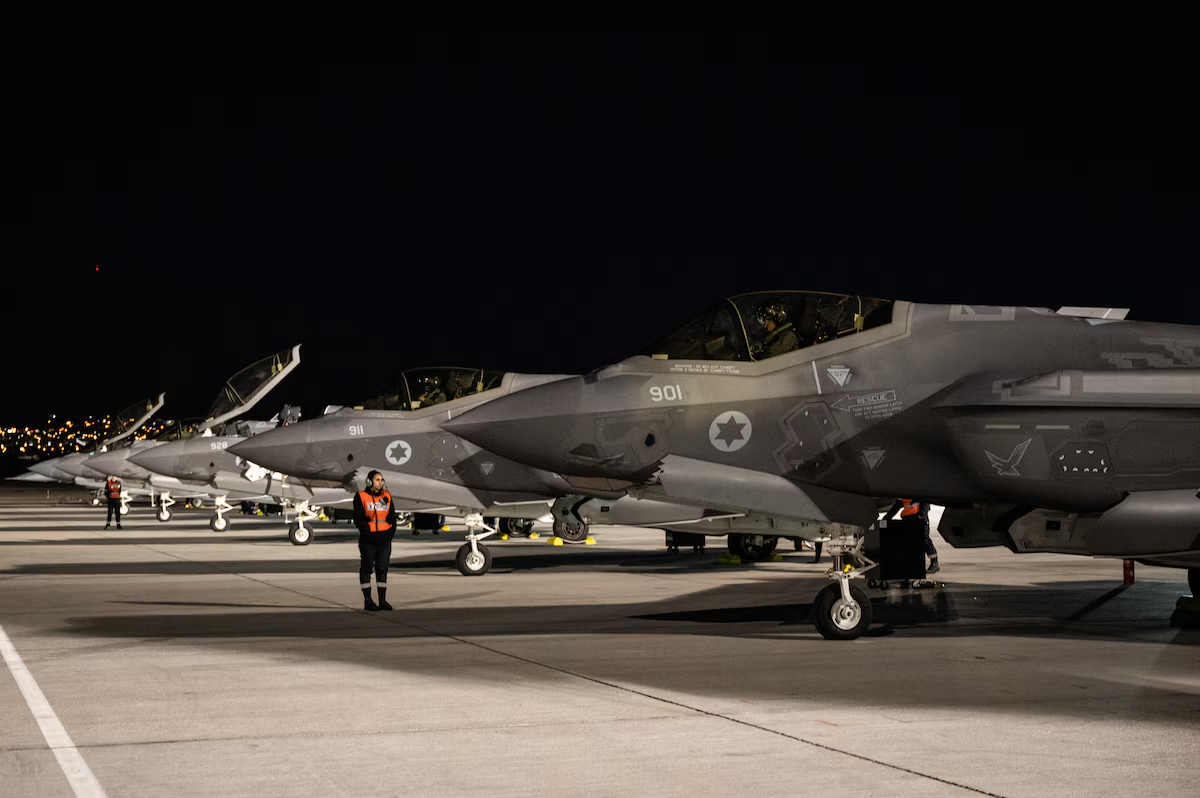
Israel’s fleet of F-15I Ra’am, F-16I Sufa, and F-35I Adir aircraft provides layered air superiority, deep-strike, and stealth penetration capabilities, meaning that qualitative edge remains intact in near-term high-intensity conflict modelling.
However, quantity combined with integration can offset certain qualitative differentials, particularly if Türkiye’s 240-plus F-16 inventory is modernised alongside Typhoon induction, producing numerical density across multiple operational axes.
Israeli concern therefore appears rooted less in immediate platform comparison and more in trajectory analysis, assessing how Ankara’s acceleration across multiple domains could narrow future margins of operational freedom.
Media amplification of deteriorating bilateral relations, including tensions over Gaza and Syria, adds political context to defence analysis, increasing perception of risk even when technical parity has not been achieved.
The separation between verifiable fact—namely the signed agreement and aircraft specifications—and political claim—assertions of imminent dominance—remains critical for balanced assessment of the Typhoon’s real impact.
Ultimately, Israeli responses reflect a strategic culture accustomed to preserving qualitative military edge, where even incremental shifts in adversary capability warrant scrutiny within long-term deterrence planning frameworks.
Regional Air Power Dynamics: Eastern Mediterranean and Multi-Front Calculus
The prospective integration of up to 56 Eurofighter Typhoons into the Turkish Air Force introduces a quantitative and qualitative variable into Eastern Mediterranean airpower equations, particularly in relation to Greece and Israel.
Greece’s acquisition of Dassault Rafale fighters has already altered Aegean deterrence dynamics, meaning Türkiye’s Typhoon procurement can be interpreted as both counterbalance and escalation hedge within that bilateral rivalry.
In the Israeli context, the Typhoon’s Meteor missile integration enhances beyond-visual-range engagement depth, potentially affecting engagement geometry in contested Syrian airspace where multiple actors operate.
However, the absence of fifth-generation stealth characteristics limits the Typhoon’s survivability in heavily defended airspace relative to Israel’s F-35I, maintaining a technological gap in penetration strike missions.
The integration of Typhoons with Turkish drones and naval assets may enable multi-domain synergy, complicating operational planning even without stealth equivalence, particularly in maritime-air coordination scenarios.
Logistics, training, and NATO interoperability requirements introduce uncertainty variables, as full operational integration depends on pilot conversion cycles, maintenance infrastructure, and software harmonisation.
Delays in KAAN or unresolved S-400 interoperability issues could create friction points within Türkiye’s broader modernization timeline, highlighting that procurement announcement does not equal instantaneous capability transformation.
Strategically, the deal also reinforces NATO’s eastern and southern flank cohesion through industrial cooperation with the United Kingdom, embedding Türkiye within European defence supply chains at a time of continental security recalibration.
The broader geopolitical context includes evolving U.S.-Türkiye dialogue over potential F-35 reinstatement waivers, a factor that could further alter long-term airpower composition should sanctions ease.
Whether the Eurofighter acquisition ultimately fosters deterrence stability or fuels competitive acceleration will depend less on aircraft specifications and more on how Ankara, Jerusalem, and Athens integrate these platforms into doctrine, signalling, and crisis management frameworks over the coming decade. — DEFENCE SECURITY ASIA
