
(VIDEO) Oil Leak at Dubai Airshow 2025 Puts India’s LCA Tejas Under Global Scrutiny
A viral oil-leak incident at Dubai Airshow 2025 has triggered global debate over the reliability, readiness, and export viability of India’s LCA Tejas fighter aircraft.

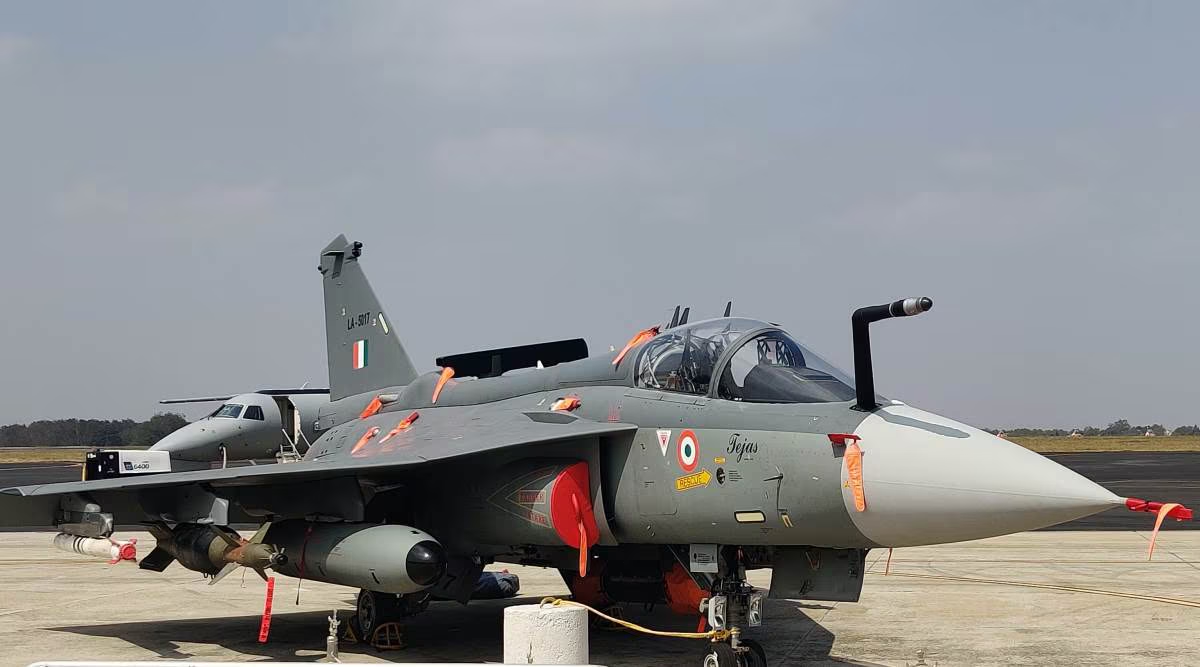
(DEFENCE SECURITY ASIA) — Social media is abuzz with tweets showing images and videos of a potential embarrassment for India’s multi-role fighter aircraft Light Combat Aircraft (LCA) Tejas at the ongoing Dubai Air Show 2025.
The Indian Air Force is in Dubai to participate in the Air Show with the Suryakiran Aerobatic Team and LCA Tejas.
Now, videos of LCA Tejas that are widely being circulated online allegedly show that there was an “oil leak from the fuselage right on the tarmac”.
“At the Dubai air show, the Indian Tejas jet faced embarrassment after reports of an oil leak surfaced,” claimed a user.
“Reports from the Dubai Air Show 2025 indicate that an IAF Tejas aircraft experienced an apparent oil leak on the tarmac. Personnel placed several bags beneath the aircraft to catch the leaking fluid, leading to widespread discussion online,” wrote another user.
Another user claimed, “Tejas leaking oil at Dubai Airshow reflects poorly on the IAF.”
A technical mishap involving an Indian fighter jet at the Dubai Air Show 2025 quickly turned into a social-media spectacle, with memes and jokes flooding online platforms within hours.
The video showed Indian Air Force technicians scrambling to contain the leak—at one point placing shopping bags under the aircraft to collect dripping oil.
This moment, innocent in operational context, quickly transformed into a global talking point due to the symbolism of a frontline fighter requiring improvisation with commercial shopping bags on one of the world’s most prestigious aerospace stages.
The incident, magnified by the speed of digital virality, created a narrative vacuum that critics rapidly filled with questions about India’s aerospace reliability, industrial standards, and overall combat aircraft credibility.
The LCA Tejas, intended to showcase India’s maturing aerospace prowess, instead found itself the centre of humorous commentary that clouded its technical merits and overshadowed its intended role as a modern multi-role fighter representing India on a global platform.
A Technical Leak Exposes Vulnerabilities in India’s Fighter Narrative
Despite India showcasing the Tejas as a modern multi-role fighter with significant capabilities, the unexpected malfunction became the highlight on social media.
Clips of air force personnel filling leaked oil into makeshift bags circulated widely, prompting a wave of humorous comments across platforms.
While Indian authorities did not immediately comment on the incident, the episode has continued to fuel discussion about the aircraft’s reliability—at least online, where humour and criticism are now running side by side.
As the Dubai Air Show continues, the Tejas leak remains one of the event’s most talked-about moments—not for its flight performance, but for the memes it inspired.
The multi-role warplane suffered an oil leak mid-show, leaving technicians scrambling to stop the mess with nothing but shopping bags.
The viral clip shows Indian Air Force personnel desperately trying to stop the oil from spreading, turning a high-tech marvel into a scene straight out of a comedy.
Social media erupted, with users mocking the “shopping bag-supported warplane” and questioning India’s claims about the Tejas’ capabilities.
Critics are calling it a major embarrassment on the international stage, raising eyebrows over the quality and reliability of the aircraft meant to represent India’s aerospace might.
Dubai Airshow, meant to showcase cutting-edge technology, instead highlighted a very human, and very messy, moment for the Indian Air Force.
This episode underscores a deeper issue in defence aviation: an aircraft’s credibility is judged not only by its ability to fly, but by its logistical discipline, maintenance ecosystem, and the confidence it projects to international observers.
In an age where digital visibility controls defence perception, even a minor leak becomes magnified into a symbolic measure of industrial maturity and the robustness of India’s fighter-aircraft manufacturing process.
Why This Incident Matters: Strategic Significance and Defence Industrial Impact
The LCA Tejas is not merely a performer at an international airshow, but the flagship of India’s decades-long attempt to secure strategic autonomy in combat aircraft manufacturing.
The Tejas is central to India’s ambitions under its “Atmanirbhar Bharat” (Self-Reliant India) defence industrial push, a national programme worth billions of dollars—estimated at more than USD 20 billion (RM 94.6 billion) in long-term procurement and development pathways.
The aircraft is positioned by India as a lightweight, cost-effective multi-role fighter aimed at competing with platforms like Pakistan’s JF-17 Block III, China’s L-15, and certain lower-tier Western light fighters.
A malfunction at a platform like Dubai Airshow carries outsized consequences because the Tejas is actively being marketed for export to countries across Southeast Asia, Africa, Latin America, and the Middle East.
In each of these markets, reliability, maintenance footprint, and technological sophistication are major determining factors for air force procurement boards.
A public oil leak—especially one captured on video and amplified globally—risks shaping international perceptions at the exact moment India hopes to secure foreign orders.
This could cause potential customers to question whether the platform has reached full operational maturity or whether its logistical and maintenance ecosystem still requires refinement.
In the competitive global light fighter market, first impressions are strategic currency, and the Tejas may have unintentionally spent some of that capital at Dubai.
The incident also magnifies longstanding concerns within the global aerospace community about India’s industrial readiness to support sustained export commitments, lifecycle maintenance obligations, and high-tempo deployment requirements associated with modern fighter operations.
This moment further reinforces that India must not only perfect the Tejas platform itself, but also demonstrate to foreign customers that its defence-industrial base possesses the resilience, quality-control discipline, and technical depth to compete in a highly contested international fighter market.
The Technical Dimensions Behind a Fighter Jet Oil Leak
Oil leaks on combat aircraft are not unprecedented, but the context and visibility of this one transform it from a mere maintenance issue into a strategic liability.
The Tejas uses the General Electric F404-GE-IN20 engine—an older but reliable American powerplant also used in past generations of F/A-18 aircraft.
A leak from the fuselage could indicate several possible technical origins:
A hydraulic line rupture
• Improper sealing during maintenance
• Overpressure in the lubrication system
• Failure in an ancillary subsystem like the accessory gearbox
• A faulty quick-disconnect coupling
Each of these issues has different implications for fleet reliability, maintainability, and readiness rates.
For an aircraft advertised as requiring minimal maintenance and low turnaround time, such an event being captured during a high-profile international airshow complicates narrative control for Indian defence officials.
Fighter jets often undergo intense operational preparation before public performances, including system checks designed to prevent such visible failures.
That a leak still occurred raises questions on whether it was a systemic oversight, rushed preparation, or inherent technical flaw.
This raises a critical point: the incident may reveal more about maintenance discipline, quality assurance cycles, and pre-flight inspection protocols than about the platform’s underlying engineering.
In the world of aviation, technical issues are expected, but visibility at the wrong moment can create disproportionate consequence.
Global Competitors Capitalise on Tejas’ Embarrassment
The timing of this incident could not be more disruptive for India’s export ambitions.
Tejas’ main competitor, the Pakistani–Chinese JF-17 Block III, has been aggressively marketed across Africa, the Middle East, and Southeast Asia, leveraging advancements in AESA radar, electronic warfare suites, and long-range Chinese air-to-air missiles like the PL-15.
A small embarrassment for Tejas is a major strategic messaging win for Islamabad and Beijing.
Footage of Indian technicians using shopping bags to capture oil has already been shared by accounts known for military commentary, including those inclined toward Pakistan’s perspective.
The Indian Air Force’s presence alongside Tejas at Dubai Airshow is meant to signal confidence in the aircraft, but the optics of the incident undermine campaign messaging at a critical time.
For nations evaluating light combat fighters—especially those with limited budgets—perception can be as powerful as engineering.
Defence procurement decisions rarely hinge on technical merit alone; they are deeply influenced by confidence, symbolism, and demonstrated reliability during high-stakes public showcases.
Dubai Airshow and the Battle for Aerospace Credibility
Dubai Airshow is one of the world’s most important defence and aerospace exhibitions, attracting billions of dollars in military contracts and hosting global aerospace giants.
In previous years, the event has been associated with high-profile announcements, including:
- F-35 export negotiations
• Sukhoi Su-75 “Checkmate” unveiling
• Eurofighter Typhoon displays
• Emirates and Etihad mega-aircraft deals
The 2025 edition is particularly strategic, as Gulf nations evaluate new-generation fighters—including South Korea’s KF-21 Boramae, China’s J-35, and Turkey’s KAAN.
For India, showcasing Tejas here is about proving its capability to join the league of fighter-exporting nations.
Instead, the oil-leak incident gave detractors ammunition to question HAL’s manufacturing quality and the Indigenous Aircraft Programme’s technical maturity.
Such visual setbacks can influence perceptions among military delegations and procurement committees from smaller nations exploring affordable fighter solutions.
In an arena where competitors aggressively position their aircraft as reliable and mature, even a single maintenance incident can be weaponised into a narrative of systemic weakness.
A Tactical Leak Evolving Into a Strategic Fault Line
The oil leak involving the Indian LCA Tejas at Dubai Airshow 2025 may have lasted only minutes, but its digital afterlife will endure far longer.
In an era where global defence narratives are shaped as much by social media as by official statements, the viral visuals have already overshadowed India’s intended messaging about its indigenous fighter programme.
For India, the incident becomes a reminder that the battle for aerospace credibility is not won solely through engineering or capability, but through flawless execution on the world’s most scrutinised stages.
For critics, the episode reinforces doubts about India’s capacity to deliver a world-class light fighter.
For potential customers, it becomes a moment that demands deeper evaluation into reliability, supply-chain maturity, and maintenance culture.
And for the global defence community, the Tejas oil-leak incident will be remembered not as a technical footnote, but as a strategic lesson on how even small failures can have outsized effects in the age of instant global visibility.
The episode also underscores how modern defence procurement is increasingly shaped by public perception and digital reputation, where a single viral clip can influence multi-billion-dollar aerospace decisions more powerfully than formal specifications.
The incident amplifies concerns among neutral observers that India must accelerate upgrades in its quality-control ecosystem, particularly as it transitions toward more complex programmes like the Tejas Mk2 and AMCA next-generation fighters.
This moment further highlights the vulnerability of emerging aviation industries competing against seasoned manufacturers, whose decades of operational experience have built layered safeguards against exactly such high-profile embarrassments.
For India’s defence planners, the leak serves as a strategic inflection point illustrating the gap between indigenous aspiration and the hard realities of sustaining global aerospace competitiveness under intense scrutiny.
This public setback also places renewed pressure on Hindustan Aeronautics Limited (HAL) to demonstrate that its production standards, maintenance protocols, and export-readiness frameworks can meet the expectations of international air forces.
Ultimately, the Dubai Airshow incident reinforces that the true test for the LCA Tejas programme will not be its promotional displays or official claims, but its ability to deliver consistent, fault-free performance in the unforgiving arena of global military aviation. — DEFENCE SECURITY ASIA
