
Armenia Suspends Tejas Mk-1A Negotiations Following Fatal Dubai Airshow Crash, Raising New Questions Over India’s LCA Programme
Armenia suspends its USD 1.2 billion Tejas Mk-1A acquisition talks following the fatal Dubai Airshow 2025 crash, delivering a major setback to India’s defence export strategy amid rising regional tensions in the South Caucasus.

(DEFENCE SECURITY ASIA) — In a major setback to India’s ambitions of transforming the Hindustan Aeronautics Limited (HAL) Tejas Light Combat Aircraft (LCA) into a globally competitive export fighter, fresh reports indicate that Armenia has suspended its ongoing negotiations for the acquisition of the Tejas Mk-1A following the devastating crash at the Dubai Airshow 2025.
This development immediately reverberated across the international defence community, particularly as Yerevan had been among New Delhi’s most promising prospective customers for the indigenous fighter jet.
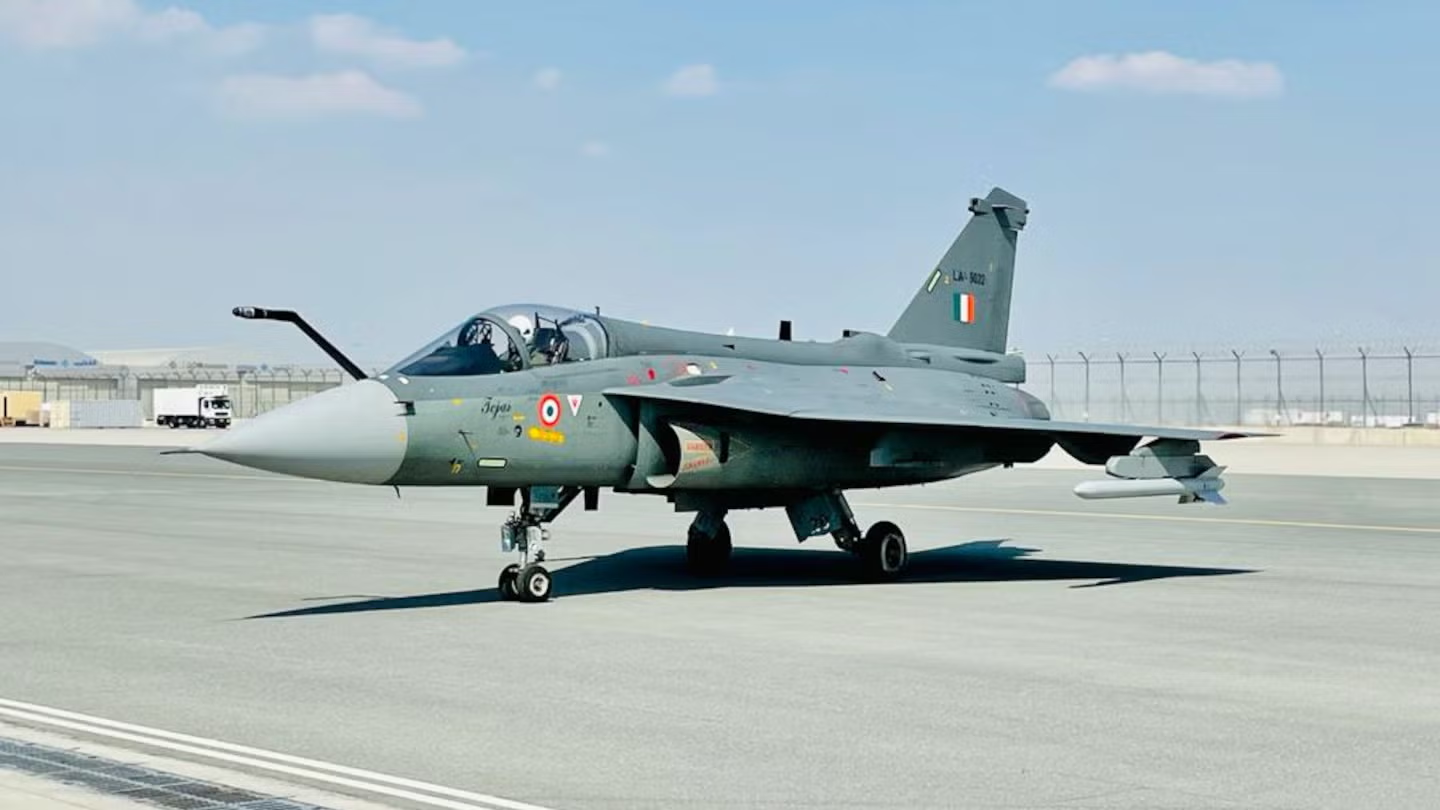
The fatal airshow crash, which claimed the life of Indian Air Force (IAF) pilot Wing Commander Namansh Syal, cast a deep shadow over the Tejas’ operational maturity and reliability at a critical moment when India was attempting to position the aircraft as a cost-effective multirole platform for emerging air forces.
The commercial impact of this suspension is significant, as Armenia was reportedly considering up to 20 Tejas Mk-1A fighters valued at around USD 1.2 billion (approximately RM 5.1 billion), which would have been one of India’s largest fighter aircraft export deals to date.
The decision is understood to have arisen shortly after footage of the Dubai crash circulated widely online, prompting Armenian defence officials to reassess the viability of the Tejas for Yerevan’s long-term military modernisation.
This abrupt pause also emerges during a period of heightened tension in the South Caucasus, where Armenia continues to recalibrate its airpower requirements in response to Azerbaijan’s drone-centric doctrines and expanding inventory of Turkish-built UCAVs, loitering munitions and precision-strike systems.
The reported suspension has therefore raised immediate concerns over the Tejas’ export prospects, India’s defence industrial credibility, and the broader strategic competition between regional aerospace players, including South Korea’s KAI FA-50, France’s Dassault Rafale, and the Pakistan-China JF-17 Thunder.
Tejas LCA Programme Under Renewed Global Scrutiny
The HAL Tejas represents India’s most ambitious indigenous combat aircraft programme, originally conceived in the 1980s to replace the IAF’s ageing MiG-21 fleet and to strengthen the country’s long-term aerospace self-reliance.
The programme has endured more than four decades of development marked by technical hurdles, cost escalations, shifting design priorities, and complex integration challenges, yet it remains a symbolic pillar of New Delhi’s “Make in India” and “Atmanirbhar Bharat” defence industrial visions.
The Tejas LCA is a single-engine, delta-wing, lightweight multirole fighter capable of air-to-air combat, air-to-ground precision strikes, maritime missions, and reconnaissance roles, and is promoted internationally as a 4.5-generation combat aircraft offering advanced capabilities at comparatively affordable cost points.
Key elements of the aircraft’s design include the earlier Israeli-origin Elta EL/M-2032 radar, modern glass cockpit displays, digital fly-by-wire flight control systems, and compatibility with a wide range of weapons including the Astra beyond-visual-range (BVR) air-to-air missile and the upcoming BrahMos-NG supersonic cruise missile.
Subsequent Mk-1A variants incorporate an Indian-designed Uttam AESA radar, updated electronic warfare suites, improved maintainability features, digital RWR systems, and structural enhancements designed to address recurring criticisms over weight distribution, limited thrust-to-weight margins, and lifecycle sustainment.
Despite these upgrades, the Tejas programme continues to encounter external scrutiny over its reliance on imported systems, particularly the American-built General Electric F404 engine, which has been subject to supply chain delays affecting HAL production schedules and IAF squadron build-up rates.
The Indian government previously placed an order worth INR 48,000 crore (approximately USD 5.8 billion / RM 24.7 billion) in 2021 for 83 Mk-1A fighters to be delivered by HAL, reflecting India’s urgent need to stabilise its fighter squadron strength which has fallen drastically due to retirements of legacy MiG platforms.
India has aggressively marketed the Tejas in Southeast Asia, South Asia, Africa, and Latin America, often highlighting the aircraft’s competitive unit cost of USD 40–50 million (RM 170–215 million), which places it significantly below Western competitors like the F-16 Block 70/72 or the Swedish Gripen C/D.
However, despite active campaigns in Malaysia, Argentina, Egypt, Botswana, and the Middle East, the Tejas has yet to secure a large and confirmed export order, with global buyers reportedly wary of its protracted development history, maturing operational envelope, and lingering technical uncertainties.

High-Profile Dubai Airshow Crash Intensifies Operational Concerns
The Dubai Airshow 2025—one of the world’s most prestigious aerospace exhibitions—provided a high-visibility platform for the Tejas to demonstrate its manoeuvrability, power-to-weight balance, and airshow aerobatic performance before thousands of spectators and delegations from over 100 participating nations.
On 21 November 2025, during a scheduled aerobatic routine, the Tejas—piloted by Wing Commander Namansh Syal—entered a negative-G manoeuvre reportedly involving an inverted roll or low-altitude turn at a height estimated below 500 feet.
According to eyewitness accounts and preliminary reporting, the aircraft suddenly lost aerodynamic stability during the manoeuvre and entered an unrecoverable nose-down attitude despite apparent attempts by the pilot to regain control.
The fighter jet impacted the ground with immense force, erupting into a massive fireball that was captured by multiple spectators, leading to rapid global dissemination of the crash footage across social media platforms and aviation forums.
Wing Commander Syal, 34, an experienced IAF pilot with over 2,000 flying hours and extensive Tejas proficiency, was killed instantly in the crash, marking the Tejas programme’s first fatal accident and its second recorded incident since a non-fatal 2021 ejection.
Initial assessments have centered on several potential contributing factors, including failure in the fly-by-wire control architecture, control surface malfunction, aerodynamic stall characteristics inherent to delta-wing designs at low-speed high-alpha conditions, or pilot disorientation under extreme negative-G loading.
The IAF has launched a full court of inquiry and is analysing both the flight data recorder (FDR) and cockpit voice recorder (CVR), though preliminary speculation suggests aerodynamic instability at the edge of the aircraft’s approved airshow envelope may have been a contributing factor.
The airshow resumed its programme just two hours after the fatal crash, triggering widespread criticism that the decision demonstrated insensitivity and undermined standard aviation safety protocols associated with fatal demonstration accidents.
Rumours that the Tejas experienced a pre-crash oil leak were quickly refuted, with officials clarifying that the emissions seen during taxiing were condensation from the environmental conditioning systems rather than fluid discharge.
The Indian government paid tribute to the fallen pilot, with leadership noting that he “served the nation with honour,” while HAL reiterated its commitment to maintaining delivery schedules despite the crash, though the broader international perception of the aircraft has clearly been affected.
Armenia Reassesses Combat Aircraft Options Amid Shifting Regional Dynamics
Armenia’s reported decision to suspend Tejas-related negotiations occurred against the backdrop of the Dubai crash’s immediate aftermath, with defence circles across Yerevan reportedly alarmed by the footage of the Tejas’ inability to recover from a low-altitude manoeuvre.
Earlier discussions between New Delhi and Yerevan since early 2025 focused on a potential procurement of around 20 Tejas Mk-1A fighters, integrated with custom Armenian electronic warfare configurations tailored for counter-UAV and anti-drone operations essential for modernising Armenia’s outdated air defence ecosystem.
The Armenian Air Force, still operating legacy Soviet-era MiG-29s and Su-25s, has been urgently seeking new-generation aircraft capable of countering Azerbaijan’s increasingly sophisticated drone warfare tools, including Turkish Bayraktar TB2s, Israeli Harop loitering munitions, and high-altitude surveillance drones.
The Tejas had emerged as a potential light-fighter solution due to its relatively lower acquisition cost, its multirole flexibility, and India’s willingness to provide customised mission packages, training, and sustainment support.
However, the Dubai crash has forced Armenian planners to reassess whether the Tejas Mk-1A’s flight control architecture and operational maturity align with Armenia’s high-risk security environment, especially given the intense kinetic engagements witnessed during the 2020 Nagorno-Karabakh conflict.
Diplomatic sources suggest that Armenia is now evaluating alternatives including South Korea’s FA-50, which has demonstrated considerable export momentum and reliability, and France’s Dassault Rafale, which Yerevan views as a proven deep-strike asset albeit with prohibitively higher cost implications.
The FA-50, priced at USD 30–35 million (RM 128–150 million), offers Yerevan a low-cost, combat-tested platform that has secured buyers across Southeast Asia, Eastern Europe, and the Middle East, while the Rafale, costing over USD 100 million (RM 430 million) per unit, provides unparalleled capability but sits beyond Armenia’s likely financial bandwidth.
Interestingly, Armenia is also reportedly advancing negotiations for an Indian-upgraded Su-30MKI package valued at USD 3 billion (RM 12.9 billion) for 8–12 units slated for delivery between 2027 and 2029, which, if confirmed, suggests a strategic pivot towards heavy fighters rather than light-combat aircraft.
If Armenia’s suspension of Tejas talks proves accurate, it would represent the second major Tejas export setback in recent years, following reports of Argentina’s cancellation of a Tejas evaluation in late 2025 over performance and supply chain concerns.
The situation also carries deeper geopolitical implications, as Russia’s decreasing defence role in Armenia and the rise of India as an alternative supplier create a shifting procurement landscape that is now complicated by questions surrounding the Tejas’ reliability.
Wider Implications for India’s Defence Export Trajectory and Strategic Ambitions
The fallout from the Dubai Airshow crash and Armenia’s reported suspension of Tejas negotiations highlights a broader strategic dilemma for India’s defence export ecosystem, particularly as New Delhi aims to expand annual defence exports to USD 5 billion (RM 21.5 billion) by 2025.
The Tejas was envisioned as a flagship export platform that would allow India to challenge the dominance of Western, Russian, Chinese, and South Korean light-fighter offerings in the global market, but recent events underscore lingering perception challenges.
Experts note that incidents involving indigenous platforms can significantly sway buyer sentiment, especially for countries with limited defence budgets and high operational risk tolerance constraints, making them cautious of aircraft with limited proven combat history.
Analysts observe that nations evaluating the Tejas will now place heavier scrutiny on India’s safety culture, testing protocols, industrial delivery reliability, and long-term logistical assurances, particularly given India’s earlier struggles with engine spares, avionics supply chains, and production timelines.
At a strategic level, this episode may accelerate India’s pivot towards strengthening domestic Tejas deployments, prioritising Mk-1A and Mk-2 induction for the IAF to address its shrinking squadron strength that currently stands at 29 against an authorised 42.
The IAF may now place greater urgency on acquiring interim fighters—possibly additional Rafales, Su-30MKI upgrades, or even exploring high-end fifth-generation options like the F-35A or Russia’s Su-57—as it seeks to stabilise its combat strength while waiting for future indigenous platforms like the AMCA.
For export prospects, the Dubai crash risks pushing undecided buyers towards alternatives like the FA-50, the Gripen C/D, or even Chinese-Pakistani JF-17 variants, which—despite their own limitations—offer track records of operational deployments in multiple air forces.
The Tejas Mk-2 and AMCA programmes could also face intensified pressure, as global buyers may perceive India’s fighter ecosystem as still maturing, making them hesitant to commit to platforms that remain in development and are reliant on foreign propulsion technologies.
At the geopolitical level, Armenia’s hesitation—if fully verified—signals how regional conflict dynamics, particularly in the South Caucasus, leave no room for procurement missteps, as Armenia faces a rapidly evolving threat matrix from Azerbaijan’s precision-strike capabilities.
This development may indirectly push Yerevan closer to Western suppliers, deepen cooperation with France or South Korea, and diminish India’s role in shaping Armenia’s airpower modernisation.
The episode also fuels competitive narratives propagated by rival media networks, particularly in Pakistan, which highlights the JF-17’s export record to Myanmar and Nigeria while portraying the Tejas programme as suffering from setbacks and structural weaknesses.
Despite these challenges, strategic observers argue that the Tejas remains a critical stepping stone for India’s broader aerospace future, contributing to the development of indigenous avionics, software integration, EW systems, and composite materials engineering that will underpin future aircraft programmes.
The Dubai crash, while a tragic setback, offers India an opportunity to refine its flight envelope modelling, enhance safety protocols, upgrade quality control frameworks, and accelerate critical indigenous subsystems to reduce vulnerability to foreign supply chain disruptions.
Ultimately, the reported Armenian suspension serves as a sobering reminder that global defence markets are unforgiving, and even a single high-profile incident can alter procurement trajectories and strategic partnerships.
India’s response—through transparent investigations, accelerated technical improvements, and strengthened diplomatic engagements—will determine whether the Tejas can recover its credibility and eventually secure the export breakthroughs that New Delhi desperately seeks.
The future of the Tejas in the international market will hinge on India’s ability to demonstrate that the programme is not defined by a single tragic incident, but by a long-term commitment to advancing indigenous aerospace innovation, ensuring pilot safety, and delivering a reliable, combat-capable platform to regional and global partners.
As Armenia recalibrates its defence procurement plans, its ultimate choices will reshape South Caucasus security dynamics, influence Azerbaijan’s threat perceptions, and determine whether India retains a foothold in a region increasingly dominated by Turkish, Israeli, Russian, and now potentially South Korean and French influence.
In sum, the Dubai Airshow crash and its reverberations highlight the fragility of aerospace reputations in an era of real-time global visibility, the rising competitiveness of the international light-fighter market, and the enormous stakes attached to India’s quest for defence export relevance. — DEFENCE SECURITY ASIA
