
Singapore Frigate Drills With China After RIMPAC in High-Stakes Indo-Pacific Balancing Act
RSS Steadfast’s deployment to China after exercises involving the United States and Japan exposes Singapore’s calibrated naval balancing strategy amid intensifying Indo-Pacific rivalry.

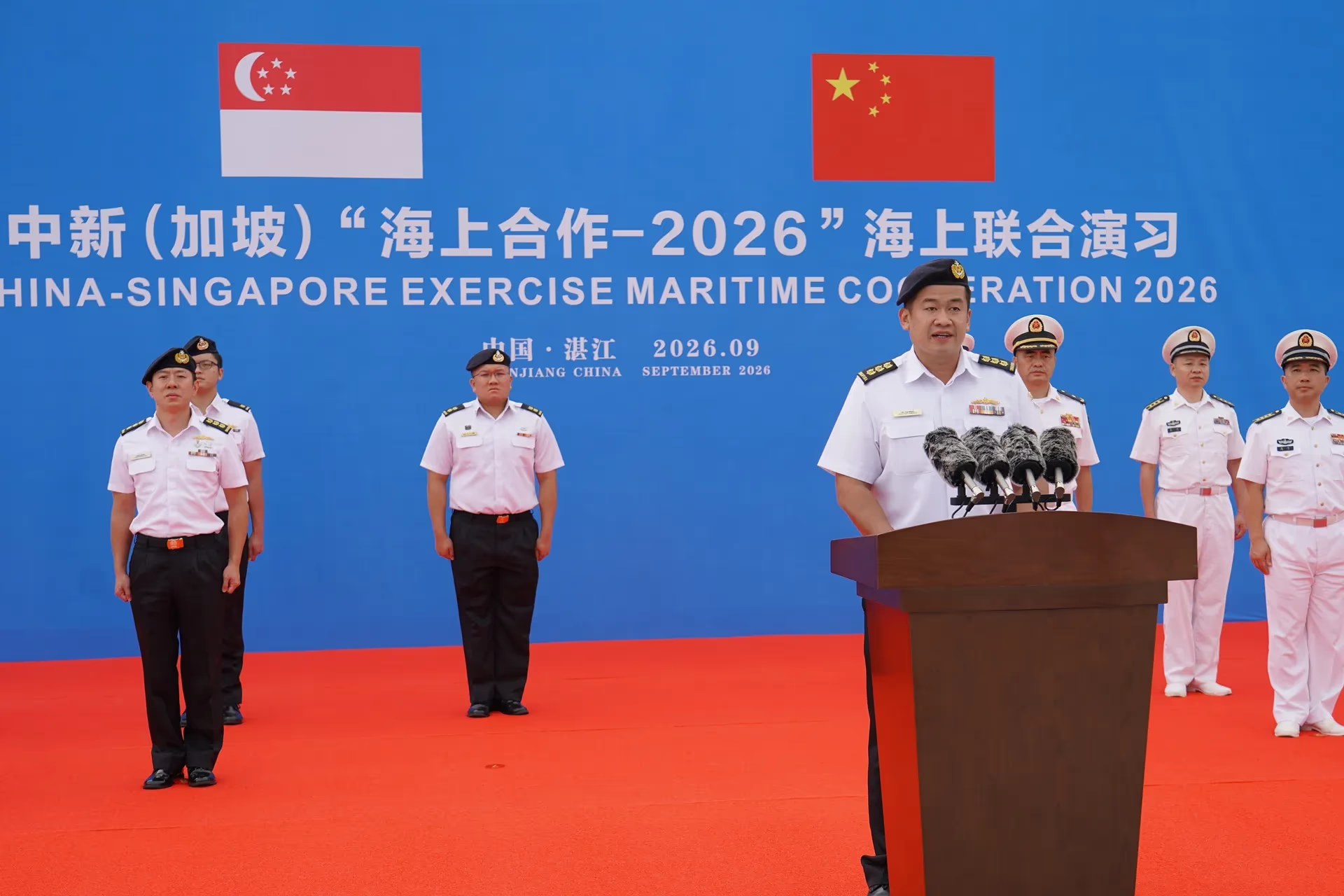
(DEFENCE SECURITY ASIA) — Singapore has sent Formidable-class frigate RSS Steadfast to Zhanjiang for Exercise Maritime Cooperation 2026, placing a Southeast Asian warship inside China’s Southern Theater Command after months operating with Western and Asian partners.
Running from September 5 to 9, the fifth bilateral naval exercise since 2015 combines shore planning with maritime serials, converting diplomacy into procedures for communications, manoeuvring, gunnery, search-and-rescue, and medical evacuation.
RSS Steadfast is training with PLA Navy Type 054A frigate PLANS Dali, creating a revealing pairing between Singapore’s automated stealth combatant and China’s larger, manpower-intensive fleet escort built for sustained regional operations.
The deployment matters because Steadfast reached China after exercising with Italian, Philippine, American, Japanese, and multinational forces, demonstrating Singapore’s determination to preserve operational access across increasingly divided regional security networks.
Zhanjiang is strategically significant as a Southern Theater naval hub facing the South China Sea, where disputed claims, expanding Chinese force posture, and external military activity have intensified requirements for crisis-management channels.

Colonel Ng Yen Meng, RSN Deputy Fleet Commander, and Rear Admiral Xia Ziming, Southern Theater Deputy Chief of Staff, opened the exercise at Ma Xie Naval Base, giving the engagement operational endorsement.
Singapore describes deployments as enhancing “mutual learning, understanding and cooperation with a wide network of international partners,” positioning China within a diversified portfolio rather than at the centre of Singaporean defence policy.
China presents the exercise differently, arguing recurring drills enhance mutual trust, practical cooperation, and capacity to safeguard regional peace, portraying bilateral military contact as an institutional mechanism with growing strategic relevance.
Those narratives overlap to sustain cooperation, yet expose competing purposes: Singapore seeks options and interoperability without alignment, while Beijing gains evidence that an American-linked regional navy remains willing to train in China.
No public information indicates either frigate will expose missile tactics, combat-system parameters, or classified data links, making bounded seamanship and humanitarian serials the foundation for confidence-building without compromising operational security.
Nevertheless, sea-rider exchanges, communications drills, and coordinated manoeuvres can reveal decision rhythms, bridge procedures, command discipline, and safety standards, generating familiarity that could reduce miscalculation during an encounter or maritime emergency.
Exercise Maritime Cooperation 2026 represents neither alliance shift nor ceremonial diplomacy, but a calibrated force-posture signal showing how a small state can engage competing powers while defending autonomy, readiness, and manoeuvring space.
(CLICK HERE): Singapore Arms Frigate With Blue Spear Missile, Doubling Naval Strike Range
Zhanjiang Drills Convert Naval Diplomacy Into Controlled Interoperability
The shore phase at Ma Xie Naval Base from September 5 to 7 centres on planning and exchanges, allowing crews to establish communications protocols, safety boundaries, command responsibilities, and sequences before sailing.
The sea phase off Zhanjiang on September 8 and 9 introduces exchanged sea riders alongside gunnery, communications, manoeuvring, joint search-and-rescue, and medical-evacuation drills, testing whether prior planning survives operational friction at sea.
China has additionally highlighted live-fire activity and underway replenishment, capabilities that extend beyond symbolism because accurate weapons employment requires disciplined fire control, while replenishment sustains naval presence beyond a ship’s organic endurance.
The descriptions are complementary rather than contradictory, although Beijing’s emphasis on replenishment and live fire foregrounds combat support and far-seas competence, while Singapore’s account concentrates on professional learning, coordination, and emergency response.
Search-and-rescue and medical evacuation offer acceptable entry points for cooperation because they address shared maritime risks without requiring agreement over sovereignty, threat perceptions, access arrangements, or legitimacy of competing regional operations.
They test transferable military functions, including detection, communications relay, casualty handling, boat or helicopter coordination, and command handovers, which remain valuable during emergencies and could support deconfliction under more dangerous conditions.
Sea-rider exchanges carry disproportionate value because embarked personnel observe another navy’s bridge routines and human factors directly, yet the controlled exercise design limits exposure to combat-management architecture, electronic-warfare methods, and weapons-employment doctrine.
Gunnery provides a visible measure of readiness without disclosing strategic missile capabilities, enabling both frigates to validate fire-control coordination and range safety while keeping consequential anti-ship and air-defence systems outside public evaluation.
Communications and manoeuvring serials establish whether ships using different command cultures and technical standards can operate safely in proximity, a requirement when Singaporean and Chinese vessels meet across congested Indo-Pacific sea lanes.
The exercise builds narrow interoperability rather than coalition integration, creating procedural trust that could improve incident management while leaving national targeting chains, operational plans, intelligence systems, and strategic alignments firmly separate.
RSS Steadfast Brings Stealth, Automation and Blue Spear Reach
RSS Steadfast, third of six Formidable-class frigates, displaces approximately 3,200 tonnes fully loaded and uses a reduced-signature La Fayette-derived hull, four-engine CODAD propulsion, and automation with roughly 90 personnel including aviators.
Its Thales Herakles multifunction radar, indigenous combat-management system, C-PEARL-M electronic-support suite, navigation radar, and active low-frequency towed sonar provide a networked sensor architecture spanning air defence, surface surveillance, and anti-submarine warfare.
The frigate’s 32-cell Sylver vertical-launch system supports Aster surface-to-air missiles, giving Singapore a defensive layer against aircraft and sea-skimming threats while preserving magazine flexibility within the limits of a compact combatant.
Steadfast was observed in August 2026 carrying Blue Spear anti-ship missiles, replacing Harpoon with an approximately 290-kilometre weapon offering maritime and land-attack modes, thereby expanding Singapore’s stand-off strike options and deterrence.
That range potentially exceeds estimates for Dali’s YJ-83 battery, but comparisons remain incomplete because effective maritime strike depends upon target detection, identification, data quality, electronic protection, mission planning, and survivable launch positioning.
An OTO Melara 76-millimetre Super Rapid gun supports exercise gunnery, while remote weapon stations, lightweight torpedoes, and an embarked S-70B Seahawk provide layered responses against small craft, submarines, and maritime contingencies.
Steadfast’s comparatively small crew reduces lifecycle and deployment manpower, yet automation concentrates workload and technical dependency, making engineering resilience, software reliability, training depth, and damage-control proficiency essential during extended high-tempo missions.
Its presence at Zhanjiang follows RIMPAC, multinational group sails, an Italian passage exercise, and SINGAPAN with Japan, turning a three-month deployment into proof of endurance, adaptable procedures, and access across competing relationships.
The frigate is undergoing extensive class mid-life modernisation expected through approximately 2028, linking naval diplomacy with Singapore’s effort to preserve combat relevance against longer-range missiles, submarines, and increasingly networked threats.
For Beijing, hosting this American-compatible platform carries value; for Singapore, bringing it into a Chinese exercise signals confidence that selective engagement can occur without surrendering technical security, sovereign control, or defence partnerships.
PLANS Dali Embodies China’s Southern Theater Escort Power
PLANS Dali is a late-batch Type 054A, or Jiangkai II-class, frigate commissioned in 2023 and assigned to Southern Theater, representing the PLA Navy’s mass-produced approach to escort, air defence, and anti-submarine warfare.
At approximately 4,000 tonnes and 134 metres long, Dali is larger than Steadfast and carries roughly twice the personnel, reflecting different assumptions about automation, maintenance, damage control, watchkeeping, and sustained operations.
Its Type 382 search radar, surface-search and targeting sensors, multiple missile illuminators, gun-control radar, hull sonar, combat data system, satellite communications, and reported towed-array capability support layered surveillance and coordinated escort missions.
Dali’s 32-cell vertical-launch system carries HHQ-16 medium-range surface-to-air missiles and can accommodate rocket-delivered anti-submarine torpedoes, combining local air defence with rapid engagement of underwater contacts detected beyond conventional torpedo range.
Eight YJ-83 anti-ship missiles provide a sea-skimming strike battery, while a 76-millimetre gun, close-in weapon systems, torpedo tubes, anti-submarine rockets, decoy launchers, and an embarked helicopter broaden its defensive and offensive options.
The frigate’s extensive anti-submarine fit is particularly relevant to Southern Theater missions because contested waters demand persistent detection, classification, localisation, and engagement capacity against submarines operating near crucial approaches and surface formations.
Dali’s larger complement supports maintenance and concurrent watches, although greater manpower imposes heavier accommodation and logistics requirements, contrasting with Singapore’s emphasis on lean crewing, automation, and technologically concentrated operator responsibilities.
Chinese imagery showed Dali conducting live-fire training in March 2026, including its main gun, anti-submarine rockets, smoke deployment, and rescue-boat activity, indicating preparation for the visible serials now scheduled with Steadfast.
Its participation allows Southern Theater Command to showcase a standard fleet asset rather than an exceptional platform, suggesting Beijing wants bilateral engagement embedded within operational activity rather than treated as extraordinary access.
The pairing compares two force-generation models: Singapore maximises capability from six automated frigates, while China fields over 40 Type 054As, using numerical depth, standardisation, distributed escort capacity, and a larger mobilisation base.
Singapore’s Networked Hedging Meets China’s Strategic Messaging
Singapore’s framing places Exercise Maritime Cooperation beside engagements involving the United States, Japan, Italy, the Philippines, and multinational forces, signalling naval cooperation with Beijing complements rather than replaces its diversified defence relationships.
That portfolio reduces dependence upon any single power, expands tactical exposure, and protects diplomatic autonomy, but requires disciplined information security and careful messaging as strategic competition makes routine military contact politically sensitive.
Rear Admiral Kwan Hon Chuong said during the 2024 exercise that the series provided “invaluable opportunities” to learn, build trust, understanding, and friendships, defining its value through professional relationships rather than alignment.
Chinese messaging gives the mechanism regional purpose, presenting successive iterations as increasing in scale and influence while linking practical cooperation to safeguarding peace, stability, maritime safety, and addressing shared security challenges.
The distinction is consequential: Singapore portrays one node within a network, whereas China portrays an expanding bilateral institution, allowing both governments to use the event without resolving different views of regional order.
Singapore’s access arrangements and training with American forces remain important context, but XMC demonstrates those relationships do not preclude structured engagement with the PLA Navy under bounded and mutually accepted conditions.
For Beijing, Steadfast’s arrival after American and Japanese exercises supports a narrative that China remains a security interlocutor for Southeast Asia, despite concern over military expansion and contested South China Sea claims.
For Singapore, participating in Zhanjiang denies any assumption that close Western interoperability equals containment, while preserving dialogue with the Chinese command most directly responsible for operations across strategically sensitive southern maritime approaches.
Neither interpretation proves realignment, and the short exercise offers insufficient evidence about wartime access, intelligence cooperation, or policy choices during confrontation, leaving deeper security commitments deliberately untested and publicly ambiguous.
The strategic signal lies in repetition: five iterations since 2015 indicate both sides see controlled naval contact as insurance against misunderstanding, even while wider defence relationships and regional narratives remain structurally different.
(CLICK HERE): Singapore Escalates Maritime Surveillance: RSAF Acquires Gulfstream G550-MSA to Secure Strait of Malacca Amid South China Sea Tensions
South China Sea Geography Raises the Stakes of a Limited Drill
Zhanjiang’s location connects the exercise to South China Sea security without requiring either participant to address sovereignty disputes, enabling cooperation where commercial density, military encounters, and competing jurisdictional claims create persistent risk.
Singapore previously specified that a sea phase occurred in international waters in the southern South China Sea, wording underscoring navigational principle while avoiding criticism of Beijing or endorsement of any claimant’s position.
China’s official explanation highlights heavy shipping traffic and both countries’ rescue responsibilities, framing search-and-rescue cooperation as a regional public good while presenting live fire and replenishment as necessary professional naval competencies.
Underway replenishment matters because it enables ships to remain deployed farther and longer, strengthening operational reach, reducing dependence upon port access, and supporting persistent presence across distant or contested maritime theatres.
Yet conducting that serial does not establish shared expeditionary intent, since no available information confirms integrated logistics planning, reciprocal basing, common operational objectives, or combined command arrangements between both navies.
The short schedule and conventional activities appear designed to maximise operational benefit while containing political exposure, avoiding scenarios involving anti-submarine prosecution, integrated air defence, missile targeting, boarding operations, or disputed maritime enforcement.
This calibrated scope matters because confidence-building fails when exercises imply commitments governments cannot sustain, whereas repeatable communications, manoeuvring, casualty evacuation, and rescue procedures can produce realistic cooperation under politically acceptable limitations.
The paired frigates keep the encounter credible, since both ships possess modern sensors, missiles, aviation facilities, and multi-mission combat systems, even though neither needs to reveal its complete combat potential.
If regional tensions escalate, familiarity established through XMC could support deconfliction or emergency coordination, but would not override national command authority, alliance considerations, rules of engagement, or divergent assessments of lawful behaviour.
Exercise Maritime Cooperation 2026 shows Indo-Pacific naval balancing is conducted not only through bases, missiles, and alliances, but through selective access, controlled interoperability, logistics signalling, and sustained communication between divergent fleets.
