
SAAB Offers GlobalEye AEW&C to Saudi Arabia as Middle East Surveillance Race Intensifies
SAAB has formally offered its advanced GlobalEye long-range AEW&C aircraft to Saudi Arabia, positioning the Kingdom for a major ISR leap as drone warfare, missile threats, and regional instability intensify across the Middle East.

(DEFENCE SECURITY ASIA) — In a strategic maneuver that underscores the accelerating contest for intelligence dominance in the Middle East, Swedish defence giant SAAB has officially extended offers to deliver its state-of-the-art GlobalEye airborne early warning and control (AEW&C) aircraft to the Kingdom of Saudi Arabia.
This proposal arrives at a time when the Middle East is experiencing unprecedented volatility, marked by intensified drone warfare, the spread of precision-guided missiles, and a rapidly shifting power balance among regional actors.

Saudi Arabia, embroiled in complex security challenges ranging from Houthi ballistic missile strikes to Iranian drone incursions, now stands at a technological crossroads where next-generation ISR (intelligence, surveillance, and reconnaissance) capabilities have become indispensable to its national security.
SAAB’s CEO, Micael Johansson, confirmed the development, stating, “We are campaigning, and we have given them offers.”
He further emphasized that Saudi Arabia is among several Gulf nations expressing strong interest in the platform, noting that “Qatar and Saudi Arabia have both shown interest in the early-warning and control aircraft already ordered by the United Arab Emirates.”
The CEO added, “We are looking forward to how the decision process will look like in these countries.”
His remarks highlight a rapidly shifting AEW&C landscape in the Gulf, where regional militaries are accelerating modernization programs amid escalating threats from beyond and within their borders.
Global demand for sophisticated AEW&C platforms is surging as armed forces worldwide brace for new-generation threats such as swarming UAVs, hypersonic missile proliferation, and grey-zone operations.
GlobalEye: A Next-Generation Multi-Domain Surveillance Platform
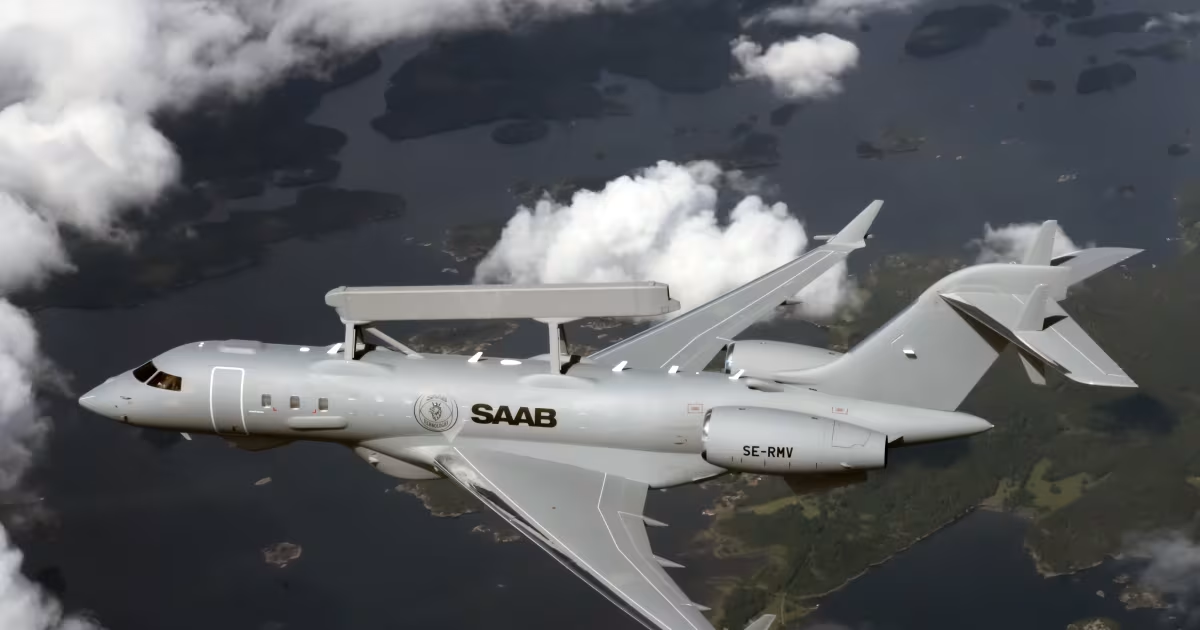
The GlobalEye AEW&C system represents the technological apex of SAAB’s airborne surveillance ecosystem, integrating long-range detection capabilities with multi-domain operational flexibility.
Developed through a partnership between SAAB and Bombardier, GlobalEye is built on the long-range Global 6000/6500 business jet, transforming a high-end commercial platform into one of the world’s most advanced intelligence aircraft.
Unlike traditional AEW&C systems that concentrate primarily on airspace monitoring, GlobalEye delivers simultaneous multi-domain coverage — air, sea, and land — allowing operators to maintain persistent surveillance over a massive geographic footprint.
The aircraft’s development lineage dates back to 2016, when SAAB initiated the program to meet rising international interest in expanded situational awareness capabilities beyond the original Erieye radar.
Its public unveiling in 2018 signaled the emergence of a new class of airborne intelligence assets tailored for nations confronting hybrid and multi-dimensional threat landscapes.
Flight-test campaigns validated the platform’s sensor fusion capabilities, endurance performance, and radar envelope expansion with minimal technical setbacks, reinforcing GlobalEye’s reputation as a reliable, rapidly deployable AEW&C solution.
At the center of GlobalEye’s technological superiority is the Erieye ER AESA radar, which features gallium nitride (GaN) transmit/receive modules that deliver a 70% increase in detection range over previous Erieye iterations.
Operating at altitudes between 30,000 and 35,000 feet, the radar can detect and track elusive airborne or maritime targets up to 450–550 km, allowing Saudi operators to monitor areas deep into hostile territory.
Complementing the Erieye ER is the Leonardo Seaspray 7500E radar, which enables high-resolution synthetic aperture radar (SAR), maritime wide-area surveillance, and ground moving target indication (GMTI).
The inclusion of a high-fidelity EO/IR turret, encrypted data links, SATCOM, and a five-station mission control suite ensures GlobalEye performs seamlessly as a strategic command node capable of orchestrating joint military operations.
Of equal importance is its 11-hour endurance, giving Saudi Arabia the ability to maintain persistent coverage over critical maritime chokepoints such as the Strait of Hormuz, Bab-el-Mandeb, and the Red Sea shipping lanes.
SAAB stresses that GlobalEye’s ability to operate autonomously or stream data to ground stations enhances operational efficiency, particularly in long-duration intelligence missions where crew fatigue and resource constraints are major concerns.
A SAAB representative previously described GlobalEye as “the world’s most advanced AEW&C solution and a strategic national asset for peace, crisis, and conflict.”
Saudi Arabia’s ISR Imperative Under Vision 2030 Modernization
If Saudi Arabia proceeds with acquiring GlobalEye, the move would represent a seismic shift in the Kingdom’s ISR posture under its Vision 2030 military transformation agenda.
The Royal Saudi Air Force (RSAF) currently operates:
- Five Boeing E-3 Sentry AWACS acquired in the 1980s
- Two Saab 2000 Erieye AEW&C aircraft
While the E-3 provides broad AEW&C capability, the fleet is entering obsolescence — a challenge mirrored by other operators such as the U.S. Air Force, which is retiring its own E-3s in favor of more modern alternatives.
The RSAF’s existing Saab Erieye platforms mean Saudi crews are already familiar with SAAB’s AEW&C architecture, potentially easing transition and reducing operational risk.
These reconnaissance assets have played key roles in monitoring Yemen’s airspace, tracking Houthi cruise missile launches, and watching for Iranian UAV flights targeting oil infrastructure, shipping routes, and military bases.
Saudi Arabia’s defence spending remains among the highest in the world, hovering at around USD 75 billion (approximately RM 350 billion) in 2024, as the Kingdom diversifies its procurement sources and reduces over-dependence on U.S. platforms.
Recent acquisitions — such as the F-15SA, upgrades to F-15C/D fleets, and ongoing discussions surrounding future F-35 participation — signal Riyadh’s determination to build one of the most formidable air forces in the Middle East.
Integrating GlobalEye into this ecosystem would deliver strategic benefits including:
- Earlier detection of low-observable threats
- Rapid cross-domain response coordination
- Enhanced air and missile defence coverage
- Strengthened maritime situational awareness
- Improved border security against irregular warfare threats
These enhancements are especially significant given the rapid proliferation of Iranian ballistic missiles, loitering munitions, and sophisticated UAV systems that have repeatedly challenged Saudi and Gulf air defences.
A Competitive AEW&C Market and the Gulf’s Evolving Strategic Landscape
SAAB’s pitch to Saudi Arabia is part of a broader Gulf-wide AEW&C strategy.
As Johansson explained, “There are a number of countries now looking at this capability and evaluating it. We are in different stages in different campaigns as we speak.”
While specific pricing has not been disclosed, previous UAE procurement records suggest that a Saudi deal for 2–4 GlobalEye aircraft could reach USD 1 billion to USD 1.4 billion (RM 4.7 billion to RM 6.6 billion) depending on configuration and support packages.
The UAE — Saudi Arabia’s close defence partner — operates five GlobalEye aircraft, completed under a program reportedly valued at 23 billion SEK or approximately USD 2.2 billion (RM 10.3 billion).
This precedent enhances interoperability prospects between Saudi and UAE air forces, enabling joint training, sensor fusion exercises, and shared early warning networks within the GCC defence architecture.
GlobalEye’s arrival in Saudi Arabia would also have profound geopolitical consequences.
Regional threats such as Houthi missile operations, Iranian naval expansions, and escalating Israeli-Lebanese tensions continue to destabilize the Middle East’s security environment.
Long-range ISR capacity has thus become not merely a technological preference but a strategic necessity.
Enhanced radar coverage would permit Saudi Arabia to:
- Monitor Iran’s ballistic missile launch corridors
- Track naval movements in the Arabian Sea and Red Sea
- Detect early-stage UAV incursions
- Support coalition operations and air policing missions
- Strengthen missile defence integration with the GCC
SAAB also stands to benefit from NATO’s recent cancellation of a €6 billion Boeing E-7 Wedgetail order, as Johansson noted:
“So now they are looking at whether they can maybe have another capability which we are of course proposing to them, the Global Eye.”
If Europe begins shifting away from Boeing solutions, it could elevate GlobalEye as a global alternative for militaries seeking a non-U.S. supplier.
For Saudi Arabia, choosing a European AEW&C system would diversify its defence supply chain, reducing political risks often associated with U.S. arms transfers.
Additionally, the acquisition could align with Vision 2030 industrial goals through maintenance, training, or limited manufacturing opportunities with Saudi Arabian Military Industries (SAMI).
GlobalEye’s Competitive Edge and the Strategic Horizon for Saudi Defence
When compared to the Boeing E-7 Wedgetail, GlobalEye offers multiple operational advantages.
The E-7, based on the Boeing 737, is larger, more expensive, and optimized for high-end air warfare — but it has faced schedule delays, political constraints, and cost overruns.
In contrast, GlobalEye’s business jet platform enables:
- Lower operating costs
- Faster deployment
- Longer endurance
- Reduced support requirements
- Smaller crew footprint
The E-3 Sentry, meanwhile, is approaching the limits of sustainability due to aging airframes and outdated systems, making GlobalEye a credible successor in Saudi Arabia’s modernization roadmap.
Regional analysts view GlobalEye as a potential game-changer.
A SAAB spokesperson stressed, “GlobalEye delivers unmatched situational awareness, and we believe it offers significant operational value for customers in the Middle East.”
If procured, the system would significantly extend Saudi Arabia’s detection horizons, granting operators more time to intercept threats before they penetrate critical airspace.
In the context of Iran-Saudi competition and continued Houthi missile launches, a powerful early-warning network is a deterrent in itself — shaping adversary calculations by reducing the element of surprise.
A Strategic Leap for Saudi Arabia’s Future ISR Architecture
SAAB’s offer of GlobalEye to Saudi Arabia represents far more than an acquisition proposal — it is an opportunity for the Kingdom to redefine its entire airborne intelligence framework for the next three decades.
As Johansson reaffirmed, “We are in different stages in different campaigns as we speak. Some campaigns we have provided offers.”
If Saudi Arabia accepts the proposition, it could signal a fundamental pivot toward European-led defence innovation and greater technological independence under Vision 2030.
In a region where threats evolve daily and where intelligence dominance can determine strategic outcomes, platforms like GlobalEye are no longer optional — they are indispensable pillars of national defence.
With geopolitical volatility intensifying across the Middle East, the integration of GlobalEye into Saudi Arabia’s ISR ecosystem would significantly enhance the Kingdom’s ability to safeguard sovereignty, deter adversaries, and sustain regional stability in an increasingly uncertain future.
Saudi Arabia’s adoption of GlobalEye would also strengthen the Kingdom’s capacity to build a comprehensive multi-layered early-warning network that integrates seamlessly with its ground-based radars and missile defence systems, creating a far more resilient national security shield against evolving regional threats.
By leveraging the long-range detection capabilities of GlobalEye, the Kingdom would gain the ability to anticipate hostile activities well beyond its borders, enabling preemptive strategic planning and improving the efficiency of joint military operations across the Gulf Cooperation Council.
The introduction of GlobalEye would further enhance the interoperability of Saudi air assets with allied nations, allowing the Kingdom to assume a greater leadership role in regional security cooperation and coalition-based missions within the Gulf and Red Sea corridors.
In strategic terms, the shift toward advanced European ISR technology would diversify the Kingdom’s defence supply chain and provide greater flexibility in procurement, upgrade pathways, and operational sovereignty amid fluctuating geopolitical alignments.
Ultimately, GlobalEye’s integration would underpin a new era of information dominance for Saudi Arabia, where real-time intelligence fusion becomes the foundation of its deterrence strategy, crisis response capability, and long-term regional security posture. — DEFENCE SECURITY ASIA
