
Russia-China Heavy Helicopter Alliance Threatens Indo-Pacific Balance as New Tibet-Optimised Airlift Giant Nears Production
The joint Rostec-AVIC heavy-lift helicopter programme is designed to strengthen China’s high-altitude military logistics capability across Tibet and the Himalayas while deepening Russia-China aerospace integration amid intensifying Indo-Pacific strategic competition.

(DEFENCE SECURITY ASIA) — The accelerating joint development of a next-generation heavy-lift helicopter by Rostec and AVIC is reshaping the military logistics architecture underpinning China’s future force projection strategy across Tibet, the Himalayas, and the broader Indo-Pacific operational theatre.
Statements delivered by Rostec Director for International Cooperation Viktor Kladov during the 10th China-Russia Expo in Harbin revealed that the long-delayed Advanced Heavy Lift helicopter programme has now passed a Chinese state audit and is transitioning toward joint development and production.
Kladov’s declaration that the aircraft “will be a sensation” upon market entry reflects Moscow and Beijing’s confidence that the platform could fundamentally alter heavy-lift aviation dynamics currently dominated by Western systems such as the Sikorsky CH-53K King Stallion and legacy Russian Mi-26 fleets.
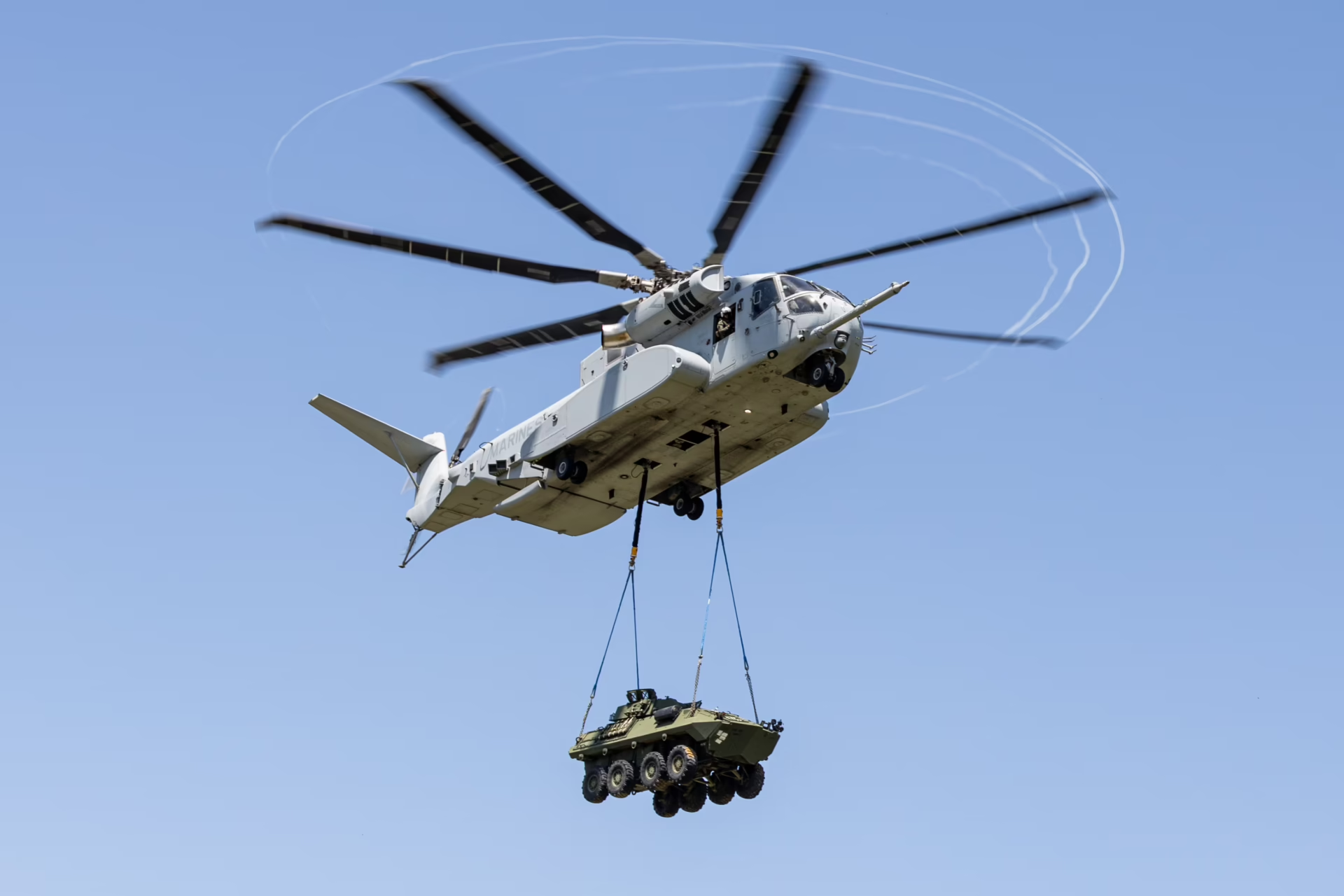
The helicopter’s projected external payload capacity of 14–16 tons positions the aircraft directly between the medium-class Mi-171 and the strategic-lift Mi-26, creating a specialised capability tier optimised for mountainous logistics, artillery transport, and high-altitude force sustainment operations.
China’s operational emphasis on Tibet and plateau warfare indicates that the aircraft is being engineered not merely for transport efficiency, but as a core enabler of persistent military mobility across terrain where thin air density traditionally cripples rotary-wing lift performance.
The programme also demonstrates how Russia and China are restructuring defence-industrial cooperation from traditional supplier-client arrangements into integrated co-development models designed to resist Western sanctions pressure and aerospace technology containment measures.
Although no flying prototype has yet emerged publicly, the project’s advancement toward production planning confirms that Beijing considers heavy-lobility aviation a strategic priority closely linked to contingency planning involving India, border reinforcement, and rapid-response logistics.
The helicopter’s development trajectory further reflects lessons drawn from recent global conflicts where sustained battlefield logistics, ammunition movement, and high-altitude resupply have proven decisive in determining operational endurance and tactical momentum.
Chinese investment reportedly approaching US$2 billion (RM7.6 billion) signals Beijing’s willingness to absorb substantial aerospace development costs to close critical capability gaps previously mitigated through dependence on imported Russian heavy helicopters.
Russia meanwhile secures long-term industrial relevance by supplying technologically complex components including the main gearbox and power transmission system, areas where Moscow still retains internationally competitive engineering advantages despite sanctions-related industrial constraints.
The programme’s expected production target of approximately 200 aircraft suggests Beijing is preparing for long-duration logistics requirements extending far beyond peacetime utility transport or disaster relief missions.
More importantly, the helicopter’s emergence strengthens the aerospace pillar of the growing Russia-China strategic partnership at a moment when both powers increasingly frame military-industrial integration as a counterweight to NATO and Indo-Pacific alliance consolidation.
Tibet Operations and Himalayan Logistics Become Central Strategic Driver
China’s emphasis on high-altitude operational capability reveals that the helicopter is being designed primarily around the severe environmental limitations imposed by the Tibetan Plateau and Himalayan mountain chain.
Rotary-wing aircraft operating above 4,000 metres encounter dramatic reductions in lift efficiency because thinner air decreases rotor performance while simultaneously limiting engine power generation and payload margins.
The new aircraft’s projected service ceiling of approximately 5,700–6,000 metres therefore addresses one of the People’s Liberation Army’s most persistent operational vulnerabilities along the Line of Actual Control with India.
Heavy-lift helicopters capable of transporting artillery systems, armoured vehicles, engineering equipment, and containerised supplies into isolated plateau regions could substantially increase China’s logistical responsiveness during border crises or military escalations.
The platform also supports Beijing’s broader strategy of converting Tibet into a permanently militarised logistics corridor capable of sustaining high-tempo operations under severe climatic and terrain conditions.
Unlike medium-lift helicopters that struggle with meaningful payloads in thin-air environments, the new Sino-Russian design appears optimised specifically for sustained plateau operations involving substantial external cargo movement.
The helicopter’s operational profile could enable faster deployment of radar systems, surface-to-air missile batteries, electronic warfare assets, and mobile command infrastructure into strategically sensitive mountain sectors.
Such mobility improvements would complicate Indian military planning because China could reinforce remote frontier positions with heavier equipment at significantly shorter notice during future confrontations.
The aircraft’s heavy-lift utility additionally strengthens China’s capacity to maintain infrastructure expansion across remote western regions where road networks remain vulnerable to weather disruption and terrain bottlenecks.
Beyond military applications, Beijing is likely to frame the programme domestically as supporting disaster relief, infrastructure construction, and emergency response missions, thereby reinforcing political legitimacy for high-cost aerospace investment.
The helicopter consequently becomes not merely an aviation platform, but a strategic instrument supporting China’s integrated civil-military fusion doctrine across contested geographic environments.
Its deployment would also complement China’s expanding airbase network and dual-use infrastructure investments across western provinces, creating a more resilient logistics ecosystem for sustained frontier operations.

Russian Aerospace Expertise Remains Critical Despite China’s Industrial Rise
Although China now dominates multiple manufacturing sectors, the helicopter programme demonstrates that Beijing still relies heavily on Russian expertise in specialised aerospace engineering domains.
Rostec’s responsibility for the main gearbox and transmission system highlights the enduring complexity of heavy-lift rotorcraft mechanics, particularly under extreme operational stress and high-altitude flight conditions.
Transmission systems capable of handling immense torque loads while maintaining reliability in thin-air environments represent one of the most technologically demanding aspects of helicopter engineering.
Russia’s decades of operational experience with the Mi-26 and other heavy rotary-wing platforms therefore remain strategically valuable despite China’s rapid industrial advancement.
The likely incorporation of Russian Aviadvigatel PD-12V turboshaft engines further indicates that Beijing continues depending on Moscow for high-output propulsion technologies not yet fully replicated domestically.
Earlier concepts involving Ukrainian Motor-Sich engines became politically untenable following geopolitical fragmentation triggered by the Russia-Ukraine conflict and subsequent sanctions regimes.
As a result, the helicopter increasingly embodies Russia’s broader import-substitution push, where domestic aerospace systems replace previously internationalised supply chains severed by geopolitical confrontation.
For Moscow, participation in the programme generates critical foreign revenue streams at a time when Western sanctions continue constraining export markets and financial access.
The helicopter also enables Russia to preserve engineering competencies within its aviation sector by embedding Russian technologies into a large-scale Chinese production ecosystem expected to remain active throughout the 2030s.
This arrangement simultaneously gives Beijing access to mature aerospace expertise while allowing Moscow to maintain strategic leverage within a rapidly expanding Chinese defence-industrial framework.
Kladov’s emphasis that the programme constitutes “full joint development” rather than simple cooperation underscores how both states increasingly portray defence collaboration as strategically equal despite China’s larger economic scale.
The project therefore symbolises a deeper geopolitical realignment in which Russia increasingly integrates technologically with China to offset isolation from Western aerospace and defence markets.
Advanced Heavy Lift Capability Alters Indo-Pacific Force Posture Calculations
The emergence of a Chinese-operated heavy-lift helicopter fleet would significantly alter military mobility calculations across the Indo-Pacific security environment.
Heavy rotary-wing platforms provide operational flexibility that fixed-wing transport aircraft cannot replicate because helicopters can deliver cargo directly into remote forward operating zones lacking prepared runways.
China’s future ability to rapidly reposition heavy equipment across difficult terrain could enhance survivability, dispersal, and logistical resilience during high-intensity regional contingencies.
The aircraft’s projected maximum take-off weight of 38–42 tons places it within a strategic category capable of transporting substantial battlefield systems rather than merely tactical infantry loads.
Such capability becomes increasingly relevant as the People’s Liberation Army modernises toward distributed operations requiring mobile sustainment across dispersed theatres and austere infrastructure environments.
The helicopter’s estimated cruising speed of approximately 270 km/h and operational range approaching 800 kilometres additionally support long-distance logistics missions across vast interior regions and frontier sectors.
In a Taiwan contingency scenario, heavy-lift aviation could support rapid island reinforcement, airfield recovery, engineering deployment, and mobile air-defence logistics supporting broader joint-force operations.
The platform also enhances China’s humanitarian assistance and disaster-relief narrative, enabling Beijing to project soft-power influence during regional emergencies while simultaneously familiarising crews with expeditionary logistics operations.
Military observers are particularly likely to compare the aircraft with the CH-53K because both designs emphasise high-payload performance, advanced rotor architecture, and operational sustainment under demanding conditions.
However, the Sino-Russian platform appears more heavily optimised for plateau logistics and strategic overland transport rather than exclusively amphibious expeditionary warfare.
Its emergence could therefore influence procurement calculations among states seeking heavy-lift alternatives outside Western defence ecosystems increasingly shaped by export restrictions and geopolitical alignment pressures.
Potential export opportunities across Asia, Africa, and the Middle East may eventually transform the helicopter into a commercially competitive strategic-lift platform within non-Western defence markets.
Delays and Engineering Complexity Reveal Programme’s Strategic Weight
Despite recent momentum, the helicopter programme’s prolonged timeline illustrates the immense technological complexity associated with developing modern heavy-lift rotorcraft platforms.
Initial Chinese concepts dating back to 2009 envisioned a roughly 30-ton civil heavy-lift aircraft before the programme gradually evolved into a far more ambitious dual-use strategic aviation system.
The 2015 framework agreement between Russian Helicopters and AVIC marked the formal beginning of Sino-Russian collaboration, yet negotiations reportedly continued for years over industrial responsibilities, intellectual property, and production arrangements.
By 2016 and 2018, AVIC assumed primary programme leadership while Russia transitioned toward a specialised supplier role focused on technically demanding subsystems rather than full-aircraft design control.
The signing of the full development contract in 2021 finally stabilised the programme after more than a decade of shifting requirements, evolving specifications, and geopolitical disruption.
Subsequent cockpit design evaluations completed in 2022 indicated that engineers had moved beyond conceptual modelling into systems integration and operational ergonomics validation.
Russian officials including Deputy Prime Minister Denis Manturov later confirmed during 2024 that the programme remained on schedule despite sanctions and industrial turbulence affecting Russia’s aerospace sector.
Nevertheless, earlier first-flight targets reportedly ranging between 2022 and 2025 have slipped, highlighting the engineering challenges associated with balancing payload, altitude performance, and transmission durability within a single airframe.
Heavy helicopters experience extraordinary structural and mechanical stress because rotor systems, engines, and transmission assemblies must operate continuously under massive aerodynamic and torque loads.
The programme’s slow progression therefore reflects not merely bureaucratic delay, but the fundamental difficulty of producing a reliable heavy-lift helicopter capable of sustained plateau operations under operationally realistic conditions.
China’s willingness to continue funding the project despite delays demonstrates that Beijing considers the capability strategically indispensable rather than commercially optional.
The state audit approval achieved in 2026 consequently represents a politically significant milestone signalling that Chinese authorities remain committed to eventual serial production despite developmental complexity.
Sino-Russian Aerospace Integration Signals Long-Term Strategic Alignment
The helicopter programme ultimately represents more than an aviation project because it reflects the gradual fusion of Russian and Chinese defence-industrial ecosystems under mounting geopolitical pressure.
As Western sanctions increasingly isolate Russian aerospace firms from European and North American markets, China offers Moscow an industrial lifeline capable of sustaining advanced engineering sectors otherwise vulnerable to contraction.
Beijing meanwhile gains access to specialised aerospace competencies that would require years and potentially billions of additional dollars to replicate independently.
This mutual dependence is gradually producing a defence-industrial relationship where strategic necessity overrides historical mistrust between Moscow and Beijing.
The helicopter programme therefore mirrors broader patterns already visible in energy cooperation, military exercises, semiconductor partnerships, and strategic technology coordination between both powers.
For Indo-Pacific security planners, the aircraft symbolises how Russia-China military cooperation is evolving from symbolic political signalling into operationally relevant capability generation.
The emergence of jointly developed aerospace platforms also complicates future sanctions strategies because production chains become distributed across multiple jurisdictions and industrial bases.
Should the aircraft eventually enter export markets, it could provide states aligned outside Western security architectures with access to advanced heavy-lift capability at potentially lower acquisition costs.
Such exports would simultaneously expand Chinese aerospace influence while preserving Russian participation within global military aviation supply networks despite continuing geopolitical isolation.
The programme’s strategic timing is equally significant because it coincides with intensifying military competition across the Himalayas, Taiwan Strait, Arctic routes, and broader Indo-Pacific maritime corridors.
Kladov’s assertion that the helicopter will create a “sensation” therefore reflects more than marketing rhetoric because the platform embodies a deeper transformation in Eurasian military-industrial alignment.
If serial production proceeds during the early-to-mid 2030s as anticipated, the helicopter could emerge as one of the most strategically consequential non-Western aerospace programmes of the decade.
