
Qatari Royal Warns U.S. It Is “Merely a Tenant” at Al-Udeid Air Base, Exposing Washington’s Strategic Dependence
A blunt warning from a senior member of Qatar’s ruling family has reignited debate over U.S. basing rights, sovereignty, and Washington’s reliance on Al-Udeid Air Base amid escalating Middle East tensions.

(DEFENCE SECURITY ASIA) — Khalid bin Jassim Al Thani, a prominent member of Qatar’s ruling family closely associated with foreign affairs discourse, issued an unusually blunt geopolitical warning when he declared, “You are merely a tenant of a military base in Qatar, so do not act as if you are doing us a favor,” a statement that immediately reframed the U.S. military presence at Al-Udeid Air Base as conditional, transactional, and subject to Qatari sovereignty rather than American entitlement.
The warning escalated sharply when Khalid bin Jassim Al Thani added, “If Qatar decides to dismantle the American base on its territory, it would not harm us much; but for you, it would amount to cutting off one of your hands in the Middle East,” a phrase that struck at the operational heart of U.S. Central Command’s forward posture and exposed Washington’s structural dependence on host-nation consent.

These remarks emerged precisely as the United States and United Kingdom quietly relocated non-essential personnel from Al-Udeid amid rising U.S.–Iran tensions, reinforcing the perception that Qatar is being involuntarily drawn into escalation dynamics generated by American strategic decisions.
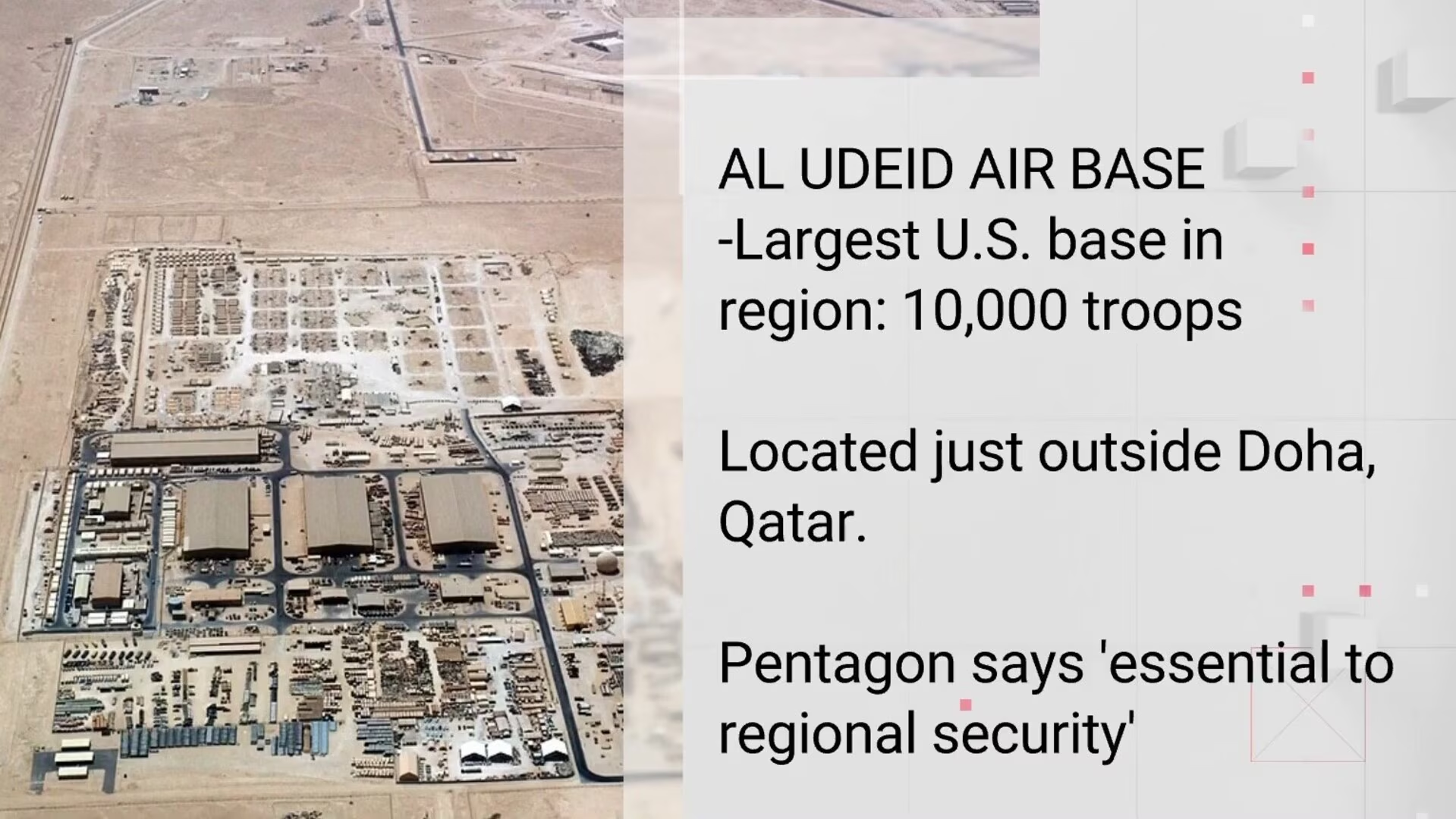
Al-Udeid Air Base, located southwest of Doha, is not a symbolic outpost but the primary forward headquarters of U.S. Central Command, hosting more than 10,000 U.S. personnel and coordinating air, intelligence, space, and strike operations across the Middle East, Africa, and South Asia.
Since the early 2000s, Al-Udeid has served as the linchpin of U.S. power projection, enabling sustained air campaigns against ISIS, logistics operations during the Afghanistan war, and rapid response capabilities across multiple theatres.
What makes Khalid bin Jassim Al Thani’s warning uniquely destabilising is that Qatar—not the United States—financed much of Al-Udeid’s construction and expansion, investing several billion U.S. dollars, equivalent to tens of billions of Malaysian Ringgit (RM), into infrastructure designed primarily for American strategic benefit.
By publicly asserting Qatar’s leverage over the base, Doha has challenged a long-standing assumption that Gulf host nations are passive beneficiaries rather than active arbiters of U.S. military access.
The statement also implicitly rebuked Washington’s contradictory posture toward Qatar, which has been alternately labelled a “major non-NATO ally” and criticised over alleged ties to groups such as Hamas, despite Doha’s central role in mediation and hostage negotiations.
For Defence Security Asia, this episode marks a critical inflection point in global basing politics, where sovereignty, risk exposure, and strategic consent are increasingly redefining the limits of American military reach.
Al-Udeid Air Base and the Architecture of U.S. Military Dependence
Al-Udeid Air Base constitutes the most operationally indispensable fixed military installation underpinning U.S. power projection in the Middle East, functioning as the nerve centre for U.S. Central Command’s air operations, intelligence fusion, and real-time strike coordination across a geographically expansive and politically volatile theatre.
Hosting over 10,000 U.S. personnel and more than 100 aircraft, including bombers, aerial refuelling tankers, and intelligence platforms, Al-Udeid enables the United States to compress decision-to-strike timelines in ways that cannot be replicated from Diego Garcia or European bases.
The base’s strategic value lies not merely in its runways but in its integrated command-and-control infrastructure, which synchronises air operations spanning Iraq, Syria, the Persian Gulf, and South Asia under a single operational architecture.
Without Al-Udeid, U.S. military planners would face severe logistical friction, elongated response times, and sharply increased operational costs measured in billions of U.S. dollars annually, equivalent to multiple tens of billions of Ringgit, undermining deterrence credibility.
Critically, Qatar financed much of the base’s original construction and subsequent expansions, reportedly spending billions to attract U.S. forces after their relocation from Saudi Arabia, thereby converting financial capital into strategic leverage.
This arrangement created an asymmetry in which Qatar assumed infrastructure costs while Washington extracted disproportionate operational advantage, validating Khalid bin Jassim Al Thani’s assertion that the base benefits the United States “far more than it benefits us.”
As regional warfare evolves toward precision-strike saturation, Al-Udeid’s fixed-site nature increasingly exposes Qatar to retaliatory risk stemming from U.S. military actions beyond Doha’s control.
The base has thus transitioned from a security asset into a strategic liability whose risks are borne primarily by the host nation.
This structural dependence explains why Qatar’s warning resonates as a credible threat rather than rhetorical posturing.
Iran, Escalation Dynamics, and Qatar’s Growing Strategic Exposure
Iranian officials have repeatedly warned that U.S. military bases hosted by regional allies would be treated as legitimate targets in the event of American escalation, placing Qatar directly within Tehran’s retaliatory strike calculus.
This threat materialised when Iran launched missiles at Al-Udeid in June 2025, causing limited physical damage but conclusively demonstrating that the base is neither immune nor symbolically protected by Qatari sovereignty.
The subsequent relocation of non-essential U.S. and British personnel, officially described as a precautionary posture adjustment, tacitly acknowledged Al-Udeid’s vulnerability within a missile-saturated battlespace.
Qatar’s government confirmed the personnel movement was linked to “current regional tensions,” underscoring Doha’s awareness that it is being involuntarily entangled in U.S.–Iran confrontation dynamics.
Unlike other Gulf states, Qatar maintains diplomatic channels with Iran, positioning itself as a mediator rather than an adversary, including reported efforts to dissuade U.S. military strikes during previous crises.
Hosting the primary hub for U.S. military operations therefore places Qatar in a contradictory position, simultaneously serving as intermediary and potential battlefield.
Khalid bin Jassim Al Thani’s warning can be interpreted as a signal that Doha will not indefinitely absorb existential risk generated by decisions made in Washington.
In modern missile warfare, proximity equates to vulnerability, and Qatar’s willingness to challenge U.S. assumptions reflects a recalibration of that equation.
This recalibration fundamentally alters the strategic calculus underpinning the U.S.–Qatar defence relationship.
Sovereignty, “Tenant Power,” and the Reversal of Alliance Hierarchies
By explicitly characterising the United States as a “tenant,” Khalid bin Jassim Al Thani deliberately inverted the traditional alliance hierarchy that has long portrayed Gulf host nations as dependent beneficiaries of American protection rather than sovereign stakeholders with decisive leverage.
This rhetorical inversion reflects a deeper strategic reality in which basing rights, geographic access, and political consent now constitute critical power assets comparable to aircraft carriers or long-range strike platforms.
The U.S.–Qatar Defence Cooperation Agreement legally affirms Qatari sovereignty over Al-Udeid, reinforcing Doha’s authority to define the conditions under which foreign forces operate on its territory.
Qatar’s experience during the 2017 Saudi-led blockade fundamentally reshaped its threat perception, revealing that hosting U.S. forces does not automatically translate into diplomatic protection or political alignment.
Washington’s initial support for Riyadh during that crisis underscored the transactional nature of alliances, accelerating Doha’s pursuit of strategic autonomy rather than blind dependence.
Khalid bin Jassim Al Thani’s reference to U.S. accusations branding Qatar as a “terrorist” supporter exposed the contradiction between Washington’s rhetoric and its operational reliance on Qatari-hosted infrastructure.
His statement, “In short, the state you label as ‘terrorist’ is the very state you are pleading with to maintain the military base and host your troops,” condensed years of accumulated grievance into a single strategic indictment.
Such language signals that Qatar is no longer willing to absorb reputational, political, and security costs without reciprocal restraint from its most powerful partner.
In alliance politics, perception shapes power, and Doha has signalled that it will now actively shape that perception.
Economic Power, Financial Interdependence, and Strategic Confidence
Qatar’s readiness to confront Washington in the public domain is structurally inseparable from its exceptional economic resilience, underpinned by the world’s third-largest natural gas reserves and a sovereign wealth fund exceeding USD 450 billion (approximately RM 2.1 trillion), which together provide Doha with long-term fiscal endurance and strategic autonomy.
This depth of capital enables Qatar to absorb diplomatic coercion, offset external pressure through diversified security and economic partnerships, and sustain policy independence in ways that would be strategically untenable for less resource-endowed states.
Qatari investments spanning U.S. real estate, aviation, energy infrastructure, and financial markets have produced a complex web of interdependence, raising the political and economic costs for Washington of any punitive response that could reverberate back into its own domestic economy.
High-profile financial linkages involving influential U.S. political and corporate actors further reinforce Doha’s assessment that leverage in contemporary statecraft extends beyond military basing into economic exposure, capital flows, and elite-level stakeholder interests.
Concurrently, Qatar’s role as a major liquefied natural gas supplier underwrites energy security across Asia, sustaining critical demand centres such as Japan, South Korea, China, and India at a time of heightened global energy volatility.
Any significant destabilisation affecting Qatar would therefore transmit immediate shockwaves through global energy markets, with second-order effects on industrial output, inflation, and economic stability across the Indo-Pacific.
This structural linkage between Gulf security and Asian energy consumption elevates Qatar’s strategic relevance from a regional actor to a systemic node within the global political-economic order.
In this context, economic power functions as a form of strategic insulation, enabling Doha to assert sovereign prerogatives while mitigating the risks of diplomatic isolation or economic retaliation.
It is this multidimensional convergence of financial strength, market interdependence, and energy centrality that ultimately underpins the credibility and strategic weight of Qatar’s warning.
Global Basing Politics and the End of Unconditional U.S. Power Projection
The Al-Udeid episode crystallises a defining characteristic of the emerging multipolar security order, in which U.S. power projection is no longer exercised unilaterally but is increasingly contingent on host-nation consent shaped by evolving threat perceptions, domestic political constraints, and the asymmetric distribution of escalation risk.
Qatar’s posture establishes a consequential precedent by demonstrating that a host state can assert sovereign control over basing arrangements, recalibrate risk exposure, and publicly signal red lines without formally dismantling alliance structures or abandoning strategic cooperation.
Across Asia, U.S. forward deployments in Japan, South Korea, and the Philippines are already subject to comparable domestic and strategic debates, as intensifying great-power competition raises the probability that host nations—not the United States—would bear the first-order consequences of retaliation in a high-end conflict.
The central lesson for Washington is that alliance management in the contemporary era requires sustained political reciprocity, strategic restraint, and respect for host-nation risk calculus, rather than reliance on legacy assumptions that access, once granted, is permanent and unconditional.
In an environment dominated by precision-guided missiles, long-range drones, and rapid escalation dynamics, military superiority alone is insufficient to override host-nation calculations that increasingly prioritise survivability, political legitimacy, and control over national territory.
Khalid bin Jassim Al Thani’s warning exposes a structural vulnerability in the U.S. global posture, highlighting that forward basing architectures designed for uncontested dominance are ill-suited to an era where political consent has become as decisive as kinetic capability.
This episode underscores a fundamental shift in how power is exercised and constrained, revealing that strategic influence is now negotiated through access arrangements rather than imposed through force presence alone.
In the contemporary security environment, access—not the sheer accumulation of platforms or assets—has emerged as the decisive currency of power projection and operational credibility.
Even the world’s most powerful military must now negotiate its presence deliberately and continuously, base by base and host by host, within an increasingly contested geopolitical landscape. — DEFENCE SECURITY ASIA
