
Two Minutes From Strike: Qatari F-15QA Eagles Shoot Down Iranian Su-24 Bombers Racing Toward U.S. Al Udeid Base
Iranian Su-24 tactical bombers flying low-altitude penetration profiles came within minutes of striking the United States’ largest Middle East air base before Qatari F-15QA fighters launched a decisive interception — exposing the fragile airpower balance shaping Gulf security.

(DEFENCE SECURITY ASIA) — The dramatic interception of two Iranian Su-24 tactical bombers approaching Qatar’s Al Udeid Air Base triggered a high-stakes aerial confrontation that immediately reverberated through global defence circles, because the encounter unfolded within minutes of a potential strike against the largest United States military installation in the Middle East hosting thousands of personnel and critical airpower infrastructure.
According to reports cited by international media, the incident forced Qatar Emiri Air Force F-15QA fighters into their first confirmed combat mission, where the technologically superior aircraft intercepted and destroyed the incoming Iranian bombers only moments before they could release their payload near Al Udeid’s strategic operational complex.
The encounter highlighted both the extraordinary operational risk undertaken by Iranian aircrews flying Cold War-era Sukhoi Su-24 bombers and the strategic significance of Al Udeid Air Base as the central logistics hub underpinning United States military force posture across the Gulf region and broader Middle East theatre.
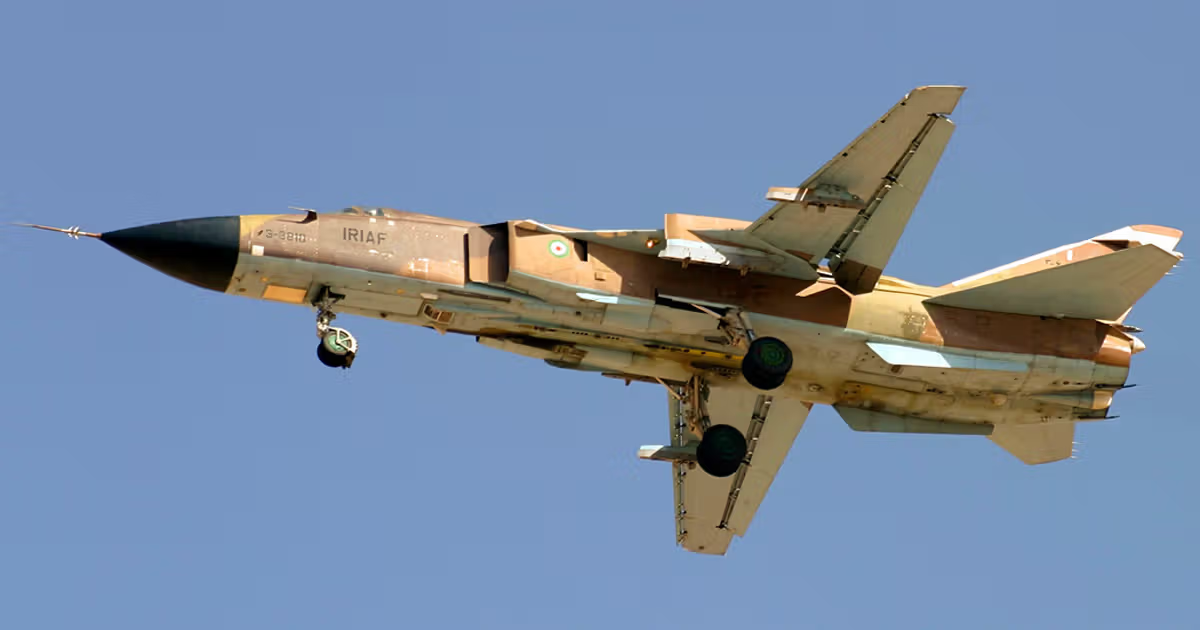
Reports indicate the Iranian aircraft approached at extremely low altitude using terrain-masking tactics designed to evade radar detection, a manoeuvre that initially delayed early warning systems and allowed the bombers to close dangerously within minutes of their intended target.
The Qatari air defence network issued warnings once the aircraft were detected nearing national airspace, but the absence of any response from the Iranian crews triggered the classification of the approaching aircraft as hostile targets within Qatar’s integrated air defence command architecture.
With the threat profile escalating rapidly, Qatari F-15QA fighters were scrambled and conducted a swift intercept operation, resulting in both Su-24 aircraft being shot down and crashing into Qatari territorial waters where recovery and search operations for the crews remain ongoing.
The confrontation exposed the stark technological disparity between Iran’s aging Soviet-era tactical bombers and Qatar’s newly acquired F-15QA multirole fighters equipped with advanced avionics, sensors, and weapons systems designed for modern network-centric warfare.
While the event demonstrated the operational readiness of Qatar’s modernized air force, it simultaneously revealed the continued willingness of Iranian aircrews to execute high-risk missions despite severe technological disadvantages and decades of sanctions limiting modernization of the Iranian Air Force fleet.
Strategically, the encounter underscores how Al Udeid Air Base functions as the logistical backbone of U.S. regional military operations, hosting advanced aircraft, intelligence assets, and command infrastructure essential to American power projection across the Gulf security architecture.
As analysts assess the implications of the encounter, the incident raises deeper questions about Iran’s operational doctrine, Qatar’s evolving military capabilities, and the increasingly fragile deterrence equilibrium shaping aerial security across one of the world’s most strategically contested airspaces.
The Strategic Target: Why Al Udeid Air Base Matters in Gulf Military Calculations
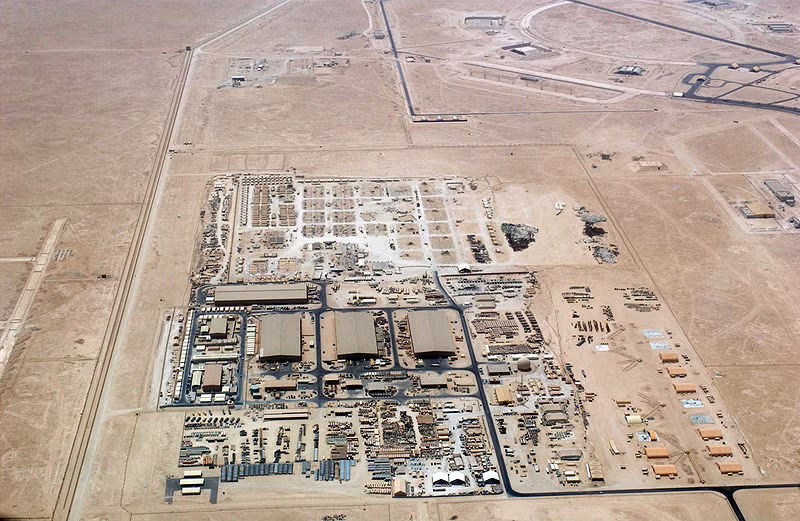
Al Udeid Air Base represents the largest United States military installation in the Middle East and functions as a strategic logistics hub supporting air operations, intelligence missions, and coalition coordination across multiple theatres, making any potential strike against the facility geopolitically significant for regional security calculations.
The base hosts thousands of American personnel alongside advanced aircraft, command infrastructure, and logistical capabilities that enable sustained air campaigns across the Gulf, Levant, and broader Middle East, positioning the installation as a critical node within U.S. military force projection architecture.
From a strategic perspective, the presence of such a large concentration of military assets transforms Al Udeid into a high-value target for adversaries seeking to challenge the operational reach of American power in the region.
Iran’s decision to deploy Su-24 tactical bombers toward Qatari airspace suggests a calculated attempt to probe the defensive envelope surrounding the base and test the responsiveness of Gulf state air defence systems integrated with U.S. military infrastructure.
The proximity of the bombers to their reported target—mere minutes from releasing their payload—illustrates how quickly such incidents can escalate into potentially catastrophic strikes against major military facilities hosting allied forces.
The strategic risk posed by the approach of these bombers lies not only in the potential damage to physical infrastructure but also in the broader political and military consequences that would follow any successful attack on a major U.S. installation.
For Qatar, defending Al Udeid represents both a national security imperative and a demonstration of its reliability as a strategic partner hosting critical U.S. military capabilities within its territory.
The successful interception therefore served not only as a tactical victory but also as a signal reinforcing Qatar’s commitment to safeguarding the joint operational infrastructure underpinning American military presence in the Gulf.
The event simultaneously underscores how regional security dynamics increasingly revolve around protecting key logistical nodes rather than traditional front-line battlefields, reflecting the central role of bases and infrastructure in modern military strategy.
In this context, the aerial confrontation highlights how even limited engagements can carry strategic consequences far beyond the immediate tactical encounter.
Iranian Su-24 Bombers: Cold War Platforms in a Modern Air Warfare Environment
The Sukhoi Su-24 tactical bomber, known by NATO reporting name “Fencer,” represents a Cold War-era aircraft originally developed by the Soviet Union during the late 1960s to conduct deep interdiction missions against heavily defended targets.
Entering service with the Soviet Air Force in 1974, the aircraft was designed specifically to penetrate enemy airspace at extremely low altitude while delivering precision strikes against strategic infrastructure and military installations.
A defining characteristic of the Su-24 is its variable-sweep wing configuration, allowing pilots to adjust wing geometry depending on mission requirements, sweeping the wings back for high-speed flight and extending them for improved manoeuvrability during low-speed operations.
This aerodynamic flexibility enabled the aircraft to perform terrain-following flight profiles that minimized radar exposure, a capability evidently employed during the attempted approach toward Qatari airspace in the recent encounter.
Iran’s acquisition of the Su-24 occurred during the late 1980s and early 1990s following the devastating Iran-Iraq War, when Tehran sought to rebuild its depleted air capabilities through limited purchases from the Soviet Union.
Additional aircraft entered Iranian service in 1991 when Iraqi Su-24 bombers fled to Iran during the Gulf War to avoid destruction by coalition forces, significantly expanding the Islamic Republic of Iran Air Force fleet.
Despite these reinforcements, sanctions imposed over decades have severely restricted Iran’s ability to maintain, upgrade, or replace components for the aging aircraft, forcing the country to rely heavily on domestic engineering solutions.
Operational assessments suggest that between twenty-one and twenty-nine Su-24 aircraft remain active within the Iranian Air Force, though exact readiness levels remain uncertain due to maintenance challenges and limited access to spare parts.
Many of these aircraft are based at Shiraz Air Base, where Iranian engineers have conducted extensive overhaul programs requiring tens of thousands of manpower hours to restore long-grounded airframes to operational status.
The unveiling of underground facilities such as the “Oghab-44” airbase indicates Tehran’s attempt to protect these aircraft within hardened shelters capable of surviving potential air strikes against Iranian military infrastructure.
Iranian Tactical Doctrine: Low-Altitude Penetration and High-Risk Missions
The approach profile reportedly used by the Iranian Su-24 crews relied on extremely low-altitude flight designed to exploit terrain masking and delay radar detection by ground-based air defence systems.
Terrain-following radar integrated within the Su-24 platform allows the aircraft to maintain flight profiles as low as approximately 200 feet above ground level, enabling it to slip beneath conventional radar coverage in certain operational environments.
Such tactics were central to Soviet tactical doctrine during the Cold War, when strike aircraft were expected to penetrate NATO air defences by flying at low altitude to evade early warning radars.
In contemporary air warfare, however, such approaches face increasing vulnerability due to modern sensor networks, airborne early warning aircraft, and integrated air defence systems capable of detecting low-altitude threats.
The fact that the Iranian aircraft managed to approach within minutes of their target before interception raises questions about detection timelines and the operational challenges associated with defending against terrain-masking flight profiles.
The reported refusal of the Iranian pilots to respond to warnings suggests the mission may have been conducted under strict operational directives that prioritized mission completion over evasive disengagement.
From a strategic standpoint, the use of aging bombers in such a high-risk mission indicates Iran’s willingness to accept substantial operational risk in order to challenge perceived adversaries or test defensive responses.
This approach reflects a broader Iranian doctrine emphasizing asymmetric tactics and strategic signalling rather than reliance on technological superiority in conventional air combat scenarios.
The determination of the Iranian aircrews to continue their approach despite overwhelming technological disadvantage demonstrates the human dimension of aerial warfare often overshadowed by discussions of advanced weapon systems.
Such missions place extraordinary demands on pilots operating outdated platforms in contested airspace where modern fighters possess overwhelming sensor and weapons advantages.
Qatar’s F-15QA Eagles: Advanced Multirole Fighters and Air Superiority Dominance
The aircraft that ultimately intercepted the Iranian bombers were Qatar Emiri Air Force F-15QA fighters, one of the most advanced variants of the F-15 Eagle platform developed by Boeing.
The F-15 family has maintained a formidable reputation in global air combat since its introduction in the 1970s, designed specifically to achieve and maintain air superiority through superior speed, manoeuvrability, and advanced avionics.
Qatar’s acquisition of the F-15QA variant reflects a strategic effort to build one of the most capable air forces in the Gulf region amid an increasingly complex regional security environment.
The purchase agreement approved by the United States in 2016 authorized up to seventy-two aircraft valued at approximately USD21.1 billion (RM80.18 billion), although the initial contract signed in 2017 covered thirty-six aircraft valued around USD12 billion (RM45.6 billion).
Deliveries began in 2021 and continue in phases, gradually expanding Qatar’s fleet of advanced fighters capable of both air-to-air and air-to-ground missions.
These aircraft operate as part of a broader modernization effort designed to integrate advanced fighters, training programs, and international partnerships into Qatar’s defence architecture.
The QEAF maintains close operational cooperation with the United States, including pilot training programs and joint operational exercises that enhance interoperability between the two air forces.
Some Qatari pilots train annually in the United States, with plans for long-term cooperation involving facilities such as Mountain Home Air Force Base in Idaho.
The positioning of these aircraft at Al Udeid and other Qatari airbases ensures rapid response capability against potential aerial threats approaching the country’s airspace.
Such deployment reflects Qatar’s strategic objective of protecting both its national airspace and the joint operational infrastructure shared with allied forces stationed within its territory.
Sensor Superiority and Air Combat Technology
The technological advantage enjoyed by the F-15QA during the interception stems largely from its advanced sensors, avionics, and electronic warfare systems designed for modern network-centric air combat.
Central to the aircraft’s capabilities is the APG-82(v)1 active electronically scanned array radar, which provides significantly greater detection range and target tracking capability compared with legacy radar systems.
This radar allows the aircraft to identify and track multiple airborne targets simultaneously while maintaining situational awareness across complex combat environments.
The F-15QA is also equipped with the Eagle Passive/Active Warning and Survivability System (EPAWSS), an advanced electronic warfare suite designed to detect and counter hostile radar and missile threats.
Such systems provide pilots with real-time threat awareness and automated defensive responses against electronic warfare attacks or missile engagements.
The cockpit incorporates large-area digital displays that integrate sensor data, navigation information, and weapons systems controls into a single interface designed to reduce pilot workload.
The aircraft’s digital fly-by-wire flight control system enhances manoeuvrability and handling characteristics while allowing the aircraft to carry larger payloads across multiple weapon hardpoints.
Powered by two high-performance turbofan engines producing approximately 29,000 pounds of thrust each with afterburner, the aircraft can reach speeds exceeding Mach 2.5.
This performance advantage ensures that modern fighters like the F-15QA can intercept slower strike aircraft rapidly once detected within defensive airspace.
In the context of the recent encounter, these capabilities enabled Qatari pilots to locate, intercept, and neutralize the incoming bombers before they could execute their mission.
Strategic Implications for Gulf Airspace Security
The interception of the Iranian bombers carries significant implications for the broader strategic environment across the Gulf region.
First, the incident demonstrates that regional airspace remains highly contested despite the presence of sophisticated air defence networks operated by Gulf states and supported by the United States.
Second, the encounter illustrates how aging aircraft platforms can still pose operational risks when employed with tactical ingenuity such as low-altitude penetration.
Third, the successful interception underscores the growing military capabilities of smaller Gulf states that have invested heavily in advanced fighter aircraft and integrated air defence systems.
Fourth, the incident reinforces the strategic significance of Al Udeid Air Base as a focal point for regional military operations and potential flashpoints in geopolitical rivalry.
Fifth, the event raises questions regarding Iran’s willingness to deploy manned aircraft in missions that expose crews to high-probability interception scenarios.
Sixth, analysts must consider whether such operations represent strategic signalling, reconnaissance probes, or potential strike preparations.
Seventh, the encounter highlights the complex interplay between technological capability, pilot skill, and operational doctrine in determining outcomes in aerial engagements.
Eighth, it also illustrates how individual tactical encounters can rapidly escalate into strategic crises when major military installations are involved.
Ninth, the downing of the aircraft may further intensify scrutiny over regional deterrence dynamics between Iran and U.S.-aligned Gulf states.
Tenth, the broader consequences of the encounter will likely shape future military planning, air defence coordination, and diplomatic engagement across the region.
