
“Energy Crisis Triggers Sovereignty Shock: Philippines Eyes Oil-Rich Sabah as Strategic Lifeline Amid Global Fuel Turmoil”
Manila’s energy emergency is reviving a dormant territorial claim with direct implications for Southeast Asian stability, regional energy security, and ASEAN power dynamics.

(DEFENCE SECURITY ASIA) — The convergence of a declared national energy emergency by Ferdinand Marcos Jr. and a renewed sovereignty push by Robin Padilla is reframing Sabah not as a dormant territorial dispute but as a strategic energy-security lever with immediate geopolitical consequences.
Padilla’s direct appeal—“Mr President, now is the time to revive our rightful claim to Sabah… North Borneo is already rich in oil resources”—links territorial assertion to hydrocarbon access at a moment when global supply shocks are destabilising domestic economic resilience.
By proposing that Philippine Coast Guard spokesperson Jay Tarriela project “patriotic zeal” toward Sabah, Padilla effectively signals a doctrinal shift from maritime deterrence in the West Philippine Sea toward resource-driven territorial signalling in Borneo.

READ: Malaysia Submits Protest Note to Philippines Over Two New Acts Violating Sabah Maritime Boundaries
Energy Crisis as Strategic Catalyst for Dormant Territorial Claims
The declaration of a national energy emergency by Marcos institutionalises the Philippines’ vulnerability as a near-total oil importer, transforming external supply disruptions into domestic strategic risk with cascading effects on employment, logistics chains, and industrial output.
Padilla’s intervention operationalises this vulnerability by framing Sabah’s hydrocarbon resources as a latent strategic reserve, implicitly suggesting that sovereignty claims could be leveraged to offset reliance on volatile global energy markets.
This linkage between territorial sovereignty and energy access redefines the Sabah issue from a historical legal dispute into a contemporary geoeconomic contest shaped by supply chain fragility and price volatility.
The senator’s emphasis on Sabah’s oil wealth introduces a resource-security narrative that aligns with broader global patterns where energy shocks revive dormant territorial or maritime claims.
However, no official Philippine government policy has yet endorsed this framing, leaving Padilla’s proposal positioned as a political signal rather than an executed strategic directive.
The absence of formal response from Malacañang or the Department of Foreign Affairs underscores institutional caution, suggesting that escalation risks are being weighed against potential energy-security gains.
At the operational level, the Philippine government’s commitment to procure additional oil supplies—including approximately one million barrels—indicates a parallel strategy focused on immediate supply stabilisation rather than territorial escalation.
This dual-track approach highlights a tension between short-term energy mitigation measures and long-term structural solutions implied by sovereignty claims over resource-rich territories.
Sabah’s Oil Power: Strategic Hydrocarbon Leverage Behind the Sovereignty Flashpoint
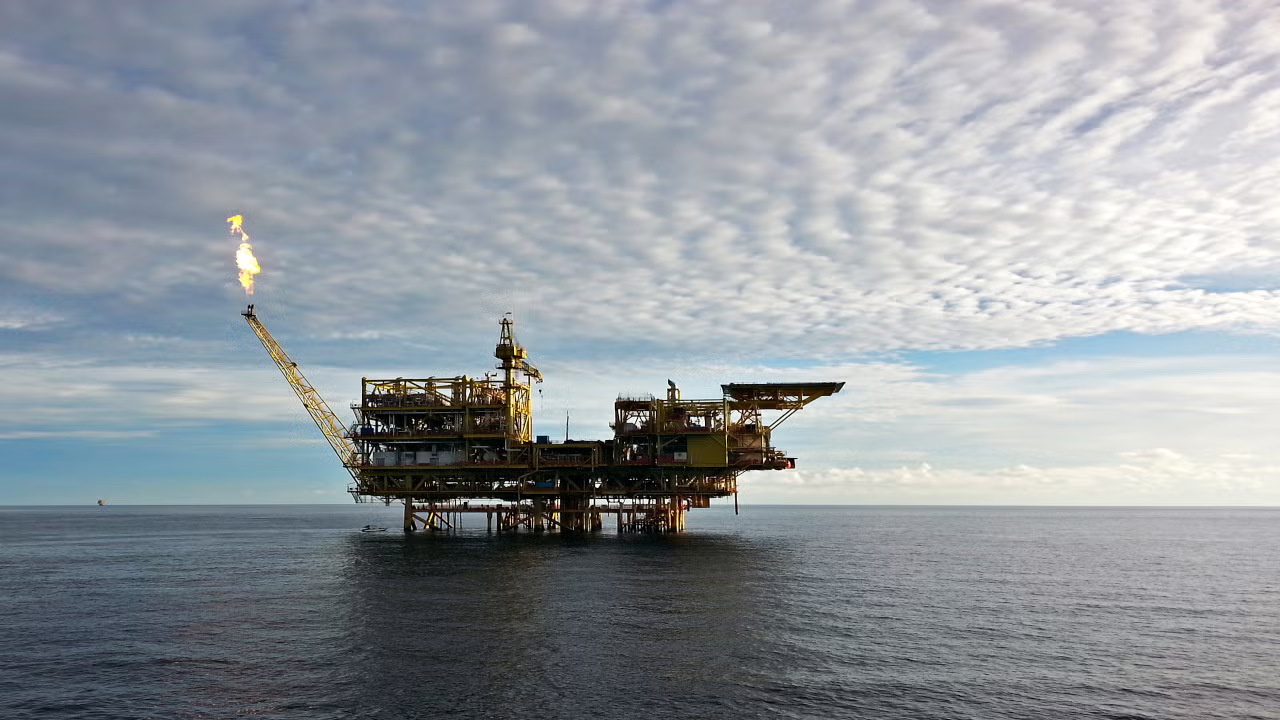
Sabah’s classification as a hydrocarbon-dense territory is anchored in its role within Malaysia’s energy architecture, where its oil and gas reserves directly underpin national production capacity and elevate its geopolitical value in regional energy security calculations.
Data compiled through 2024 and consolidated in late 2025 indicates Sabah holds approximately 32 percent of Malaysia’s total oil reserves, positioning it as the single largest contributor among Malaysia’s three primary hydrocarbon regions.
In contrast, Sabah accounts for approximately 8 percent of Malaysia’s natural gas reserves, reflecting a production structure that is more oil-weighted compared to Sarawak’s gas-dominant profile and Peninsular Malaysia’s balanced output mix.
Overall, Sabah contributes roughly 19 percent of Malaysia’s total petroleum reserves, establishing it as a critical node within the country’s upstream energy portfolio and reinforcing its classification as a strategically significant hydrocarbon province.
Absolute reserve estimates frequently cited in 2025 industry reporting place Sabah’s oil resources at approximately 1.5 billion barrels and its natural gas reserves at around 11 trillion cubic feet, encompassing a spectrum of proven, probable, and contingent assets.
These reserves are distributed across onshore, shallow-water, and deepwater basins, with sustained output enabled through enhanced oil recovery techniques and continuous exploration activity designed to offset natural decline in mature fields.
Despite global price volatility, Malaysia’s national energy outlook remains stable in the near term, with Petroliam Nasional Berhad indicating domestic production capacity is sufficient to meet demand requirements at least through May 2026.
Operationally, Sabah’s production profile is characterised by oil-heavy output, with mature fields maintained through infrastructure upgrades and recovery optimisation programmes to sustain throughput under evolving reservoir conditions.
Key production indicators include the Samarang field generating approximately 36,000 barrels of oil equivalent per day, alongside national crude and condensate output reaching 45.2 million barrels in the second quarter of 2025.
Infrastructure such as the Sabah Oil and Gas Terminal in Kimanis, capable of processing up to 300,000 barrels of oil per day and one billion cubic feet of gas daily, reinforces Sabah’s role as a central processing and export hub within Malaysia’s energy network.
Historical Sovereignty Fault Line: Legal Ambiguity and Strategic Dormancy in the Sabah Dispute
The Sabah sovereignty dispute originates from the 1878 agreement between the Sultanate of Sulu and British commercial actors, where divergent interpretations of the document continue to shape competing legal claims and geopolitical narratives.
The Philippine position frames the agreement as a lease arrangement involving annual payments of approximately USD5,000 (RM19,000) later adjusted to USD5,300 (RM20,140).
Malaysia, however, interprets the same agreement as a definitive transfer of sovereignty, establishing a legal foundation for its administrative control and long-term integration of Sabah into its national territory.
The formalisation of the Philippine claim in 1962 under President Diosdado Macapagal marked the transition of the dispute from historical inheritance to state-level sovereignty assertion within the emerging post-colonial regional order.
Sabah’s incorporation into the Malaysian Federation in 1963 following the Cobbold Commission process introduced a competing legitimacy framework, which the Philippines did not fully accept despite the Manila Accord’s provision that its claim would not be prejudiced.
The enactment of Republic Act 5446 in 1968 further institutionalised the Philippine claim within domestic legal structures, embedding sovereignty assertion into national legislative policy.
A critical judicial milestone occurred in 2011 when the Philippine Supreme Court ruled that the claim remains “retained,” thereby preserving its legal viability despite decades of diplomatic dormancy.
The 2013 Lahad Datu standoff demonstrated the potential for kinetic escalation, where armed incursion by Sulu claimants triggered violence and prompted Malaysia to halt annual payments associated with the original agreement.
At present, the Philippine claim remains dormant in formal international legal forums, with no active litigation at the International Court of Justice or comparable mechanisms to adjudicate sovereignty.
Parallel arbitration efforts by heirs of the Sultanate of Sulu seeking unpaid “cession money” reflect a separate legal track with mixed outcomes in European courts, highlighting the fragmented and unresolved nature of the broader dispute architecture.
Sabah’s Hydrocarbon Profile and Strategic Value in Regional Energy Architecture
Sabah’s classification as an oil- and gas-rich territory provides the material foundation for Padilla’s argument, positioning the region as a potential energy-security asset within Southeast Asia’s hydrocarbon network.
The territory’s integration into Malaysia’s energy sector, however, reflects decades of established production, infrastructure development, and regulatory control under Malaysian jurisdiction.
This entrenched operational framework limits the feasibility of any rapid shift in resource control, indicating that any Philippine claim would translate into a prolonged diplomatic or legal process rather than immediate energy access.
Padilla’s framing nevertheless introduces Sabah into the Philippines’ strategic calculus as a potential offset to import dependency, particularly under conditions of sustained global price escalation.
The emphasis on resource wealth also aligns with broader Indo-Pacific competition over energy corridors, offshore reserves, and supply chain resilience.
From a military-technical perspective, the absence of Philippine operational infrastructure in Sabah underscores the gap between sovereignty claims and extractive capability.
This gap implies that even a successful claim would require extensive capital investment, infrastructure development, and international partnerships before yielding tangible energy outputs.
Consequently, Sabah’s value in the current discourse is primarily strategic and symbolic, serving as a lever in policy debates rather than an immediately exploitable resource base.
Historical Legal Foundations Versus Contemporary Sovereignty Realities
The Philippine claim to Sabah is rooted in a legal interpretation of the 1878 agreement between the Sultanate of Sulu and British entities, which Manila views as a lease rather than a cession of sovereignty.
Malaysia’s counterposition treats the same agreement as a definitive transfer of sovereignty, creating a fundamental legal divergence that has persisted across decades of diplomatic engagement.
Key milestones—including the 1962 formal claim, Sabah’s incorporation into Malaysia in 1963, and subsequent legal assertions—demonstrate the durability of the dispute despite its dormancy in active policy.
The Philippine Supreme Court’s 2011 ruling that the claim remains “retained” provides a legal basis for potential reactivation, reinforcing Padilla’s argument that the issue remains unresolved.
However, the absence of active litigation in international forums such as the International Court of Justice indicates a strategic decision by successive administrations to prioritise diplomatic stability over legal confrontation.
Malaysia’s position that the issue is closed introduces a structural constraint on any Philippine attempt to revive the claim, as it would likely be met with immediate diplomatic resistance.
The historical precedent of the 2013 Lahad Datu standoff further illustrates the risks of escalation, where sovereignty assertions translated into kinetic confrontation and disrupted bilateral relations.
These historical dynamics underscore that any revival of the claim would operate within a complex legal and geopolitical environment where outcomes are uncertain and potentially destabilising.
Operational Signalling and the Role of the Philippine Coast Guard
Padilla’s suggestion to deploy Tarriela and the Philippine Coast Guard introduces an operational dimension to what has historically been a legal and diplomatic dispute.
The reference to “low and high tide” visibility tactics mirrors the Coast Guard’s approach in the West Philippine Sea, where persistent presence operations are used to assert maritime claims.
Transposing this doctrine onto Sabah, a land-based territory, raises questions about the feasibility and intent of such an approach, suggesting a symbolic rather than literal operational proposal.
Nevertheless, the invocation of Coast Guard assets signals an interest in expanding the Philippines’ assertion toolkit beyond maritime zones into contested territorial spaces.
This shift would require significant doctrinal adaptation, as the operational environment in Sabah differs fundamentally from the maritime context of the South China Sea.
The proposal also introduces potential escalation pathways, as visible deployments could be interpreted by Malaysia as a challenge to its sovereignty, triggering diplomatic or security responses.
At present, there is no indication of actual deployment plans, reinforcing the interpretation that Padilla’s statement functions primarily as political signalling rather than operational intent.
The ambiguity surrounding this proposal highlights the gap between rhetorical escalation and executable military or paramilitary actions.
ASEAN Dynamics and Regional Stability Considerations
Any revival of the Sabah claim would have immediate implications for Philippines-Malaysia relations, which are embedded within broader ASEAN frameworks prioritising stability and non-confrontation.
Malaysia’s role as a key regional partner in addressing issues such as the South China Sea amplifies the strategic cost of bilateral friction.
The Philippines’ position as ASEAN chair in 2026 further complicates the equation, as leadership responsibilities require maintaining regional cohesion while managing national interests.
Analysts have characterised Padilla’s proposal as a potential liability for regional relations, indicating concern that it could disrupt cooperative mechanisms within ASEAN.
Public discourse reflects a spectrum of responses, ranging from support for energy independence to calls for negotiation or joint development rather than confrontation.
These reactions suggest that while the energy-security argument resonates domestically, there is awareness of the diplomatic risks associated with sovereignty escalation.
The absence of official government endorsement reinforces a cautious approach, with policymakers likely weighing the benefits of resource access against the costs of regional instability.
In this context, Sabah emerges as a test case for how energy pressures can reshape geopolitical priorities within Southeast Asia’s multilateral framework.
Strategic Outlook: Energy Pressure as a Driver of Territorial Recalibration
Padilla’s initiative illustrates how acute energy crises can reactivate long-dormant territorial claims, transforming historical disputes into instruments of contemporary strategic policy.
The linkage between hydrocarbon access and sovereignty assertion reflects a broader trend where resource scarcity drives geopolitical recalibration.
However, the structural realities of Malaysian control, ASEAN dynamics, and legal complexity indicate that any substantive shift in Sabah’s status would be a long-term process with uncertain outcomes.
The Philippine government’s current focus on immediate energy procurement suggests that short-term stability remains the priority, even as strategic debates evolve.
The absence of formal policy action leaves the Sabah claim in a state of strategic ambiguity, where it functions as a signalling tool rather than an operational objective.
This ambiguity allows Manila to explore the political and strategic implications of the claim without committing to escalation.
At the same time, it introduces uncertainty into regional security calculations, as neighbouring states assess the potential for policy shifts under sustained energy pressure.
Ultimately, the Sabah issue underscores the intersection of energy security, territorial sovereignty, and geopolitical strategy in an increasingly volatile global environment.
