
‘Pakistan Gets J-35 Stealth Fighters, India Gets Excuses’: Gen Bakshi’s Explosive Warning Exposes Growing Air Power Gap with China-Pakistan Axis
As Pakistan moves closer to becoming the first export operator of China’s J-35 stealth fighter, growing concerns inside India highlight how fifth-generation warfare, technology transfer policies, and Beijing’s military backing could reshape the future balance of air power in South Asia.

(DEFENCE SECURITY ASIA) — The prospect of Pakistan becoming the first foreign operator of China’s J-35 fifth-generation stealth fighter is intensifying strategic anxiety in New Delhi because it threatens to introduce a qualitative capability shift that could alter the regional air-power balance before India fields its own indigenous stealth platform.
Retired Indian Army Major General Gagandeep “G.D.” Bakshi’s public frustration reflects deeper concerns within India’s national security establishment that Pakistan is gaining access to transformational military technologies capable of reshaping deterrence dynamics while India remains constrained by procurement delays and limited access to comparable Western systems.
His criticism extends beyond political rhetoric because it underscores a growing perception that India’s strategic partnerships with the United States and France have yet to deliver the level of technological access required to maintain long-term military parity against the increasingly integrated China-Pakistan defence axis.
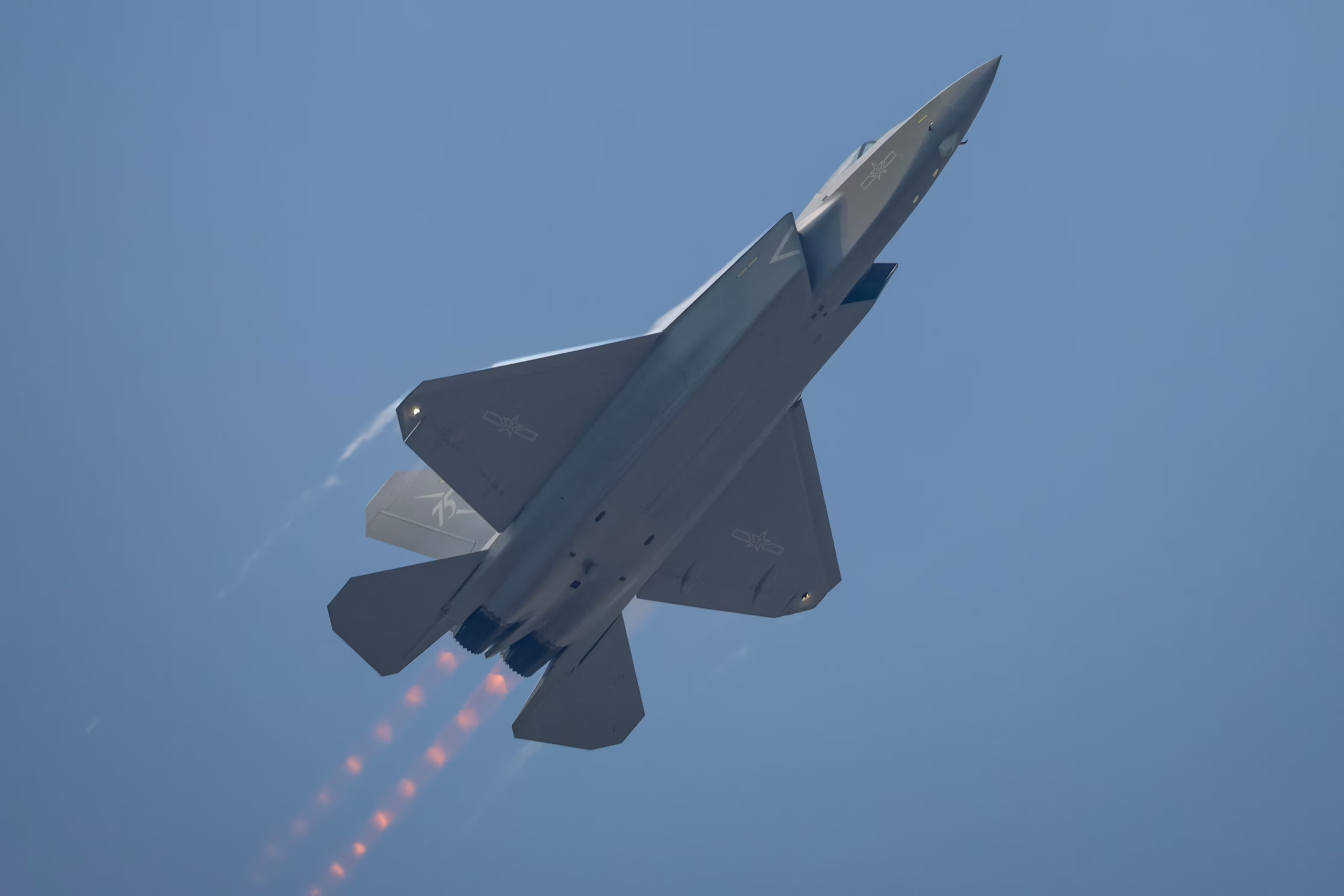
The controversy emerges at a strategically consequential moment as the Pakistan Air Force moves closer to acquiring a combat platform designed to exploit low-observable characteristics, sensor fusion, and network-centric warfare concepts that could challenge the operational assumptions underpinning India’s current air-power doctrine.
At its core, the debate is not about the acquisition of another fighter aircraft but about which state gains the ability to achieve first-detection, first-engagement, and first-kill advantages in a future battlespace increasingly dominated by stealth, data fusion, and long-range precision strike capabilities.
The development carries particular significance because South Asia’s deterrence equilibrium has historically depended upon maintaining relative technological balance, with both India and Pakistan seeking asymmetric advantages to offset disparities in economic resources, military size, and strategic depth.
Pakistan’s reported access to the J-35, alongside Chinese KJ-500 airborne early warning aircraft and HQ-19 strategic air-defence systems, suggests Beijing is prepared to transfer an increasingly sophisticated military ecosystem rather than individual platforms, thereby multiplying Pakistan’s operational effectiveness across multiple domains.
For India, the challenge is not merely the arrival of a stealth fighter in Pakistani service but the prospect that a China-backed kill chain integrating airborne surveillance, networked command-and-control, and low-observable strike assets could emerge years before the Advanced Medium Combat Aircraft reaches operational maturity.
The resulting debate is forcing Indian defence planners to reassess procurement priorities, force-modernisation timelines, and the broader viability of relying upon foreign strategic partners to bridge critical capability gaps during a period of accelerating regional military transformation.
Military establishments across the Indo-Pacific are monitoring these developments closely because the successful export and operational deployment of the J-35 would signal China’s emergence as a credible supplier of fifth-generation combat aviation, potentially challenging decades of Western dominance in the high-end aerospace market.
The controversy also reflects a broader geopolitical contest in which Beijing is increasingly leveraging advanced defence exports as instruments of strategic influence, offering partner states access to cutting-edge military technologies that many Western suppliers remain reluctant to transfer.
Ultimately, Bakshi’s criticism highlights a deeper reality of twenty-first-century power competition: fifth-generation fighter aircraft have become more than combat platforms, serving instead as strategic indicators of technological trust, alliance credibility, defence-industrial maturity, and geopolitical alignment within an increasingly contested international security environment.
The Strategic Meaning Behind Bakshi’s Frustration
Bakshi’s criticism reflects a recurring concern within Indian strategic circles that New Delhi’s defence partnerships have not yet produced access to transformational technologies equivalent to those increasingly available through China-Pakistan cooperation.
His comments specifically targeted perceptions that American and French defence industries remain reluctant to transfer the most advanced technologies despite decades of expanding military and diplomatic engagement with India.
The frustration stems partly from India’s continued reliance on 4.5-generation platforms such as the Rafale, Su-30MKI, Mirage 2000, and Tejas, all of which remain highly capable but lack true stealth characteristics.
From an operational perspective, stealth technology fundamentally alters air combat by reducing detection ranges, complicating interception efforts, and enabling deeper penetration into contested airspace.
The criticism also highlights concerns that future regional conflicts may increasingly be decided by sensor fusion, low-observable design, and network-centric warfare rather than traditional measures of aircraft numbers.
India’s strategic community has long viewed technology transfer as essential because indigenous defence development remains dependent upon access to advanced aerospace manufacturing techniques and mission systems.
The debate therefore extends beyond aircraft acquisition and into questions regarding India’s broader ambitions for defence self-reliance under long-term modernization initiatives.
Bakshi has consistently advocated expanding India’s Rafale fleet as an interim measure designed to preserve operational credibility while indigenous fifth-generation programs continue development.
His argument reflects a belief that delays in acquiring next-generation capabilities create a vulnerability window that adversaries may attempt to exploit before Indian modernization efforts mature.
The broader significance of his remarks lies in how they encapsulate growing concerns that technological timelines, rather than force size alone, may increasingly determine future military balances across Asia.

J-35: China’s Emerging Challenger to the F-35
The Shenyang J-35 represents China’s second operational fifth-generation fighter program and serves as a key component of Beijing’s ambition to challenge Western dominance in advanced combat aviation.
Designed as a twin-engine low-observable platform, the aircraft incorporates stealth shaping, advanced sensors, networked warfare capabilities, and modern avionics intended to support both air-superiority and strike missions.
The aircraft is frequently described as China’s closest equivalent to the American F-35, although definitive performance comparisons remain difficult due to limited publicly available operational data.
Military analysts view the platform as particularly significant because it demonstrates China’s increasing confidence in exporting technologies previously reserved for the People’s Liberation Army.
The export variant potentially offers partner nations access to stealth capabilities without the political constraints often associated with Western fifth-generation fighter programs.
If successfully integrated into Pakistani service, the aircraft would provide the Pakistan Air Force with capabilities unavailable elsewhere in South Asia.
The J-35’s operational value would likely depend heavily upon integration with airborne surveillance platforms, secure data links, and long-range precision weapons.
Such integration enables stealth fighters to function as intelligence-gathering nodes capable of contributing to broader network-centric operations rather than acting solely as traditional combat aircraft.
For Beijing, successful export of the J-35 would also strengthen its position as a supplier of advanced military technologies to strategically aligned states.
The program therefore carries significance not only as a military platform but also as an instrument of geopolitical influence and defence-industrial competition.
Pakistan’s Expanding Fifth-Generation Ecosystem
Pakistan’s reported agreement involving the J-35 extends beyond aircraft procurement and appears connected to a broader modernization package that includes KJ-500 airborne early warning aircraft and HQ-19 missile-defence systems.
Such a package would create an increasingly integrated combat architecture capable of enhancing situational awareness, survivability, and operational coordination across multiple domains.
The KJ-500 would provide persistent airborne surveillance and battle-management functions, extending detection ranges and improving targeting support for frontline combat aircraft.
This capability is particularly important because stealth aircraft achieve maximum effectiveness when supported by robust sensor networks operating beyond enemy detection ranges.
Meanwhile, the HQ-19 introduces an additional layer of strategic significance by strengthening air and missile defence coverage around critical military infrastructure.
The combination of stealth fighters, airborne early warning assets, and advanced missile defences creates a more resilient force posture than any individual platform could achieve independently.
Reports that Pakistani pilots have already commenced training activities in China suggest preparations may be advancing beyond conceptual discussions toward practical implementation.
Earlier statements indicated that Pakistan could potentially receive up to 40 J-35 aircraft, creating one of the largest fifth-generation fighter fleets outside major powers.
Such numbers would significantly influence regional air-combat calculations, particularly during high-intensity contingency scenarios involving rapid escalation.
The broader package reflects the depth of China-Pakistan defence cooperation, which has already produced programs such as the JF-17 and acquisition of J-10C multirole fighters.
India’s Fifth-Generation Gap and the AMCA Timeline
India currently operates no fifth-generation combat aircraft despite possessing one of the world’s largest and most experienced air forces.
The Indian Air Force continues to rely upon modernized fourth-generation and 4.5-generation platforms that provide substantial capability but lack the survivability advantages associated with low-observable designs.
New Delhi’s long-term answer remains the Advanced Medium Combat Aircraft program, which represents India’s most ambitious indigenous aerospace development initiative.
A significant milestone occurred in May 2026 when requests for prototype development proposals were issued to private-sector industry participants.
Despite this progress, operational induction remains projected for the 2030s, creating a transitional period during which regional competitors may gain fifth-generation experience.
This timing gap is strategically important because operational expertise often proves as valuable as hardware itself in determining combat effectiveness.
Countries introducing fifth-generation aircraft develop doctrine, maintenance practices, pilot training methodologies, and networked operational concepts over many years.
Consequently, early adopters may accumulate institutional advantages before competitors field equivalent platforms.
Discussions regarding interim solutions, including possible Russian Su-57 cooperation and technology-transfer arrangements, continue to surface periodically within Indian defence debates.
However, no confirmed acquisition pathway has yet emerged capable of closing the gap before the indigenous AMCA reaches operational maturity.
How the J-35 Could Reshape South Asia’s Air-Power Balance
The strategic significance of Pakistan’s prospective J-35 acquisition lies less in the introduction of a new fighter aircraft than in the arrival of a stealth-enabled combat capability capable of disrupting the Indian Air Force’s long-established assumptions regarding detection, interception, and airspace control during high-intensity conflict scenarios.
Unlike conventional fourth-generation and 4.5-generation fighters, the J-35 is designed to exploit low-observable technologies, sensor fusion architecture, and network-centric warfare concepts that collectively compress an adversary’s decision-making cycle while expanding opportunities for surprise and operational deception.
By reducing radar cross-section and delaying detection by ground-based and airborne surveillance networks, the aircraft could potentially create temporary penetration corridors through which precision-guided munitions may be delivered against strategically significant military infrastructure, command centres, and air-defence nodes.
The platform’s true combat value would emerge not from stealth characteristics alone but from its integration into a broader Chinese-supplied kill chain comprising KJ-500 airborne early warning aircraft, advanced data-link networks, and long-range air-to-air missiles capable of engaging threats beyond visual range.
Such an architecture would enable Pakistani pilots to receive targeting information from off-board sensors without activating their own radar systems, thereby preserving stealth advantages while extending engagement envelopes against Indian combat aircraft operating within contested airspace.
For Indian military planners, the emergence of a stealth-equipped Pakistan Air Force introduces a new operational variable that could complicate peacetime force-posture planning and increase the resources required to secure critical military installations against low-observable aerial threats.
The development is likely to accelerate Indian investment in counter-stealth technologies, including multi-band radar networks, passive detection systems, infrared search-and-track sensors, and advanced electronic warfare capabilities designed to negate the advantages enjoyed by low-observable platforms.
Beyond the tactical level, the J-35 could influence crisis stability by providing Pakistan with additional options for covert force projection, thereby introducing greater uncertainty into escalation calculations during future military confrontations between the two nuclear-armed rivals.
The psychological impact may prove almost as significant as the aircraft’s operational performance because stealth fighters alter adversary threat perceptions by creating uncertainty regarding where and when offensive operations might be launched, forcing defenders to allocate resources across a wider spectrum of contingencies.
From a regional perspective, the transfer of fifth-generation combat aviation technology reinforces China’s emergence as the principal architect of Pakistan’s military modernization, extending Beijing’s strategic influence into South Asia through capability transfers rather than direct military deployments.
For Beijing, enabling Pakistan to field a credible stealth capability creates an additional strategic pressure point against India, compelling New Delhi to divide defence resources between managing challenges along the disputed Himalayan frontier and preserving air superiority across the subcontinent.
The broader geopolitical implication is that the J-35 program represents not merely an aircraft export but a demonstration of China’s growing willingness to challenge Western dominance in the global defence market by offering advanced combat systems once considered beyond the reach of most partner nations.
Although the ultimate military effectiveness of the J-35 will depend upon pilot proficiency, doctrine development, sustainment infrastructure, and combat-network integration, its introduction is already reshaping procurement priorities, strategic planning assumptions, and deterrence calculations throughout South Asia.
The prospect of Pakistan fielding a Chinese fifth-generation fighter years before India operationalizes its indigenous AMCA program could create a temporary but strategically significant capability window that both sides will seek to exploit or offset through accelerated modernization initiatives.
Consequently, the debate surrounding the J-35 is no longer centred on aircraft numbers or procurement contracts but on which state can establish decision superiority, information dominance, and survivable strike capability in an increasingly contested and technology-driven battlespace.
