
Italy’s €0 Giuseppe Garibaldi Transfer to Indonesia Sparks Multi-Billion-Dollar Submarine and Jet Deal, Redrawing Indo-Pacific Naval Power Balance
Giuseppe Garibaldi Grant Unlocks DGK-Class Submarines, Leonardo M-346 Jet Trainers and ATR-72 Maritime Patrol Aircraft in Defence Pact with Major Indo-Pacific Implications

(DEFENCE SECURITY ASIA) — Italy’s decision to transfer its decommissioned light aircraft carrier Giuseppe Garibaldi to Indonesia for €0 constitutes a strategic manoeuvre with measurable implications for Southeast Asia’s maritime security architecture, recalibrating naval force posture in the South China Sea while embedding Rome deeper into Indo-Pacific defence supply chains through a structured procurement package tied to submarines, jet trainers, and maritime patrol aircraft.
The grant arrangement, confirmed by Indonesian defence officials, unfolds amid intensifying geopolitical friction across maritime chokepoints, where exclusive economic zone enforcement, illegal fishing, and foreign naval presence converge to pressure Jakarta’s Minimum Essential Force doctrine and accelerate its transition from a predominantly green-water orientation toward limited blue-water operational ambition.

Brigadier General Rico Ricardo Sirait, Head of the Indonesian Ministry of Defence’s Public Relations and Information Bureau, clarified the financial structure by stating, “The Giuseppe Garibaldi is a grant from the Italian government. The Indonesian government will allocate a budget for retrofitting or adjustments to meet the operational needs of the Indonesian Navy,” thereby separating acquisition cost from lifecycle expenditure while signalling structured capital allocation of approximately US$450 million (RM1.71 billion).
Admiral Muhammad Ali, Chief of Staff of the Indonesian Navy, reinforced timeline urgency during parliamentary proceedings by noting, “For Garibaldi, it is still in process. We hope it can arrive in Indonesia before the TNI anniversary,” referencing October 5, 2026, and implicitly acknowledging that platform integration must align with strategic signalling cycles as well as operational readiness milestones.
The carrier’s transfer operates within a reciprocal framework under which Indonesia is expected to place procurement orders for six DGK-class midget submarines, 24 Leonardo M-346 advanced jet trainers, and three ATR-72 maritime patrol aircraft, embedding defence industrial interdependence while generating multi-billion-dollar contract value denominated in both euro and US dollar terms.
This arrangement shifts Italy from a peripheral European supplier to a central Indo-Pacific defence stakeholder, leveraging decommissioned capital assets to unlock downstream production, training, maintenance, and technology transfer agreements projected to exceed €500 million (RM1.9 billion) in recurring sustainment revenue over the next decade.
For Indonesia, the acceptance of a 13,850-tonne aircraft carrier originally commissioned in 1985 and decommissioned in 2024 creates a doctrinal inflection point, forcing reassessment of escort fleet composition, maritime air integration, logistics footprint, and crew training pipelines within the Indonesian Navy’s evolving force structure.
At 180 metres in length and historically configured for anti-submarine warfare and AV-8B Harrier II operations, the Giuseppe Garibaldi’s ski-jump deck, hangar capacity for up to 18 aircraft, and hybrid adaptability toward helicopter and UAV operations introduce a scalable aviation node capable of extending maritime ISR and amphibious support reach across archipelagic corridors.
The vessel’s projected refit—budgeted at US$450 million (RM1.71 billion)—will reportedly include propulsion updates, avionics modernisation, and integration of Indonesian-specific sensors and weapons systems, converting a legacy NATO platform into a tailored hybrid helicopter-UAV carrier aligned with Jakarta’s operational geography and fiscal constraints.
Strategically, the transfer underscores an emerging model of defence diplomacy in which decommissioned European naval assets catalyse broader procurement ecosystems, reinforcing Italy’s Indo-Pacific presence while enabling Indonesia to acquire symbolic power projection capability without initial capital outlay, albeit with significant retrofit and sustainment commitments.
Carrier as Strategic Signalling Instrument and Force Posture Multiplier
The Giuseppe Garibaldi’s integration into TNI-AL represents more than fleet expansion, because a carrier platform inherently restructures command-and-control architecture, maritime air tasking cycles, and amphibious contingency planning, thereby altering Indonesia’s strategic signalling posture within contested waters near the Natuna Islands and the Malacca Strait.
Originally designed as an anti-submarine warfare platform but later adapted for fixed-wing and rotary aviation, the carrier’s ski-jump configuration and aviation support infrastructure provide Indonesia with a flexible aviation node capable of hosting NH90 helicopters, maritime strike assets, or indigenous unmanned aerial systems such as Elang Hitam.
While no fixed-wing STOVL acquisition has been confirmed, the platform’s structural capability preserves optionality, allowing Jakarta to maintain ambiguity regarding future air-wing composition and thereby enhancing deterrence signalling without immediate commitment to costly fifth-generation procurement pathways.
The refit allocation of US$450 million (RM1.71 billion) must therefore be interpreted not as refurbishment alone but as a strategic investment in sensor fusion, communications interoperability, and deck-cycle optimisation required to sustain credible helicopter and UAV sortie rates across dispersed maritime zones.
Operationalising a carrier also imposes escort vessel requirements, including frigates, corvettes, and submarine screens, which implies downstream fleet procurement pressure and doctrinal recalibration, particularly given Indonesia’s historically archipelagic defence orientation rather than expeditionary posture.
The carrier’s 13,850-tonne displacement, while modest compared to supercarriers, nonetheless introduces aviation-enabled ISR persistence, enabling distributed maritime domain awareness across resource-rich zones vulnerable to illegal fishing and foreign incursions.
However, the platform’s age—commissioned in 1985—necessitates scrutiny regarding structural fatigue, propulsion lifecycle, and integration costs, especially given Indonesia’s defence spending level of approximately 0.7 percent of GDP, which constrains long-term sustainment without external financing mechanisms.
The strategic utility of the Giuseppe Garibaldi therefore hinges less on prestige and more on Indonesia’s ability to synchronise logistics chains, maintenance cycles, and air-wing doctrine with Italian technical support, creating a hybrid model of semi-blue-water capability rooted in European sustainment ecosystems.
From Italy’s perspective, the transfer externalises decommissioning burden while embedding Italian shipyards such as Fincantieri into long-term overhaul cycles, ensuring that even a zero-euro transfer can generate significant lifecycle revenue and strategic presence within ASEAN maritime security frameworks.

DGK-Class Submarines and Littoral Undersea Deterrence Architecture
Central to the reciprocal procurement arrangement are six DGK-class midget submarines from DRASS Galeazzi, representing a subsurface capability calibrated specifically for shallow-water and littoral operations across Indonesia’s 17,000-island archipelago.
The DGK-class, often associated with earlier DG-550 iterations, displaces approximately 550 tonnes and incorporates advanced stealth characteristics, including air-independent propulsion modules that extend submerged endurance and reduce acoustic signature in congested maritime corridors.
Industry estimates value the submarine package at approximately US$1.2 billion (RM4.56 billion), embedding significant financial weight within the broader defence deal and reinforcing Italy’s position as a principal undersea technology provider to Jakarta.
A 2023 memorandum of understanding between DRASS and PT Republik Palindo established the foundation for joint production, while subsequent 2025 framework agreements formalised development of an Indonesian-specific variant incorporating local industrial participation and technology transfer provisions.
A senior PT Republik Palindo official emphasised industrial sovereignty by stating, “This collaboration not only enhances our underwater defence but also builds sovereign capabilities in submarine manufacturing,” separating aspirational national capability from immediate operational output while acknowledging phased localisation.
The DGK-class design includes torpedo tubes compatible with heavyweight munitions and integration for swimmer delivery vehicles, enabling special forces insertion, covert ISR missions, and asymmetric denial operations in narrow straits where large conventional submarines may be constrained.
DRASS’s delivery of two swimmer delivery vehicles in February 2026 reinforces incremental capability buildup, creating a layered undersea architecture in which midget submarines and SDVs operate synergistically within Indonesia’s littoral defence matrix.
Strategically, such submarines enhance deterrence not through blue-water endurance but through unpredictability and denial capacity in shallow zones, complicating adversary naval planning while remaining fiscally and operationally aligned with Indonesia’s geography.
For Italy, the submarine contract ensures production continuity, sustainment revenue, and industrial diplomacy leverage, linking undersea manufacturing ecosystems in Italy with emerging assembly capacity in Indonesia, thereby extending Rome’s Indo-Pacific defence footprint beyond surface naval assets.
M-346 Advanced Jet Trainers and Airpower Modernisation Pipeline
Indonesia’s commitment to acquire 24 Leonardo M-346 advanced jet trainers, specifically the M-346F Block 20 variant, extends the defence package into aerospace modernisation, reinforcing pilot training infrastructure while providing light combat versatility.
The Letter of Intent signed at the Singapore Airshow in February 2026 initiates progression toward a procurement contract valued at approximately €1.5 billion, equivalent to roughly US$1.62 billion or RM6.16 billion, embedding a substantial financial pillar within the overall Italian-Indonesian defence framework.
Air Chief Marshal Mohamad Tonny Harjono described the platform’s operational rationale by stating, “The M-346 will revolutionise our training pipeline, preparing pilots for Rafale and F-16 operations while providing cost-effective close air support in counter-insurgency scenarios,” thereby linking advanced training with multi-role utility.
The M-346’s twin-engine, transonic performance profile, with a top speed of Mach 1.15, combined with avionics capable of simulating fifth-generation fighter environments, enables Indonesia to bridge generational gaps in pilot proficiency without immediate procurement of additional frontline fighters.
Replacement of the ageing BAE Hawk fleet addresses maintenance reliability and obsolescence concerns, while localised maintenance and overhaul through PT ESystem Solutions embeds aerospace sustainment capacity domestically under technology partnership frameworks.
From a force posture perspective, the acquisition strengthens Indonesia’s aircrew generation rate, ensuring that future carrier-based helicopter coordination, maritime ISR integration, and joint operations benefit from enhanced pilot training pipelines.
Leonardo’s statement that “The parties will now move into the next stage of discussions intended to achieve a procurement contract signing soon” signals contractual momentum while maintaining separation between political intent and legally binding execution.
Strategically, the M-346 component aligns with Indonesia’s diversification away from traditional suppliers such as Russia and South Korea, redistributing dependency vectors toward European industrial networks without overt alignment to any single great-power bloc.
Italy, through Leonardo, secures not only aircraft sales but simulator packages, ground support equipment, and long-term sustainment contracts, reinforcing the economic logic underpinning the zero-euro carrier transfer.
ATR-72 Maritime Patrol Aircraft and Maritime Domain Awareness Expansion
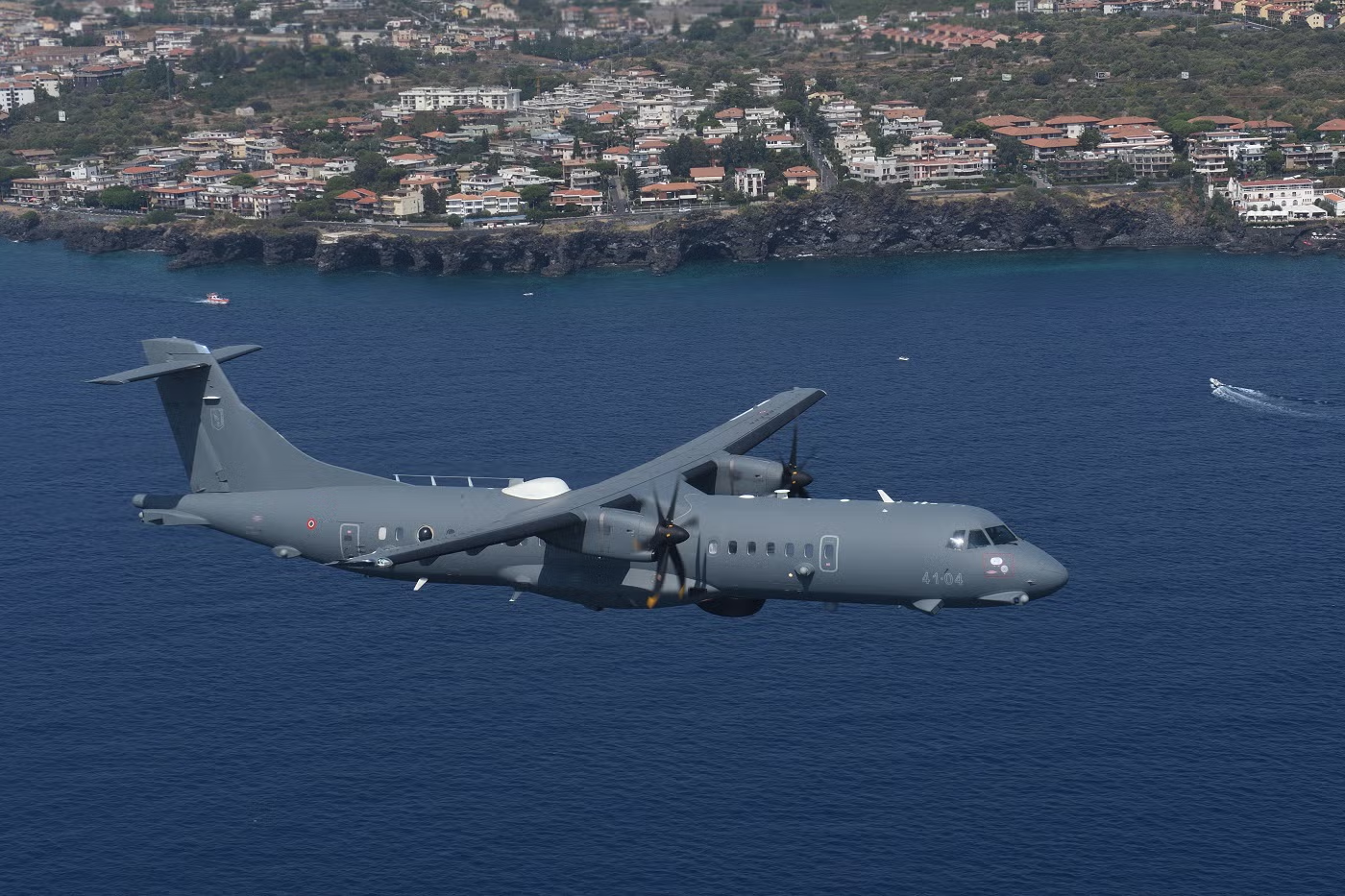
The acquisition of three ATR-72 maritime patrol aircraft extends the defence package into persistent maritime surveillance, enhancing Indonesia’s anti-submarine warfare and ISR capability across contested sea lanes.
Valued at approximately US$300 million (RM1.14 billion), the ATR-72 MPA component provides cost-effective endurance with operating costs reportedly around 30 percent lower than comparable jet-powered surveillance platforms, aligning fiscal prudence with operational necessity.
Configured for anti-submarine warfare, the ATR-72 variant is expected to incorporate mission suites including radar systems, sonobuoys, and magnetic anomaly detection equipment, enabling detection and tracking of submerged threats across shallow and open-water environments.
A TNI-AL strategist noted, “These aircraft will integrate seamlessly with our new carrier group, providing persistent ISR over vast ocean areas,” underscoring the intent to link airborne surveillance with carrier-based aviation nodes in a coordinated maritime task force construct.
Integration of MPAs with DGK-class submarines and a helicopter-UAV carrier architecture produces a layered maritime domain awareness network spanning surface, subsurface, and aerial vectors, complicating adversary planning within Indonesia’s exclusive economic zone.
The ATR platform, developed by a Franco-Italian consortium between Airbus and Leonardo, further deepens European industrial linkage, distributing Indonesia’s supply chain dependencies across multiple European aerospace ecosystems.
Operationally, the aircraft enhance surveillance coverage of the Natuna Islands and the Malacca Strait, two arteries critical to global trade flows and vulnerable to illegal fishing and foreign naval presence.
Strategically, the ATR-72 acquisition complements rather than substitutes surface combatant procurement, reinforcing ISR depth without significantly increasing high-end capital ship expenditure.
Industrial Diplomacy, Lifecycle Economics, and Regional Security Architecture
The broader package, encompassing carrier transfer, submarines, jet trainers, and MPAs, exemplifies a structured industrial diplomacy model in which legacy asset grants catalyse multi-platform procurement ecosystems anchored in long-term sustainment.
Italian firms including Fincantieri and Leonardo stand to manage overhauls, upgrades, and logistics support for the Giuseppe Garibaldi, submarines, and aircraft, generating projected recurring revenue exceeding €500 million (RM1.9 billion) over the next decade.
For Indonesia, technology transfer provisions embedded within submarine and aerospace agreements align with the Global Maritime Fulcrum doctrine, reinforcing domestic industrial participation while retaining reliance on Italian expertise for complex maintenance cycles.
The deal repositions Indonesia within ASEAN as a state experimenting with limited power projection capability, potentially elevating its diplomatic weight without formally aligning to alliances such as AUKUS or entering explicit bloc politics.
Critics argue that allocation of US$450 million (RM1.71 billion) toward carrier retrofitting could divert resources from patrol vessels and coastal defence, yet proponents contend that aviation-enabled maritime ISR and deterrence produce disproportionate strategic value.
Italy’s diplomatic framing emphasises partnership with the world’s fourth-most populous nation, embedding European defence industry within Southeast Asia’s evolving security ecosystem at a time of intensifying Indo-Pacific competition.
Importantly, verifiable facts—carrier grant structure, procurement intentions, and stated budget figures—must be distinguished from political claims regarding strategic intent, while acknowledging that final contract execution remains contingent on parliamentary approvals and negotiation closure.
Uncertainty persists regarding escort fleet adequacy, crew training pipelines, and long-term sustainment affordability, creating variables that will determine whether the Giuseppe Garibaldi functions as a transformative force multiplier or a constrained symbolic asset.
Nevertheless, as negotiations advance toward potential formalisation by mid-2026, the Italian-Indonesian defence package demonstrates how targeted industrial reciprocity, logistics integration, and calibrated force posture enhancement can reshape Southeast Asia’s maritime security calculus without overt escalation. — DEFENCE SECURITY ASIA
