
Israel Running Critically Low on Arrow Interceptors as Iran Missile Barrages Strain Missile Defense Shield, U.S. Warned of Stockpile Crisis Months Ago
Depletion of Arrow ballistic missile interceptors raises concerns over Israel’s ability to sustain high-intensity missile defense as Iranian barrages continue and emergency defense funding accelerates production.

(DEFENCE SECURITY ASIA) — Israel has quietly informed the United States that its stockpile of long-range ballistic missile interceptors has reached critically low levels as the ongoing conflict with Iran continues to impose sustained pressure on the country’s layered missile-defense architecture, raising concerns over force endurance, interceptor production capacity, and the long-term viability of high-intensity missile defense operations.
U.S. officials acknowledged that Washington had been aware for months that Israel’s inventory of anti-ballistic interceptors was limited, indicating that the current shortage reflects a predictable outcome of prolonged missile exchanges rather than a sudden logistical failure, underscoring the structural vulnerability of expensive, slow-to-produce defensive munitions in sustained regional warfare.
The depletion has strategic implications extending beyond the immediate Israel–Iran confrontation because the Arrow anti-ballistic missile system represents the upper-tier shield protecting Israeli territory from long-range ballistic threats, meaning reduced interceptor availability directly affects deterrence credibility, escalation control, and the stability of the regional missile balance.
Officials familiar with the situation state that Israel entered the current phase of the conflict already under strain following the intense missile exchanges during last year’s confrontation with Iran, when hundreds of ballistic missiles were launched, forcing repeated interceptor use and drawing heavily on existing reserves before the present escalation even began.
Ongoing Iranian missile barrages during the current conflict have further accelerated interceptor consumption rates, with some missiles reportedly equipped with cluster-type payloads that disperse submunitions during descent, forcing Israeli air-defense operators to launch multiple interceptors per incoming threat in order to ensure reliable destruction.
U.S. sources indicated that although Israel’s interception success rates have remained high during recent attacks, the volume of incoming missiles combined with the need for redundant engagements has created a consumption rate that exceeds replenishment capacity, highlighting the economic and industrial limits of modern missile defense systems in prolonged combat conditions.
Israeli officials have publicly rejected claims that interceptor stocks are critically low, with Foreign Minister Gideon Sa’ar stating that Israel possesses alternative defensive capabilities including fighter aircraft, but independent reporting and U.S. assessments indicate that pressure on interceptor inventories is real and operationally significant.
Israel has approved an emergency defense allocation estimated at approximately USD 830 million (RM 3.15 billion) to support accelerated production, procurement, and development of additional missile-defense solutions, signalling that the shortage is being treated as a strategic logistics problem rather than a temporary operational fluctuation.
U.S. officials confirmed that American interceptor inventories are not facing the same level of depletion and that Washington has previously provided defensive support during earlier phases of the conflict, including the use of THAAD and Patriot systems to reinforce Israel’s layered air-defense network against Iranian ballistic missile attacks.
The current situation reflects a broader pattern observed in modern missile warfare, where interceptor stockpiles rather than detection capability or engagement accuracy increasingly become the limiting factor in high-intensity conflicts involving large-scale ballistic missile salvos, particularly when defensive systems rely on costly precision interceptors produced in relatively small numbers.
READ: “Israel Admits Missile Shield Limits: Iran’s 5,000-Strong Ballistic Arsenal Could Overwhelm Iron Dome, Arrow and U.S. Gulf Bases”
Arrow System Under Pressure from Sustained Iranian Ballistic Missile Salvos
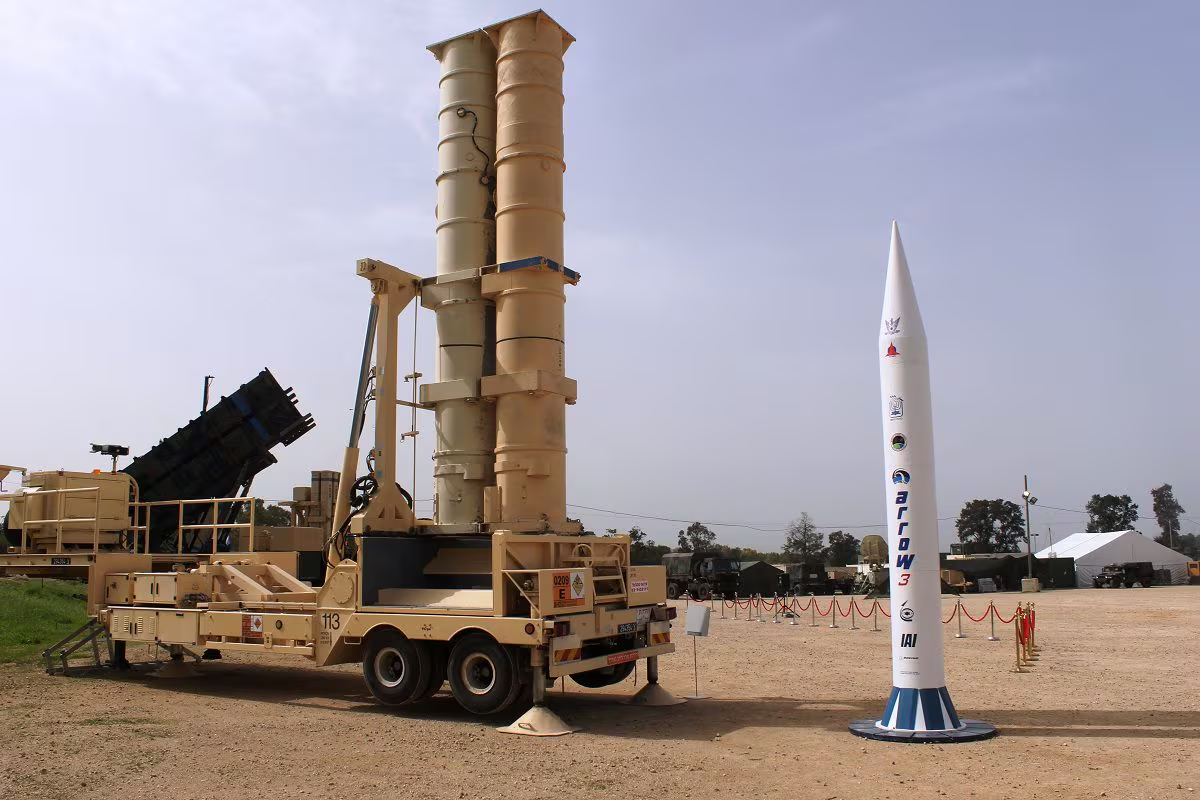
Israel’s primary defense against long-range Iranian ballistic missiles relies on the Arrow missile-defense system, specifically the Arrow 2 and Arrow 3 interceptors, which form the dedicated anti-ballistic layer designed to destroy high-speed threats that exceed the engagement envelope of lower-tier systems.
Arrow 3 operates in the exo-atmospheric regime, intercepting incoming ballistic missiles outside Earth’s atmosphere at very high altitude using hit-to-kill technology, making it the critical component for defeating long-range missiles launched from Iran before they re-enter the atmosphere.
Arrow 2 provides an additional defensive layer within the atmosphere at lower altitude, engaging medium-range and shorter-range ballistic threats at roughly tens of kilometres above the surface, ensuring that missiles not destroyed by the upper-tier interceptor still face a secondary engagement opportunity.
Because Arrow interceptors are specifically designed for long-range ballistic targets, shortages in this system cannot easily be compensated by other air-defense layers, meaning that depletion directly reduces Israel’s ability to counter the type of missile most frequently used by Iran in recent barrages.
The cost of each interceptor, measured in millions of dollars per shot, creates a structural imbalance in prolonged engagements because offensive ballistic missiles are often cheaper to produce than the interceptors required to destroy them, giving the attacker a potential economic advantage during sustained exchanges.
High interception success rates reported during earlier phases of the conflict required large numbers of interceptors to be fired per attack, demonstrating that even effective missile defense systems can face rapid depletion when confronted with repeated large-scale launches over an extended period.
Iranian use of saturation tactics, including the simultaneous launch of multiple ballistic missiles, increases the probability that defensive forces must fire multiple interceptors against each incoming threat to guarantee destruction, further accelerating consumption of limited stocks.
The addition of cluster-type payloads to some missiles complicates interception because the dispersion of submunitions can require multiple engagements to neutralize the threat, forcing defenders to expend more interceptors per target than originally planned.
This operational dynamic illustrates that the effectiveness of a missile-defense system is not determined solely by its technical capability but also by the size of its available stockpile, the speed of production, and the ability to sustain high-tempo engagements over weeks or months.
Multi-Layered Israeli Missile Shield Facing Logistics Limits
Israel’s missile-defense architecture is designed as a multi-tiered system combining several layers, each optimized for different threat ranges, but the current shortage highlights that the overall shield is only as strong as its most specialized and limited component.
Iron Dome forms the lowest layer, designed primarily to intercept short-range rockets and artillery projectiles, making it unsuitable for engaging long-range ballistic missiles launched from Iran, meaning it cannot compensate for shortages in the Arrow system.
David’s Sling occupies the middle tier and is intended to intercept medium-range rockets, cruise missiles, and certain tactical ballistic threats, but it is not optimized for long-range ballistic missile interception, limiting its usefulness against the type of weapons currently being launched.
The Arrow system therefore remains the only dedicated anti-ballistic missile layer capable of reliably engaging long-range threats, meaning any reduction in Arrow interceptor availability has disproportionate impact on the overall defensive posture.
In recent conflicts, multiple layers have often been used simultaneously, with Arrow interceptors engaging threats at high altitude while other systems prepare to intercept any missile that penetrates the upper layer, creating a layered defense designed to maximize interception probability.
This layered approach increases defensive effectiveness but also multiplies interceptor consumption because multiple systems may fire during a single attack, especially when incoming missiles are assessed as high-risk or carrying complex payloads.
The reliance on multiple defensive layers also means that shortages in one system can force other layers to operate outside their intended role, potentially reducing efficiency and increasing overall expenditure of defensive munitions.
The present shortage therefore reflects not only the intensity of Iranian missile attacks but also the inherent logistics burden of maintaining a multi-tiered defense capable of handling simultaneous threats from rockets, cruise missiles, and long-range ballistic missiles.
Sustaining such a defense during prolonged conflict requires continuous industrial production, financial resources, and external support, all of which become critical factors once initial stockpiles begin to decline.
U.S.–Israel Coordination and Emergency Budget Response
U.S. officials confirmed that Washington had anticipated Israel’s interceptor shortage because the high rate of use during previous missile exchanges had already reduced available inventories, making the current situation a continuation of an existing trend rather than an unexpected crisis.
American support during earlier phases of the conflict included the deployment of additional defensive systems and the firing of U.S. interceptors to help reinforce Israel’s air-defense network, demonstrating that missile defense in the region often operates as a combined effort rather than a purely national capability.
Despite this cooperation, U.S. sources indicated that American interceptor stocks are not currently facing the same level of depletion, suggesting that the shortage is specific to Israel’s operational tempo and the scale of attacks directed against its territory.
Israel’s approval of an emergency defense allocation estimated at USD 830 million (RM 3.15 billion) indicates that the government views the interceptor shortage as a strategic logistics issue requiring immediate financial and industrial response rather than a short-term operational adjustment.
The funding is expected to support accelerated interceptor production, procurement of additional defensive equipment, and the development of alternative technologies designed to reduce dependence on expensive missile interceptors during prolonged conflicts.
Officials stated that new solutions are being developed while existing systems are being upgraded, suggesting that Israel is attempting to increase both the quantity and effectiveness of its defensive capabilities to prevent similar shortages in future engagements.
The emergency budget also reflects the high cost of missile defense, where maintaining readiness against large-scale ballistic attacks requires sustained investment even during periods when the systems are not actively being used in combat.
Coordination with the United States remains central to Israel’s defensive strategy because American systems, funding, and industrial capacity can provide additional resilience when Israeli stocks fall below operational requirements.
The current situation demonstrates that even technologically advanced missile-defense networks depend heavily on supply chains, production rates, and financial resources, making logistics as important as technology in determining battlefield outcomes.
Iranian Missile Tactics Increasing Interceptor Consumption
Iranian missile operations during the current conflict have reportedly included tactics designed to maximize the number of interceptors required per incoming attack, increasing the strain on Israeli defensive inventories even when interception success remains high.
One such tactic involves launching large salvos of ballistic missiles simultaneously, forcing defenders to fire multiple interceptors in quick succession to maintain a high probability of destruction against each incoming target.
Another reported tactic is the use of cluster-type warheads that disperse submunitions in the air, complicating interception calculations because defensive systems must account for the possibility of multiple fragments reaching the ground.
These tactics do not necessarily guarantee successful strikes but they increase the cost and consumption rate of defensive operations, creating pressure on stockpiles even when most missiles are intercepted before impact.
High-tempo missile exchanges therefore become a contest of endurance rather than accuracy, where the side capable of sustaining production and resupply for longer periods gains strategic advantage regardless of short-term battlefield results.
The use of such tactics highlights the asymmetry between offensive and defensive systems, as ballistic missiles can often be produced faster and at lower cost than the interceptors required to destroy them.
This imbalance means that prolonged missile warfare can gradually weaken even a highly capable defense if the rate of incoming attacks exceeds the rate at which interceptors can be replaced.
The current reports of low interceptor stocks indicate that Israel may be approaching the limits of what its existing production capacity can support during sustained conflict conditions.
Such a situation increases the importance of external support, accelerated manufacturing, and next-generation systems capable of engaging threats more efficiently with fewer interceptors.
Arrow-4 Development and Future Missile Defense Sustainability
Israel is accelerating the development of the next-generation Arrow 4 interceptor as part of a broader effort to strengthen the upper tier of its missile-defense network and reduce the risk of future shortages during prolonged high-intensity conflicts.
The new interceptor is intended to improve performance against advanced ballistic threats while also addressing the need for greater efficiency, allowing fewer interceptors to be used per engagement compared with earlier systems.
Officials have indicated that future missile-defense planning must account not only for interception capability but also for the industrial capacity required to sustain large numbers of engagements over time.
The experience of recent conflicts has demonstrated that missile defense cannot rely solely on technological superiority, because the decisive factor in extended warfare may be the ability to maintain sufficient stocks of interceptors.
Accelerated development programs therefore represent both a technical upgrade and a logistics strategy intended to ensure that defensive systems remain sustainable even during prolonged regional confrontation.
The current shortage of interceptors illustrates how quickly high-intensity missile exchanges can consume resources that take months or years to produce, forcing governments to reconsider stockpile size and production planning.
Future missile-defense architecture is likely to focus on increasing efficiency, reducing cost per interception, and improving integration between different defensive layers in order to reduce overall consumption during large-scale attacks.
Until such improvements are fully implemented, Israel’s defensive posture will remain dependent on a combination of existing interceptor stocks, emergency production funding, and coordination with the United States to maintain the credibility of its anti-ballistic missile shield.
The situation remains fluid as the conflict continues, with interceptor availability, production speed, and operational tempo now emerging as central factors shaping the strategic balance between Israel’s missile defense network and Iran’s ballistic missile capability.
