
Royal Navy K3 Scout Drone Security Scare: Chinese Components Sent Signals to China, Exposing Critical Vulnerability in Britain’s Autonomous Warfare Fleet
Royal Navy K3 Scout drone boats operated alongside Royal Marines face scrutiny after Chinese-origin camera components transmitted heartbeat communications to a Chinese IP address, exposing the supply-chain risks confronting Britain’s expanding autonomous warfare strategy.
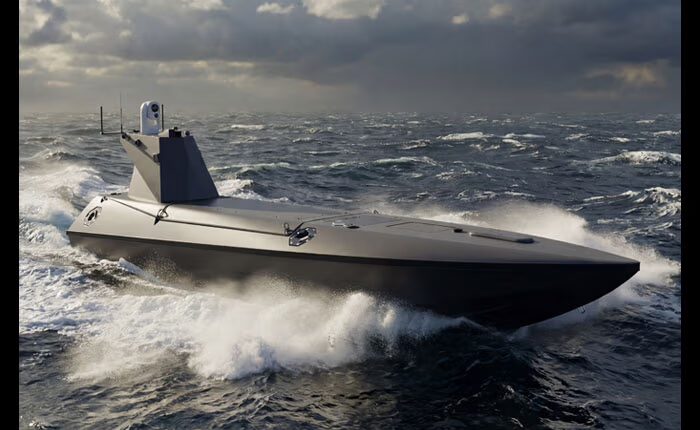
(DEFENCE SECURITY ASIA) — The Royal Navy’s accelerating transition toward autonomous maritime warfare has encountered a significant supply-chain security challenge after cameras aboard its new K3 Scout uncrewed surface vessels were discovered transmitting automated “heartbeat communications” to an IP address located in China.
The discovery affects a roughly £12 million fleet of approximately 20 British-built K3 Scout drone boats introduced with Royal Marines elements in March 2026, placing cybersecurity, component provenance and sovereign military technology at the centre of Britain’s Hybrid Navy ambitions.
The communications originated from third-party cameras containing Chinese-origin components, despite the equipment being supplied with security assurances and described as compliant with United States National Defense Authorization Act restrictions governing designated Chinese manufacturers and defence procurement.

Crucially, the available evidence does not establish that reconnaissance imagery, operational information or classified military data reached China, with investigators identifying heartbeat signals designed to confirm that connected cameras remained online and were functioning normally.
The Ministry of Defence said a routine cyber vulnerability assessment detected the issue within a Kraken uncrewed surface vessel subsystem, demonstrating how apparently peripheral commercial technologies can create unexpected network pathways inside increasingly software-dependent military platforms.
“A thorough investigation found no evidence of MoD data or systems being accessed, compromised or transmitted externally,” the ministry said, adding that assurance procedures were specifically designed to identify vulnerabilities before they developed into operational security compromises.
Kraken Technology Group similarly said a joint audit with the Royal Navy determined that no sensitive information had travelled outside intended channels, while identified vulnerabilities were closed after internet connectivity was removed from the affected camera systems.
Yet the episode carries consequences beyond whether sensitive imagery was actually transmitted because autonomous warfare increasingly depends upon interconnected sensors, processors, communications modules and software whose security becomes inseparable from the survivability and credibility of the wider combat architecture.
For Britain, that problem intersects directly with Project Beehive, under which the Royal Navy is developing hybrid formations combining conventional crewed warships with autonomous systems capable of surveillance, force protection, logistics, electronic warfare and potentially kinetic missions.
The K3 Scout’s reported proximity to sensitive Royal Marines and special-forces activities intensifies the security implications because persistent electro-optical sensors can potentially capture personnel identities, training patterns, operating procedures and force preparations even without penetrating classified command networks.
Defence concerns also extend towards potential Gulf operations associated with maintaining freedom of navigation through the Strait of Hormuz, although public evidence does not establish that Chinese authorities obtained information concerning British operational planning or deployments.
The episode consequently represents a test of whether Western militaries can expand autonomous fleets rapidly without allowing globally distributed commercial supply chains to create hidden dependencies capable of undermining operational security, technological sovereignty and confidence in networked warfare.
Chinese-Origin Camera Components Expose the Hidden Attack Surface Inside Autonomous Warships
The vulnerability emerged during routine cybersecurity testing when analysts identified unauthorised outbound communications from the K3 Scout camera subsystem, revealing that equipment performing a seemingly straightforward surveillance function possessed an external network relationship not anticipated by military operators.
Investigators determined that the cameras were transmitting heartbeat communications, small automated packets ordinarily used to establish whether networked devices remain operational, rather than finding publicly documented evidence that complete video feeds or classified intelligence had been exported.
That distinction is operationally important because communication with a Chinese IP address does not independently demonstrate Chinese intelligence exploitation, but an unexplained external connection nevertheless represents a security weakness requiring immediate containment within military networks.
The Ministry of Defence consequently removed internet connectivity from the affected cameras, effectively eliminating their external communications pathway while allowing investigators and Kraken Technology to audit hardware, software and third-party components across the K3 Scout surveillance architecture.
For autonomous platforms, such vulnerabilities can become disproportionately consequential because persistent sensors routinely generate information concerning geographic position, operating tempo, nearby personnel, mission preparation and platform availability that may collectively reveal patterns without exposing traditionally classified documents.
The controversy deepened because the cameras had reportedly been represented as NDAA-compliant, illustrating that compliance with restrictions against designated manufacturers does not necessarily guarantee that every subcomponent originates outside China or presents no cybersecurity concern.
Modern defence electronics frequently incorporate globally sourced processors, circuit boards, communications modules, firmware and software libraries, creating complicated provenance chains in which prime contractors can inherit vulnerabilities introduced several manufacturing tiers beneath the finished military platform.
This makes hardware assurance fundamentally different from conventional platform certification because cybersecurity must extend beyond hull, propulsion and primary combat systems into cameras, routers, processors and peripheral equipment capable of establishing independent network connections.
A hostile actor would not necessarily require direct control of an autonomous vessel to obtain intelligence value if compromised subsystems could expose metadata revealing operating locations, activation schedules, maintenance cycles or patterns surrounding sensitive military facilities.
There is presently no public evidence demonstrating such exploitation occurred aboard K3 Scout, making the confirmed security failure the existence of unintended external communications rather than an established Chinese intelligence operation against Royal Navy autonomous forces.

K3 Scout Gives Royal Marines a 55-Knot, 650-Nautical-Mile Autonomous Maritime Platform
The K3 Scout is an approximately 8.4-metre, 27-foot multirole uncrewed surface vessel developed by British company Kraken Technology, combining high speed, modular payload capacity and autonomous operation for demanding littoral and expeditionary maritime missions.
With a maximum speed around 55 knots, approximately 650 nautical miles of range at 25 knots and mission-dependent endurance approaching 30 days, the platform provides considerably greater operational flexibility than the description “spy drone” implies.
Its approximately 600-kilogram payload capacity enables the vessel to accommodate mission-specific sensors and equipment supporting intelligence, surveillance and reconnaissance, force protection, logistics, electronic warfare, maritime strike and other littoral operations without requiring a permanently embarked crew.
These characteristics make K3 particularly relevant to distributed maritime operations because commanders can push sensors and payloads into contested coastal environments without exposing larger crewed vessels and personnel to equivalent levels of direct tactical risk.
High speed permits rapid repositioning between surveillance sectors, while extended range enables operations beyond immediate harbour approaches, expanding the geographic footprint within which Royal Marines and naval commanders can establish persistent unmanned maritime presence.
Its modular architecture also allows different mission packages to be installed as operational requirements evolve, reducing dependence upon separate purpose-built vessels and potentially accelerating deployment of new sensors, electronic-warfare equipment or kinetic payloads.
That same modularity creates cybersecurity complexity because every third-party payload integrated into an open architecture potentially introduces additional processors, firmware, network interfaces and communications pathways requiring independent verification before operational deployment.
The camera incident therefore demonstrates how autonomous maritime capability cannot be measured purely through speed, range, endurance and payload because cyber resilience and trusted component provenance increasingly determine whether commanders can safely exploit those physical performance advantages.
For Royal Marines conducting littoral reconnaissance or special operations support, confidence that onboard sensors remain isolated from unauthorised external networks becomes particularly critical because operational patterns can reveal more strategic information than individual photographs or isolated communications.
K3 Scout consequently embodies both sides of the autonomous warfare equation: relatively inexpensive unmanned platforms can distribute military capability across wider maritime spaces, but their dependence upon commercial technology creates new vulnerabilities requiring continuous technical surveillance and supply-chain auditing.
Project Beehive Security Failure Challenges Britain’s Hybrid Navy Strategy
Britain acquired approximately 20 K3 Scouts under Project Beehive, providing the Royal Navy and Royal Marines with a meaningful fleet through which tactics, command relationships and operating concepts for crewed-uncrewed maritime warfare can be developed.
The vessels have been associated with the Coastal Forces Squadron and 47 Commando Royal Marines, positioning them at the intersection between conventional naval operations, littoral manoeuvre and specialist military missions where persistent surveillance and rapid deployment offer significant operational utility.
Project Beehive represents a broader shift away from viewing autonomous vessels as isolated experimental technologies toward integrating them into operational formations where numerous unmanned platforms can complement expensive frigates, destroyers, submarines and amphibious forces.
Such hybrid force structures could expand surveillance coverage and complicate adversary targeting because commanders may distribute sensors across numerous relatively small vessels rather than concentrating reconnaissance capability aboard a limited number of high-value crewed platforms.
The logistics footprint could similarly change because unmanned boats require fuel, maintenance, communications infrastructure and payload support but eliminate accommodation, life-support and many personnel requirements associated with conventional patrol craft operating across equivalent maritime areas.
However, distributed autonomous forces multiply the number of network endpoints requiring protection, meaning twenty inexpensive USVs could generate a larger cybersecurity-management burden than a smaller fleet of tightly controlled conventional vessels with mature military-standard architectures.
The K3 camera problem therefore exposes a strategic contradiction facing Western navies: rapid commercial integration can deliver autonomous capability quickly, while rigorous component certification, software verification and supply-chain assurance can slow precisely the procurement tempo autonomy is intended to accelerate.
Britain’s response will consequently influence confidence in future Hybrid Navy procurement because commanders must know that modular systems introduced rapidly into service cannot establish unauthorised connections that compromise operational security or expose force patterns.
The incident does not demonstrate that Project Beehive itself has been compromised, but it shows that future autonomous procurement will require security architecture extending systematically from mission computers and communications networks down to commercially sourced peripheral sensors.
For NATO militaries pursuing similar crewed-uncrewed concepts, Britain’s experience provides an early warning that autonomous fleet expansion must be accompanied by zero-trust networking, continuous vulnerability assessment and comprehensive verification of hardware provenance across every mission subsystem.
NATO, Special Operations and Gulf Missions Raise the Geopolitical Stakes
The strategic significance extends beyond British waters because K3 Scout has participated in NATO experimentation, including Baltic Task Force X activities where autonomous maritime systems were evaluated within increasingly networked multinational operational environments.
Participation in allied exercises makes component security particularly consequential because an autonomous vessel connected to multinational command structures potentially occupies a broader information ecosystem than the platform’s comparatively small physical dimensions would suggest.
No evidence indicates NATO networks were penetrated through K3 Scout, but the discovery strengthens the argument that allied interoperability must include common cybersecurity and supply-chain standards rather than focusing exclusively upon communications compatibility and tactical data exchange.
The platform has also attracted United States special-operations interest, further internationalising scrutiny of its technological architecture and demonstrating how successful autonomous designs can migrate rapidly between allied militaries, industrial partnerships and different operational requirements.
Again, nothing publicly available establishes that American systems experienced the same camera vulnerability, and extending the British discovery into claims concerning compromised United States capabilities would exceed the evidence currently available.
Potential Gulf employment raises another strategic dimension because the Strait of Hormuz combines dense commercial shipping, Iranian surveillance and strike capabilities, constrained geography and enormous economic significance, creating an environment where persistent unmanned reconnaissance could provide substantial operational value.
K3 Scouts could theoretically support maritime-domain awareness, force protection and distributed surveillance while allowing larger Royal Navy assets to maintain greater stand-off distances, although specific British operational concepts for the vessels remain sensitive and incompletely disclosed.
Anonymous defence concerns that preparations involving the platforms related to potential Gulf operations therefore carry significance, but they remain allegations rather than proof that operational plans, personnel identities or mission data were transmitted through the compromised cameras.
The controversy nevertheless demonstrates why seemingly minor telemetry can matter geopolitically because knowledge that particular military equipment is active, deployed or repeatedly operating near sensitive locations may contribute to broader intelligence assessments when combined with other collection methods.
For China and Western governments alike, autonomous military proliferation is consequently transforming supply-chain security into an arena of strategic competition where control over semiconductors, sensors, communications hardware and embedded software increasingly intersects directly with intelligence security.
Britain’s K3 Scout Incident Signals a Wider Defence Supply-Chain Security Challenge
Shadow Security Minister Alicia Kearns framed the controversy around sovereignty, arguing, “If we cannot say with confidence what is inside our own military equipment, we cannot say it is ours, or that we are sovereign.”
Her intervention reflects a broader political argument that national ownership of a defence platform provides limited strategic autonomy when critical subsystems depend upon foreign-origin components whose functionality, firmware and network behaviour cannot be independently guaranteed.
Kearns further warned about cameras containing Chinese parts potentially recording special-forces personnel, training and operations, although the government and Kraken maintain that investigations found no evidence sensitive information was transmitted outside intended channels.
Maintaining that distinction is essential because political concerns about espionage risk should not be transformed into technical conclusions unsupported by forensic evidence, particularly when the publicly confirmed communications consisted of device heartbeat signals rather than documented intelligence exfiltration.
Nevertheless, the episode could drive wider auditing because autonomous warfare expands military dependence upon commercial-off-the-shelf electronics whose shorter development cycles and multinational manufacturing chains differ substantially from traditional defence equipment built through tightly controlled national suppliers.
For defence planners, the relevant metric therefore becomes not simply whether equipment is manufactured domestically, but whether every network-capable component can be traced, tested, isolated and continuously monitored throughout the platform’s operational lifecycle.
Industrial partners may consequently face greater pressure to demonstrate software bills of materials, component provenance, firmware integrity and external communications behaviour before equipment is connected to sensitive military networks or deployed around strategically important personnel and infrastructure.
These requirements could increase procurement costs and slow fielding schedules, but failing to impose them risks allowing inexpensive peripheral equipment to undermine billion-dollar combat networks whose security depends upon every connected device respecting carefully defined information boundaries.
The K3 Scout remains a high-speed, long-range autonomous platform with significant potential for Royal Navy surveillance, force protection and distributed maritime operations, and the available evidence does not establish that its fundamental autonomy architecture was compromised.
Britain’s larger warning is therefore structural: as NATO militaries accelerate toward autonomous, software-defined and hybrid fleets, battlefield advantage will increasingly depend not only upon who fields the most drones, but who can prove every component inside them can be trusted.
This version deliberately avoids claiming that China obtained Royal Navy imagery or classified intelligence, because the supplied material establishes heartbeat communications and Chinese-origin components, while both the MoD and Kraken dispute that sensitive information was exfiltrated.
