
IRGC Commander Issues Stark “Finger on the Trigger” Warning as Iran Signals Readiness for Direct Confrontation with U.S. and Israel
Major General Mohammad Pakpour’s declaration of trigger-ready forces underscores Iran’s shift toward immediate kinetic deterrence as internal unrest, nuclear tensions, and post-war instability collide.

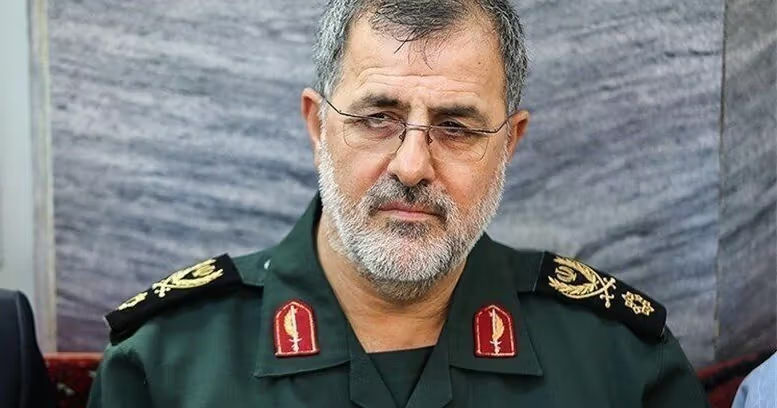
(DEFENCE SECURITY ASIA) — Major General Mohammad Pakpour, Commander of the Ground Forces of the Islamic Revolutionary Guard Corps, delivered one of the most explicit strategic warnings in recent Middle Eastern history when he declared that Iranian forces now have their “finger on the trigger,” signalling a posture of immediate kinetic readiness amid converging internal unrest and external military pressure.
Speaking during Iran’s national Soldier Day, Pakpour asserted that the IRGC and the Iranian state are “more prepared than ever,” explicitly framing this readiness as direct obedience to Ayatollah Ali Khamenei, whom he described as “a leader dearer than their own lives,” a formulation that underscores the fusion of ideology, command authority, and operational doctrine within Iran’s security architecture.
“The Islamic Revolutionary Guard Corps and dear Iran have their finger on the trigger, more prepared than ever, ready to carry out the orders and measures of the supreme commander-in-chief,” Pakpour stated, positioning this warning not merely as deterrent rhetoric but as a declaration of elevated rules of engagement across Iran’s military spectrum.
This pronouncement unfolds against the dual pressures of sustained nationwide protests and the unresolved strategic consequences of the June 2025 twelve-day conflict, during which U.S.-supported Israeli strikes targeted Iranian nuclear infrastructure and missile facilities, marking the most direct military confrontation between the parties to date.
Pakpour’s language deliberately invokes “historical experiences” and a “more painful and regret-inducing fate,” a phrasing designed to remind Washington and Tel Aviv of prior regional miscalculations while reinforcing Tehran’s narrative that current domestic unrest represents an extension of externally engineered warfare rather than an organic political uprising.
The warning was carried prominently by Iranian state media and synchronised with parallel statements from senior IRGC and joint-command officials, collectively signalling a unified strategic messaging campaign intended to deter escalation while legitimising domestic security operations under the rubric of national defence.
Crucially, the timing of Pakpour’s remarks suggests a calculated effort to consolidate regime cohesion by portraying Iran’s internal instability as inseparable from foreign military threats, thereby reframing protests as a battlespace rather than a political phenomenon.
For regional and global security planners, the declaration that Iran’s military forces are on a hair-trigger posture introduces significant escalation risk across the Middle East, with direct implications for U.S. forward deployments, Israeli homeland defence, and energy security corridors critical to Asian economies.
The “Finger on the Trigger” Warning and the Shadow of the Twelve-Day War
Pakpour’s Soldier Day statement explicitly referenced lessons from the “twelve-day imposed war,” a clear allusion to the June 2025 conflict in which Israeli forces, backed by U.S. intelligence, logistics, and diplomatic cover, conducted strikes against Iranian uranium enrichment sites and missile depots.
Iran’s subsequent ballistic missile retaliation demonstrated both the scale and survivability of its missile arsenal, with multiple projectiles penetrating Israeli air defences and inflicting damage on strategic infrastructure, an outcome later acknowledged by former Israeli war minister Avigdor Lieberman, who cited “heavy losses on strategic targets.”
The war exposed critical vulnerabilities on both sides, revealing limitations in Israel’s interceptor capacity while highlighting Iran’s reliance on massed missile launches to offset technological asymmetries in airpower and intelligence.
Pakpour’s warning therefore functions as a reminder that Iran has already demonstrated willingness to escalate beyond proxy engagements, directly targeting Israeli territory when core national assets are threatened.
The warning was reinforced by statements from other senior Iranian officials, including IRGC spokesperson Abu al-Fadl Shekarchi, who declared, “Trump knows that if the hand of aggression expands, we will not stand idly by. We will set their world ablaze and leave them no safe haven in the region.”
Similarly, General Ali Abdollahi Aliabadi warned that any U.S. attack would render “all US interests, bases, and centres of influence” legitimate targets, signalling Iran’s readiness to expand the battlespace across the region.
These statements collectively suggest that Iran’s deterrence posture now rests on explicit threats of horizontal escalation, encompassing U.S. forces across the Gulf, Levant, and potentially beyond.
Iran’s explicit invocation of the twelve-day war as a cautionary precedent also signals that Tehran now regards limited, high-intensity state-to-state conflict with Israel and indirect confrontation with the United States as a proven, survivable operating condition rather than an unacceptable strategic threshold.
By framing the 2025 conflict as an “imposed war” that validated Iranian missile doctrine rather than exposed fatal weaknesses, Pakpour implicitly argues that Iran’s layered deterrence—combining saturation strikes, strategic depth, and ideological resolve—has altered adversary cost-benefit calculations more decisively than diplomatic restraint ever could.
In this context, the “finger on the trigger” warning is not merely reactive posturing but a deliberate escalation-control signal, intended to convince adversaries that any future strike on Iran’s nuclear or missile infrastructure would trigger a faster, broader, and less restrained response than witnessed during the twelve-day war.

IRGC Ground Forces, Pakpour’s Command Legacy, and Iran’s Asymmetric War Doctrine
The Islamic Revolutionary Guard Corps, established in the aftermath of the 1979 Iranian Revolution, functions as the ideological and operational guardian of the Islamic Republic, operating parallel to the conventional Artesh while retaining independent command, procurement, and strategic planning authority.
Unlike the regular army, the IRGC’s mission explicitly prioritises regime survival, counter-insurgency, and expeditionary deterrence, a mandate that has driven the development of missile forces, unmanned systems, cyber units, and proxy warfare capabilities that now define Iran’s regional power projection model.
Major General Pakpour, appointed as Ground Forces Commander in 2009 following decades of service dating back to the Iran-Iraq War, has overseen a transformation of IRGC land forces from static territorial defence units into highly mobile, networked formations optimised for asymmetric and hybrid conflict scenarios.
Under Pakpour’s leadership, IRGC ground units have integrated tactical ballistic missiles, armed drones, loitering munitions, and rapid-deployment infantry elements into layered response doctrines designed to overwhelm technologically superior adversaries through saturation and dispersion.
Pakpour’s repeated emphasis on readiness and pre-emption reflects doctrinal lessons drawn from conflicts in Syria, Iraq, and Yemen, where Iranian-aligned forces leveraged precision strike capabilities and deniable proxy networks to impose strategic costs on adversaries without triggering full-scale war.
His January 2026 assertion that the IRGC stood at the “height of readiness” to defeat “delusional plots” by Washington and Tel Aviv now appears as a precursor to the Soldier Day warning, indicating a sustained escalation in Iranian threat signalling rather than an isolated rhetorical outburst.
The IRGC’s institutional role in suppressing internal dissent further complicates its strategic posture, as frontline deployment against protesters blurs the distinction between domestic security enforcement and military operations, reinforcing the regime’s framing of unrest as an extension of foreign aggression.
This fusion of internal and external threat perception is central to understanding why Pakpour’s warning carries both deterrent and coercive dimensions, aimed simultaneously at foreign adversaries and domestic audiences.
Internal Unrest, Hybrid Warfare, and the Militarisation of Protest Suppression
The strategic context of Pakpour’s warning is inseparable from Iran’s internal crisis, as protests that erupted over economic grievances rapidly evolved into widespread challenges to regime authority across multiple provinces.
Iranian authorities imposed an unprecedented nationwide internet blackout, described as a “national kill-switch,” lasting over two weeks, a measure reflecting both the scale of unrest and the regime’s fear of information warfare amplifying domestic dissent.
Official figures acknowledge over 3,000 deaths, with authorities attributing casualties to U.S.- and Israeli-backed “rioters,” while independent organisations report significantly higher tolls and mass arrests, accusations that directly implicate IRGC units in frontline suppression.
President Masoud Pezeshkian and Parliament Speaker Mohammad Bagher Ghalibaf have characterised the unrest as a “hybrid war” integrating cognitive, economic, military, and terrorism fronts, explicitly linking domestic protests to foreign strategic objectives.
Foreign Minister Seyed Abbas Araghchi reinforced this narrative, arguing that U.S. threats “gave plotters an incentive” for “maximum bloodshed,” while asserting Iran’s readiness to “fire back with everything we have” if external aggression continues.
This framing enables the regime to justify extraordinary security measures while simultaneously elevating the IRGC’s role as defender of national sovereignty, thereby reinforcing Pakpour’s declaration of trigger-ready forces.
From a strategic perspective, the conflation of internal dissent with external warfare increases escalation risk by lowering thresholds for military responses to events that might otherwise remain within the domain of domestic policing.
U.S., Israeli, and Allied Reactions to Iran’s Escalatory Signalling
The United States has responded cautiously to Pakpour’s warning, reinforcing deterrence through the deployment of carrier strike groups and air defence assets while publicly downplaying Iranian threats as rhetorical posturing amid regime fragility.
President Donald Trump has oscillated between explicit threats and diplomatic overtures, at times warning Iranian leaders of annihilation while later asserting that “Iran does want to talk, and we’ll talk,” a pattern that has contributed to strategic ambiguity.
Israeli assessments have been more acute, with Prime Minister Benjamin Netanyahu warning that any Iranian attack would trigger a response “with a force it has not yet known,” even as Israeli leaders privately acknowledge vulnerabilities in homeland defence readiness.
Former Israeli Military Intelligence chief Tamir Hayman has revealed that Israel nearly launched pre-emptive strikes on Iran on two recent occasions, underscoring the fragility of crisis stability under current conditions.
Foreign Minister Gideon Sa’ar has urged allies to designate the IRGC as a terrorist organisation, a move that would further internationalise the confrontation and constrain diplomatic off-ramps.
These responses illustrate how Pakpour’s warning has amplified threat perceptions across capitals, narrowing the margin for error and increasing the probability of miscalculation.
Regional and Asian Strategic Implications of Iran’s Hair-Trigger Posture
Iran’s missile arsenal, estimated at over 3,000 ballistic systems including hypersonic variants, places U.S. bases, Israeli cities, and Gulf infrastructure within immediate striking distance, fundamentally altering regional military balances.
The Strait of Hormuz, through which roughly 20 percent of global oil flows, remains acutely vulnerable to IRGC naval and missile operations, posing direct risks to Asian energy security.
China, Iran’s largest oil customer, has deepened strategic cooperation under a long-term partnership framework, while remaining publicly silent on Iran’s internal repression, implicitly supporting Tehran’s narrative of Western interference.
India faces strategic dilemmas as escalation threatens its investments in Iran’s Chabahar Port, while Southeast Asian states and Japan remain exposed to energy supply disruptions that would ripple through their economies.
For South Korea, alignment with U.S. regional strategy complicates its position amid rising Iranian threats against American assets.
From a financial perspective, any sustained conflict could drive oil prices well beyond USD 120 per barrel (approximately MYR 560 per barrel), intensifying inflationary pressures across Asia and destabilising global markets.
Pakpour’s declaration that Iran’s forces stand with their “finger on the trigger” thus resonates far beyond the Middle East, introducing strategic uncertainty across interconnected security and economic systems.
A Region Balanced on the Edge
Major General Pakpour’s warning encapsulates a moment of extreme strategic tension in which Iran’s leadership seeks to project strength amid internal fragility and external pressure.
By explicitly declaring trigger-ready forces under the authority of Ayatollah Khamenei, the IRGC signals a willingness to escalate rapidly if deterrence fails.
Yet this posture also reflects the regime’s acute vulnerability, as protests erode legitimacy and foreign threats converge.
For Washington, Tel Aviv, and Asian stakeholders alike, the overriding challenge lies in preventing miscalculation in an environment where rhetoric, ideology, and military readiness are dangerously intertwined.
Absent credible de-escalation mechanisms, the Middle East now stands at a precipice where a single misjudgment could ignite a conflict with global consequences measured not only in lives lost, but in shattered markets and destabilised regions. — DEFENCE SECURITY ASIA
