
[VIDEO] Iran Claims Missile Damaged US F-16 Near Hormuz; CENTCOM Denies Attack
Tehran alleges a missile explosion damaged an American fighter and forced a mission abort, putting Iranian air defence capability and US operational freedom near Hormuz under scrutiny.

(DEFENCE SECURITY ASIA) — Iran’s claim that its air defences damaged an American F-16 over the Persian Gulf places Tehran’s asserted interception capability at the centre of questions about fighter survivability and operational freedom near the Strait of Hormuz.
The Iranian Army’s Public Relations Office described an engagement involving domestic air defence systems, presenting the alleged missile encounter as evidence that its integrated network could detect, track and threaten American aircraft operating nearby.
According to the Iranian statement, a missile exploded near the fighter on November 20, allegedly causing damage that forced its pilot to abandon the mission and seek an emergency landing at a regional airport.
U.S. Central Command categorically denied the allegation on November 21, establishing a direct dispute over whether an engagement occurred rather than merely disagreement about the severity of damage allegedly sustained by the American aircraft.
The Iranian account nevertheless identifies a militarily consequential scenario: a fighter surviving an alleged missile encounter while losing its ability to complete the assigned mission, potentially allowing air defence forces to achieve operational disruption.
That distinction matters because air defence effectiveness extends beyond destroying aircraft, with mission interruption representing a potentially meaningful outcome when defending forces seek to constrain an opponent’s operational tempo or access to contested airspace.
Reports of an F-16 transmitting emergency code 7700 near Hormuz have intensified scrutiny, although the reported emergency cannot independently establish missile damage or demonstrate a causal connection with the engagement described by Iranian authorities.
Iranian media also circulated footage presented as depicting the encounter, but its authenticity, timing and relationship to the reported aircraft emergency remain unverified, limiting conclusions about the specific engagement mechanism and its claimed outcome.
CENTCOM stated, “Iran did not attack a U.S. F-16 fighter aircraft yesterday — at all,” rejecting Tehran’s central allegation while separately asserting that American fighters throughout the Middle East remained safe and accounted for.
DSA’s assessment is that Iran’s claim warrants scrutiny because a verified mission disruption would demonstrate operational relevance without requiring aircraft destruction, although the available evidence does not establish that such an outcome actually occurred.
For regional military planners, the substantive issue is whether Iranian sensors, missile engagement procedures and command coordination could impose additional operational demands on American aircraft approaching the strategically sensitive waters surrounding the Hormuz chokepoint.
The reported development therefore places Iranian air defence credibility, American recovery infrastructure and competing deterrence narratives within one contested episode whose military significance depends on evidence connecting the claimed launch with the reported emergency.
(READ) Four F-15Es Destroyed, Eight Damaged: Iran War Tests US Airpower
Iran’s Claimed Engagement Highlights the Value of Mission Disruption
Iran’s account describes a sequence extending from detection to tracking and missile employment, placing the alleged encounter within an integrated defensive process rather than presenting it simply as an isolated claim of aircraft damage.
If independently substantiated, that sequence would indicate that participating Iranian units maintained sufficient awareness and coordination to progress from observing an aircraft to attempting an engagement against a fast-moving target in the Gulf environment.
The distinction between surveillance and engagement remains important, because detecting a fighter does not automatically provide the continuous, accurate targeting information needed to guide a missile into a position capable of producing damaging effects.
Iran’s description of an explosion near the aircraft invokes a plausible general damage mechanism, since fragmentation can affect aircraft systems without direct impact, although that mechanism remains unverified in this particular reported encounter itself.
A fighter returning to an airfield would not necessarily invalidate a claim of limited damage, because aircraft can survive hostile effects, but an emergency landing equally cannot establish that hostile effects occurred during flight.
The operational question would therefore concern whether the pilot lost mission capability, because a forced withdrawal could deny the intended sortie outcome even if the aircraft remained recoverable and its crew escaped serious injury.
For a defending force, that result could represent a more limited form of success than a shootdown while still complicating an opponent’s planning, particularly if similar threats required additional protection for subsequent combat missions.
Iran’s reference to domestically developed air defence systems also carries strategic weight, associating the claimed encounter with national capability, although the statement provides no independently verified measure of system performance or sustained combat readiness.
The absence of a named missile prevents a precise assessment of guidance, engagement range and warhead characteristics, leaving the alleged operational outcome more prominent than the technical evidence needed to establish how it occurred.
Iran’s strongest defensible position consequently rests on its explicit engagement claim and alleged mission interruption, while a broader conclusion that its network has restricted American air operations would require additional independently verifiable operational evidence.
(READ) Chinese Missile Suspected in U.S. F-15E Strike Eagle Shootdown Over Iran, Raising New Questions About Beijing’s Role in Future Air Wars
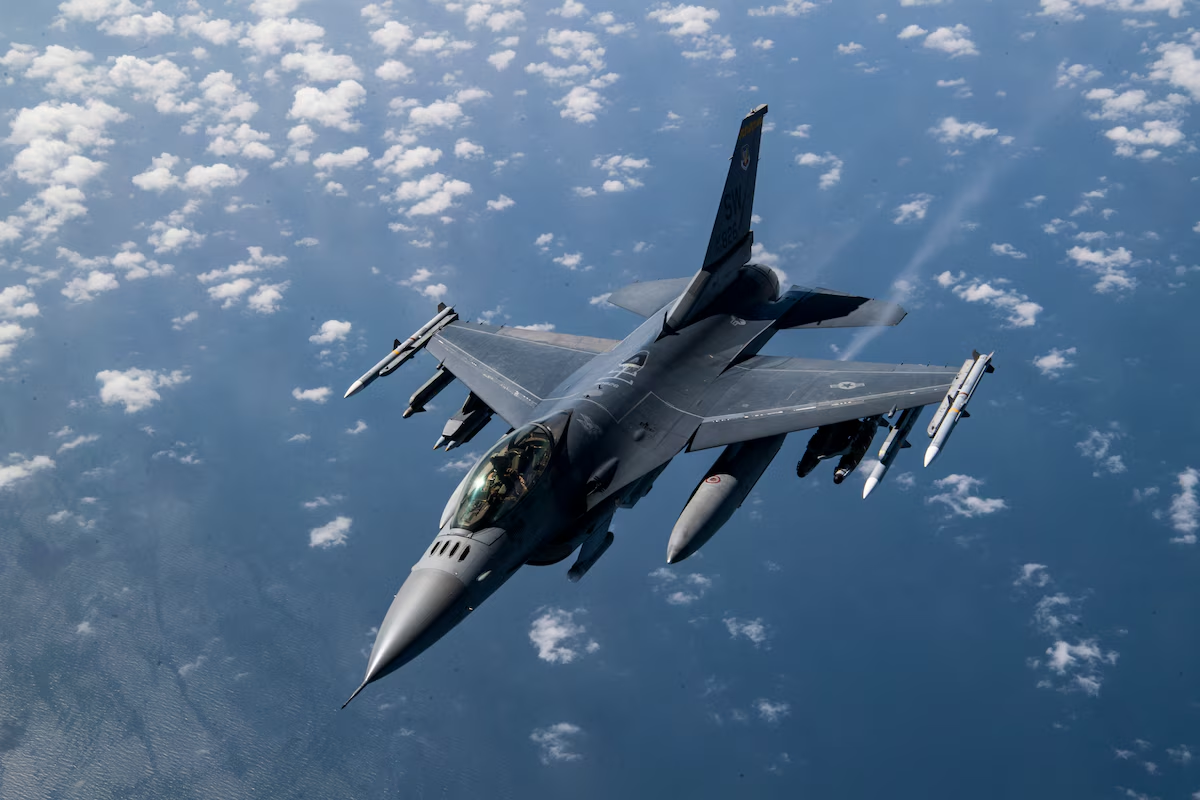
Emergency Flight Reports Give the Iranian Account a Point of Scrutiny
The reported F-16 emergency has become central to attention surrounding Iran’s allegation because it potentially offers an observable aircraft event against which the timing and circumstances of the claimed missile engagement could be examined.
Public accounts described an emergency declaration near the Strait of Hormuz around 20:16 UTC on November 20, followed by a substantial descent and an alleged diversion towards Al Dhafra Air Base in the UAE.
If authenticated, those observations would establish an aircraft emergency and recovery movement, providing a basis for further investigation while leaving unresolved whether the cause involved hostile action, mechanical trouble or another circumstance affecting flight.
Code 7700 communicates a general emergency rather than a combat damage classification, meaning its appearance cannot settle the Iranian claim without reliable evidence linking the aircraft’s difficulties to a specific missile launch or detonation.
The reported descent from approximately 32,000 feet to 4,500 feet similarly describes aircraft behaviour, but does not independently distinguish damage response, defensive manoeuvring or procedures associated with an unrelated emergency during the same flight.
Some accounts identified the aircraft as F-16CM serial 87-0355 and described it as a Block 40 variant, although those details remain unverified and cannot establish the fighter’s equipment, assignment or condition during the episode.
For Iran’s account, the significance of these reports lies in the possibility of chronological corroboration, but any apparent alignment must survive verification of timestamps, aircraft identity, location and the reliability of underlying tracking information.
The footage released by Iranian media could become more consequential if authenticated and connected to independently established flight activity, because a demonstrable engagement sequence would strengthen the evidentiary basis beyond competing statements and online interpretation.
Conversely, footage lacking verifiable timing or target identification cannot establish missile effectiveness, leaving Tehran’s account dependent on official assertion rather than a reconstructed encounter showing how the alleged damage affected the aircraft’s subsequent behaviour.
The evidentiary gap therefore concerns causation rather than simply visibility: an emergency and an engagement claim can coexist without proving a connection, while additional authenticated records could materially change the assessment of Iran’s allegation.
Gulf Basing and Recovery Capacity Shape the Consequences of Aircraft Damage
Iran’s alleged mission interruption draws attention to the logistical foundations of American airpower, because even a recoverable fighter can require diversion, inspection and maintenance before commanders can determine whether it remains available for operations.
If an aircraft suffered fragmentation damage, its return to service would depend on the affected systems, inspection findings, available expertise and replacement components, making recovery only the first stage in restoring usable combat capability.
That conditional scenario explains why a defending force might emphasise damage rather than destruction, since forcing an aircraft out of its assigned mission could generate additional support demands without producing a visible wreckage site.
The reported diversion to Al Dhafra remains unverified, but the account illustrates the importance of accessible regional airfields when deployed aircraft encounter difficulties and require an alternative recovery location within practical reach of operations.
A diversion airfield must provide more than a runway, because emergency response, ground handling and technical assessment influence whether the aircraft can be secured, evaluated and returned to service after an unexpected interruption in flight.
For Gulf hosts, such recovery arrangements connect military access with operational resilience, although this episode provides no verified evidence of changed Emirati permissions, expanded support commitments or new restrictions affecting American use of regional facilities.
If Iran’s damage claim were confirmed, analysts would need to examine the duration of aircraft unavailability before estimating its operational significance, since a brief inspection and prolonged repair would have substantially different consequences for readiness.
The available information establishes neither outcome, preventing credible estimates of lost sorties, maintenance costs or reduced fleet availability and leaving the wider logistics implications conditional on evidence that physical damage occurred during the alleged encounter.
No verified ship-specific readiness details accompany the report, so conclusions involving nearby destroyers, carrier aviation or naval missile defence responses would introduce unsupported assumptions about forces whose participation has not been established in this episode.
The strongest logistics interpretation is therefore that Iran alleges an action capable of transferring pressure from the battlespace to the recovery network, while the actual scale of that pressure remains unknown without authenticated aircraft records.
Hormuz Gives Iran’s Air Defence Claim Wider Strategic Significance
The Strait of Hormuz gives Tehran’s allegation international importance because military activity around a major energy transit corridor carries consequences beyond the immediate aircraft encounter, particularly when governments contest who can operate there without interference.
Iran’s narrative seeks to demonstrate that American fighter operations remain exposed to its defensive network, presenting the alleged engagement as evidence that technological sophistication does not automatically remove the risk of mission disruption near Iranian territory.
If verified, the encounter would support a narrower conclusion about Iranian engagement capability under specific circumstances, rather than establishing general control of Gulf airspace or proving that American aircraft could no longer conduct operations there.
That distinction preserves the claim’s military significance without exaggerating it, because a successful limited engagement can influence threat assessments even when the defending force cannot consistently prevent an opponent from operating across the wider theatre.
American planners would assess any confirmed engagement against existing protective measures, potentially examining mission routing, warning systems and electronic countermeasures, although the present record establishes no actual changes to those procedures or supporting force arrangements.
CENTCOM’s denial represents a direct challenge to Tehran’s credibility, making subsequent evidence important not only for reconstructing the encounter but also for evaluating the reliability of competing public accounts about the regional military situation.
For Gulf governments, the immediate policy concern involves managing uncertainty around nearby operations, because disputed military encounters can complicate threat assessments even when authorities have not confirmed aircraft damage, altered deployments or interference with commercial navigation.
For Indo-Pacific observers, the broader relevance lies in how integrated air defence claims interact with expeditionary basing and contested information, especially when publicly visible aircraft behaviour becomes attached to an unverified account of weapons employment.
Authenticated engagement records, reliable aircraft identification and authoritative inspection findings would provide the clearest route towards resolving the dispute, particularly if they connected an Iranian missile event with the reported emergency and subsequent recovery activity.
Until then, Iran’s account remains a consequential claim of air defence effectiveness, CENTCOM’s rejection remains categorical, and the strategic question concerns whether future evidence establishes the mission disruption Tehran says its forces successfully imposed.
