
Four F-15Es Destroyed, Eight Damaged: Iran War Tests US Airpower
Four destroyed F-15E Strike Eagles and eight lightly damaged fighters highlight the separate pressures of friendly fire, hostile engagement and missile attacks on US combat readiness.
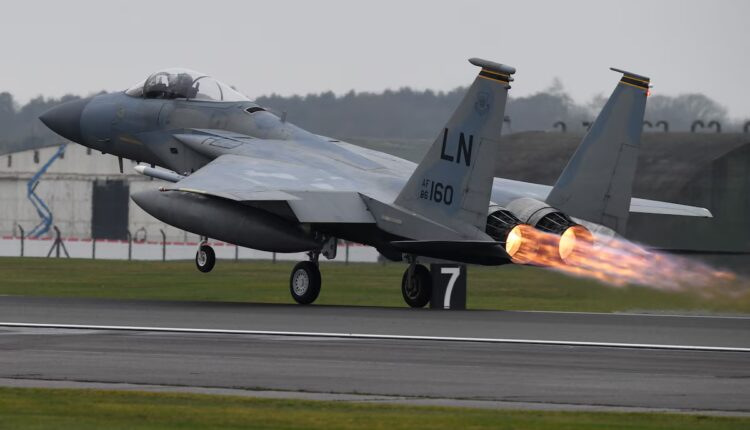
(DEFENCE SECURITY ASIA) — America’s aircraft losses in Operation Epic Fury expose a wider vulnerability than the claim that twelve F-15E Strike Eagles were destroyed, with the supplied October tally separating four destroyed fighters from eight lightly damaged aircraft.
That distinction changes the strategic assessment because permanent combat attrition, temporary maintenance disruption and friendly fire impose different pressures on force availability, replacement procurement and coalition coordination, even when all three appear together within an aggregated aircraft damage count.
The October 5 compilation lists 81 American aircraft lost or damaged since February 28, encompassing fighters, tankers, surveillance platforms, helicopters and drones, but its mixed categories prevent that headline number from establishing how many aircraft were permanently removed from service.
Three F-15Es were destroyed in a friendly fire incident over Kuwait on March 2, while a fourth was destroyed over Iran in early April, placing coalition air defence coordination alongside hostile engagement as a central explanation for fighter attrition.
Joint Chiefs Chairman General Dan Caine said the Kuwait losses were not caused by hostile fire and remained under investigation, a distinction that directs scrutiny towards identification and engagement procedures without establishing which technical or procedural failure caused the incident.

Eight additional F-15 Strike Eagles sustained light damage during Iranian ballistic missile attacks on Jordan’s Muwaffaq Salti Air Base in September, illustrating how aircraft can survive an attack while still imposing inspection, repair and force protection demands on the deployed formation.
The accounting warning that losses “may remain subject to revision” matters operationally because classification, ongoing combat and uncertain attribution limit any attempt to translate public aircraft counts directly into remaining combat strength or demonstrated Iranian air defence effectiveness.
Similarly, the US$1.9 billion to US$3.3 billion equipment loss estimate covers a broader category than F-15Es and predates the Jordan strike, making its presentation as the replacement bill for twelve destroyed fighters materially misleading for procurement and readiness analysis.
DSA’s assessment is that the more consequential pattern lies across the support network, where damaged tankers, airborne warning aircraft and rescue platforms can complicate strike operations even when most frontline fighters remain available and individual airframes return to service.
The resulting logistics footprint extends beyond replacement aircraft to missile defence interceptors, maintenance capacity, flying hours and fuel, connecting tactical incidents at regional bases with the financial and operational endurance required to sustain an extended American air campaign.
The central strategic question is therefore how the United States sustains strike capacity across a contested regional network, rather than whether a combined damage tally demonstrates the destruction of an entire twelve-aircraft F-15E formation by Iranian weapons alone.
(READ): Iran Displays Wreckage of Downed US F-15E as Underground IRGC Exhibition Challenges American Airpower
F-15E Losses Reveal Separate Combat and Coalition Risks
The Kuwait incident occurred while three F-15Es supported active operations against Iranian aircraft, ballistic missiles and drones, creating a mixed aerial threat environment in which coalition defenders mistakenly engaged friendly aircraft and destroyed all three Strike Eagles involved.
All six crew members ejected, were recovered and were reported in stable condition, preserving trained personnel while leaving the deployed force with permanent aircraft losses that could not be resolved through inspection or the minor repairs described in Jordan.
The initial account identified Kuwaiti air defences, while subsequent allegations implicated at least one Kuwaiti F/A-18 Hornet, but the supplied material contains no final investigation finding establishing the precise weapon, identification failure or sequence of engagement decisions involved.
This unresolved distinction matters because a fighter interception error and a ground missile engagement error would point towards different corrective measures, making any definitive claim about failed identification systems premature without evidence connecting the engagement to a specific cause.
DSA’s analytical assessment is that coalition air defence requires more than platform compatibility, because simultaneous defensive and offensive operations also depend on shared identification, airspace coordination and engagement discipline when friendly strike aircraft operate near incoming hostile threats.
The fourth destroyed F-15E was lost over southwestern Iran during a strike mission, with the aircraft identified as DUDE 44 from the 494th Fighter Squadron, demonstrating a separate exposure associated with penetrating hostile territory and recovering downed personnel.
President Donald Trump and American officials described a shoulder-fired, heat-seeking missile striking an engine, but that remains an official explanation within the supplied record rather than independently established proof of the weapon type or the aircraft’s engagement circumstances.
If that explanation is accurate, the incident highlights the persistence of local infrared threats during strike operations, although the available account does not establish flight altitude, defensive countermeasure employment or why the aircraft entered the missile’s effective engagement envelope.
The supplied chronology places the shootdown on April 3 local time while the compilation records an April 5 reporting date, requiring readers to distinguish the combat event from later confirmation and the completion of the associated recovery operation.
Together, the Kuwait and Iran incidents demonstrate distinct attrition mechanisms that demand distinct operational responses, with coalition engagement safeguards addressing friendly fire while threat avoidance, defensive measures and recovery planning address exposure during missions over hostile territory and terrain.
(READ): Iran Strike May Have Destroyed U.S. E-3G AWACS at Prince Sultan Air Base in Saudi Arabia, Threatening Gulf Air Superiority

Jordan Missile Strike Puts Airbase Resilience Under Pressure
The September attack on Muwaffaq Salti Air Base near Azraq shifts attention from fighters surviving airborne engagements to aircraft protection on the ground, where deployed strike capacity depends on shelters, usable taxiways, maintenance facilities and functioning defensive coverage together.
The supplied account places the ballistic missile attack overnight September 8–9 and describes approximately eight F-15Es suffering light damage before returning to service, indicating temporary disruption rather than the permanent removal implied by treating all twelve fighters as destroyed.
Return to service limits the replacement implications, but it does not establish that operational activity continued without interruption, because inspections and repairs necessarily required maintenance work while the supplied material provides no quantified measure of lost sorties or downtime.
An A-10 sustained severe wing damage in the same attack, demonstrating that aircraft exposed during one strike can suffer substantially different outcomes and that a single base-level damage count cannot describe the repair burden across every affected platform accurately.
American forces reportedly fired roughly thirty Patriot interceptors, while Jordan said it engaged around twenty incoming missiles and destroyed eighteen, but those figures describe different reported actions and cannot establish a reliable interception probability without a reconciled engagement record.
Satellite imagery analysis described impacts on taxiways and aircraft shelters, adding infrastructure exposure to the aircraft damage picture, although the supplied information does not quantify runway closure, shelter destruction or the resulting effect on the base’s sustained sortie generation.
The Islamic Revolutionary Guard Corps claimed strikes on aircraft sites while American officials characterised F-15E damage as limited, and those statements should be assessed separately from the narrower reported outcome that eight fighters underwent minor repairs and resumed service.
DSA’s assessment is that a defensive success measured through intercepted missiles can coexist with consequential ground damage, because force protection ultimately concerns the functioning airbase network and available aircraft rather than an interception total considered independently of surviving impacts.
Dispersal, protected parking and repair capacity are relevant countermeasures in principle, but the supplied account does not establish which measures were employed or absent, preventing a supported conclusion that a particular basing decision caused the damage sustained in Jordan.
The strategic signalling is nevertheless significant: Iranian ballistic missile attacks reached a base supporting American operations, while the reported fighter recoveries indicate resilience, leaving neither claims of complete base security nor claims of decisive fighter destruction supported by this episode.
(READ): Iran War Wipes Out 25 Percent of US MQ-9 Reaper Fleet in Historic Drone Attrition
Tankers, AWACS and Drones Expose the Support Network
The broader tally includes seven KC-135 Stratotankers, but those entries encompass a fatal crash, a second aircraft’s emergency landing and five aircraft damaged on the ground, making tanker availability a support-network concern rather than a uniform combat shootdown category.
One KC-135 crashed in western Iraq on March 12, killing all six crew members in an incident described as unrelated to hostile fire, while a second aircraft involved made an emergency landing in Israel with its eventual condition unspecified.
Five other KC-135s were damaged at Prince Sultan Air Base in Saudi Arabia during March, linking aerial refuelling capacity to ground protection and maintenance demands even though the supplied record does not establish the duration of their operational unavailability.
An E-3 Sentry was also damaged at Prince Sultan, with some accounts describing a direct hit and possible irreparability, but its classification remains damaged in the compilation and therefore cannot support an unqualified assertion that the aircraft was destroyed.
For operational planning, tanker and airborne warning availability matters because strike packages depend on endurance and coordinated airspace awareness, although the record provides insufficient detail to quantify how these incidents altered mission radius, coverage hours or the number of supported sorties.
The forty-five MQ-9 Reapers form the largest category, while earlier figures covering the period through June 30 reached thirty, suggesting that drone attrition accounts for much of the tally’s growth without resolving each individual aircraft’s loss circumstances or timing.
The supplied account identifies constrained production and an existing Reaper fleet drawdown as concerns, making sustained losses potentially harder to absorb through straightforward replacement, although it contains no production schedule or allocation data sufficient to calculate a resulting force deficit.
Three MQ-1 series aircraft and one MQ-4C Triton also appear, but the Triton entry concerns a mishap, reinforcing the need to separate hostile engagements from accidents before drawing conclusions about Iranian counter-drone performance or surveillance coverage degradation across the campaign.
A damaged F-35A made an emergency landing after Iranian ground fire on March 19, illustrating exposure without proving a permanent loss, and the supplied material does not establish the weapon involved, repair outcome or implications for low-observable performance in combat.
DSA’s assessment is that losses among scarce enabling aircraft could affect commitments beyond the Middle East if replacements or redeployments become necessary, but an actual reduction in Indo-Pacific coverage cannot be inferred without evidence of changed allocations or force movements.
F-15E Rescue Shows How One Loss Can Multiply Exposure
The recovery of DUDE 44’s crew illustrates how a single destroyed fighter can generate a larger operational commitment, because personnel recovery over hostile territory requires supporting aircraft and ground teams whose exposure extends beyond the original strike mission itself.
Both crew members ejected and landed miles apart, with the pilot recovered the same day and the injured weapons systems officer extracted after roughly fifty hours, creating separate recovery timelines and a prolonged requirement to locate and protect surviving personnel.
The supplied account describes more than ninety American personnel on the ground in Iran and a substantial supporting air package, but it does not provide a complete force list or establish the contribution of each aircraft to the recovery effort.
Two MC-130J Commando II aircraft were intentionally destroyed after they could not depart, distinguishing recovery-related denial of equipment from direct enemy destruction while showing how ground mobility problems can turn participating support aircraft into permanent losses during a rescue.
Four AH-6 Little Birds were also recorded as destroyed by American forces because they were unrecoverable, adding specialised helicopter attrition to the rescue footprint without establishing that Iranian weapons directly destroyed those aircraft or explaining every circumstance preventing their recovery.
An A-10 crashed after enemy fire during the rescue effort, while an HH-60W Jolly Green II sustained small-arms damage, demonstrating that protecting and extracting aircrew can expose multiple aircraft types to separate threats within the same broader recovery operation.
DSA’s assessment is that rescue planning must account for aircraft recovery and equipment denial alongside personnel extraction, because a successful evacuation can preserve lives while still imposing substantial material losses and additional demands on scarce specialised aviation forces afterwards.
The tally also includes an AH-64 Apache shot down over the Strait of Hormuz and an MH-60 Sea Hawk crash over the Arabian Sea, but the supplied material does not connect those incidents to the F-15E rescue operation itself.
The Sea Hawk incident killed the commanding officer while three of four crew members were recovered, adding a separate personnel and readiness consequence that cannot be reduced to an airframe valuation or attributed to hostile fire from the information provided.
The strategic lesson is conditional rather than absolute: rescue commitments can expand the risk generated by one aircraft loss, but this record cannot determine whether a different extraction plan would have preserved the support aircraft destroyed during the operation.
US$3.3 Billion Figure Masks the Campaign’s Larger Logistics Bill
The US$1.9 billion to US$3.3 billion estimate concerns equipment losses assessed as of August 1, including items such as a destroyed THAAD radar, and therefore represents neither an F-15E replacement valuation nor the cost of the October aircraft tally.
Because that cutoff preceded the September Jordan strike, the estimate cannot incorporate those later aircraft damage entries, while its upper bound reflects potential emergency replacement funding rather than a confirmed expenditure to replace every affected aircraft or equipment item.
The wider Pentagon cost estimate reached approximately US$38 billion through August 1, including US$21.7 billion for munitions, US$1.9 billion for equipment losses, US$10.4 billion for increased flying hours and US$2.7 billion for jet fuel during the campaign period assessed.
Those rounded components do not equal the headline total precisely, but their relative scale shows that munitions and sustained aviation activity dominate the disclosed financial burden, making aircraft replacement alone an incomplete measure of the campaign’s demand on American resources.
The munitions category includes a substantial missile defence interceptor share, connecting protection against Iranian attacks with expenditure that continues even when aircraft survive, while fuel and flying-hour costs reflect the logistical effort needed to sustain deployed air operations over time.
The estimate excludes pre-war baseline operating costs and base reconstruction, meaning the published total does not capture every resource requirement associated with maintaining or restoring the regional posture and cannot serve as a comprehensive reconstruction or lifetime replacement budget.
A separate US$33.4 billion figure used a June 29 cutoff, while later reporting described approximately US$43.6 billion by early autumn, but different methods and reporting periods prevent those amounts from establishing a precise, directly comparable expenditure trajectory across the campaign.
Estimated monthly incremental costs of roughly US$2 billion during lower-intensity periods and US$3 billion at July’s tempo indicate how operational intensity affects resource consumption, although those estimates cannot establish future spending without assumptions about mission rates and defensive demand.
For force posture, the combined burden involves sustaining aircraft, repairing bases and replenishing defensive munitions while protecting specialised capabilities, creating potential allocation pressures that matter globally but require evidence of actual shortages before claims of strategic overstretch become definitive.
Ultimately, four destroyed F-15Es and eight repaired fighters reveal a more complex battlespace than the twelve-loss headline suggests, with coalition coordination, contested basing, rescue exposure and support-network endurance providing the stronger framework for assessing American airpower against Iran today.
