
Iran Strikes U.S. Missile-Defense “Eyes” Across Middle East — Satellite Analysis by American Broadcaster Shows Radar Network Hit in Five Countries
Satellite imagery reviewed by ABC News confirms repeated attacks on AN/TPY-2 and AN/FPS-132 radar sites across Saudi Arabia, UAE, Jordan, Kuwait, Qatar and Bahrain, raising concerns over degraded early-warning capability in the regional missile-defense network.
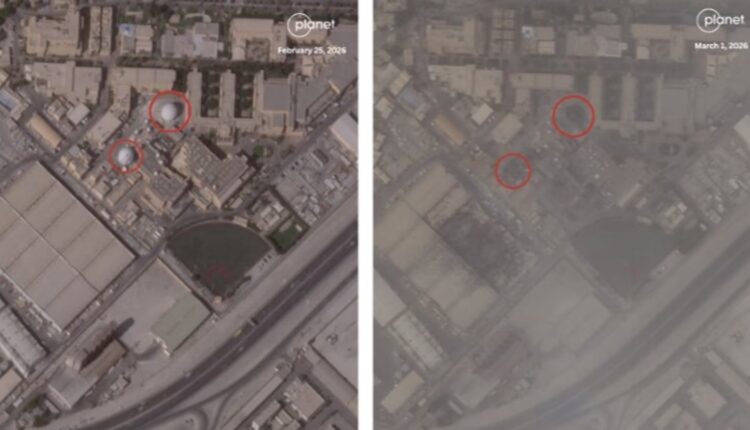
(DEFENCE SECURITY ASIA) — Commercial satellite imagery and video analysis reviewed by American broadcaster ABC News has confirmed that radar and missile-defense installations forming the backbone of the United States and allied early-warning architecture across the Middle East have been struck at least ten times since the opening phase of the ongoing regional conflict, indicating a deliberate campaign to degrade sensor coverage rather than destroy combat units outright.
The strikes targeted highly sensitive surveillance infrastructure across multiple Gulf and Levant bases, creating operational uncertainty for integrated air- and missile-defense networks and raising concerns among defence analysts that the loss or damage of radar nodes could shorten warning timelines for incoming missile and drone attacks across several theatres simultaneously.
Experts cited in the analysis warned that the destruction or impairment of high-value radar assets such as the AN/TPY-2 and AN/FPS-132 could partially blind theatre-level missile-defense systems, with former NATO arms-control director William Alberque stating that such systems are “incredibly expensive, really delicate and unbelievably vulnerable,” adding that damaging them reduces capability even if it does not completely collapse the defence network.
The fact that the damage to radar and missile-defense installations was verified through independent commercial satellite imagery and video analysis reviewed by ABC News is significant because it provides external confirmation of impacts on U.S. and allied military infrastructure without relying on official government battle-damage assessments.
Such independent verification increases the credibility of the findings for defence analysts and policymakers, as it demonstrates that the reported strikes on critical early-warning systems are supported by observable evidence rather than unconfirmed claims from any party involved in the conflict.
READ: Iranian Drone Strike Destroys U.S. AN/FPS-117 Radar in Saudi Arabia, Raising Fears of Gulf Air-Defence Blind Spot
Coordinated Strike Pattern Suggests Sensor-First Targeting Doctrine
Satellite imagery reviewed from commercial providers indicates that more than twenty-five locations across seven bases in at least five countries were hit during the first two weeks of fighting, with the pattern of impacts showing repeated focus on radar domes, communications arrays, and associated logistical buildings rather than runways or aircraft shelters.
The targeting profile suggests a deliberate effort to degrade situational awareness across the region’s missile-defense grid, a tactic that analysts say allows follow-on drone and ballistic-missile strikes to exploit gaps in detection coverage rather than attempting to overwhelm the entire defence network simultaneously.
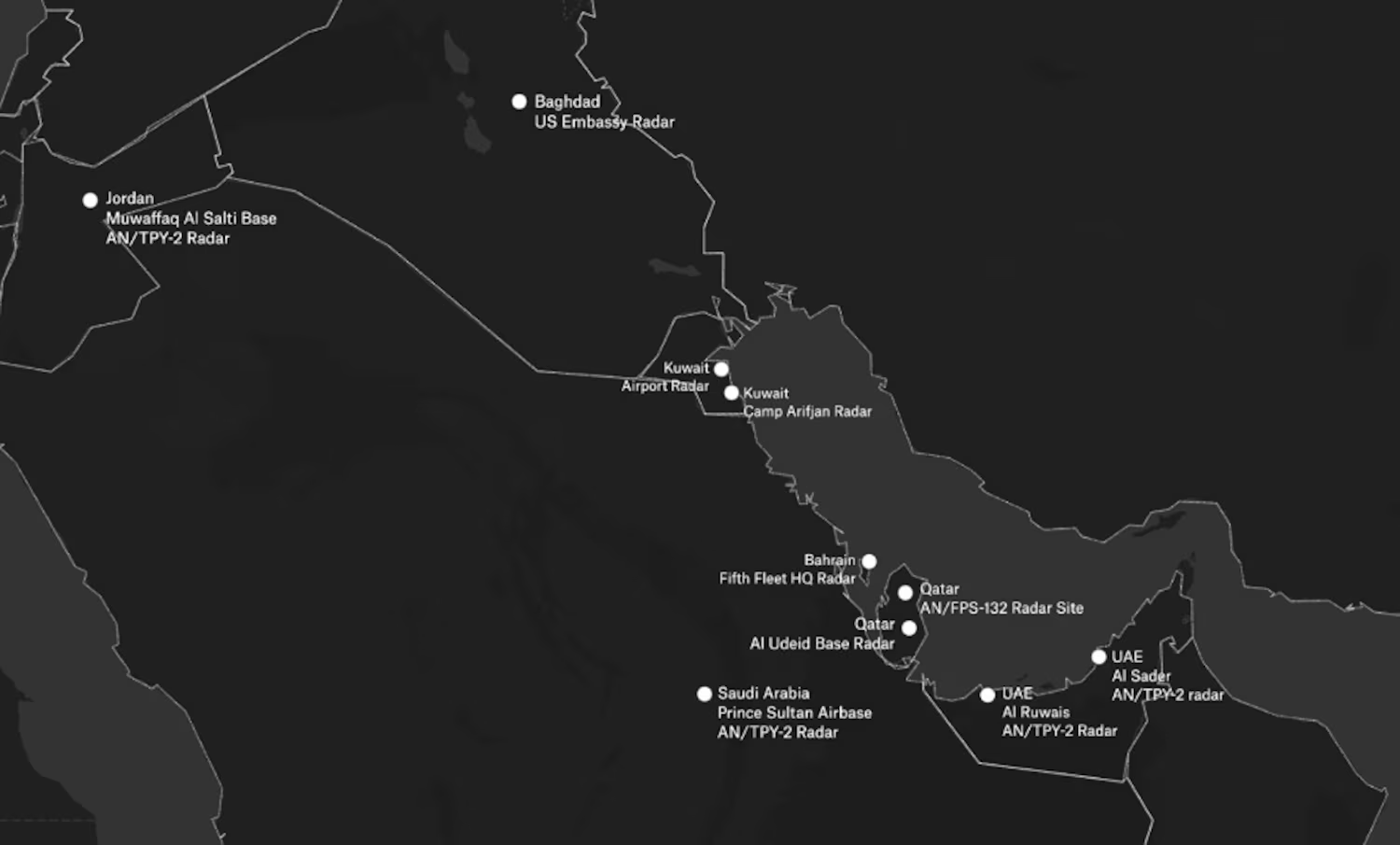
Visual evidence examined in the review confirmed strikes in Saudi Arabia, the United Arab Emirates, Jordan, Kuwait, Qatar, and Bahrain, with several sites showing smoke plumes, structural damage, or debris patterns consistent with precision drone or missile impact on radar-related infrastructure.
The use of low-cost long-range drones, including systems assessed to be variants of the Shahed family, appears to have enabled repeated attacks against fixed radar facilities that cannot easily be relocated once installed, increasing the vulnerability of large phased-array and missile-defence sensors.
Analysts noted that radar installations are among the most critical yet least protected components of integrated air-defence networks, because they must remain exposed to maintain line-of-sight coverage, making them attractive targets during the opening stages of any campaign aimed at weakening missile-defence effectiveness.
The concentration of strikes across multiple countries indicates that the attacks were intended to affect the regional detection network as a whole rather than a single national system, thereby complicating coordination between U.S. forces and partner states operating under shared air-defence arrangements.
Damage to surveillance nodes at geographically separated bases could reduce overlapping radar coverage, forcing command centres to rely more heavily on secondary sensors or airborne platforms, which increases operational strain and reduces reaction time during high-tempo missile exchanges.
Even limited structural damage to radar facilities can temporarily reduce tracking accuracy, maintenance availability, or power stability, meaning that an attacker does not need to completely destroy the system to achieve a measurable reduction in defensive performance.
The repeated selection of radar-equipped locations across the Gulf suggests that the campaign was designed to create cumulative degradation over time, rather than relying on a single large strike, thereby sustaining pressure on defensive networks throughout the conflict.
High-Value Radar Systems Among Confirmed Targets
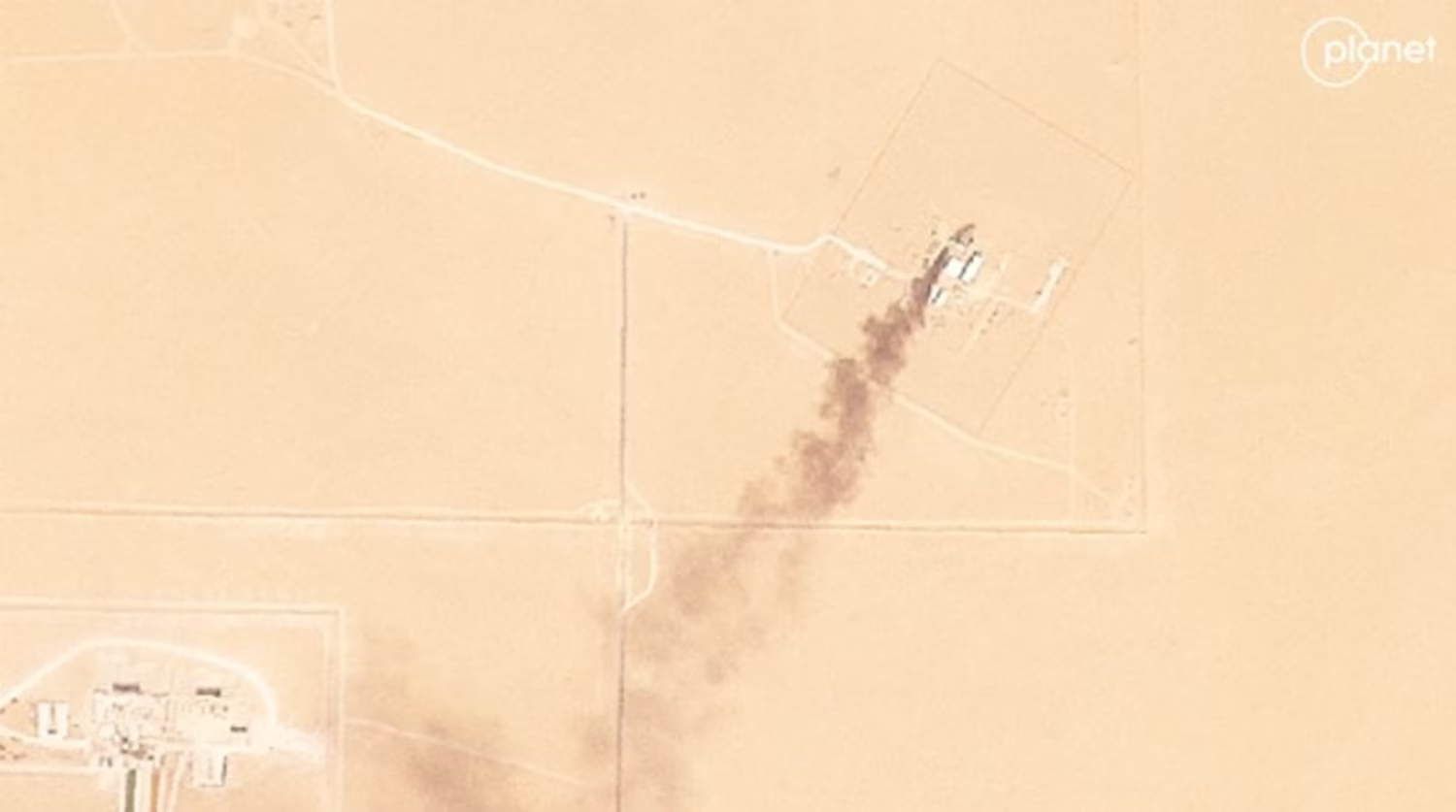
One of the earliest confirmed incidents occurred at Prince Sultan Air Base in Saudi Arabia, where satellite imagery dated March 1 showed smoke rising from a building previously identified in earlier imagery as housing an AN/TPY-2 radar system associated with missile-defence operations.
Imagery from the same date also indicated impacts near radar facilities close to Abu Dhabi and Al Sader in the United Arab Emirates, where equipment visible in earlier commercial photographs appeared to have been struck, suggesting that pre-existing fixed installations were deliberately targeted.
Lower-resolution imagery from March 2, supported by local confirmation, indicated damage to buildings at Muwaffaq al-Salti Air Base in Jordan, where an AN/TPY-2 system was reportedly located, reinforcing the pattern of strikes against high-value surveillance assets.
Satellite photographs dated March 4 showed damage to multiple radar domes at Camp Arifjan in Kuwait, with the extent of structural impact suggesting that the attack was aimed at disabling detection capability rather than hitting nearby support facilities.
Imagery taken on March 9 revealed damage to what appeared to be satellite dishes at Al Udeid Air Base in Qatar, indicating that communications and sensor-support equipment linked to air-defence operations may also have been affected.
Analysis of images from March 3 at Umm Dahal in Qatar showed debris and water runoff consistent with firefighting activity near an AN/FPS-132 phased-array radar installation, a system described as the only one of its type in the region and part of a defence agreement valued at approximately USD1.1 billion (≈RM4.18 billion).
Video footage posted online on the first day of the conflict appeared to show a drone striking a radome at the U.S. Navy Fifth Fleet headquarters in Manama, Bahrain, with same-day satellite imagery confirming structural damage at the location.
The repeated appearance of radar-related damage across different countries indicates that the campaign focused on components essential to early warning rather than attempting to destroy entire bases, a tactic that analysts say can produce significant operational effects with fewer weapons.
Because large phased-array radars such as the AN/FPS-132 and AN/TPY-2 rely on specialised components and calibration, even limited damage can require lengthy repairs, reducing availability during critical periods of sustained missile activity.
Documented Strikes on U.S. and Allied Radar / Sensor Sites (Satellite & Video Analysis)
| No | Location / Base | Country | Date | System / Facility Hit | Evidence from Imagery Analysis | Strategic Significance |
|---|---|---|---|---|---|---|
| 1 | Prince Sultan Air Base | Saudi Arabia | 1 March 2026 | AN/TPY-2 radar facility building | Satellite imagery showed smoke plume rising from structure identified in earlier imagery as housing AN/TPY-2 | High-value missile-defense radar; loss reduces early-warning coverage |
| 2 | Radar sites near Abu Dhabi | UAE | 1 March 2026 | Radar installations (fixed sites) | Imagery indicated strikes on radar facilities visible in earlier satellite photos from 2016 and 2018 | Fixed radar sites difficult to replace; affects regional sensor network |
| 3 | Al Sader radar site | UAE | 1 March 2026 | Radar equipment facility | Prior imagery confirmed presence of radar systems at the struck location | Suggests deliberate targeting of known surveillance nodes |
| 4 | Muwaffaq al-Salti Air Base | Jordan | 2 March 2026 | AN/TPY-2 radar buildings | Lower-resolution imagery and local confirmation indicated structural damage | Impacts missile-defense detection for Levant sector |
| 5 | Camp Arifjan | Kuwait | 4 March 2026 | Radar domes | Satellite images showed multiple damaged radar domes, confirmed locally | Multiple domes hit indicates repeated targeting attempt |
| 6 | Al Udeid Air Base | Qatar | 9 March 2026 | Satellite dishes / sensor arrays | Imagery revealed damage to dish-type installations linked to surveillance systems | May affect communications / tracking capability |
| 7 | Umm Dahal radar site | Qatar | 3 March 2026 | AN/FPS-132 phased-array radar | Debris visible on radar face; water runoff indicated firefighting activity | Region’s only AN/FPS-132; part of ~USD1.1 billion (≈RM4.18 billion) deal |
| 8 | U.S. Fifth Fleet HQ, Manama | Bahrain | 28 Feb 2026 | Radome / radar dome | Video showed drone impact; same-day satellite imagery confirmed damage | Early-conflict strike on naval command sensor site |
Vulnerability of Fixed Missile-Defense Sensors Highlighted
Experts quoted in the analysis emphasised that radar systems represent some of the most valuable assets in any missile-defence architecture, with individual AN/TPY-2 units estimated to cost around USD500 million (≈RM1.9 billion), reflecting the complexity of their sensors, processors, and power systems.
Former NATO Arms Control director, William Alberque noted that while destroying a single radar does not eliminate an entire missile-defence capability, it reduces detection capacity and forces the network to operate with fewer sensors, increasing the risk that incoming threats may be identified later than planned.
“It is incredibly expensive, really delicate and unbelievably vulnerable… Taking out one TPY-2 does not take down your theater missile defense capability. It just reduces… you’re just partially blinded.”
Tom Karako, director of the Missile Defense Project at the Center for Strategic and International Studies, stated that disabling the radar associated with a missile-defence battery effectively removes its ability to function as designed, because the system loses the data required to track incoming threats.
He described the dynamic as a “cat-and-mouse game,” in which attackers attempt to strike sensors while defenders attempt to maintain coverage through redundancy, relocation, or the use of additional platforms such as airborne surveillance aircraft.
Sam Lair of the Center for Nonproliferation Studies said that targeting Gulf radar installations makes operational sense because degrading detection capability complicates the ability of the United States and its partners to identify, classify, and intercept missile launches in time.
Fixed radar systems must remain stationary to provide continuous coverage, which makes them easier to locate through satellite imagery and long-range reconnaissance, increasing their exposure during conflicts involving drones and precision-guided munitions.
Unlike mobile launchers or aircraft, large phased-array radars cannot be quickly dispersed once installed, meaning that attackers can plan strikes against known coordinates with a high probability of hitting critical equipment.
The reliance on a limited number of high-power sensors to cover large geographic areas creates structural vulnerability, because damage to even one site can create gaps in the detection network until repairs or replacement systems are deployed.
Although layered defence architectures are designed to provide redundancy, analysts noted that the loss of early-warning radars can still reduce reaction time for interceptors, increasing the difficulty of defending against simultaneous missile and drone attacks.
Satellite Imagery Limits Full Damage Assessment
Commercial satellite imagery used in the analysis came primarily from Planet Labs, with investigators noting that the available pictures were sometimes delayed or lower in resolution, making it difficult to determine the full extent of damage at several locations.
In some cases, national authorities reduced the release of updated imagery after the first week of the conflict, limiting the ability of independent analysts to confirm whether damaged facilities had been repaired or remained out of operation.
Because of these limitations, the confirmed number of radar sites struck ranges between nine and ten, with the possibility that additional damage may not yet be visible in publicly available imagery.
The use of commercial imagery nevertheless allowed analysts to identify smoke plumes, debris patterns, damaged domes, and water runoff from firefighting activity, providing indirect evidence of impact even when detailed structural views were not available.
Investigators also used verified video footage posted online to cross-check satellite observations, helping confirm the timing and location of several strikes when imagery alone was insufficient.
The reliance on open-source intelligence reflects the difficulty of obtaining official battle-damage assessments during an active conflict, particularly when the systems involved are part of sensitive missile-defence networks.
Officials declined to provide detailed information about the extent of damage, with one statement noting that potential battle-damage assessments are not discussed publicly, leaving analysts to rely on indirect evidence.
This lack of official confirmation increases uncertainty about the operational status of the radar network, making it harder to determine how much early-warning capability has actually been lost.
Despite these limitations, the available imagery consistently shows that radar-related infrastructure has been among the most frequently hit targets since the conflict began.
Strategic Implications for Regional Missile-Defense Posture
The pattern of strikes indicates that the campaign is aimed at reducing detection capability across the entire regional defence network rather than achieving immediate battlefield destruction, a strategy that can increase the effectiveness of subsequent missile and drone attacks.
By degrading early-warning coverage, attackers may be able to shorten the time available for interception decisions, forcing defenders to operate under higher pressure and increasing the chance that some threats will penetrate the defence shield.
Because the affected radar sites are spread across multiple countries, the impact is not limited to a single national system but affects the collective defensive posture of U.S. forces and partner states operating in the region.
The damage to high-value sensors also increases logistical demands, as repairs to large radar systems require specialised parts, trained personnel, and secure facilities, all of which may be difficult to provide during ongoing hostilities.
If the attacks continue, defenders may need to rely more heavily on mobile or airborne sensors to compensate for gaps in fixed coverage, potentially altering the deployment pattern of surveillance aircraft and other support assets.
Repeated strikes on radar installations could also force changes in force posture, with additional emphasis placed on protecting sensor sites rather than concentrating solely on interceptors or launchers.
The campaign demonstrates that even advanced missile-defence architectures remain dependent on vulnerable detection systems, highlighting the importance of redundancy and dispersion in modern air- and missile-defence planning.
Analysts note that while the network remains functional due to overlapping sensors, the cumulative effect of multiple strikes could gradually reduce effectiveness if repairs cannot keep pace with continued attacks.
The continuing uncertainty over the true level of damage means that both attackers and defenders must operate under incomplete information, increasing the risk of miscalculation as the conflict enters its third week.
