[VIDEO] Iran’s “Silent Drone Hunters” Shock Pentagon: Radar-Silent Interceptors Now Threaten U.S. MQ-9 Reaper and Israeli Hermes-900 UAV Dominance
Tehran’s radar-silent counter-UAV architecture built around Missile-358 interceptors and Majid air defence systems is quietly eroding the operational freedom of American and Israeli surveillance drones across contested Middle Eastern airspace.

(DEFENCE SECURITY ASIA) — The intensifying aerial confrontation between Iran, the United States, and Israel is quietly revealing a structural shift in modern airpower competition, as Tehran’s evolving counter-UAV architecture increasingly threatens the operational freedom of some of the world’s most sophisticated reconnaissance and strike drones.
Even as American and Israeli airstrikes target Iranian military infrastructure with precision-guided munitions and stealth aircraft, Iranian air-defence units are demonstrating an ability to degrade unmanned aerial operations through a dispersed network of radar-silent systems designed specifically to hunt drones in contested electromagnetic environments.
Statements from Iranian defence officials describing the emergence of “autonomous drone-interceptor networks capable of neutralising hostile UAV activity without exposing radar signatures” highlight a strategic doctrine aimed not at traditional air superiority, but at eroding the surveillance backbone that underpins Western precision-strike warfare.
Missile 358: Iran’s Autonomous “Free-Hunt” Anti-Drone Interceptor
At the centre of Iran’s counter-UAV architecture sits the Missile 358, a jet-powered loitering interceptor designed to patrol airspace autonomously and destroy hostile unmanned aerial vehicles without reliance on radar emissions or continuous ground-based command links.
The system represents a departure from traditional surface-to-air missile doctrine because it functions not as a reactive interceptor awaiting radar cueing, but as a persistent aerial hunter capable of autonomously searching designated patrol zones for targets such as MQ-9 Reaper and Hermes-900 platforms.
Operating at approximately Mach 0.6, equivalent to roughly 740 kilometres per hour at sea level, the Missile 358 possesses sufficient speed and endurance to patrol wide engagement corridors while maintaining the manoeuvrability required to intercept medium-altitude long-endurance UAVs conducting surveillance missions.
Its maximum operational radius of approximately 100 kilometres from the launch point allows Iranian operators to establish forward drone-interception patrol boxes extending well beyond protected military facilities, thereby creating overlapping kill zones inside airspace traditionally considered relatively permissive for UAV operations.
This engagement envelope aligns precisely with the typical operating altitude of strategic surveillance drones, as MQ-9 Reaper and Hermes-900 platforms routinely conduct intelligence, surveillance, and reconnaissance missions between 5,000 and 7,500 metres above ground level.
The missile’s interception ceiling of roughly 8.5 kilometres places these UAV platforms directly inside its engagement envelope, creating a persistent threat layer that forces operators to consider altitude restrictions and routing adjustments during reconnaissance operations.
Autonomous engagement capability is achieved through onboard sensors integrated with artificial intelligence algorithms capable of identifying heat signatures, radar cross-section anomalies, and electromagnetic emissions generated by target drones during normal flight operations.
Once the system acquires a target signature, the interceptor transitions into terminal guidance mode, closing the distance without external radar illumination and eliminating the electronic warning cues that normally alert UAV operators to an impending missile engagement.
From an operational perspective, this means that a drone operator monitoring sensor feeds thousands of kilometres away may simply observe a sudden loss of telemetry or video transmission without receiving any electronic warning indicating the source of the attack.
Iranian engineers have nevertheless incorporated optional radio-correction capability allowing ground controllers to transmit brief course adjustments when required, particularly in complex electromagnetic environments or when intercepting manoeuvring drones employing electronic countermeasures.
Radar Silence as Strategy: The AD-08 Majid Short-Range Air Defence System
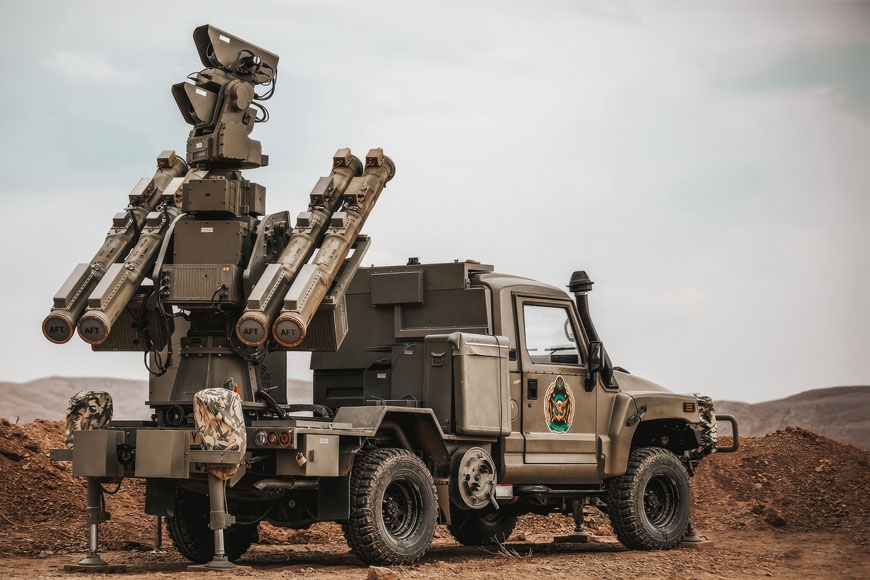
Complementing the loitering interception capability of Missile 358 is the AD-08 Majid short-range air defence system, a mobile platform built around the principle that avoiding radar emissions dramatically increases survivability against technologically superior adversaries.
Unlike conventional air-defence vehicles that depend on fire-control radars for target acquisition and tracking, the Majid system relies entirely on passive electro-optical sensors and thermal imaging systems mounted on a compact mobile chassis.
This design philosophy allows the platform to remain electronically silent throughout most of its operating cycle, thereby preventing aircraft and drones equipped with radar-warning receivers from detecting its presence during search and tracking phases.
When hostile UAVs enter the system’s engagement envelope, the Majid activates optical tracking sensors and launches infrared-guided missiles capable of reaching speeds approaching Mach 2, significantly reducing the time available for target evasion.
With a maximum engagement range of approximately eight kilometres, these missiles can reach a target within roughly fifteen seconds of launch, creating an extremely compressed reaction window for drone operators attempting to alter course or altitude.
The system’s engagement ceiling of roughly six kilometres corresponds closely with the lower altitude spectrum of UAV reconnaissance missions, ensuring that medium-altitude surveillance platforms operating below their maximum ceiling remain vulnerable to interception.
Electro-optical targeting provides another operational advantage because thermal imaging sensors can detect the heat signatures generated by UAV engines and avionics systems even in conditions where visual observation would be degraded by haze, darkness, or partial cloud cover.
Because the Majid does not rely on radar emissions, traditional anti-radiation missiles designed to home in on radar signals become ineffective against the platform, complicating suppression of enemy air-defence operations by technologically advanced air forces.
Repurposed Air-to-Air Missiles: R-73 and R-27T Ground-Launch Adaptations
Beyond purpose-built interceptor systems, Iranian engineers have demonstrated notable ingenuity by adapting legacy air-to-air missiles such as the R-73 and R-27T for ground-based anti-drone operations using relatively simple mobile launch platforms.
Originally developed for fighter aircraft dogfights, the R-73 infrared-guided missile possesses high off-boresight engagement capability and thrust-vectoring control surfaces that provide exceptional manoeuvrability during terminal interception phases.
When adapted for ground launch, these characteristics enable the missile to intercept relatively slow but manoeuvrable UAV targets whose flight profiles would normally complicate engagement using slower command-guided surface-to-air systems.
The conversion process involves mounting the missile on rail launchers installed on pickup trucks or light armoured vehicles equipped with thermal imaging sights that provide targeting data for the missile’s infrared seeker head.
Because the missile retains its original infrared guidance system, it can autonomously track the heat signature of a UAV engine once the operator visually designates the target through the thermal imaging system.
In some operational scenarios the ground-launched configuration can even improve engagement geometry because the missile does not need to climb immediately from a high-altitude launch platform, allowing its propulsion system to maximise acceleration toward the target.
The R-27T variant extends interception range even further due to its larger rocket motor and longer engagement envelope, providing Iranian units with the ability to threaten UAV operations at distances beyond the reach of short-range air-defence systems.
These improvised launch platforms can be concealed in civilian environments such as industrial zones, tree lines, or highway underpasses, creating highly unpredictable short-range engagement zones that are difficult for airborne surveillance systems to detect.
Layered Counter-UAV Doctrine and Strategic Airspace Denial
Iranian military doctrine integrates the Missile 358, Majid system, and repurposed infrared missile launchers into a layered defence network designed to degrade UAV operations across multiple altitude bands simultaneously.
Longer-range interception patrols conducted by the Missile 358 can push hostile drones toward lower altitudes or force them to alter flight paths, increasing the probability that they will enter the engagement envelopes of shorter-range defensive systems.
Once UAVs descend into the lower altitude spectrum to avoid autonomous interceptors, Majid platforms and improvised R-73 or R-27T launchers provide dense short-range coverage around critical infrastructure and military facilities.
Because these systems operate without continuous radar emissions, the resulting defensive network becomes extremely difficult for electronic intelligence platforms to map or catalogue through traditional signal-detection methods.
This layered architecture effectively transforms Iranian airspace into a patchwork of overlapping engagement zones where UAV operators must assume the presence of undetected defensive systems even when no radar activity is detected.
Such uncertainty forces mission planners to adopt more conservative flight profiles, reduce sensor dwell times over targets, and allocate additional resources to route planning and threat assessment during reconnaissance missions.
The strategic effect is not necessarily the complete denial of UAV operations but the gradual erosion of the intelligence collection efficiency that makes unmanned aerial platforms central to modern precision-strike warfare.
Mobility, Cost Asymmetry, and the Economics of Drone Warfare
One of the most strategically significant characteristics of Iran’s counter-UAV network is the extreme mobility of its launch platforms, which allows them to relocate rapidly after firing or upon detecting potential counter-strike activity.
A Missile 358 battery capable of launching interceptors from one location can disperse across multiple alternative sites within minutes, complicating retaliatory strike planning by aircraft attempting to neutralise the threat.
Similarly, Majid launch vehicles concealed in natural terrain or urban environments can reposition quickly after engagement, exploiting the time lag between detection and strike planning typical of modern suppression of enemy air defence operations.
This mobility fundamentally challenges Western reliance on persistent surveillance and precision strike retaliation because radar-silent systems provide few electronic signatures that can be used for rapid geolocation.
Cost asymmetry further amplifies the strategic impact of this defensive architecture, as the financial value of each interception attempt is dramatically lower than the cost of the UAV platforms being targeted.
An MQ-9 Reaper drone, for example, represents a procurement cost measured in tens of millions of dollars, equivalent to approximately USD 30 million or roughly RM114 million at an exchange rate of USD1 = RM3.8.
By comparison, individual interceptors such as Missile 358 units or repurposed R-73 launch platforms represent a fraction of that financial investment, enabling Iran to absorb significant interceptor losses while still achieving favourable economic attrition ratios.
This cost imbalance forces Western military planners to weigh the financial and operational consequences of losing high-value unmanned platforms against the relatively low cost of the defensive systems designed to destroy them.
Over time, even a small number of successful interceptions can create strategic pressure by increasing insurance risk calculations for UAV operations in contested airspace.
Psychological Pressure and the Future of Drone Warfare
Beyond the physical destruction of UAV platforms, Iran’s radar-silent drone-hunting capability introduces a psychological dimension that gradually erodes the confidence of operators conducting remote reconnaissance missions.
The knowledge that autonomous interceptors may already be patrolling the airspace ahead of a drone flight path forces mission planners to assume the presence of unseen threats even when electronic sensors detect no radar activity.
This uncertainty can lead to conservative operational decisions such as shortened reconnaissance windows, altered patrol routes, or reduced altitude envelopes that limit the effectiveness of onboard sensor payloads.
As reconnaissance missions become shorter and more risk-averse, the overall intelligence yield from UAV operations declines, reducing the situational awareness advantage traditionally enjoyed by technologically advanced militaries.
The cumulative impact of these small operational adjustments can be significant because modern military campaigns rely heavily on continuous drone surveillance to identify targets, track enemy movements, and guide precision-guided munitions.
Iran’s emphasis on passive sensors, autonomous interceptors, and highly mobile launch platforms therefore represents a strategic attempt to undermine the information superiority that has underpinned Western airpower doctrine for decades.
If the architecture continues to evolve as Iranian engineers refine sensor resolution, interceptor endurance, and network integration, the challenge facing U.S. and Israeli UAV operations could intensify significantly in future conflicts.
For defence planners and analysts monitoring the evolution of drone warfare, Iran’s radar-silent drone hunters represent an early indicator that the era of uncontested UAV dominance may be entering a far more dangerous and contested phase.